 plumi
Definition and determination of pH: AQA A‑Level Chemistry questions
AQA A-Level Chemistry past-paper questions on 3.1.12.2 Definition and determination of pH, 2008–2025, with mark schemes and examiner’s reports where available.
Paper
All papers
Exam
All years
Calculations
Q08.1
The whole paper ↗
Q06.3
The whole paper ↗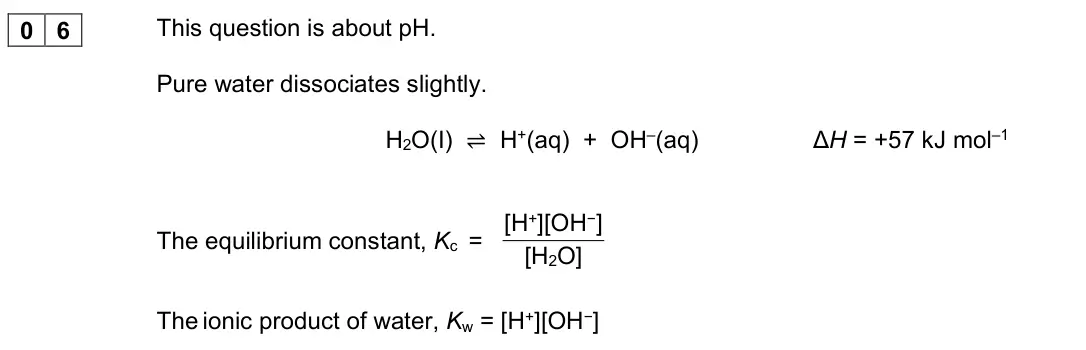
Q06.4
The whole paper ↗Q06.5
The whole paper ↗Q06.8
The whole paper ↗Q04.3
The whole paper ↗
Q09.1
The whole paper ↗
Q09.2
The whole paper ↗Q05.2
The whole paper ↗
Q03.2
The whole paper ↗
How many marks did you get?
Q03.5
The whole paper ↗Q1(c)(i)
The whole paper ↗
Q1(c)(ii)
The whole paper ↗
All 36 questions on Definition and determination of pH, as a list
- June 2025, Paper 1, Q08.1 (2 marks): Nitric acid is a strong acid. Calculate the pH of 0.150 mol dm–3 nitric acid. Give your answer to 2 decimal places. [2 marks] pH
- June 2022, Paper 3, Q14 (1 mark): A strong acid H2X dissociates in aqueous solution. H2X(aq) → 2 H+(aq) + X2– (aq) What is the pH of a 0.020 mol dm–3 solution of this acid? [1 mark] A 1.00 B 1.4
- November 2021, Paper 1, Q06.3 (4 marks): Give the expression for pH. Calculate the pH of pure water at 50 °C Give your answer to 2 decimal places. Explain why water is neutral at 50 °C [4 marks] Expres
- November 2021, Paper 1, Q06.4 (1 mark): Use Figure 3 to give the true pH value when the pH meter reading is 5.6 [1 mark]
- November 2021, Paper 1, Q06.5 (1 mark): Suggest why the pH probe is washed with distilled water between each of the calibration measurements. [1 mark]
- November 2021, Paper 1, Q06.8 (5 marks): 36.25 cm3 of 0.200 mol dm–3 sodium hydroxide solution are added to 25.00 cm3 of 0.150 mol dm–3 hydrochloric acid. Calculate the pH of the final solution at 25 º
- November 2020, Paper 1, Q04.3 (4 marks): A student dilutes 25.0 cm3 of 0.500 mol dm–3 propanoic acid by adding water until the total volume is 100.0 cm3 Calculate the pH of this diluted solution of pro
- November 2020, Paper 3, Q13 (1 mark): Which statement about pH is correct? [1 mark] A The pH of a weak base is independent of temperature. B At temperatures above 298 K, the pH of pure water is less
- November 2020, Paper 3, Q32 (1 mark): Which is the concentration of NaOH(aq), in mol dm–3, that has pH = 14.30? Kw = 1.00 × 10⁻¹⁴ mol2 dm–6 at 25 °C [1 mark] A –1.16 B 5.01 × 10⁻¹⁵ C 2.00 × 10¹⁴ D 2
- November 2020, Paper 3, Q34 (1 mark): What is the pH of 0.015 mol dm–3 sulfuric acid? [1 mark] A –1.82 B –1.52 C 1.52 D 1.82
- June 2019, Paper 1, Q09.1 (4 marks): For pure water at 40 °C, pH = 6.67 A student thought that the water was acidic. Explain why the student was incorrect. Determine the value of Kw at this tempera
- June 2019, Paper 1, Q09.2 (3 marks): Sodium hydroxide solution was added gradually from a burette to 25 cm3 of 0.080 mol dm–3 propanoic acid at 25 °C The pH was measured and recorded at regular int
- June 2018, Paper 1, Q05.2 (6 marks): In an experiment, 10.35 cm3 of 0.100 mol dm–3 hydrochloric acid are added to 25.0 cm3 of 0.150 mol dm–3 barium hydroxide solution. Calculate the pH of the solut
- June 2017, Paper 1, Q03.2 (2 marks): Calculate the pH of pure water at 10 °C Give your answer to two decimal places. [2 marks pH of water
- June 2017, Paper 1, Q03.4 (3 marks): Calculate the pH of a 0.0131 mol dm−3 solution of calcium hydroxide at 10 °C Give your answer to two decimal places. [3 marks] pH of solution
- June 2017, Paper 1, Q03.5 (2 marks): The 0.0131 mol dm−3 calcium hydroxide solution at 10 °C was a saturated solution. A student added 0.0131 mol of magnesium hydroxide to 1.00 dm3 of water at 10 °
- June 2017, Paper 3, Q27 (1 mark): The rate equation for the acid-catalysed reaction between iodine and propanone is: rate = k [H+] [C3H6O] The rate of reaction was measured for a mixture of iodi
- Specimen, Paper 3, Q13 (1 mark): What is the pH of a 0.020 mol dm–3 solution of a diprotic acid which is completely dissociated? [1 mark] A 1.00 B 1.40 C 1.70 D 4.00 1 3
- June 2016, CHEM4 (old spec), Q1(c)(i) (2 marks): Calculate the pH of the solution formed after 50.0 cm3 of distilled water are added to beaker A. Give your answer to 2 decimal places. [2 marks] 3 3
- June 2016, CHEM4 (old spec), Q1(c)(ii) (4 marks): Calculate the pH of the solution formed after 50.0 cm3 of 0.0108 mol dm−3 aqueous sodium hydroxide are added to beaker B. Give your answer to 2 decimal places.
- June 2014, CHEM4 (old spec), Q2(e) (3 marks): Two solutions, one with a pH of 4.00 and the other with a pH of 9.00, were left open to the air. The pH of the pH 9.00 solution changed more than that of the ot
- June 2013, CHEM4 (old spec), Q3(e) (6 marks): Using a burette, 26.40 cm3 of 0.550 mol dm–3 sulfuric acid were added to a conical flask containing 19.60 cm3 of 0.720 mol dm–3 aqueous sodium hydroxide. Assume
- June 2012, CHEM4 (old spec), Q3(c) (3 marks): A 25.0 cm3 sample of 0.0850 mol dm–3 hydrochloric acid was placed in a beaker. Distilled water was added until the pH of the solution was 1.25 Calculate the tot
- January 2012, CHEM4 (old spec), Q4(a) (2 marks): A 25.0 cm3 sample of 0.0850 mol dm–3 hydrochloric acid was placed in a beaker and 100 cm3 of distilled water were added. Calculate the pH of the new solution fo
- January 2012, CHEM4 (old spec), Q4(c) (6 marks): A 25.0 cm3 sample of 0.620 mol dm–3 nitric acid was placed in a beaker and 38.2 cm3 of 0.550 mol dm–3 aqueous sodium hydroxide were added. Calculate the pH of t
- June 2011, CHEM4 (old spec), Q2(a)(i) (1 mark): Write an expression for pH. (1 mark)
- June 2011, CHEM4 (old spec), Q2(c)(ii) (4 marks): Calculate the pH of the solution formed when 40.0 cm3 of 0.154 mol dm–3 potassium hydroxide are added to 20.0 cm3 of 0.154 mol dm–3 ethanoic acid at 25 °C. At 2
- January 2011, CHEM4 (old spec), Q2(a)(i) (1 mark): Write an expression for pH. (1 mark) 3
- January 2011, CHEM4 (old spec), Q2(a)(ii) (1 mark): Calculate the pH of 0.154 mol dm–3 hydrochloric acid. (1 mark) 3 3
- January 2011, CHEM4 (old spec), Q2(a)(iii) (2 marks): Calculate the pH of the solution formed when 10.0 cm3 of 0.154 mol dm–3 hydrochloric acid are added to 990 cm3 of water.
- June 2010, CHEM4 (old spec), Q5(a)(i) (1 mark): Write an expression for pH. (1 mark)
- June 2010, CHEM4 (old spec), Q5(c) (6 marks): Calculate the pH of the solution formed when 25.0cm3 of 0.150moldm–3 aqueous sulfuric acid are added to 30.0cm3 of 0.200moldm–3 aqueous potassium hydroxide at 2
- January 2010, CHEM4 (old spec), Q2(a)(i) (1 mark): Write an expression for the term pH. (1 mark) 3
- January 2010, CHEM4 (old spec), Q2(a)(ii) (2 marks): Calculate the concentration, in mol dm–3, of an aqueous solution of sulfuric acid that has a pH of 0.25
- June 2008, CHM4 (2008 spec), Q1(a) (1 mark): 1 (a) Calculate the pH of 0.0380 mol dm–3 hydrochloric acid. (1 mark)
- June 2008, CHM4 (2008 spec), Q1(b) (2 marks): 1 (b) Calculate the pH of the solution formed when 100 cm3 of pure water are added to 100 cm3 of this 0.0380 mol dm–3 hydrochloric acid. (2 marks)
Questions, mark schemes and examiner’s reports are © AQA, from their published past papers. Plumi isn’t affiliated with any exam board. Want whole papers? AQA A-Level Chemistry past papers.
The Plumi iPad app also offers exam-style questions with AI feedback on your handwritten working.