 plumi
Buffer action: AQA A‑Level Chemistry questions
AQA A-Level Chemistry past-paper questions on 3.1.12.6 Buffer action, 2008–2025, with mark schemes and examiner’s reports where available.
Paper
All papers
Exam
All years
Calculations
Q08.5
The whole paper ↗
Q08.6
The whole paper ↗Q04.5
The whole paper ↗
Q10.4
The whole paper ↗
Q04.4
The whole paper ↗
Q04.5
The whole paper ↗Q04.4
The whole paper ↗
Q09.4
The whole paper ↗
Q09.5
The whole paper ↗Q05.6
The whole paper ↗
Q02.1
The whole paper ↗
Q02.2
The whole paper ↗Q06.5
The whole paper ↗Q04.2
The whole paper ↗Q1(d)(iii)
The whole paper ↗
Q9(a)
The whole paper ↗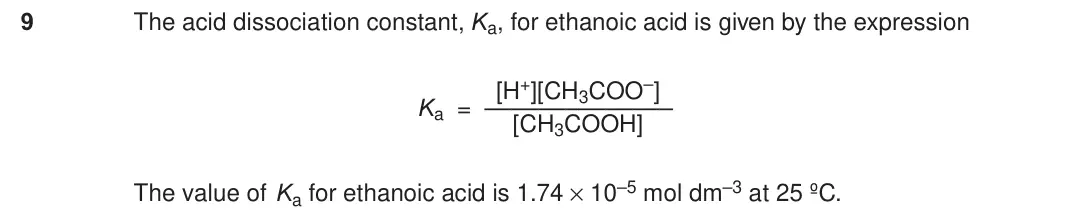
Q9(b)
The whole paper ↗
All 37 questions on Buffer action, as a list
- June 2025, Paper 1, Q08.5 (2 marks): Explain, qualitatively, how this buffer solution resists pH change when a small amount of sodium hydroxide solution is added. [2 marks]
- June 2025, Paper 1, Q08.6 (7 marks): Calculate the pH change that occurs when 1.50 cm3 of 0.200 mol dm–3 HCl(aq) are added to buffer solution B. Give your answer to 2 decimal places. The acid disso
- June 2024, Paper 3, Q04.5 (2 marks): When sodium hydroxide solution is added to aqueous propanoic acid, the solution formed acts as a buffer when between 5 cm3 and 15 cm3 have been added. Explain w
- June 2023, Paper 1, Q10.4 (5 marks): For butanoic acid, Ka = 1.51 × 10⁻⁵ mol dm–3 20.0 cm3 of 0.100 mol dm–3 sodium hydroxide solution are added to 25.0 cm3 of 0.100 mol dm–3 butanoic acid solution
- June 2023, Paper 3, Q20 (1 mark): Equal volumes of pairs of solutions are mixed. Which pair forms a buffer solution? [1 mark] A ammonia and ammonium chloride B ammonia and methylamine C ethanoic
- June 2022, Paper 1, Q04.4 (3 marks): State how a buffer solution can be made from solutions of potassium hydroxide and ethanoic acid. Give an equation for the reaction between potassium hydroxide a
- June 2022, Paper 1, Q04.5 (5 marks): A buffer solution is made by adding 2.00 g of sodium hydroxide to 500 cm3 of 1.00 mol dm–3 ethanoic acid solution. Calculate the pH of this buffer solution at 2
- November 2021, Paper 3, Q05 (5 marks): A mixture of methanoic acid and sodium methanoate in aqueous solution acts as an acidic buffer solution. The equation shows the dissociation of methanoic acid.
- November 2020, Paper 1, Q04.4 (6 marks): A buffer solution with a pH of 4.50 is made by dissolving x g of sodium propanoate (C2H5COONa) in a solution of propanoic acid. The final volume of buffer solut
- June 2019, Paper 1, Q09.4 (6 marks): A student prepared a buffer solution by adding 0.0136 mol of a salt KX to 100 cm3 of a 0.500 mol dm–3 solution of a weak acid HX and mixing thoroughly. The stud
- June 2019, Paper 1, Q09.5 (1 mark): A buffer solution has a constant pH even when diluted. Use a mathematical expression to explain this. [1 mark]
- June 2018, Paper 1, Q05.6 (5 marks): A buffer solution contains 0.025 mol of sodium ethanoate dissolved in 500 cm3 of 0.0700 mol dm–3 ethanoic acid at 25 °C A sample of 5.00 cm3 of 2.00 mol dm–3 hy
- June 2017, Paper 1, Q02.1 (3 marks): The acid dissociation constant, Ka, for ethanoic acid is given by the expression Ka = COOH] [CH ] [H ] COO [CH 3 3 + − The value of Ka for ethanoic acid is 1.74
- June 2017, Paper 1, Q02.2 (6 marks): In a different buffer solution, the concentration of ethanoic acid was 0.260 mol dm−3 and the concentration of ethanoate ions was 0.121 mol dm−3 A 7.00 × 10⁻³ m
- June 2017, Paper 3, Q22 (1 mark): The diagram shows a pH curve produced by adding a strong alkali to a weak acid. Which point on the curve represents a solution that can act as a buffer? [1 mark
- Specimen, Paper 1, Q06.5 (2 marks): pH= 8
- Specimen, Paper 3, Q04.2 (5 marks): pH =
- June 2016, CHEM4 (old spec), Q1(d)(iii) (3 marks): Calculate the value of –––––––––––– in the solution with the pH of 4.84 [3 marks] [salt] [ethanoic acid]
- June 2015, CHEM4 (old spec), Q9(a) (3 marks): A buffer solution is prepared using ethanoic acid and sodium ethanoate. In the buffer solution, the concentration of ethanoic acid is 0.186 mol dm–3 and the con
- June 2015, CHEM4 (old spec), Q9(b) (5 marks): In a different buffer solution, the concentration of ethanoic acid is 0.251 mol dm–3 and the concentration of sodium ethanoate is 0.140 mol dm–3. A sample of hy
- June 2014, CHEM4 (old spec), Q2(d)(iii) (5 marks): A buffer solution with a pH of 4.00 is made using benzenecarboxylic acid and sodium benzenecarboxylate. Calculate the mass of sodium benzenecarboxylate (Mr = 14
- June 2013, CHEM4 (old spec), Q5(c)(ii) (2 marks): The acid dissociation constant Ka for lactic acid has the value 1.38 × 10⁻⁴ mol dm–3 at 298 K. Calculate the pH of an equimolar solution of lactic acid and sodi
- June 2013, CHEM4 (old spec), Q5(c)(iii) (3 marks): Suggest an alternative name for the term acidity regulator. Explain how a mixture of lactic acid and sodium lactate can act as a regulator when natural processe
- January 2013, CHEM4 (old spec), Q2(c)(i) (3 marks): Calculate the pH of this buffer solution at 25 oC.
- January 2013, CHEM4 (old spec), Q2(c)(ii) (4 marks): A 5.00 cm3 sample of 0.100 mol dm–3 hydrochloric acid is added to the buffer solution in part (c) (i). Calculate the pH of the buffer solution after this additi
- June 2012, CHEM4 (old spec), Q3(e) (6 marks): An acidic buffer solution is formed when 10.0 cm3 of 0.125 mol dm–3 aqueous sodium hydroxide are added to 15.0 cm3 of 0.174 mol dm–3 aqueous HX. The value of Ka
- January 2012, CHEM4 (old spec), Q3(d) (1 mark): Give the formula of an organic compound that forms an alkaline buffer solution when added to a solution of ethylamine. (1 mark)
- January 2012, CHEM4 (old spec), Q3(e) (2 marks): Explain qualitatively how the buffer solution in part (d) maintains an almost constant pH when a small amount of hydrochloric acid is added to it.
- June 2011, CHEM4 (old spec), Q2(c)(i) (4 marks): Calculate the pH of the solution formed when 10.0 cm3 of 0.154 mol dm–3 potassium hydroxide are added to 20.0 cm3 of 0.154 mol dm–3 ethanoic acid at 25 °C.
- January 2011, CHEM4 (old spec), Q2(c) (2 marks): Explain why the pH of an acidic buffer solution remains almost constant despite the addition of a small amount of sodium hydroxide.
- January 2011, CHEM4 (old spec), Q2(d)(i) (4 marks): Calculate the pH of this buffer solution.
- January 2011, CHEM4 (old spec), Q2(d)(ii) (4 marks): A 5.00 x 10⁻⁴ mol sample of sodium hydroxide was added to this buffer solution. Calculate the pH of the buffer solution after the sodium hydroxide was added.
- January 2010, CHEM4 (old spec), Q2(c)(iii) (6 marks): Calculate the pH of the buffer solution formed when 10.00cm3 of 0.100mol dm–3 potassium hydroxide are added to 25.00cm3 of 0.410mol dm–3 ethanoic acid.
- June 2008, CHM4 (2008 spec), Q1(d) (6 marks): 1 (d) An aqueous buffer solution which contains 0.0550 mol of a different weak acid, HA, and 0.0250 mol of NaA in 100 cm3 of solution has a pH of 4.20 The value
- June 2008, CHM6W (2008 spec), Q3 (1 mark): 3 What is the final pH of the solution obtained when 0.200 mol of sodium propanoate is added to 1.00 dm3 of a 0.100 mol dm–3 solution of propanoic acid (Ka = 1.
- June 2008, CHM6W (2008 spec), Q6 (1 mark): 6 a solution of a weak acid partially neutralised by sodium hydroxide?
- January 2008, CHM4 (2008 spec), Q2(b) (6 marks): (b) A buffer solution contains 0.250 mol of propanoic acid and 0.190 mol of sodium propanoate in 1000 cm3 of solution. A 0.015 mol sample of solid sodium hydrox
Questions, mark schemes and examiner’s reports are © AQA, from their published past papers. Plumi isn’t affiliated with any exam board. Want whole papers? AQA A-Level Chemistry past papers.
The Plumi iPad app also offers exam-style questions with AI feedback on your handwritten working.