 plumi
The ionic product of water, Kw: AQA A‑Level Chemistry questions
AQA A-Level Chemistry past-paper questions on 3.1.12.3 The ionic product of water, Kw, 2008–2025, with mark schemes and examiner’s reports where available.
Paper
All papers
Exam
All years
Calculations
Q07.1
The whole paper ↗
Q07.2
The whole paper ↗Q06.2
The whole paper ↗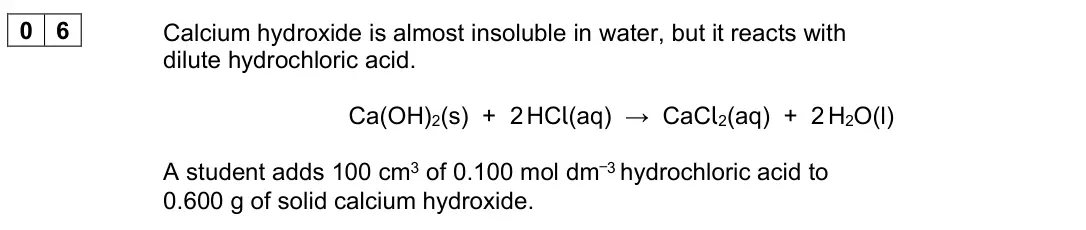
Q04.2
The whole paper ↗
Q04.3
The whole paper ↗Q06.1
The whole paper ↗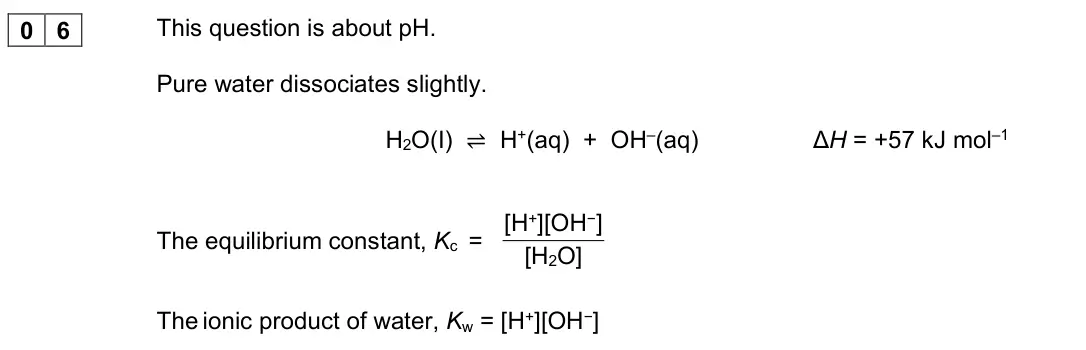
Q06.2
The whole paper ↗Q06.3
The whole paper ↗Q06.8
The whole paper ↗Q09.1
The whole paper ↗
Q05.2
The whole paper ↗
Q05.3
The whole paper ↗Q03.1
The whole paper ↗
Q03.2
The whole paper ↗Q03.3
The whole paper ↗How many marks did you get?
All 40 questions on The ionic product of water, Kw, as a list
- June 2024, Paper 1, Q07.1 (3 marks): Give the expression for Kw Calculate the pH of pure water at 40 °C Give your answer to 2 decimal places. [3 marks] Kw pH
- June 2024, Paper 1, Q07.2 (5 marks): 35.0 cm3 of 0.150 mol dm–3 aqueous sodium hydroxide are mixed with 20.0 cm3 of a 0.100 mol dm–3 solution of hydrochloric acid. The temperature of the solution f
- June 2024, Paper 3, Q18 (1 mark): Values of the ionic product of water (Kw) at different temperatures are given. Kw = 6.40 × 10⁻¹⁵ mol2 dm–6 at 18 °C Kw = 1.00 × 10⁻¹⁴ mol2 dm–6 at 25 °C Which s
- June 2023, Paper 3, Q06.2 (5 marks): The final mixture contains a saturated solution of Ca(OH)2 at 293 K At 293 K • the solubility of Ca(OH)2 in this solution is 0.400 g dm–3 • Kw = 6.80 × 10⁻¹⁵ mo
- June 2023, Paper 3, Q17 (1 mark): Which change causes the pH of 10 cm3 of 1.0 mol dm–3 NaOH to be halved at 298 K? Kw = 1.0 × 10⁻¹⁴ at 298 K [1 mark] A adding 10 cm3 of water B adding 10 dm3 of
- June 2022, Paper 1, Q04.2 (3 marks): Strontium is an element in Group 2. Calculate the pH of a 0.0100 mol dm–3 solution of strontium hydroxide at 10 oC You may assume that strontium hydroxide is co
- June 2022, Paper 1, Q04.3 (2 marks): The pH of a barium hydroxide solution is lower at 50 °C than at 10 °C At 50 °C a 25 cm3 sample of this barium hydroxide solution was neutralised by 22.45 cm3 of
- November 2021, Paper 1, Q06.1 (1 mark): Explain why [H2O] is not shown in the Kw expression. [1 mark]
- November 2021, Paper 1, Q06.2 (2 marks): Explain why the value of Kw increases as the temperature increases. [2 marks]
- November 2021, Paper 1, Q06.3 (4 marks): Give the expression for pH. Calculate the pH of pure water at 50 °C Give your answer to 2 decimal places. Explain why water is neutral at 50 °C [4 marks] Expres
- November 2021, Paper 1, Q06.8 (5 marks): 36.25 cm3 of 0.200 mol dm–3 sodium hydroxide solution are added to 25.00 cm3 of 0.150 mol dm–3 hydrochloric acid. Calculate the pH of the final solution at 25 º
- November 2020, Paper 3, Q13 (1 mark): Which statement about pH is correct? [1 mark] A The pH of a weak base is independent of temperature. B At temperatures above 298 K, the pH of pure water is less
- November 2020, Paper 3, Q32 (1 mark): Which is the concentration of NaOH(aq), in mol dm–3, that has pH = 14.30? Kw = 1.00 × 10⁻¹⁴ mol2 dm–6 at 25 °C [1 mark] A –1.16 B 5.01 × 10⁻¹⁵ C 2.00 × 10¹⁴ D 2
- June 2019, Paper 1, Q09.1 (4 marks): For pure water at 40 °C, pH = 6.67 A student thought that the water was acidic. Explain why the student was incorrect. Determine the value of Kw at this tempera
- June 2018, Paper 1, Q05.2 (6 marks): In an experiment, 10.35 cm3 of 0.100 mol dm–3 hydrochloric acid are added to 25.0 cm3 of 0.150 mol dm–3 barium hydroxide solution. Calculate the pH of the solut
- June 2018, Paper 1, Q05.3 (1 mark): The pH of water at 30 °C is 6.92 Give the reason why water is neutral at this temperature. [1 mark]
- June 2017, Paper 1, Q03.1 (1 mark): Which is the correct expression for Kw? Tick () one box. [1 mark A Kw = ] ][OH [H O] [H2 − + B Kw = [H+][H2O] C Kw = [H+][OH−] D Kw = O] [H ] ][OH [H 2 − +
- June 2017, Paper 1, Q03.2 (2 marks): Calculate the pH of pure water at 10 °C Give your answer to two decimal places. [2 marks pH of water
- June 2017, Paper 1, Q03.3 (1 mark): Suggest why this pure water at 10 °C is not alkaline. [1 mark
- June 2017, Paper 1, Q03.4 (3 marks): Calculate the pH of a 0.0131 mol dm−3 solution of calcium hydroxide at 10 °C Give your answer to two decimal places. [3 marks] pH of solution
- June 2017, Paper 3, Q10 (1 mark): What is the pH of a 0.46 mol dm−3 solution of potassium hydroxide at 298 K? (Kw = 1.0 × 10⁻¹⁴ mol2 dm−6 at 298 K) [1 mark] A 0.34 B 13.66 C 13.96 D 14.34
- Specimen, Paper 1, Q06.3 (3 marks): Concentration = mol dm – 6
- June 2015, CHEM4 (old spec), Q4(a) (2 marks): Explain why the expression for Kw does not include the concentration of water. [2 marks]
- June 2015, CHEM4 (old spec), Q4(b) (2 marks): Explain why the value of Kw increases as the temperature increases. [2 marks]
- June 2015, CHEM4 (old spec), Q4(c) (3 marks): Calculate the pH of pure water at 50 ºC. Give your answer to 2 decimal places. [3 marks]
- June 2015, CHEM4 (old spec), Q4(d) (3 marks): Calculate the pH of 0.12 mol dm–3 aqueous NaOH at 50 ºC. Give your answer to 2 decimal places. [3 marks]
- June 2014, CHEM4 (old spec), Q2(c) (3 marks): Calculate the pH of a 0.0120 mol dm–3 solution of calcium hydroxide. The ionic product of water Kw = 1.00 × 10⁻¹⁴ mol2 dm–6. Give your answer to 2 decimal place
- January 2013, CHEM4 (old spec), Q2(a)(i) (1 mark): Write an expression for the ionic product of water. (1 mark)
- January 2013, CHEM4 (old spec), Q2(a)(ii) (2 marks): At 42 oC, the value of Kw is 3.46 × 10⁻¹⁴ mol2 dm–6. Calculate the pH of pure water at this temperature.
- January 2013, CHEM4 (old spec), Q2(a)(iii) (2 marks): At 75 oC, a 0.0470mol dm–3 solution of sodium hydroxide has a pH of 11.36 Calculate a value for Kw at this temperature.
- January 2012, CHEM4 (old spec), Q4(c) (6 marks): A 25.0 cm3 sample of 0.620 mol dm–3 nitric acid was placed in a beaker and 38.2 cm3 of 0.550 mol dm–3 aqueous sodium hydroxide were added. Calculate the pH of t
- June 2011, CHEM4 (old spec), Q2(a)(ii) (1 mark): Write an expression for the ionic product of water, Kw (1 mark) 3
- June 2011, CHEM4 (old spec), Q2(a)(iii) (2 marks): At 10 °C, a 0.154 mol dm–3 solution of potassium hydroxide has a pH of 13.72 Calculate the value of Kw at 10 °C.
- June 2011, CHEM4 (old spec), Q2(c)(ii) (4 marks): Calculate the pH of the solution formed when 40.0 cm3 of 0.154 mol dm–3 potassium hydroxide are added to 20.0 cm3 of 0.154 mol dm–3 ethanoic acid at 25 °C. At 2
- June 2010, CHEM4 (old spec), Q5(a)(ii) (1 mark): Write an expression for Kw (1 mark)
- June 2010, CHEM4 (old spec), Q5(b)(i) (2 marks): Calculate the pH of pure water at 50°C. (2 marks)
- June 2010, CHEM4 (old spec), Q5(b)(ii) (1 mark): Suggest why this pure water is not acidic. (1 mark) 3
- June 2010, CHEM4 (old spec), Q5(b)(iii) (3 marks): Calculate the pH of 0.140moldm–3 aqueous sodium hydroxide at 50°C.
- January 2008, CHM4 (2008 spec), Q1(a) (4 marks): (a) The dissociation of water can be represented by the following equilibrium. H2O(l) H+(aq) + OH–(aq) (i) Write an expression for the ionic product of water, K
- January 2008, CHM4 (2008 spec), Q1(b) (2 marks): (b) At 25°C the value of Kw is 1.00 × 10⁻¹⁴ mol2 dm–6. Calculate the pH of a 0.136 mol dm–3 solution of KOH at 25°C. (2 marks)
Questions, mark schemes and examiner’s reports are © AQA, from their published past papers. Plumi isn’t affiliated with any exam board. Want whole papers? AQA A-Level Chemistry past papers.
The Plumi iPad app also offers exam-style questions with AI feedback on your handwritten working.