 plumi
Combustion of alkanes: AQA A‑Level Chemistry questions
AQA A-Level Chemistry past-paper questions on 3.3.2.3 Combustion of alkanes, 2008–2025, with mark schemes and examiner’s reports where available.
Paper
All papers
Exam
All years
Calculations
Q03.5
The whole paper ↗
Q08.5
The whole paper ↗
Q02.4
The whole paper ↗
Q02.6
The whole paper ↗Q04.3
The whole paper ↗
Q01.1
The whole paper ↗
Q01.2
The whole paper ↗Q01.5
The whole paper ↗Q11.4
The whole paper ↗
Q04.1
The whole paper ↗
Q04.2
The whole paper ↗Q04.3
The whole paper ↗Q01.1
The whole paper ↗
Q04.3
The whole paper ↗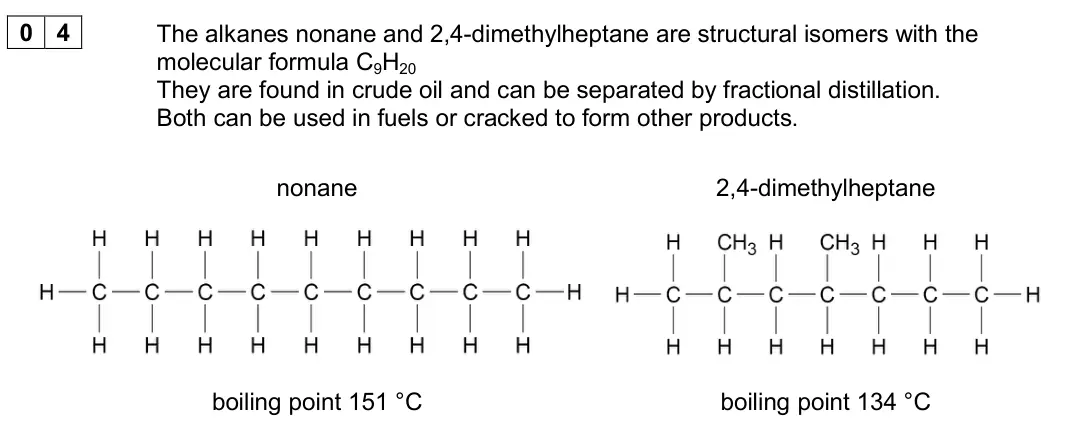
Q04.4
The whole paper ↗Q06.2
The whole paper ↗
Q04.1
The whole paper ↗
Q03.3
The whole paper ↗
All 90 questions on Combustion of alkanes, as a list
- June 2025, AS Paper 2, Q09 (1 mark): Which statement about the combustion of petrol in vehicles is correct? [1 mark] A Exhaust gases can contain a mixture of unburned hydrocarbon molecules. B In th
- June 2024, Paper 2, Q03.5 (2 marks): Natural gas is used in power stations to produce electricity. Natural gas contains sulfur impurities. Sulfur dioxide forms when these impurities are burned. Sta
- June 2023, Paper 2, Q08.5 (2 marks): Complete combustion of the biofuel made from sewage sludge produces the greenhouse gas carbon dioxide. Suggest one other possible environmental problem with the
- June 2023, AS Paper 2, Q02.4 (2 marks): Give the equation for the complete combustion of 3-ethyl-4-methylhexane. Use the molecular formula for 3-ethyl-4-methylhexane in your equation. [2 marks]
- June 2023, AS Paper 2, Q02.6 (2 marks): Nitrogen monoxide (NO) is formed when petrol is burned in cars. State one environmental problem that NO causes. State what is used to remove NO from the exhaust
- June 2022, AS Paper 2, Q04.3 (1 mark): Alkanes have the general formula CnH2n+2 Alkanes undergo complete combustion in a plentiful supply of oxygen. CnH2n+2 + x O2 → n CO2 + (n+1) H2O Determine x in
- November 2021, AS Paper 2, Q22 (1 mark): Which statement is not correct about the pollutant sulfur dioxide? [1 mark] A It can be removed from car exhaust gases by a catalytic converter. B It can be rem
- November 2020, Paper 3, Q01.1 (2 marks): Explain how oxides of nitrogen are formed in engines. [2 marks]
- November 2020, Paper 3, Q01.2 (1 mark): State why it is desirable to decrease emissions of oxides of nitrogen from vehicles. [1 mark]
- November 2020, Paper 3, Q01.5 (1 mark): Some carbon particulates are also formed in both diesel and petrol vehicles. Explain why carbon particulates are formed. [1 mark]
- June 2019, Paper 2, Q11.4 (1 mark): Give an equation for the complete combustion of the ester C19H34O2 [1 mark]
- June 2019, AS Paper 2, Q04.1 (1 mark): The petrol fraction from crude oil contains octane (C8H18). Give an equation for the complete combustion of octane. [1 mark]
- June 2019, AS Paper 2, Q04.2 (1 mark): The combustion of petrol in car engines produces the pollutant nitrogen monoxide. Give an equation for a reaction that removes nitrogen monoxide in a catalytic
- June 2019, AS Paper 2, Q04.3 (2 marks): Sulfur dioxide is produced in the combustion of fossil fuels. The total emissions of sulfur dioxide in the UK have fallen dramatically since 1970. Sulfur dioxid
- June 2018, Paper 2, Q01.1 (1 mark): Alkanes can be used as fuels. Give an equation for the combustion of heptane (C7H16) in an excess of oxygen. [1 mark]
- June 2018, AS Paper 2, Q04.3 (1 mark): Give an equation for the complete combustion of nonane. [1 mark]
- June 2018, AS Paper 2, Q04.4 (2 marks): Nonane is often found in fuel for jet engines. Combustion in jet engines produces pollutants including nitrogen monoxide (NO). Explain how this nitrogen monoxid
- June 2017, AS Paper 1, Q06.2 (2 marks): Suggest two reasons why the sulfur dioxide by-product of this process is remove from the exhaust gases. [2 mark Reason 1 Reason 2
- June 2017, AS Paper 2, Q04.1 (1 mark): Write an equation for the complete combustion of propane in oxygen. [1 mark]
- June 2016, AS Paper 2, Q03.3 (1 mark): Isooctane is added to petrol to increase its octane rating. Some high-performance engines require fuel with a higher octane rating. Write an equation for the co
- June 2016, AS Paper 2, Q03.5 (1 mark): Carbon monoxide is produced when incomplete combustion takes place in engines. Nitrogen monoxide is another pollutant produced in car engines. Write an equation
- June 2016, AS Paper 2, Q12 (1 mark): Sulfur dioxide (SO2) is produced when some fossil fuels are burned. Which of the following statements is true? [1 mark] A Sulfur dioxide can be removed from was
- June 2016, CHEM1 (old spec), Q4(a)(ii) (1 mark): Write an equation to show the complete combustion of C8H18 [1 mark]
- June 2016, CHEM2 (old spec), Q7(b)(i) (1 mark): Write an equation for the production of carbon monoxide by the incomplete combustion of methane. [1 mark]
- June 2015, CHEM1 (old spec), Q6(b) (1 mark): If the boiler for a central heating system is faulty, a poisonous gas may be produced during the combustion of C16H34 Write an equation for the reaction that fo
- June 2015, CHEM1 (old spec), Q6(c) (2 marks): Explain why the sulfur compounds found in crude oil should be removed from the fractions before they are used for central heating fuel. [2 marks]
- June 2014, CHEM1 (old spec), Q5(b) (1 mark): The combustion of dodecane produces several products. Write an equation for the incomplete combustion of dodecane to produce gaseous products only. [1 mark]
- June 2014, CHEM1 (old spec), Q5(c)(i) (2 marks): Explain how these oxides of nitrogen are formed. [2 marks]
- June 2014, CHEM1 (old spec), Q5(c)(ii) (1 mark): Write an equation to show how nitrogen monoxide in the air is converted into nitrogen dioxide. [1 mark]
- June 2014, CHEM1 (old spec), Q5(c)(iii) (1 mark): Nitric acid (HNO3) contributes to acidity in rainwater. Deduce an equation to show how nitrogen dioxide reacts with oxygen and water to form nitric acid. [1 mar
- June 2013, CHEM1 (old spec), Q2(b)(i) (1 mark): Write an equation for this reaction. (1 mark)
- June 2013, CHEM1 (old spec), Q2(b)(ii) (1 mark): State one hazard associated with the solid product in part (b) (i). (1 mark)
- June 2013, CHEM1 (old spec), Q2(d)(i) (1 mark): Write an equation for this reaction. (1 mark)
- June 2013, CHEM1 (old spec), Q2(d)(ii) (1 mark): Identify a catalyst used in a catalytic converter. (1 mark)
- January 2013, CHEM1 (old spec), Q4(c) (1 mark): Write an equation for the complete combustion of C4H10 (1 mark)
- January 2013, CHEM1 (old spec), Q4(d) (1 mark): Explain why the complete combustion of C4H10 may contribute to environmental problems. (1 mark)
- January 2013, CHEM1 (old spec), Q4(f)(i) (1 mark): Write an equation for the combustion of ethanethiol to form carbon dioxide, water and sulfur dioxide. (1 mark)
- January 2013, CHEM1 (old spec), Q4(f)(ii) (2 marks): Identify a compound that is used to react with the sulfur dioxide in the products of combustion before they enter the atmosphere. Give one reason why this compo
- January 2013, CHEM1 (old spec), Q5(d) (1 mark): Suggest why a leak of NO2 gas from the Ostwald Process will cause atmospheric pollution. (1 mark)
- June 2012, CHEM5 (old spec), Q4(e) (1 mark): Write an equation to show how nitrogen monoxide is formed in an internal combustion engine. (1 mark)
- June 2012, CHEM1 (old spec), Q2(d)(ii) (1 mark): Give one use of Y. (1 mark)
- June 2012, CHEM1 (old spec), Q2(d)(iii) (1 mark): Write an equation to show the reaction of Y in a limited supply of air to produce a solid and water only. (1 mark)
- June 2012, CHEM1 (old spec), Q2(d)(iv) (2 marks): When a sample of Y, contaminated with CH3SH, is burned completely in air, a toxic gas is formed. Identify this toxic gas and suggest a compound that could be us
- June 2012, CHEM1 (old spec), Q2(d)(v) (1 mark): Suggest the name of the process that occurs when the toxic gas in part (d) (iv) is removed. (1 mark)
- June 2012, CHEM2 (old spec), Q2(d)(ii) (1 mark): Write an equation for the complete combustion of methanol. (1 mark)
- January 2012, CHEM1 (old spec), Q4(a)(i) (1 mark): Write an equation for the incomplete combustion of octane to produce carbon monoxide as the only carbon-containing product. (1 mark)
- January 2012, CHEM1 (old spec), Q4(a)(ii) (1 mark): Suggest one reason why the combustion was incomplete. (1 mark)
- January 2012, CHEM1 (old spec), Q4(b)(i) (1 mark): Write an equation for a reaction between these two toxic gases that occurs in a catalytic converter when these gases are removed. (1 mark)
- January 2012, CHEM1 (old spec), Q4(b)(ii) (2 marks): Identify a metal used as a catalyst in a catalytic converter. Suggest one reason, other than cost, why the catalyst is coated on a ceramic honeycomb. Metal Reas
- January 2012, CHEM1 (old spec), Q4(c)(i) (1 mark): State one environmental problem that can be caused by the release of this gas. (1 mark)
- January 2012, CHEM1 (old spec), Q4(c)(ii) (2 marks): Identify one substance that could be used to remove this gas. Suggest one reason, other than cost, why this substance is used. Substance Reason why used (2 mark
- June 2011, CHEM1 (old spec), Q6(a) (3 marks): There is a risk of gas explosions in coal mines. This risk is mainly due to the presence of methane. If the percentage of coal-mine methane (CMM) in the air in
- June 2011, CHEM1 (old spec), Q6(b) (3 marks): Methane can be obtained from crude oil. Some of this crude oil contains an impurity called methanethiol (CH3SH). This impurity causes environmental problems whe
- June 2011, CHEM1 (old spec), Q7(d) (2 marks): Write an equation for the incomplete combustion of pentane to form a solid pollutant. Suggest why this solid pollutant is an environmental problem.
- June 2011, CHEM2 (old spec), Q8(c) (5 marks): The scientists also analysed the exhaust gases from an incinerator used to destroy waste poly(ethene). Mass spectrometry showed that there was a trace gas with
- January 2011, CHEM4 (old spec), Q3(d) (1 mark): The following reaction has been suggested as an alternative method for the production of methanol. CO2(g) + 3H2(g) CH3OH(g) + H2O(g) The hydrogen used in this m
- January 2011, CHEM1 (old spec), Q4(a) (1 mark): Write an equation to show the complete combustion of cetane. (1 mark)
- January 2011, CHEM1 (old spec), Q4(c)(i) (2 marks): Write an equation to show how NO is formed and give a condition needed for its formation. Equation Condition (2 marks)
- January 2011, CHEM1 (old spec), Q4(c)(ii) (2 marks): Write an equation to show how NO is removed from the exhaust gases in a catalytic converter. Identify a catalyst used in the converter. Equation Catalyst (2 mar
- January 2011, CHEM1 (old spec), Q4(c)(iii) (1 mark): Deduce an equation to show how NO2 reacts with water and oxygen to form nitric acid (HNO3). (1 mark)
- June 2010, CHEM1 (old spec), Q4(b) (1 mark): Give one reason why the oxide NO is a pollutant gas. (1 mark)
- June 2010, CHEM1 (old spec), Q4(c) (1 mark): The oxide NO reacts with oxygen to form nitrogen dioxide. Write an equation for this reaction. (1 mark)
- June 2010, CHEM1 (old spec), Q4(d) (2 marks): Explain how NO is produced in the engine of a motor vehicle. (2 marks)
- June 2010, CHEM1 (old spec), Q4(e) (1 mark): Write an equation to show how NO is removed from the exhaust gases in motor vehicles using a catalytic converter. (1 mark)
- June 2010, CHEM1 (old spec), Q5(a)(i) (1 mark): Write an equation for the complete combustion of butane. (1 mark)
- June 2010, CHEM1 (old spec), Q5(a)(ii) (1 mark): State a condition which may cause carbon to be formed as a product in the combustion of butane. (1 mark)
- June 2010, CHEM1 (old spec), Q5(b)(i) (1 mark): Suggest the identity of the toxic gas. (1 mark)
- June 2010, CHEM1 (old spec), Q5(b)(ii) (1 mark): Suggest why calcium oxide reacts with the toxic gas. (1 mark)
- June 2010, CHEM1 (old spec), Q5(b)(iii) (1 mark): Suggest why the calcium oxide is coated on a mesh. (1 mark)
- January 2010, CHEM1 (old spec), Q4(b)(i) (1 mark): Write an equation for this reaction. (1 mark)
- January 2010, CHEM1 (old spec), Q4(b)(ii) (1 mark): State how the products of this reaction may affect the environment. (1 mark)
- January 2010, CHEM1 (old spec), Q4(c) (1 mark): Give the name of a solid pollutant which may form when pentane burns incompletely in air. (1 mark)
- January 2010, CHEM2 (old spec), Q8(a)(ii) (1 mark): Give one environmental reason why the SO2 gas formed in this reaction is not allowed to escape into the atmosphere. (1 mark)
- June 2009, CHEM1 (old spec), Q3(c)(ii) (1 mark): 3 (c) (ii) Suggest one environmental problem caused by incomplete combustion of ethanol in a car engine. (1 mark)
- June 2009, CHEM1 (old spec), Q3(c)(iii) (1 mark): 3 (c) (iii) Suggest one economic problem for the car user caused by incomplete combustion of ethanol in the car engine. (1 mark)
- June 2009, CHEM1 (old spec), Q3(d)(i) (2 marks): 3 (d) (i) State how the sulfur dioxide can be removed from the waste gases produced when this propane is burned on a large scale in industry. Suggest a reason w
- June 2009, CHEM2 (old spec), Q5(a)(i) (1 mark): 5 (a) (i) Write an equation for the formation of carbon monoxide from carbon. (1 mark)
- January 2009, CHEM1 (old spec), Q6(d) (4 marks): 6 (d) Write an equation for the incomplete combustion of C8H18 to form carbon monoxide and water only. A catalytic converter is used to remove carbon monoxide f
- January 2009, CHEM1 (old spec), Q6(e) (2 marks): 6 (e) When some petrol was accidentally contaminated in 2007, the sensors in the affected cars caused a decrease in the supply of petrol to the engine. Suggest
- January 2009, CHM1 (2008 spec), Q2(a) (1 mark): 2 (a) Write an equation for the complete combustion of ethyne to form carbon dioxide and water only. (1 mark)
- June 2008, CHM3W (2008 spec), Q1(a)(ii) (1 mark): 1 (a) (ii) Write an equation for the incomplete combustion of the hydrocarbon nonane (C9H20) to give CO and H2O as the only products. (1 mark)
- June 2008, CHM3W (2008 spec), Q1(a)(iii) (2 marks): 1 (a) (iii) State one essential condition for the formation of NO from air in a petrol- engined car. Write an equation for the reaction in which NO is formed. E
- June 2008, CHM3W (2008 spec), Q1(b)(i) (1 mark): 1 (b) (i) Identify one of the metals used as a catalyst in a catalytic converter. (1 mark)
- June 2008, CHM3W (2008 spec), Q1(b)(ii) (1 mark): 1 (b) (ii) Balance the following equation. C8H18 + ……NO ……CO2 + ……N2 + ……H2O (1 mark)
- June 2008, CHM3W (2008 spec), Q1(c) (1 mark): 1 (c) Natural gas is mainly methane and is burned as a fuel. State what is meant by the term fuel. (1 mark)
- June 2008, CHM3W (2008 spec), Q1(d) (1 mark): 1 (d) Natural gas contains a small amount of hydrogen sulphide, H2S Write an equation for the combustion of H2S in air to give SO2 and H2O as the only products.
- January 2008, CHM3W (2008 spec), Q1(c)(i) (1 mark): (i) Write an equation for the incomplete combustion of decane (C10H22) to give carbon monoxide and water only. (1 mark)
- January 2008, CHM3W (2008 spec), Q1(c)(ii) (1 mark): (ii) Identify a solid pollutant which could form during the incomplete combustion of decane. (1 mark)
- January 2008, CHM3W (2008 spec), Q1(c)(iii) (1 mark): (iii) Identify the pollutant which would be formed from the sulphur-containing impurities in petroleum if they were burned. (1 mark)
- January 2008, CHM3W (2008 spec), Q4(a) (2 marks): (a) Write an equation for the reaction between nitrogen monoxide and carbon monoxide in a catalytic converter of a petrol-engined car. Identify a catalyst used
Questions, mark schemes and examiner’s reports are © AQA, from their published past papers. Plumi isn’t affiliated with any exam board. Want whole papers? AQA A-Level Chemistry past papers.
The Plumi iPad app also offers exam-style questions with AI feedback on your handwritten working.