 plumi
The mole and the Avogadro constant: AQA A‑Level Chemistry questions
AQA A-Level Chemistry past-paper questions on 3.1.2.2 The mole and the Avogadro constant, 2008–2025, with mark schemes and examiner’s reports where available.
Paper
All papers
Exam
All years
Calculations
Q06.3
The whole paper ↗
Q05.2
The whole paper ↗
Q04.3
The whole paper ↗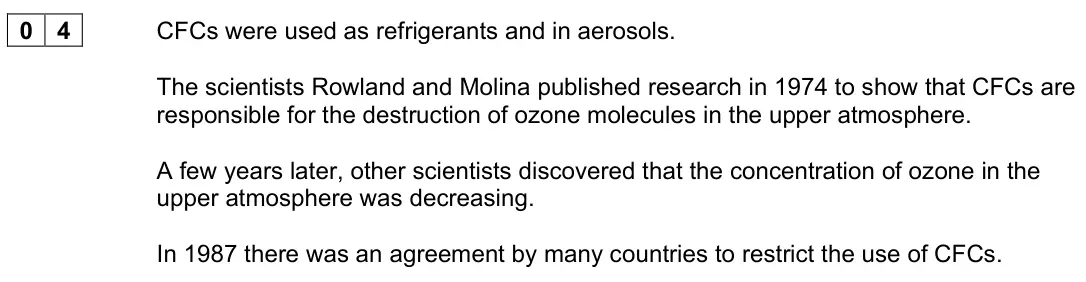
Q07.4
The whole paper ↗
- Your answer
Q08.3
The whole paper ↗
Q02.1
The whole paper ↗
Q02.2
The whole paper ↗Q02.3
The whole paper ↗Q02.5
The whole paper ↗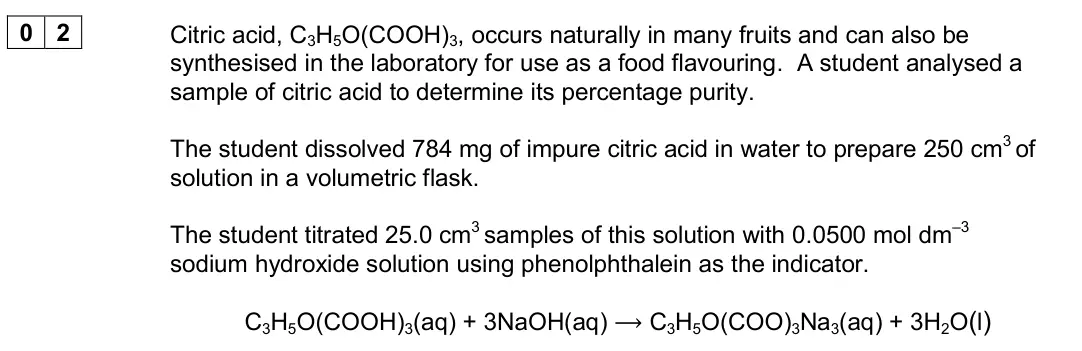
- Your answer
All 44 questions on The mole and the Avogadro constant, as a list
- June 2025, AS Paper 1, Q22 (1 mark): At temperature T and pressure P, 0.287 g of nitrogen has a volume of 25.0 cm3 Which quantity of substance at temperature T and pressure P contains the same numb
- June 2025, AS Paper 2, Q06.3 (2 marks): Concentrated phosphoric acid (H3PO4) has a density of 1.69 g cm–3 The concentrated acid contains 85% phosphoric acid and 15% water by mass. Calculate the amount
- June 2024, AS Paper 2, Q22 (1 mark): A sample of cyclohexane contains 3.011 × 1024 atoms of carbon. What is the mass of this sample? The Avogadro constant, L = 6.022 × 10²³ mol–1 [1 mark] A 70.0 g
- June 2022, AS Paper 2, Q05.2 (2 marks): 1-iodopropane is a liquid at room temperature. Calculate the number of molecules in 5.0 cm3 of 1-iodopropane (Mr = 169.9). Give your answer in standard form. Fo
- November 2021, AS Paper 2, Q04.3 (2 marks): A typical refrigerator contained 0.50 kg of CFC-11 (Mr = 137.5). One molecule of CFC-11 causes the destruction of approximately 100 000 molecules of ozone. Use
- November 2021, AS Paper 2, Q11 (1 mark): When driving a car, a legal limit for ethanol (Mr = 46.0) is 80 mg per 100 cm3 of blood. What is this concentration in mol dm–3? [1 mark] A 1.74 × 10⁻¹ B 1.74 ×
- November 2020, AS Paper 1, Q07.4 (1 mark): Calculate the amount, in moles, of silver iodide obtained. Mr (AgI) = 234.8 [1 mark] Amount of silver iodide mol
- June 2019, AS Paper 1, Q09 (1 mark): Which sample, measured at room temperature and pressure, contains the greatest number of the stated particles? [1 mark] A 1 g of hydrogen molecules B 1 g of hel
- June 2019, AS Paper 2, Q10 (1 mark): A ‘drink-driving’ offence is committed if the blood alcohol level of a driver is over 80 mg of ethanol per 100 cm3 of blood. What is the concentration, in mol d
- June 2019, AS Paper 2, Q24 (1 mark): The heat released when 1.00 g of ethanol (Mr = 46.0) undergoes complete combustion is 29.8 kJ What is the heat released by each molecule, in joules, when ethano
- June 2018, Paper 1, Q08.3 (1 mark): Calculate the concentration, in mol dm–3, of sodium ions in the solution produced in the reaction in Question 08.2. [1 mark] Concentration mol dm–3
- June 2018, AS Paper 1, Q02.1 (4 marks): A 1.00 g sample of toothpaste was found to contain 2.88 x 10⁻⁵ mol of sodium fluoride. Calculate the concentration of sodium fluoride, in ppm, for the sample of
- June 2018, AS Paper 1, Q02.2 (1 mark): Sodium fluoride is toxic in high concentrations. Major health problems can occur if concentrations of sodium fluoride are greater than 3.19 x 10⁻² g per kilogra
- June 2018, AS Paper 1, Q02.3 (1 mark): The concentration of sodium fluoride in a prescription toothpaste is 2800 ppm. Use your answer to Question 02.2 to deduce the mass of toothpaste, in kg, that a
- June 2018, AS Paper 1, Q11 (1 mark): How many protons are there in 6.0 g of nitrogen gas? Avogadro constant, L = 6.022 x 10²³ mol–1 [1 mark] A 1.3 x 10²³ B 9.0 x 10²³ C 1.8 x 1024 D 3.6 x 1024
- June 2018, AS Paper 1, Q19 (1 mark): A solution of volume 500 cm3 contains 150 g of ammonia. What is the concentration, in mol dm–3, of ammonia in this solution? [1 mark] A 0.51 B 8.82 C 16.7 D 17.
- June 2018, AS Paper 2, Q02.5 (3 marks): Use your answer to Question 02.3 to find the mass, in mg, of citric acid dissolved in 250 cm3 of the solution. The relative molecular mass (Mr) of citric acid i
- June 2018, AS Paper 2, Q09 (1 mark): A student has a 10 cm3 sample of 1.00 × 10⁻² mol dm−3 methanoic acid solution. The student is asked to dilute the methanoic acid solution to a concentration of
- June 2018, AS Paper 2, Q21 (1 mark): A gas cylinder contains 5.0 kg of propane. How many propane molecules are in the cylinder? The Avogadro constant, L = 6.022 × 10²³ mol–1 [1 mark] A 6.8 × 10²² B
- June 2018, AS Paper 2, Q22 (1 mark): Which sample of liquid has the greatest volume? [1 mark] A 500 mg of pentane (density = 0.63 g cm–3) B 650 mg of propan-1-ol (density = 0.80 g cm–3) C 1.20 g of
- June 2017, Paper 1, Q04.3 (1 mark): Calculate the mass, in kg, of one atom of 49Ti The Avogadro constant L = 6.022 × 10²³ mol−1 [1 mark Mass kg
- June 2017, Paper 3, Q26 (1 mark): A solution of lead(ll) chloride (Mr = 278.2) contains 1.08 g of PbCl2 in 100 cm3 of solution. In this solution, the lead(ll) chloride is fully dissociated into
- June 2017, Paper 3, Q30 (1 mark): A student is provided with 5.00 cm3 of 1.00 mol dm−3 ammonia solution. The student was asked to prepare an ammonia solution with a concentration of 0.050 mol dm
- June 2017, AS Paper 1, Q14 (1 mark): 1 4 A 4.85 g sample of anhydrous sodium sulfate is dissolved in water and the solution made up to 250 cm3 in a volumetric flask. What is the concentration in mo
- June 2017, AS Paper 1, Q15 (1 mark): 1 5 Which of these contains the greatest number of atoms? [1 mark] A 127 mg of iodine B 1.54 × 10⁻⁴ kg of phosphorus C 81.0 mg of carbon dioxide D 1.70 × 10⁻⁴ k
- June 2017, AS Paper 2, Q19 (1 mark): Which sample contains the most molecules? The Avogadro constant, L = 6.022 x 10²³ mol−1 [1 mark] A 2.10 × 10²² molecules of methane, CH4 B 1.00 g of oxygen, O2
- June 2017, AS Paper 2, Q22 (1 mark): A sample of 2.0 mol dm−3 acid has a volume of 100 cm3 What volume of water, in cm3, should be added to this acid to dilute the sample to a concentration of 1.5
- June 2017, AS Paper 2, Q24 (1 mark): Analysis of a sample of a chemical with formula C22H30N6O4S, showed that it contained 0.0195 mol of carbon. What mass of nitrogen was present in the sample? [1
- June 2016, AS Paper 1, Q06.2 (1 mark): Calculate the mass, in kg, of a single 52Cr+ ion. Assume that the mass of a 52Cr+ ion is the same as that of a 52Cr atom. (The Avogadro constant L = 6.022 x 10²
- June 2016, AS Paper 1, Q12 (1 mark): There are 392 mol of pure gold in a bar measuring 10 cm by 10 cm by 40 cm. What is the density of gold in kg dm−3? [1 mark] A 193 B 19.3 C 1.93 D 0.193
- June 2016, AS Paper 1, Q24 (1 mark): In a car airbag, sodium azide (NaN3) decomposes to form sodium metal and nitrogen gas. 2NaN3(s) → 2Na(s) + 3N2(g) The sodium metal then reacts with potassium ni
- June 2016, AS Paper 2, Q05.5 (2 marks): A refrigerator contains 1.41 kg of 1,1,1-trifluoroethane (CF3CH3). Calculate the number of molecules of 1,1,1-trifluoroethane in the refrigerator. Give your ans
- June 2016, AS Paper 2, Q20 (1 mark): The Mr of hydrated copper sulfate (CuSO4.5H2O) is 249.6. Which of the following is the mass of hydrated copper sulfate required to make 50.0 cm3 of a 0.400 mol
- Specimen, Paper 3, Q09 (1 mark): 6
- June 2015, CHEM1 (old spec), Q7(c)(i) (3 marks): A 500 cm3 volume of the nitrous acid solution was used to destroy completely 150 g of the sodium azide. Calculate the concentration, in mol dm–3, of the nitrous
- June 2014, CHEM1 (old spec), Q2(a)(i) (1 mark): Calculate the amount, in moles, of iron(III) nitrate in the 2.16 g sample. Give your answer to 3 significant figures. [1 mark]
- January 2013, CHEM1 (old spec), Q5(b)(i) (2 marks): Calculate the amount, in moles, of ammonia in 3.00 kg.
- June 2011, CHEM1 (old spec), Q2(a)(i) (1 mark): Calculate the amount, in moles, of HNO3 in 36.2 cm3 of 0.586 mol dm–3 nitric acid. Give your answer to 3 significant figures. (1 mark)
- January 2011, CHEM1 (old spec), Q3(d)(i) (2 marks): Calculate the amount, in moles, of MgCO3 in 6.27 g of magnesium carbonate. (2 marks)
- June 2010, CHEM1 (old spec), Q3(a)(i) (2 marks): Calculate the amount, in moles, of MgO in 0.741g of magnesium oxide. (2 marks)
- January 2010, CHEM1 (old spec), Q2(a)(i) (2 marks): Calculate the amount, in moles, of (NH4)2SO4 in 3.14g of ammonium sulfate. (2 marks)
- June 2009, CHEM1 (old spec), Q2(a)(i) (1 mark): 2 (a) (i) Calculate the amount, in moles, of magnesium in the 0.0732 g sample. (1 mark)
- January 2009, CHEM1 (old spec), Q3(b)(i) (2 marks): 3 (b) (i) Calculate the amount, in moles, of TiCl4 in 165 g. (2 marks)
- January 2009, CHEM1 (old spec), Q5(a)(ii) (1 mark): 5 (a) (ii) Calculate the amount, in moles, of MCO3 in 0.548 g. (1 mark)
Questions, mark schemes and examiner’s reports are © AQA, from their published past papers. Plumi isn’t affiliated with any exam board. Want whole papers? AQA A-Level Chemistry past papers.
The Plumi iPad app also offers exam-style questions with AI feedback on your handwritten working.