 plumi
The ideal gas equation: AQA A‑Level Chemistry questions
AQA A-Level Chemistry past-paper questions on 3.1.2.3 The ideal gas equation, 2008–2025, with mark schemes and examiner’s reports where available.
Paper
All papers
Exam
All years
Calculations
Q08.1
The whole paper ↗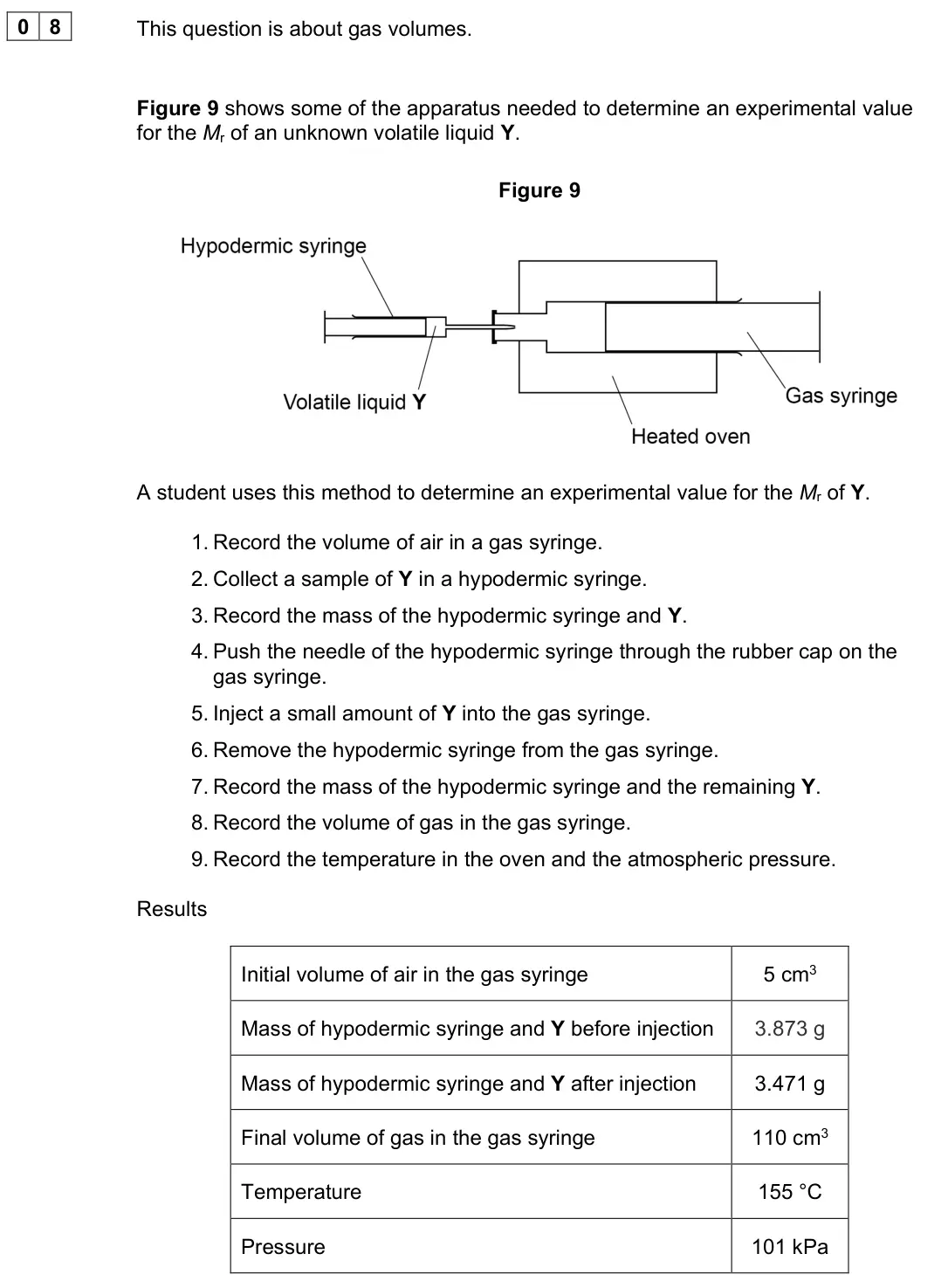
Q08.2
The whole paper ↗Q08.3
The whole paper ↗- Your answer
Q05.2
The whole paper ↗
Q09.4
The whole paper ↗
Q05.1
The whole paper ↗
Q07.1
The whole paper ↗
Q07.2
The whole paper ↗Q07.3
The whole paper ↗Q03.4
The whole paper ↗
Q04.1
The whole paper ↗
Q10.3
The whole paper ↗
Q06.1
The whole paper ↗
Q08.1
The whole paper ↗
Q08.2
The whole paper ↗Q08.3
The whole paper ↗
All 50 questions on The ideal gas equation, as a list
- June 2025, Paper 2, Q08.1 (5 marks): Use the results to determine an experimental value for the Mr of Y. The gas constant, R = 8.31 J K–1 mol–1 Show your working. [5 marks] Mr
- June 2025, Paper 2, Q08.2 (3 marks): The percentage uncertainty in the volume of Y in the gas syringe is 0.95% The percentage uncertainty in the temperature is 0.12% The uncertainty in each balance
- June 2025, Paper 2, Q08.3 (1 mark): A teacher suggests placing a seal over the needle of the hypodermic syringe after collecting the sample of liquid Y, and then replacing the seal after injecting
- June 2025, AS Paper 1, Q09 (1 mark): What is the mass, in kg, of 2000 m3 of carbon monoxide gas at 100 kPa and 25 °C? R = 8.31 J K–1 mol–1 [1 mark] A 2.261 B 2.696 C 2261 D 2696
- June 2025, AS Paper 1, Q22 (1 mark): At temperature T and pressure P, 0.287 g of nitrogen has a volume of 25.0 cm3 Which quantity of substance at temperature T and pressure P contains the same numb
- June 2025, AS Paper 2, Q05.2 (5 marks): A student does an experiment to determine the Mr of a volatile liquid X. In this experiment a conical flask of known volume is filled with vaporised X which is
- June 2024, Paper 1, Q09.4 (6 marks): A metal nitrate X(NO3)2 completely decomposes when heated. 2 X(NO3)2(s) → 2 XO(s) + 4 NO2(g) + O2(g) A 0.832 g sample of X(NO3)2 decomposes on heating to produc
- June 2024, AS Paper 2, Q05.1 (7 marks): Magnesium reacts with hydrochloric acid. Mg(s) + 2 HCl(aq) → MgCl2(aq) + H2(g) 0.400 g of magnesium is added to 20.0 cm3 of 1.50 mol dm–3 hydrochloric acid. Ide
- June 2023, Paper 2, Q07.1 (4 marks): Calculate the volume, in cm3, of propanone in the gas syringe. The gas constant, R = 8.31 J K−1 mol−1 [4 marks] Volume of propanone cm3
- June 2023, Paper 2, Q07.2 (2 marks): The gas syringe is then cooled to 75 °C, without changing the pressure. Calculate the decrease in volume. (If you were unable to calculate the volume in Questio
- June 2023, Paper 2, Q07.3 (2 marks): The total uncertainty in using the balance to measure the mass of propanone in Question 07.1 is ±0.001 g Calculate the uncertainty that this causes in the volum
- June 2023, AS Paper 1, Q04 (5 marks): M is a Group 2 metal that forms the nitrate M(NO3)2 0.320 g of M(NO3)2 is heated strongly and decomposes completely. 2 M(NO3)2 (s) → 2 MO (s) + 4 NO2 (g) + O2 (
- June 2022, Paper 1, Q03.4 (5 marks): Hydrogen peroxide decomposes to form water and oxygen. Give an equation for this reaction. Calculate the amount, in moles, of hydrogen peroxide that would be ne
- June 2022, AS Paper 2, Q04.1 (5 marks): TNT (C7H5N3O6) is an explosive because it can decompose very quickly and exothermically to form a large volume of gas. An equation for this decomposition is 2 C
- November 2021, AS Paper 1, Q10.3 (5 marks): At a different temperature, a mixture contains 0.025 mol of sulfur dioxide 0.049 mol of oxygen 0.034 mol of sulfur trioxide. The total pressure of the mixture i
- November 2021, AS Paper 2, Q06.1 (5 marks): In the first experiment, liquid Y is injected into a sealed flask under vacuum. The liquid vaporises in the flask. Table 2 shows data for this experiment. Table
- November 2020, Paper 3, Q07 (1 mark): When heated, a sample of potassium chlorate(V) (KClO3) produced 67.2 cm3 of oxygen, measured at 298 K and 110 kPa 2 KClO3(s) → 2 KCl(s) + 3 O2(g) What is the am
- November 2020, AS Paper 1, Q08.1 (4 marks): A student does an experiment to determine the relative molecular mass (Mr) of liquid A using the apparatus shown in Figure 2. The student injects a sample of A
- November 2020, AS Paper 1, Q08.2 (2 marks): The student noticed that some of the liquid injected into the gas syringe did not vaporise. Explain the effect that this has on the Mr calculated by the student
- November 2020, AS Paper 1, Q08.3 (1 mark): Each reading on the balance used to record the mass of the fine needle syringe and contents had an uncertainty of ±0.001 g Calculate the percentage uncertainty
- June 2019, Paper 1, Q06.6 (4 marks): Iodine vaporises easily. Calculate the volume, in cm3, that 5.00 g of iodine vapour occupies at 185 °C and 100 kPa The gas constant R = 8.31 J K–1 mol–1 Give yo
- June 2019, AS Paper 2, Q09.3 (6 marks): Butane can be used as a replacement for CFCs in refrigerators. During its use, the butane is repeatedly converted from liquid to gas and then back to liquid. Li
- June 2018, Paper 1, Q08.2 (6 marks): When 250 mg of sodium were added to 500 cm3 of water at 25 °C a gas was produced. Give an equation for the reaction that occurs. Calculate the volume, in cm3, o
- June 2018, AS Paper 1, Q06.1 (5 marks): Define the term relative molecular mass (Mr). Use the experimental results in Table 2 to determine the relative molecular mass of Y. The gas constant R = 8.31 J
- June 2018, AS Paper 1, Q06.2 (2 marks): Some of the liquid injected did not evaporate because it dripped into the gas syringe nozzle outside the oven. Explain how this would affect the value of the Mr
- June 2017, Paper 3, Q28 (1 mark): A 385 cm3 sample of carbon dioxide at 100 kPa and 25 °C was mixed with 2.89 × 10⁻² mol of argon. The gas constant, R = 8.31 J K−1 mol−1 What is the mole fractio
- June 2017, Paper 3, Q34 (1 mark): 130 cm3 of oxygen and 40 cm3 of nitrogen, each at 298 K and 100 kPa, were placed into an evacuated flask of volume 0.50 dm3. What is the pressure of the gas mix
- June 2017, AS Paper 2, Q02.1 (5 marks): Calculate the relative molecular mass of X. Show your working. Give your answer to the appropriate number of significant figures. The gas constant, R = 8.31 J K
- June 2017, AS Paper 2, Q23 (1 mark): Two sealed flasks with the same volume are left side by side. Flask A contains 4.0 × 10⁻³ mol of methane. Flask B contains 340 mg of a different gas. Both gases
- June 2016, AS Paper 1, Q05.1 (3 marks): Calculate the mass of ammonia in flask Q. Give your answer to the appropriate number of significant figures. [3 marks
- June 2016, AS Paper 1, Q05.2 (3 marks): When the tap is opened, ammonia passes into flask P. The temperature decreases by 5 °C. The final pressure in both flasks is 75.0 kPa. Calculate the volume, in
- June 2016, AS Paper 2, Q23 (1 mark): 2 mol of ideal gas X are stored in a flask of fixed volume. Which of the following changes would lead to the greatest increase in pressure inside the flask? [1
- Specimen, Paper 1, Q07.5 (6 marks): Oxidation state =
- Specimen, Paper 3, Q07 (1 mark): A sample of 2.18 g of oxygen gas has a volume of 1870 cm3 at a pressure of 101 kPa. What is the temperature of the gas? The gas constant is R = 8.31 J K–1 mol–1
- Specimen, Paper 3, Q19 (1 mark): In an experiment to identify a Group 2 metal (X), 0.102 g of X reacts with an excess of aqueous hydrochloric acid according to the following equation. X + 2HCl
- June 2016, CHEM1 (old spec), Q6(a) (4 marks): In the first step of the first method, phosphorus is burned in air at 500 ºC to produce gaseous phosphorus(V) oxide. P4(s) + 5O2(g) P4O10(g) 220 g of phosphorus
- June 2015, CHEM1 (old spec), Q7(b) (6 marks): If a car is involved in a serious collision, the sodium azide decomposes to form sodium and nitrogen as shown in the equation. 2NaN3(s) 2Na(s) + 3N2(g) The nitr
- June 2014, CHEM1 (old spec), Q2(a)(iii) (4 marks): Calculate the volume, in m3, of nitrogen dioxide gas at 293 ºC and 100 kPa produced from 2.16 g of iron(III) nitrate. The gas constant is R = 8.31 J K–1 mol–1.
- January 2013, CHEM1 (old spec), Q5(a) (4 marks): In one production run, the gases formed in Reaction 1 occupied a total volume of 4.31 m3 at 25 ºC and 100 kPa. Calculate the amount, in moles, of NO produced. G
- June 2012, CHEM1 (old spec), Q5(a) (5 marks): Boron trichloride (BCl3) can be prepared as shown by the following equation. B2O3(s) + 3C(s) + 3Cl2(g) 2BCl3(g) + 3CO(g) A sample of boron oxide (B2O3) was reac
- January 2012, CHEM1 (old spec), Q6(b) (3 marks): In a second experiment, the nitrogen monoxide gas produced in the reaction occupied 638 cm3 at 101 kPa and 298 K. Calculate the amount, in moles, of NO gas prod
- June 2011, CHEM1 (old spec), Q2(b)(i) (3 marks): Calculate the total amount, in moles, of gases produced.
- January 2011, CHEM1 (old spec), Q3(b) (3 marks): In another experiment, 0.658 mol of CO2 was produced. This gas occupied a volume of 0.0220 m3 at a pressure of 100 kPa. Calculate the temperature of this CO2 an
- June 2010, CHEM1 (old spec), Q3(b) (3 marks): In another experiment, a different sample of magnesium nitrate decomposed to produce 0.402mol of gas. Calculate the volume, in dm3, that this gas would occupy a
- January 2010, CHEM1 (old spec), Q2(d) (3 marks): A sample of ammonia gas occupied a volume of 1.53 × 10⁻² m3 at 37°C and a pressure of 100 kPa. (The gas constant R = 8.31JK–1 mol–1) Calculate the amount, in mo
- June 2009, CHEM1 (old spec), Q2(b) (3 marks): 2 (b) In a second experiment, 0.512 mol of hydrogen gas was produced when another sample of magnesium reacted with dilute nitric acid. Calculate the volume that
- January 2009, CHM1 (2008 spec), Q2(b) (4 marks): 2 (b) A student reacted a 1.33 g sample of impure calcium carbide with an excess of water and collected the ethyne produced in a gas syringe. The volume of ethy
- June 2008, CHM1 (2008 spec), Q2(c) (4 marks): 2 (c) After the reaction in part (b) was complete, 0.166 mol of oxygen was left unreacted. The final temperature was 300 K. The volume of the sealed container w
- June 2008, CHM6W (2008 spec), Q15 (1 mark): 15 An equation for the incomplete combustion of butane in oxygen is C4H10 + 4 O2 →4CO + 5H2O The volume in dm3 of oxygen at 295 K and 100 kPa required to burn 0
- January 2008, CHM1 (2008 spec), Q2(c) (4 marks): (c) A sample of sodium carbonate reacted with hydrochloric acid to produce 7.75 × 10⁻² mol of CO2 State the ideal gas equation and use it to calculate the volum
Questions, mark schemes and examiner’s reports are © AQA, from their published past papers. Plumi isn’t affiliated with any exam board. Want whole papers? AQA A-Level Chemistry past papers.
The Plumi iPad app also offers exam-style questions with AI feedback on your handwritten working.