 plumi
Vibrations: WJEC A‑Level Physics questions
Every WJEC A-Level Physics exam question on 3.2 Vibrations, 2016–2025, with its mark scheme and examiner’s report.
Find questions1,173
Calculations
Q6(a)
The whole paper ↗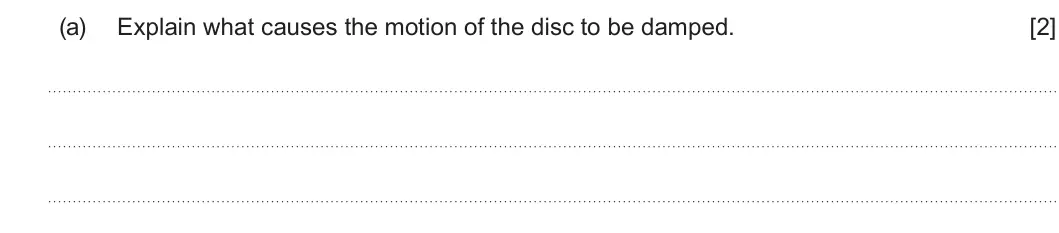
Q6(b)(i)
The whole paper ↗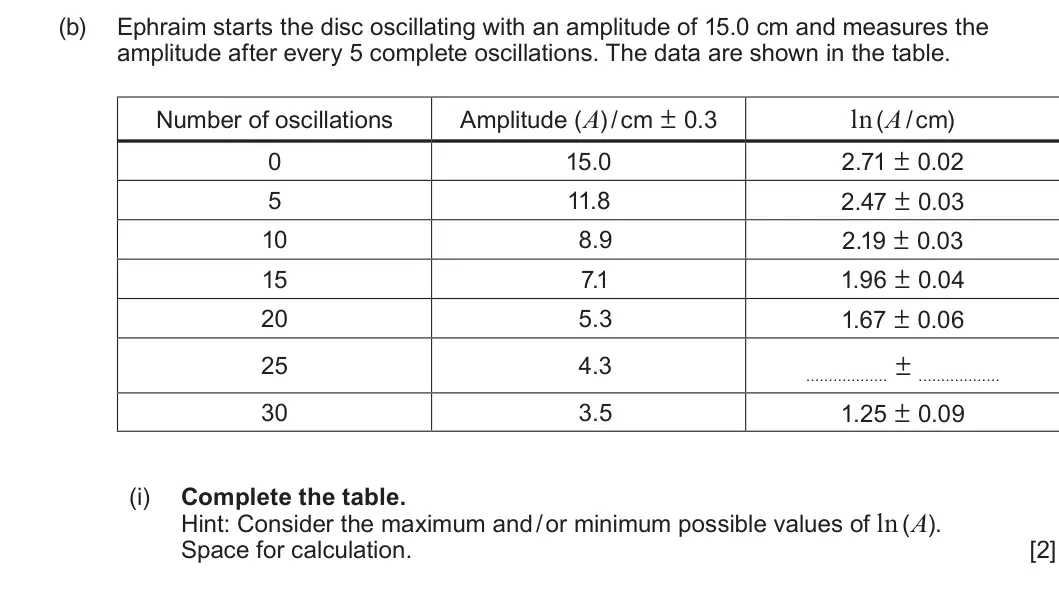
Q6(b)(ii)
The whole paper ↗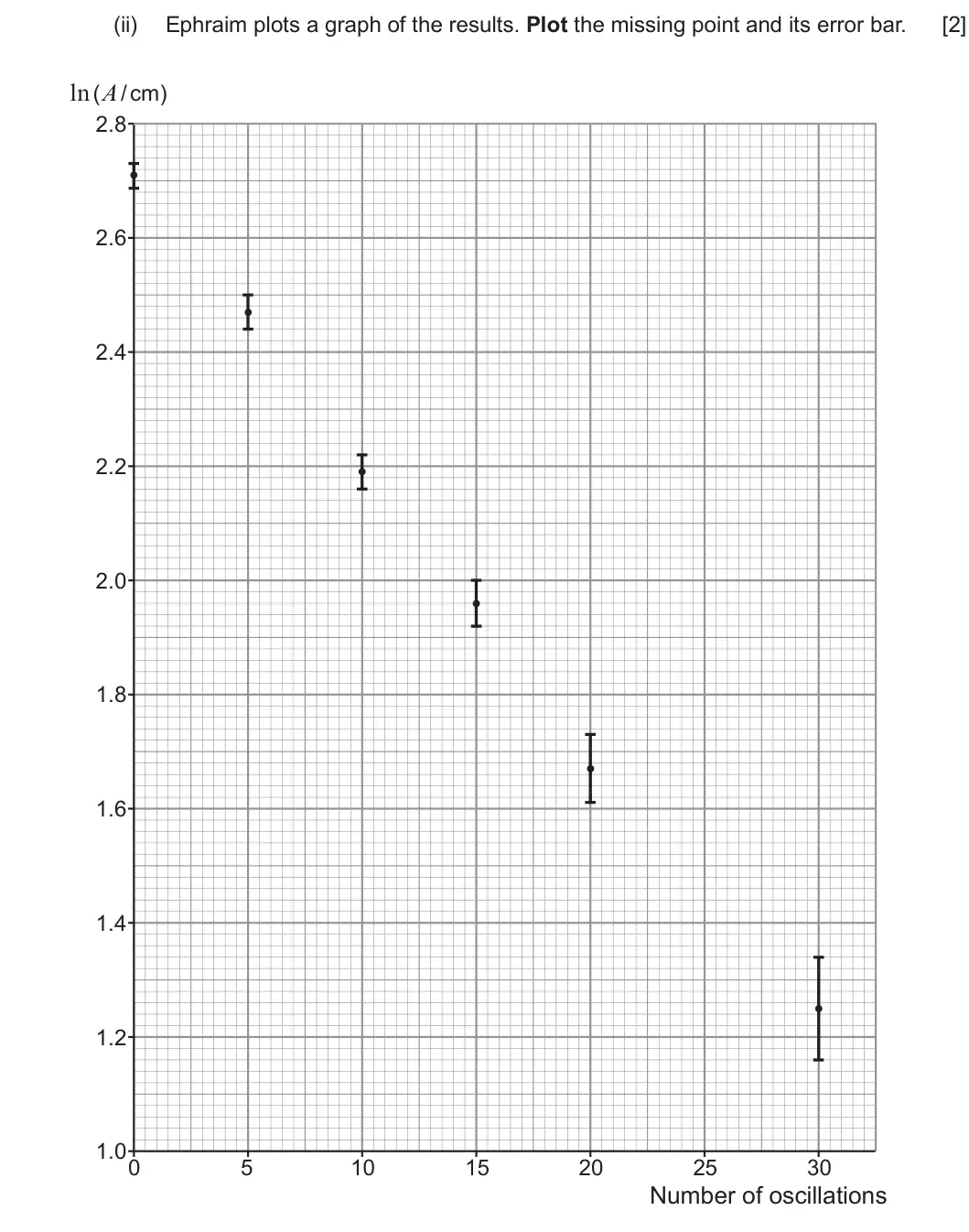
Q6(b)(iii)
The whole paper ↗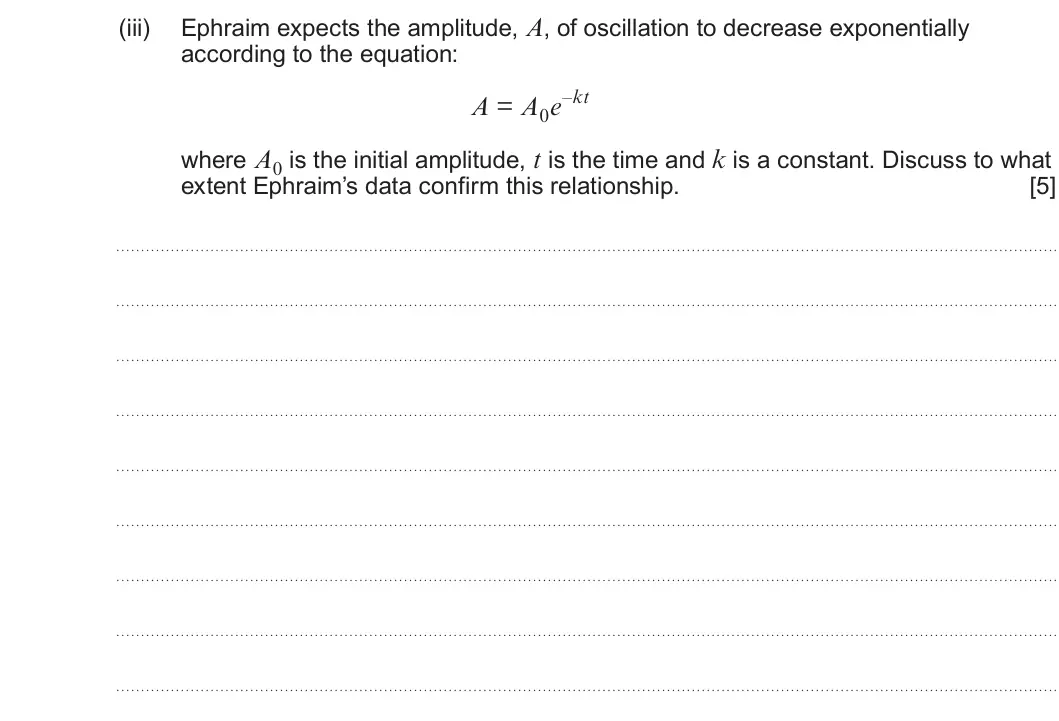
Q4(a)
The whole paper ↗
Q4(b)
The whole paper ↗
Q4(c)
The whole paper ↗
Q4(d)(i)
The whole paper ↗
Q4(d)(ii)
The whole paper ↗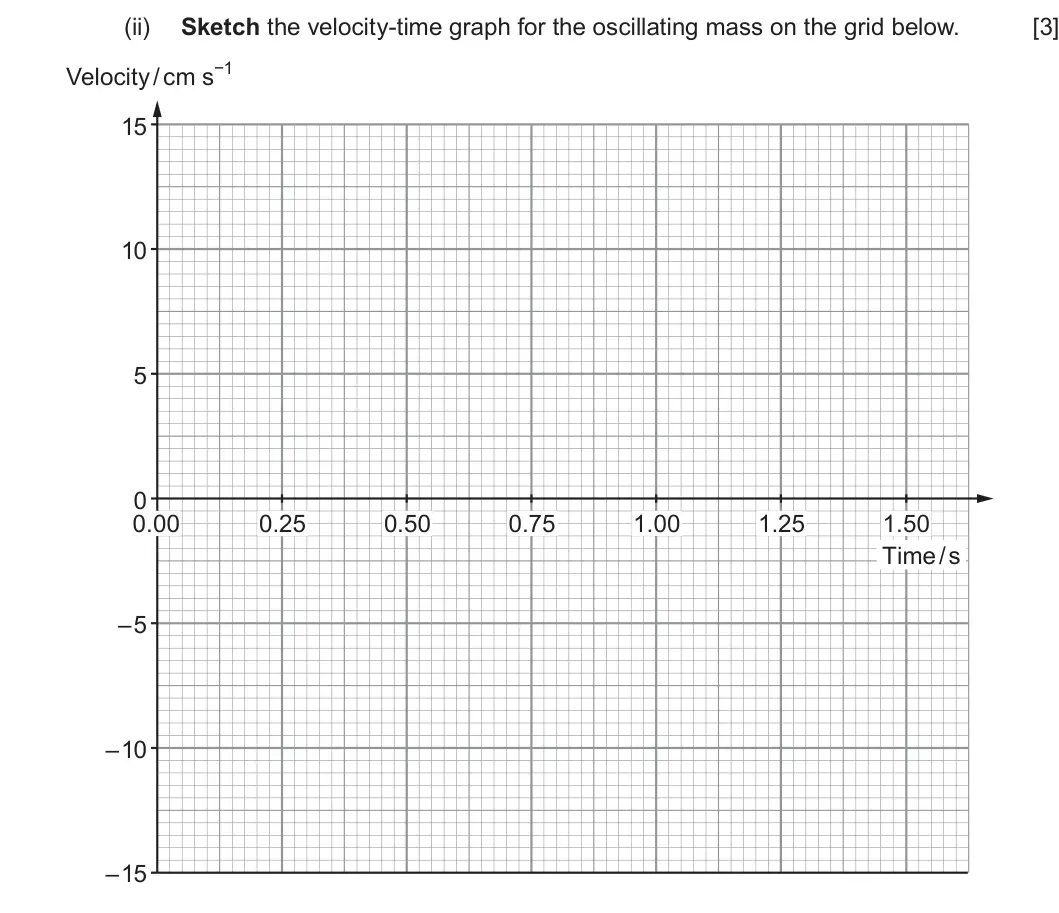
Q4(e)(i)
The whole paper ↗
Q4(e)(ii)
The whole paper ↗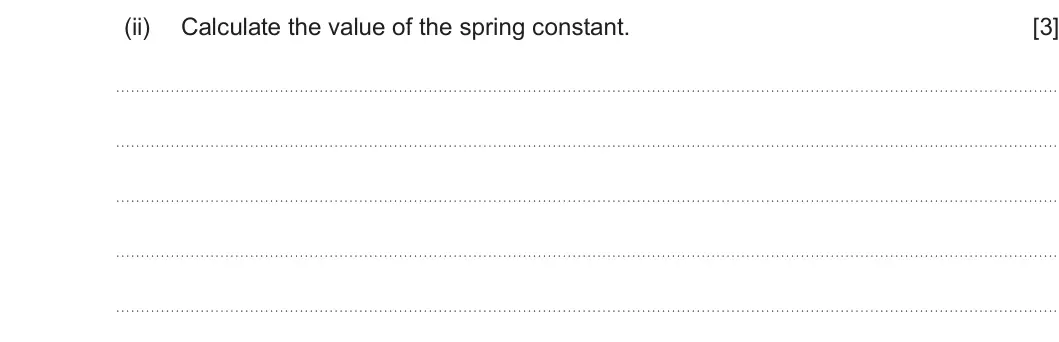
Q4(f)
The whole paper ↗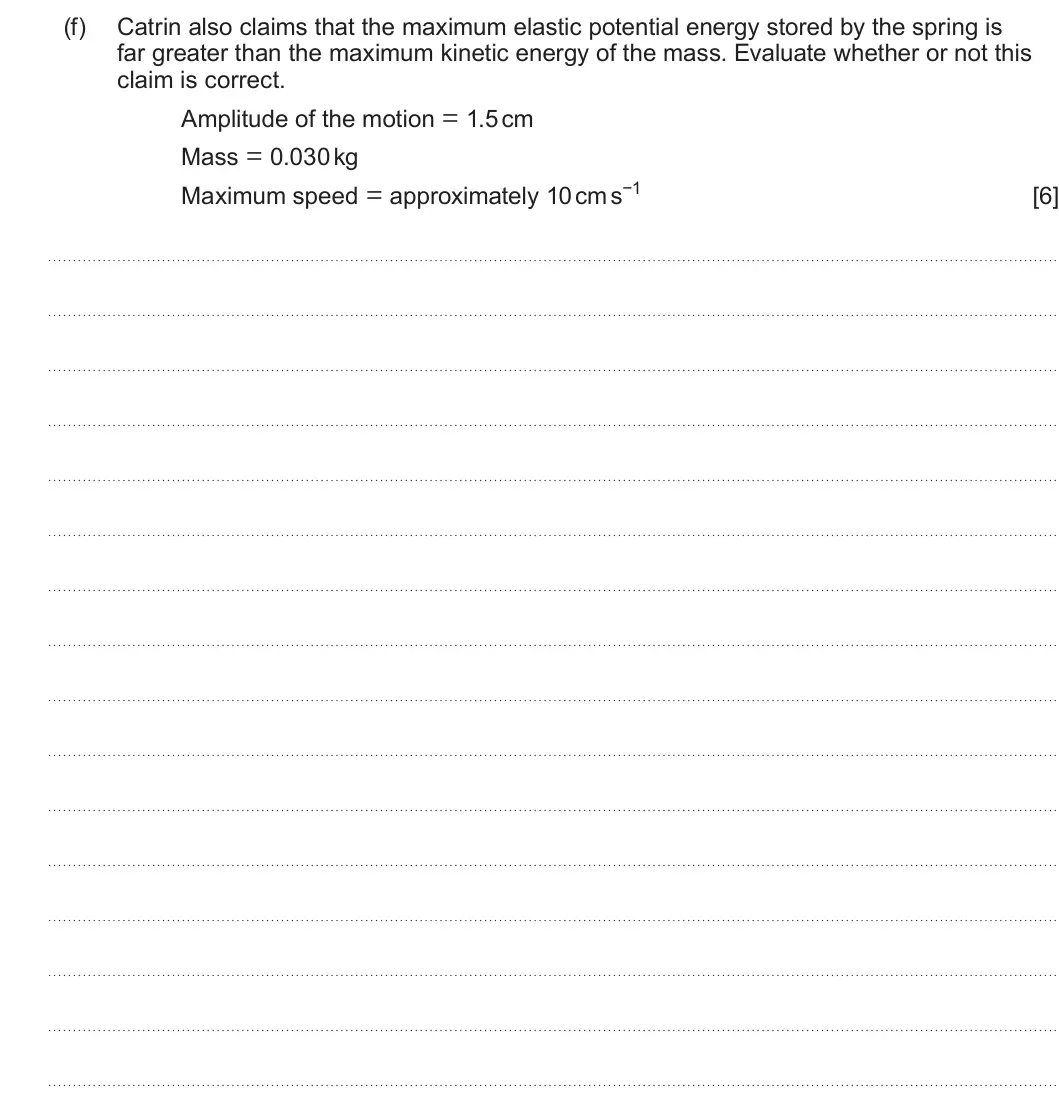
Q5(a)
The whole paper ↗
Q5(b)
The whole paper ↗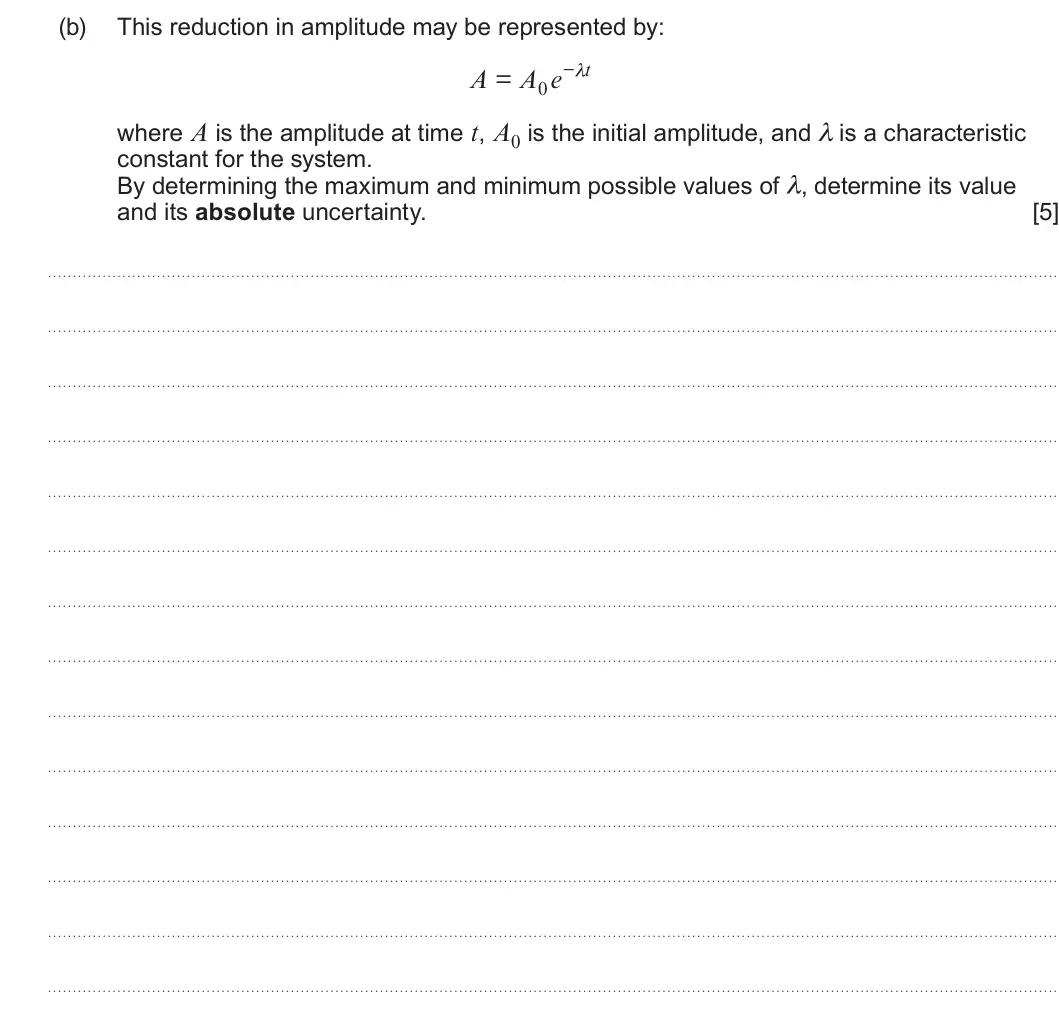
Q5(c)
The whole paper ↗
Q6(a)
The whole paper ↗
Q6(b)
The whole paper ↗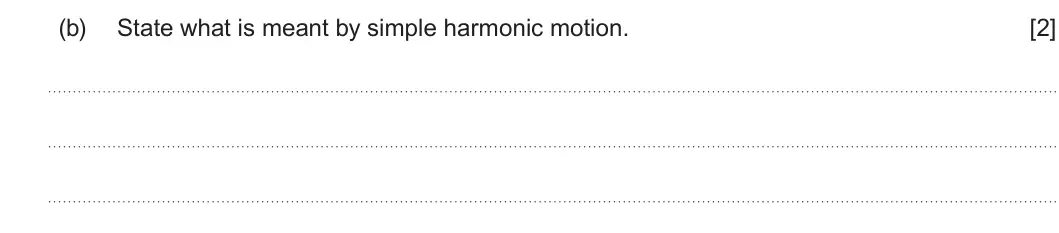
Q6(c)
The whole paper ↗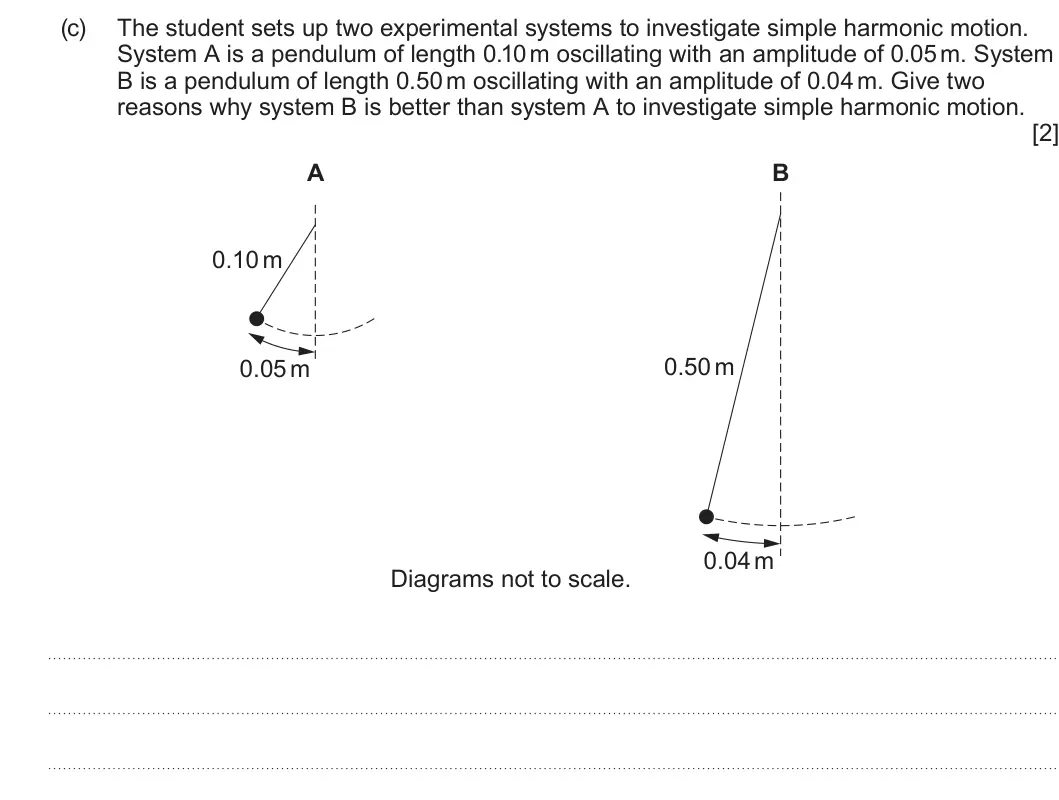
Q6(d)(i)
The whole paper ↗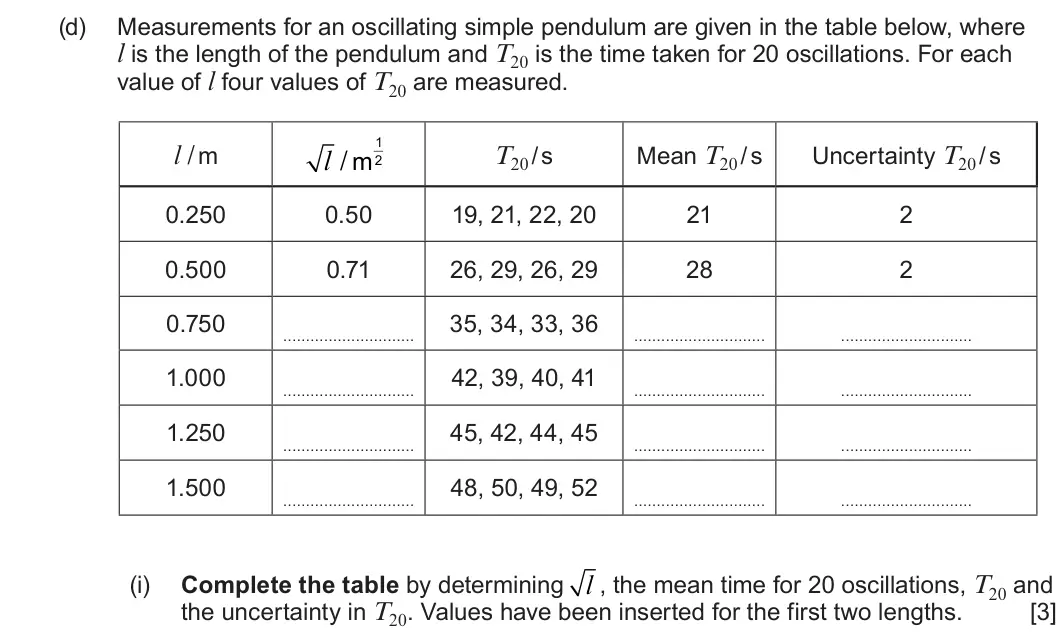
Q6(d)(ii)
The whole paper ↗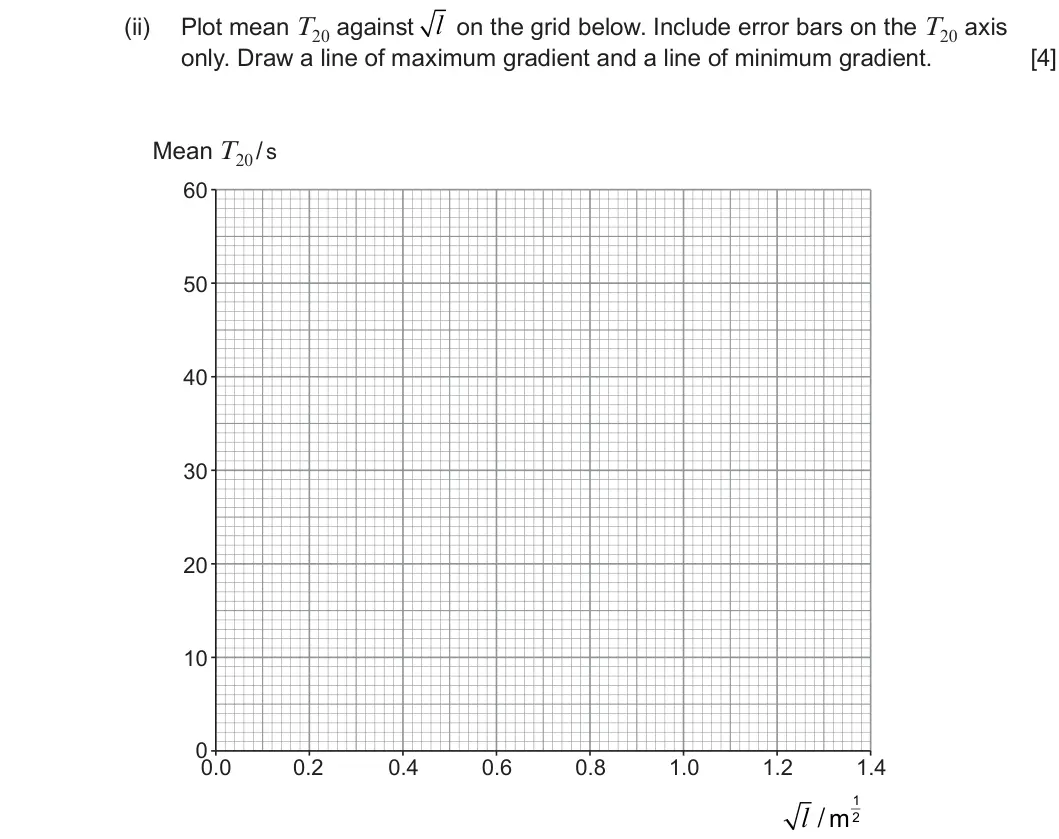
All 59 questions on Vibrations, as a list
- Summer 2025, Unit 3, Q6(a) (2 marks): Explain what causes the motion of the disc to be damped. [2]
- Summer 2025, Unit 3, Q6(b)(i) (2 marks): Complete the table. Hint: Consider the maximum and / or minimum possible values of ln (A). Space for calculation. [2]
- Summer 2025, Unit 3, Q6(b)(ii) (2 marks): Ephraim plots a graph of the results. Plot the missing point and its error bar. [2] ln(A/cm) 2.8 2.6 2.4 2.2 2.0 1.8 1.6 1.4 1.2 1.0 0 5 10 15 20 25 30 Number o
- Summer 2025, Unit 3, Q6(b)(iii) (5 marks): Ephraim expects the amplitude, A, of oscillation to decrease exponentially according to the equation: A = A0e–kt where A0 is the initial amplitude, t is the tim
- Summer 2024, Unit 3, Q4(a) (2 marks): Draw on the grid above the curve of best fit. [2]
- Summer 2024, Unit 3, Q4(b) (2 marks): Explain what is meant by the ‘period of the oscillation’. Use the graph to support your answer. [2]
- Summer 2024, Unit 3, Q4(c) (2 marks): [2] 2 y t 1.5 cos cm
- Summer 2024, Unit 3, Q4(d)(i) (3 marks): By drawing a tangent to the displacement-time curve, show that the maximum velocity of the oscillating mass is approximately 10 cm s−1. [3]
- Summer 2024, Unit 3, Q4(d)(ii) (3 marks): Sketch the velocity-time graph for the oscillating mass on the grid below. [3] Velocity / cm s−1 15 10 5 0 0.00 0.25 0.50 0.75 1.00 1.25 1.50 Time / s –5 –10 –1
- Summer 2024, Unit 3, Q4(e)(i) (2 marks): State what is meant by ‘simple harmonic motion’. [2]
- Summer 2024, Unit 3, Q4(e)(ii) (3 marks): Calculate the value of the spring constant. [3]
- Summer 2024, Unit 3, Q4(f) (6 marks): Catrin also claims that the maximum elastic potential energy stored by the spring is far greater than the maximum kinetic energy of the mass. Evaluate whether o
- Summer 2024, Unit 3, Q5(a) (1 mark): Suggest what causes the decrease in amplitude. [1]
- Summer 2024, Unit 3, Q5(b) (5 marks): This reduction in amplitude may be represented by: A = A0 e−λt where A is the amplitude at time t, A0 is the initial amplitude, and λ is a characteristic consta
- Summer 2024, Unit 3, Q5(c) (1 mark): Give one example of damped motion that occurs in everyday life. [1]
- Summer 2023, Unit 3, Q6(a) (1 mark): Describe what is meant by a simple pendulum. [1]
- Summer 2023, Unit 3, Q6(b) (2 marks): State what is meant by simple harmonic motion. [2]
- Summer 2023, Unit 3, Q6(c) (2 marks): The student sets up two experimental systems to investigate simple harmonic motion. System A is a pendulum of length 0.10 m oscillating with an amplitude of 0.0
- Summer 2023, Unit 3, Q6(d)(i) (3 marks): Complete the table by determining l , the mean time for 20 oscillations, T20 and the uncertainty in T20. Values have been inserted for the first two lengths. [3
- Summer 2023, Unit 3, Q6(d)(ii) (4 marks): only. Draw a line of maximum gradient and a line of minimum gradient. [4] Mean T20/s 60 50 40 30 20 10 0 0.0 0.2 0.4 0.6 0.8 1.0 1.2 1.4 1 l / m 2
- Summer 2023, Unit 3, Q6(d)(iii) (2 marks): Justify why error bars for l are not plotted on the graph. [2]
- Summer 2023, Unit 3, Q6(d)(iv) (5 marks): Use the maximum and minimum gradients to determine a mean value for the acceleration due to gravity, g, and its percentage uncertainty. [5]
- Summer 2023, Unit 3, Q6(e) (3 marks): Another student says that the gradient of the graph would be approximately twice as large if the experiment was carried out on the Moon, where the acceleration
- Summer 2022, Unit 3, Q3(a)(i) (2 marks): Identify the two characteristics of the graph that show that the object is oscillating with simple harmonic motion. [2]
- Summer 2022, Unit 3, Q3(a)(ii) (3 marks): approximately 7.7 rad s–1. [3]
- Summer 2022, Unit 3, Q3(a)(iii) (5 marks): Calculate: I. the period of oscillation; [1] II. the spring constant; [2] III. the velocity of the object as it passes through the centre of oscillation. [2]
- Summer 2022, Unit 3, Q3(a)(iv) (3 marks): The object was released at the displacement of –0.05 m at time t = 0 Sketch on the axes below: I. the potential energy of the system (label the sketch PE), II.
- Summer 2022, Unit 3, Q3(b) (6 marks): Explain what is meant by the terms damping and resonance and discuss their importance in real systems giving an example for each. [6 QER]
- Summer 2019, Unit 3, Q3(a) (1 mark): State what quantities are represented by: [1] a ω x
- Summer 2019, Unit 3, Q3(b)(i) (3 marks): determine the maximum acceleration; [3]
- Summer 2019, Unit 3, Q3(b)(ii) (3 marks): sketch a graph showing the variation of a with x. Insert values on the a-axis. Values are given on the x-axis. [3] a / m s–2 _ 0.012 0.012 x / m
- Summer 2019, Unit 3, Q3(c) (3 marks): The oscillating object in part (b) is at its centre position when t = 0 and moving in the positive x direction. Insert the missing values in the expression for
- Summer 2019, Unit 3, Q3(d)(i) (2 marks): an application of forced oscillations that is useful; [2]
- Summer 2019, Unit 3, Q3(d)(ii) (3 marks): an example of forced oscillations that should be avoided. [3]
- Summer 2019, Unit 3, Q4 (6 marks): Describe an experiment that uses a pendulum to determine the acceleration due to gravity with graphical analysis. [6 QER]
- Summer 2019, Unit 4, Q2(b)(iii) (3 marks): Myfanwy correctly calculates that the force on a 25 tonne spaceship would be negligible at point P and that the force would increase by approximately 0.5 N for
- Summer 2018, Unit 3, Q6(a)(ii) (2 marks): the period of oscillation. [2]
- Summer 2018, Unit 3, Q6(b) (2 marks): The student notices the amplitude of oscillation decreasing and records the following amplitudes. Oscillation number (n) Amplitude (A) /m 0 0.095 10 0.062 20 0.
- Summer 2018, Unit 3, Q6(c)(i) (1 mark): Justify that A0 is the amplitude when n = 0 [1]
- Summer 2018, Unit 3, Q6(c)(ii) (2 marks): By considering the amplitude when n = 30 use the equation to determine a value for N. [2]
- Summer 2018, Unit 3, Q6(d)(i) (1 mark): Complete the third column in the table. The first four rows have already been completed. [1] ⎛ A0 ⎞ Oscillation number (n) Amplitude (A) / m ln ⎝⎜ ⎠⎟ A 0 0.095
- Summer 2018, Unit 3, Q6(d)(ii) (3 marks): Plot ln (y-axis) as a function of the oscillation number (x-axis) and draw a line ⎝⎜ ⎠⎟ A of best fit. [3]
- Summer 2018, Unit 3, Q6(d)(iii) (2 marks): Explain whether or not your graph is in agreement with the equation . A= A0e N [2]
- Summer 2018, Unit 3, Q6(d)(iv) (3 marks): Use the graph to determine a value for N. [3]
- Summer 2018, Unit 3, Q6(d)(v) (1 mark): Explain which of the two values obtained for N is expected to be the more accurate, the value in part (c)(ii) or (d)(iv). [1]
- Summer 2018, Unit 3, Q7(a)(i) (2 marks): [2]
- Summer 2018, Unit 3, Q7(a)(ii) (2 marks): Calculate the maximum speed of the mass. [2]
- Summer 2018, Unit 3, Q7(a)(iii) (2 marks): Show that the kinetic energy (Ek) of the mass, in joules, may be written as: [2] Ek = 3.8 × 10⁻³ sin2 1.57t
- Summer 2018, Unit 3, Q7(a)(iv) (4 marks): The displacement-time curve for the pendulum is shown for a time interval of one period i.e. 4.0 s. Draw curves for velocity, v, and Ek on the axes below for th
- Summer 2018, Unit 3, Q7(a)(v) (2 marks): Determine the maximum height reached by the pendulum mass above the level of its lowest point. [2]
- Summer 2018, Unit 3, Q7(b)(i) (1 mark): Sketch the amplitude of a lightly damped system as the frequency of the driver is increased. The natural frequency f0 of the system is indicated. Label the curv
- Summer 2018, Unit 3, Q7(b)(ii) (1 mark): Name the effect seen near the frequency, f0. [1]
- Summer 2018, Unit 3, Q7(b)(iii) (2 marks): Sketch a second curve on the axes above for an identical oscillating system that is damped to a greater extent. Label the curve as Y. [2] Paragraph This angle i
- Summer 2017, Unit 3, Q6(a)(i) (1 mark): Name the two forces acting on the mass. [1]
- Summer 2017, Unit 3, Q6(a)(ii) (3 marks): By considering these forces show that: resultant force component on the mass along the arc = – mg sinθ You may add to the diagram if you wish. [3]
- Summer 2017, Unit 3, Q6(a)(iii) (2 marks): If the oscillation is small so that sin θg θ show in clear steps that the acceleration along the arc may be written as: [2] gs acceleration = – l
- Summer 2017, Unit 3, Q6(a)(iv) (2 marks): Discuss whether the equation in part (a)(iii) satisfies the definition of simple harmonic motion. [2]
- Summer 2017, Unit 3, Q6(b)(i) (3 marks): Determine its: I. period; [2] II. frequency. [1]
- Summer 2017, Unit 3, Q6(b)(ii) (2 marks): If the maximum displacement angle of the mass is 0.067 rad, justify the use of simple harmonic motion in part (b)(i). [2] Paragraph Although a resonant cavity s
Questions, mark schemes and examiner’s reports are © WJEC CBAC Ltd, from their published past papers. Plumi isn’t affiliated with any exam board. Want whole papers? Every WJEC A-Level Physics paper.
Rather write your answers by hand on iPad? Plumi marks them against the same mark schemes.