 plumi
What is the connection between forces and motion?: OCR GCSE Physics B questions
Every OCR GCSE Physics B exam question on P4.3 What is the connection between forces and motion?, 2018–2025, with its mark scheme and examiner’s report.
Paper
All papers
Exam
All years
Calculations
Q7(b)(ii)
The whole paper ↗
Q7(c)
The whole paper ↗Q9(a)(iii)
The whole paper ↗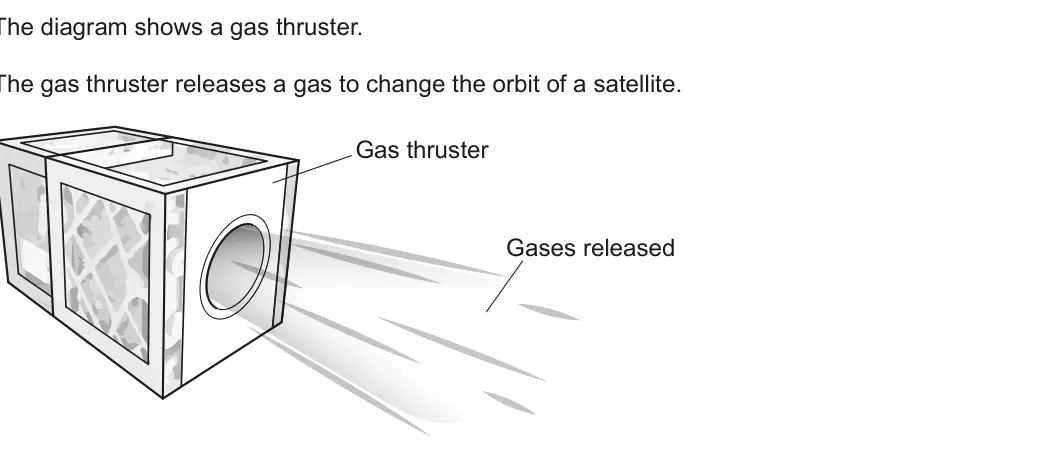
Q9(b)
The whole paper ↗Q8(a)(ii)
The whole paper ↗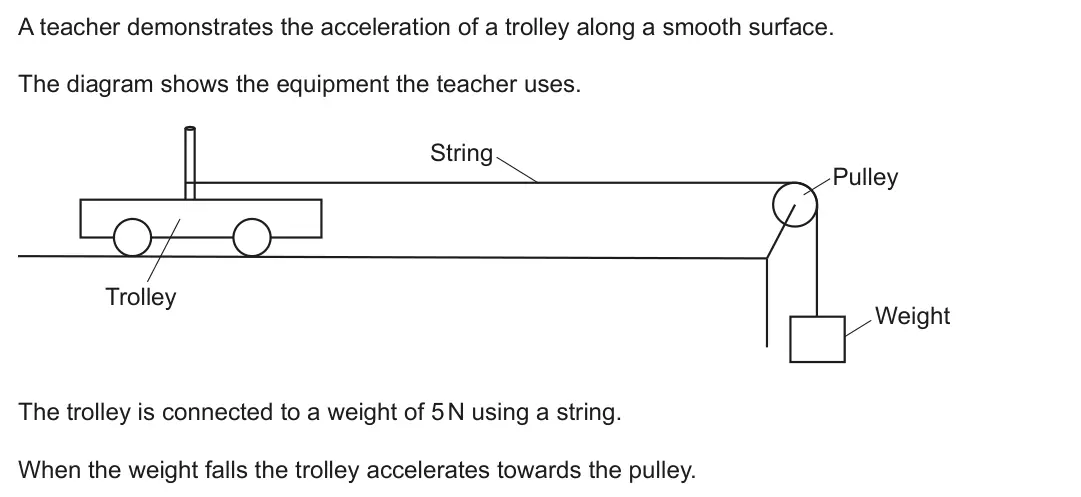
Q8(a)(iii)
The whole paper ↗Q8(b)
The whole paper ↗Q8(c)
The whole paper ↗Q8(a)(ii)
The whole paper ↗
Q8(a)(iii)
The whole paper ↗Q8(b)
The whole paper ↗Q8(a)(i)
The whole paper ↗
Q8(a)(ii)
The whole paper ↗Q7(a)(iii)
The whole paper ↗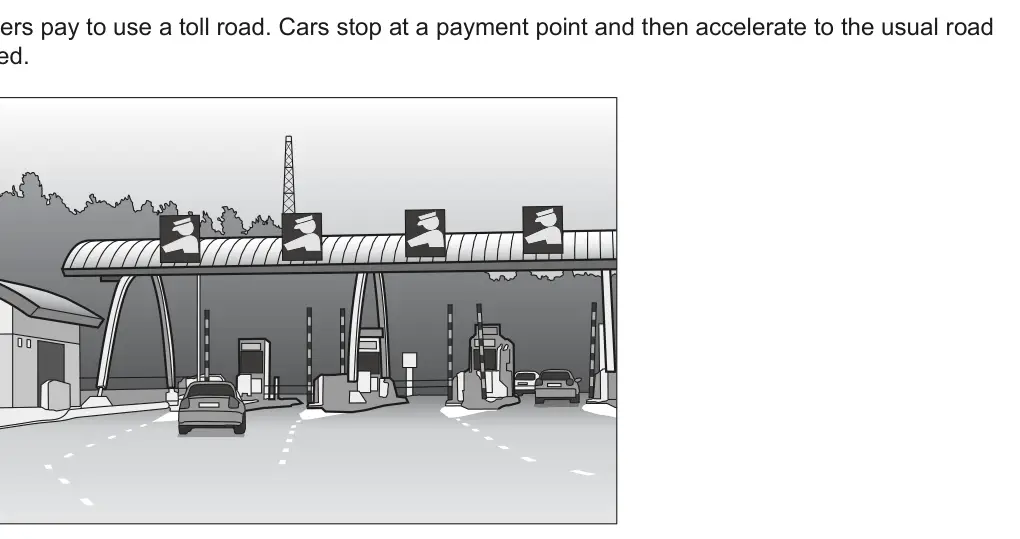
Q7(b)
The whole paper ↗Q8(a)(ii)
The whole paper ↗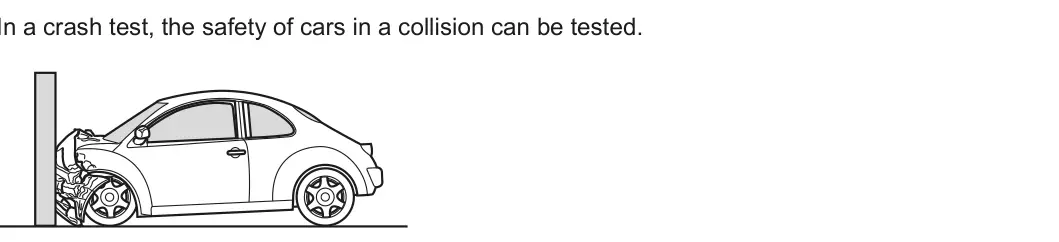
Q8(a)(iii)
The whole paper ↗Q10(b)
The whole paper ↗
Q10(c)
The whole paper ↗
All 88 questions on What is the connection between forces and motion?, as a list
- June 2025, Paper 1 Foundation, Q7(b)(ii) (2 marks): Explain how the thruster ejecting a gas causes the satellite to change speed. Use ideas about forces. [2]
- June 2025, Paper 1 Foundation, Q7(c) (2 marks): The computer on the satellite reports data about the gas molecules leaving the thruster. The table shows the data. Initial speed (m / s) Final speed (m / s) Tim
- June 2025, Paper 3 Higher, Q9(a)(iii) (2 marks): Explain why the satellite is accelerating when it is in a stable circular orbit. [2]
- June 2025, Paper 3 Higher, Q9(b) (3 marks): When the satellite moves to its new orbit its momentum is 9 144 000 kgm / s. Calculate the velocity of the satellite in its new orbit. The mass of the satellite
- June 2025, Paper 4 Higher, Q8(a)(ii) (3 marks): Calculate the change in momentum when the trolley accelerates from 0.5 m / s to 1.2 m / s. Use the Equation Sheet. Change in momentum = kg m / s [3]
- June 2025, Paper 4 Higher, Q8(a)(iii) (4 marks): The accelerating force on the trolley is 5 N. Calculate the time taken for the trolley to increase its velocity from 0.5 m / s to 1.2 m / s. Use: • the Equation
- June 2025, Paper 4 Higher, Q8(b) (3 marks): In reality, frictional forces act on the trolley. The actual time taken for the trolley to accelerate from 0.5 m / s to 1.2 m / s is different to the answer cal
- June 2025, Paper 4 Higher, Q8(c) (2 marks): The teacher repeats the same experiment with a new trolley which has a greater inertial mass than the original trolley. Explain why the statement below is true:
- June 2024, Paper 1 Foundation, Q8(a)(ii) (1 mark): Estimate the mass of a typical family car. Tick (3) one box. 250 kg 1500 kg 5000 kg 20000 kg [1]
- June 2024, Paper 1 Foundation, Q8(a)(iii) (3 marks): Calculate the resultant force on the car. Use: • your answers to parts (a)(i) and (a)(ii) • the Equation Sheet. Resultant force = N [3]
- June 2024, Paper 1 Foundation, Q8(b) (1 mark): After a few minutes the driver needs to perform an emergency stop. Suggest one danger caused by large deceleration. [1]
- June 2024, Paper 2 Foundation, Q8(a)(i) (2 marks): Calculate the braking force. The mass of car A = 1500 kg Use the equation: force = mass × acceleration Braking force = N [2]
- June 2024, Paper 2 Foundation, Q8(a)(ii) (2 marks): A very large mass is added to car A and the test is repeated. The braking force is unchanged. Complete the sentences about the deceleration and the time taken f
- June 2024, Paper 3 Higher, Q7(a)(iii) (3 marks): Calculate the momentum of the car when it reaches a constant speed of 30 m / s. The mass of the car is 950 kg. Use the Equation Sheet. Momentum = kg m / s [3]
- June 2024, Paper 3 Higher, Q7(b) (3 marks): Later in the journey, the car is driving with a momentum of 14 250 kg m / s. The driver brakes sharply and the car comes to a stop in 3 s. Calculate the force t
- June 2024, Paper 4 Higher, Q8(a)(ii) (3 marks): The car has a mass of 1500 kg. Calculate the momentum of the car just before it collides with the barrier. Use the Equation Sheet. Give the correct unit. Moment
- June 2024, Paper 4 Higher, Q8(a)(iii) (4 marks): During the collision the resultant force on the car is 750 000 N. Calculate the time that the resultant force acts. Use the Equation Sheet. Time the resultant f
- June 2023, Paper 2 Foundation, Q5 (6 marks): 5* In an emergency the total distance required for a car to come to a stop depends on the thinking distance and the braking distance. The data in the table show
- June 2023, Paper 2 Foundation, Q10(b) (2 marks): In another head-on crash test, a car with a mass of 1000 kg decelerates at 150 m / s2. Calculate the force needed to produce this deceleration. Use the equation
- June 2023, Paper 2 Foundation, Q10(c) (3 marks): The picture shows what happens to the crumple zone of a car in a controlled head-on crash. Explain how the crumple zone of a car improves safety for the driver
- June 2023, Paper 2 Foundation, Q13(a) (3 marks): Explain how Jamal can make the trolley and aeroplane accelerate more quickly using the same apparatus. [3]
- June 2023, Paper 3 Higher, Q13(b)(ii) (4 marks): The solar probe will reach a speed of 190 km / s, with a momentum of 9.5 × 10⁶ kg m / s. Calculate the mass of the solar probe. Use the Equation Sheet. Mass = k
- June 2023, Paper 4 Higher, Q2(a) (3 marks): Explain how Jamal can make the trolley and aeroplane accelerate more quickly using the same apparatus. [3]
- June 2023, Paper 4 Higher, Q5(a) (2 marks): When the speed doubles, the thinking distance doubles, and the braking distance quadruples. Use this information to complete the table. [2]
- June 2023, Paper 4 Higher, Q5(b) (1 mark): A student concludes that the stopping distance must be at least triple when the speed doubles. Use data from the table to explain why the student is correct. [1
- June 2022, Paper 1 Foundation, Q7(a) (3 marks): The size of force P is 30 N. The distance from the pivot to force P is 6.0 cm. Calculate the moment of the force. Use the equation: moment of a force = force ×
- June 2022, Paper 1 Foundation, Q7(b)(i) (1 mark): The force Q is caused by the metal cylinder pushing against the lever. Which statement describes how to increase Q without increasing P? Tick (✓) one box. Push
- June 2022, Paper 1 Foundation, Q8(a)(ii) (3 marks): Jack’s mass is 60 kg. Calculate Jack’s acceleration. Use information from Fig. 8.2. Use the equation: acceleration = force ÷ mass Acceleration = m / s2 [3]
- June 2022, Paper 1 Foundation, Q8(b) (2 marks): Fig. 8.3 shows the horizontal forces acting on Jack a few moments later. Jack is still running. Air resistance Forwards force from parachute from muscles 250 N
- June 2022, Paper 1 Foundation, Q8(c) (2 marks): Jack wants to buy a new training parachute. He wants a parachute that will give the biggest possible air resistance. The table shows information about three par
- June 2022, Paper 2 Foundation, Q1(a) (2 marks): Complete the missing values in the table. Use the equation: stopping distance = thinking distance + braking distance [2]
- June 2022, Paper 2 Foundation, Q1(b) (4 marks): Different factors affect stopping distance. Draw lines to connect each factor with either thinking distance, braking distance, or both thinking distance and bra
- June 2022, Paper 2 Foundation, Q10(a) (1 mark): In which measurement, A, B, C or D, is the ruler unbalanced? Tick (3) one box A B C D [1]
- June 2022, Paper 2 Foundation, Q10(b) (1 mark): Give one reason for your answer to (a). [1]
- June 2022, Paper 2 Foundation, Q10(c) (4 marks): Amir replaces the load force with an unknown weight, W, and places it 45 cm from the pivot. He finds that the ruler balances when a 6 N effort force is placed 3
- June 2022, Paper 3 Higher, Q9(a)(i) (3 marks): Gear B exerts a 20 N force on Gear A. Calculate the moment of the 20 N force on Gear A. Moment = Nm [3]
- June 2022, Paper 3 Higher, Q9(a)(ii) (2 marks): Gear A also exerts a force on Gear B. Compare the forces and moments acting on Gear A and Gear B. [2]
- June 2022, Paper 3 Higher, Q9(b) (2 marks): Gear C is added, as shown in Fig. 9.2. 30 teeth 20 teeth 15 teeth A B C Fig. 9.2 Gear A rotates 24 times in one minute. How many times does gear C rotate in one
- June 2022, Paper 4 Higher, Q3(a)(ii) (1 mark): What is the magnitude of the total reaction force, R? [1]
- June 2022, Paper 4 Higher, Q3(a)(iii) (1 mark): The driving force is increased to 4500 N and the car accelerates. State the resultant force acting on the car as the car accelerates. [1]
- June 2022, Paper 4 Higher, Q3(b) (3 marks): Explain how the magnitude of the resultant force changes as the car accelerates to its maximum speed. [3]
- November 2021, Paper 1 Foundation, Q8(a)(i) (2 marks): One of the forces acting on the block is friction. This friction force acts to the left, as shown in Fig. 8.1. Describe one other force acting on the block afte
- November 2021, Paper 1 Foundation, Q8(a)(ii) (1 mark): Why does the block slow down when it is released? [1]
- November 2021, Paper 1 Foundation, Q8(c) (2 marks): Sarah wants to do an experiment to investigate how the initial speed of the block affects the distance the block travels before stopping. Suggest how Sarah coul
- November 2021, Paper 1 Foundation, Q10(a) (1 mark): Estimate the total stopping distance of a car travelling at a speed of 45 mph, using the chart. Total stopping distance = thinking distance + braking distance T
- November 2021, Paper 1 Foundation, Q10(b) (2 marks): Some residential areas are reducing their speed limits from 30 mph to 20 mph. Explain why reducing the speed limit improves road safety. Use data from the chart
- November 2021, Paper 1 Foundation, Q10(c) (2 marks): Ben looks at the chart. The braking distance is always much bigger than the thinking distance. Discuss Ben’s statement. Use data from the chart in your answer.
- November 2021, Paper 1 Foundation, Q10(d) (2 marks): Speed is a factor which affects the total stopping distance of a car in an emergency. State one other factor, and explain why it affects the total stopping dist
- November 2021, Paper 1 Foundation, Q12(a) (3 marks): Explain how to use the ruler and the table to measure Alex’s reaction time. You can draw a diagram to support your answer. [3]
- November 2021, Paper 1 Foundation, Q12(b) (1 mark): Suggest why the table does not include values below 12 cm. [1]
- November 2021, Paper 1 Foundation, Q12(c) (2 marks): Sundip wants to use the 30 cm ruler to measure the reaction times of her class. Sundip The 30 cm ruler will not be suitable to measure some students’ reaction t
- November 2021, Paper 2 Foundation, Q9(b)(ii) (2 marks): When the electromagnet picks up the scrap metal the counter weight is moved further away from the pivot. Explain how this prevents the crane from tipping over.
- November 2021, Paper 2 Foundation, Q12 (6 marks): 12* A space company is testing a rocket that may eventually take humans to Mars. The mass of the rocket before lift-off is 1 420 000 kg including the fuel. Duri
- November 2021, Paper 3 Higher, Q1(a) (3 marks): Explain how to use the ruler and the table to measure Alex’s reaction time. You can draw a diagram to support your answer. [3]
- November 2021, Paper 3 Higher, Q1(b) (1 mark): Suggest why the table does not include values below 12 cm. [1]
- November 2021, Paper 3 Higher, Q1(c) (2 marks): Sundip wants to use the 30 cm ruler to measure the reaction times of her class. Sundip The 30 cm ruler will not be suitable to measure some students’ reaction t
- November 2021, Paper 3 Higher, Q7(a) (2 marks): When the van is fully loaded, it has a smaller acceleration because it has a higher inertial mass. Explain what is meant by inertial mass and how it can be calc
- November 2021, Paper 3 Higher, Q7(b)(ii) (2 marks): What does the velocity-time graph show about the resultant force acting on the van in the first 5 seconds of its motion? Use Newton’s second law to explain your
- November 2021, Paper 3 Higher, Q11(a)(ii) (2 marks): Nina comments on the average speed calculated in (a)(i). The calculated speed is the average speed because the speed of the block is changing as it passes throu
- November 2021, Paper 3 Higher, Q11(b) (3 marks): Nina wants to do an experiment to investigate how the mass of the block affects the distance travelled by the block before it stops. Suggest how Nina could do t
- November 2021, Paper 4 Higher, Q2 (6 marks): 2* A space company is testing a rocket that may eventually take humans to Mars. The mass of the rocket before lift-off is 1 420 000 kg including the fuel. Durin
- November 2021, Paper 4 Higher, Q7(a)(i) (3 marks): Calculate the resultant force on the car as it slows from 40 mph to 0 mph. Use the data sheet and the graph. The change in momentum of the car is 21 600 kg m /
- November 2021, Paper 4 Higher, Q7(b)(i) (3 marks): The speed limit on the road outside a school is 15 mph. Explain why reducing the speed of cars is an important factor in reducing injuries on roads. [3]
- November 2021, Paper 4 Higher, Q7(b)(ii) (4 marks): Stopping distance is the sum of the thinking distance and the braking distance. Ben At 40 mph, my store of kinetic energy will be double compared to driving at
- November 2020, Paper 2 Foundation, Q3(a)(i) (1 mark): After falling for a small period of time, balanced forces act on Beth. Describe Beth's movement when these balanced forces act. [1]
- November 2020, Paper 3 Higher, Q4(a) (3 marks): Calculate the momentum of planet 1. Momentum = kg m / s [3]
- November 2020, Paper 3 Higher, Q4(b)(i) (2 marks): Explain why Eve is correct. [2] Kai As the radius of the orbit increases, the speed decreases.
- November 2020, Paper 3 Higher, Q4(b)(ii) (2 marks): Suggest why Kai is correct. [2]
- November 2020, Paper 3 Higher, Q6(b) (4 marks): In the driving test, Jane’s car is moving at a speed of 16 m / s when she is asked to complete an emergency stop. The car comes to a stop in a total time of 2.2
- November 2020, Paper 3 Higher, Q11(b)(ii) (1 mark): What will happen to the metal ring and the elastic ropes at the moment that Alex lets go? [1]
- June 2019, Paper 2 Foundation, Q6(d)(i) (1 mark): Estimate the mass of the van, in kilograms (kg). Mass = kg [1]
- June 2019, Paper 2 Foundation, Q6(d)(ii) (3 marks): Estimate the average force acting on the van. Use your answers from (c) and (d)(i) to answer the question. Force = N [3]
- June 2019, Paper 3 Higher, Q2(a)(i) (1 mark): Add an arrow to Fig 2.1 to show the normal contact force between Jamal and the slide. Label this arrow N. [1]
- June 2019, Paper 3 Higher, Q2(a)(ii) (1 mark): Add an arrow to Fig. 2.1 to show the force of friction between Jamal and the slide. Label this arrow F. [1]
- June 2019, Paper 4 Higher, Q9(a) (2 marks): The Kepler telescope has been used to detect planets around distant stars. It orbits around the Sun in a circular orbit, as shown in Fig. 9.1. orbit Kepler tele
- June 2019, Paper 4 Higher, Q9(c) (4 marks): The Hubble Space Telescope was launched from the surface of the Earth using a reusable rocket (Space Shuttle). Fig. 9.2 shows the typical forces acting on a roc
- June 2019, Paper 4 Higher, Q10(b)(i) (2 marks): Fig. 10.2 shows the momentum against time graph for the van. 20 000 momentum (kg m / s) 10 000 collision collision 0 0 2 4 6 time (s) Fig. 10.2 Use Fig. 10.2 to
- June 2019, Paper 4 Higher, Q10(b)(ii) (3 marks): Calculate the speed of the car immediately after the collision. Use the information given in (b)(i) to help you answer the question. Speed = m / s [3]
- June 2018, Paper 1 Foundation, Q5(a) (3 marks): Mia weighs 200 N. Calculate the moment of Mia’s weight about the centre of the see-saw. Moment = N m [3]
- June 2018, Paper 1 Foundation, Q5(b) (3 marks): Li weighs 250 N. To balance Mia as shown in the diagram, he needs to sit at a distance d from the centre of the see-saw. Calculate the distance d. Distance d =
- June 2018, Paper 3 Higher, Q9(b) (2 marks): The diagram below is a free-body diagram for the tablet resting on the bottom of the glass. Two of the forces acting on the tablet have already been drawn. Draw
- June 2018, Paper 3 Higher, Q11(a) (3 marks): Calculate the moment of the 1.0 kg mass about the pivot, in units of Nm. Use the equation: moment of a force = force × distance (normal to the direction of the
- June 2018, Paper 3 Higher, Q11(b)(i) (1 mark): The measured distances to the pivot are all slightly smaller than the predicted distances to the pivot. Explain why. [1]
- June 2018, Paper 3 Higher, Q11(b)(ii) (1 mark): Suggest one way to improve his experiment to remove this difference. [1]
- June 2018, Paper 3 Higher, Q12(a) (2 marks): Calculate the momentum of trolley A. Momentum = kg m / s [2]
- June 2018, Paper 3 Higher, Q12(b)(i) (4 marks): Show that the velocity of the joined-up trolleys after the collision is about 0.5 m / s. [4]
- June 2018, Paper 3 Higher, Q12(b)(ii) (4 marks): The collision takes a total time of 0.20 s. Calculate the average force acting on trolley A during the collision. Average force = N [4]
- June 2018, Paper 4 Higher, Q6(a) (3 marks): Explain, using ideas of momentum and force, how air molecules exert pressure on the wall. [3]
Questions, mark schemes and examiner’s reports are © OCR, from their published past papers. Plumi isn’t affiliated with any exam board. Want whole papers? Every OCR GCSE Physics B paper.
Rather write your answers by hand on iPad? Plumi marks them against the same mark schemes.