 plumi
How can we describe motion in terms of energy transfers?: OCR GCSE Physics B questions
Every OCR GCSE Physics B exam question on P4.4 How can we describe motion in terms of energy transfers?, 2018–2025, with its mark scheme and examiner’s report.
Paper
All papers
Exam
All years
Calculations
Q7(a)
The whole paper ↗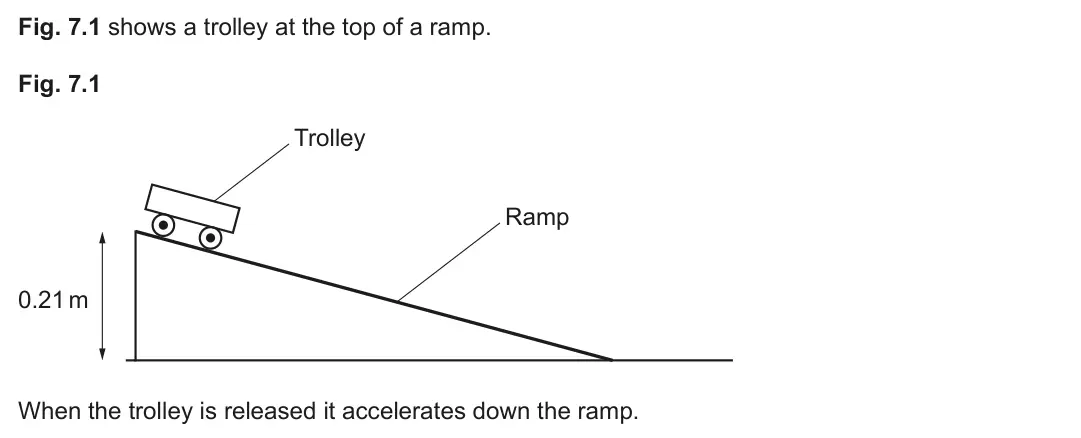
Q7(b)(i)
The whole paper ↗Q7(b)(ii)
The whole paper ↗Q7(c)
The whole paper ↗Q7(d)
The whole paper ↗Q8(a)(i)
The whole paper ↗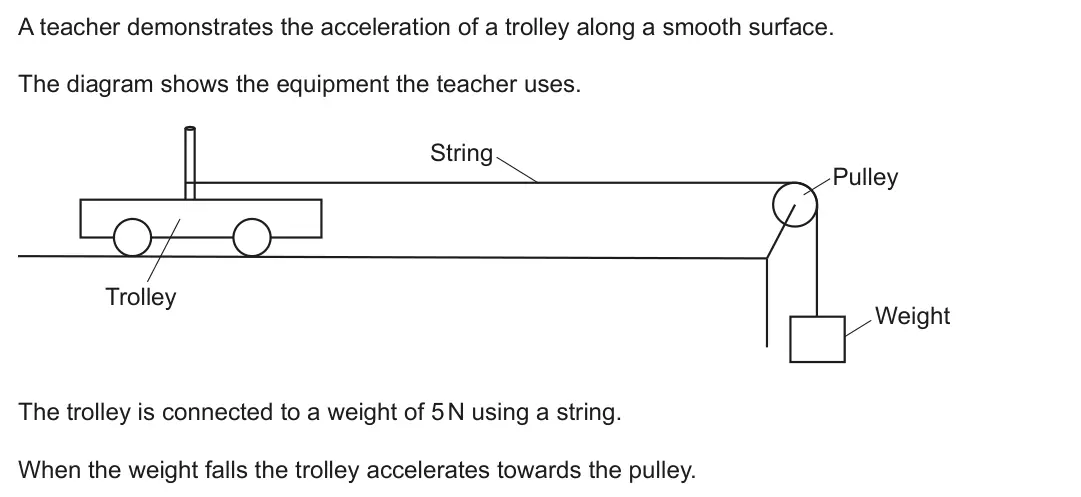
Q3(b)(i)
The whole paper ↗
Q3(b)(ii)
The whole paper ↗Q3(c)
The whole paper ↗Q5(a)
The whole paper ↗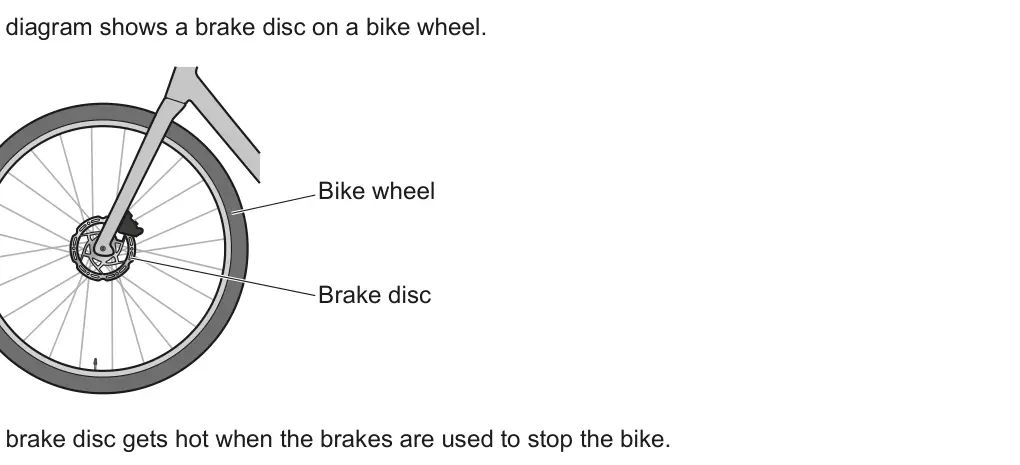
Q3(a)
The whole paper ↗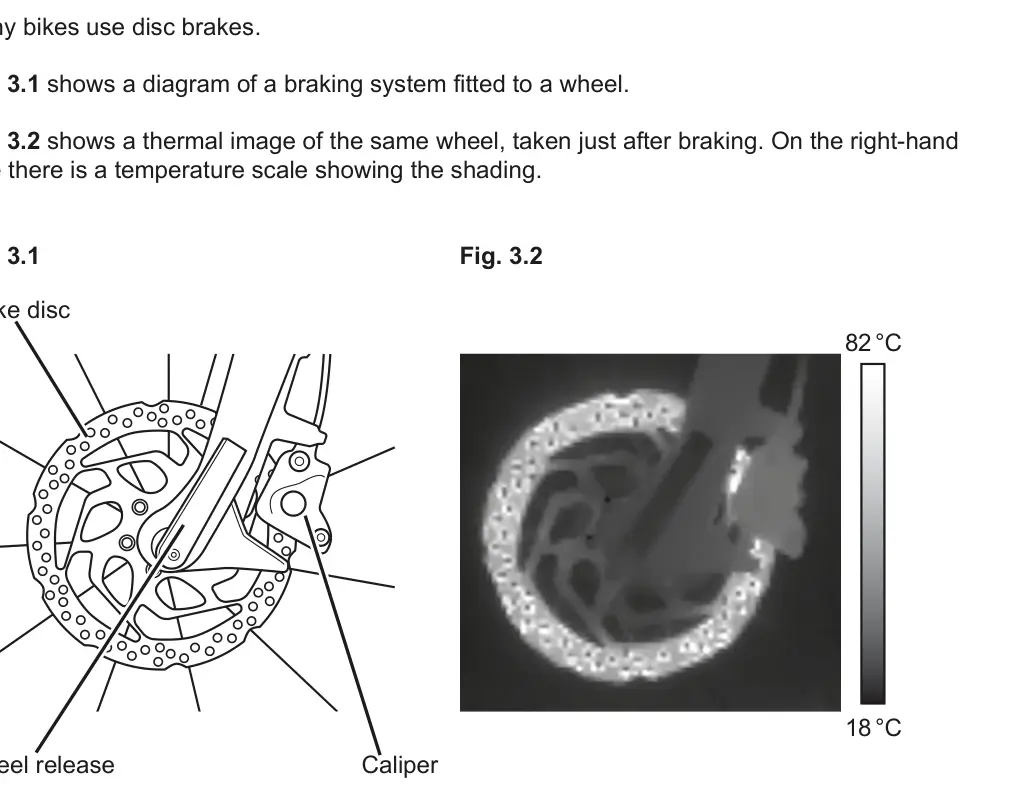
Q3(b)
The whole paper ↗Q3(c)
The whole paper ↗Q6(c)
The whole paper ↗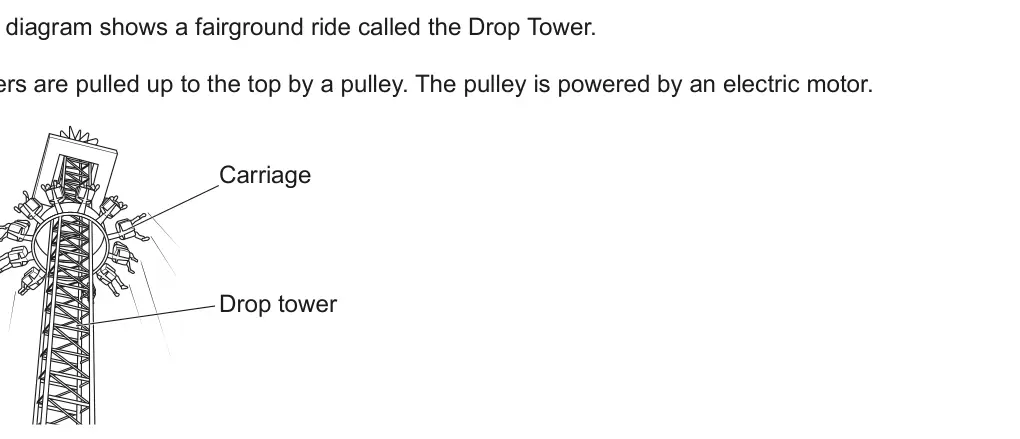
Q8(b)
The whole paper ↗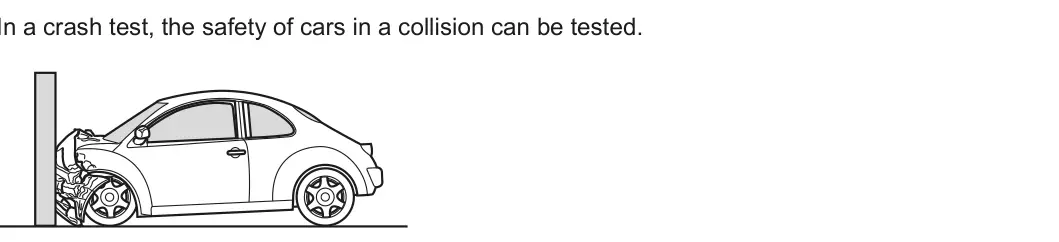
Q6(a)(i)
The whole paper ↗
Q6(b)(i)
The whole paper ↗Q6(b)(ii)
The whole paper ↗Q6(b)(iii)
The whole paper ↗Q13(b)(ii)
The whole paper ↗
All 63 questions on How can we describe motion in terms of energy transfers?, as a list
- June 2025, Paper 2 Foundation, Q7(a) (2 marks): Complete the table to show whether the gravitational potential energy and kinetic energy stores of the trolley increase, decrease or stay the same as the trolle
- June 2025, Paper 2 Foundation, Q7(b)(i) (3 marks): Calculate the gravitational potential energy store of the trolley when it is at a height of 0.21 m. Use the Equation Sheet. Gravitational field strength = 10 N
- June 2025, Paper 2 Foundation, Q7(b)(ii) (4 marks): The trolley reaches a maximum velocity of 1.7 m / s when it travels down the ramp. Calculate the maximum kinetic energy store of the trolley. Use the Equation S
- June 2025, Paper 2 Foundation, Q7(c) (4 marks): A force of 0.8 N acts on the trolley in the same direction that the trolley is accelerating. The trolley travels 1.5 m down the ramp. Calculate the work done on
- June 2025, Paper 2 Foundation, Q7(d) (2 marks): Explain why energy is transferred to the surroundings as the trolley travels down the ramp. [2]
- June 2025, Paper 4 Higher, Q8(a)(i) (3 marks): Calculate the kinetic energy store of the trolley when it has a velocity of 0.5 m / s. Use the Equation Sheet. Kinetic energy store = J [3]
- June 2024, Paper 1 Foundation, Q3(b)(i) (2 marks): Calculate the mean mass of each rider. Mean mass = kg [2]
- June 2024, Paper 1 Foundation, Q3(b)(ii) (1 mark): Calculate the mass of the empty carriage. Mass = kg [1]
- June 2024, Paper 1 Foundation, Q3(c) (2 marks): The carriage and 12 riders are pulled up through a height of 60 m to get to the top of the ride. Calculate the change in gravitational potential energy of the c
- June 2024, Paper 1 Foundation, Q5(a) (2 marks): Complete the sentence to explain why brakes get hot. Use words from the list. chemical elastic gravitational kinetic thermal The brakes transfer energy from the
- June 2024, Paper 3 Higher, Q3(a) (1 mark): Which part of the bike visible in Fig. 3.2 gets hottest during braking? Tick (3) one box. Brake disc Caliper Wheel release [1]
- June 2024, Paper 3 Higher, Q3(b) (2 marks): The brake disc is attached to the wheel. When the brakes are applied, calipers clamp onto the disc to slow it down. Explain how brakes slow a bike down. Use ide
- June 2024, Paper 3 Higher, Q3(c) (2 marks): Complete the sentence to explain why brakes get hot. Use words from the list. chemical elastic gravitational kinetic thermal The brakes transfer energy from the
- June 2024, Paper 3 Higher, Q6(c) (3 marks): The carriage reaches a maximum speed of only 25 m/s because of air resistance. Calculate the total kinetic energy gained by the carriage and the riders between
- June 2024, Paper 4 Higher, Q8(b) (3 marks): Three cars, A, B and C, are tested further. In this test, when the car collides with the barrier, the front of the car crumples and the car rebounds away. Some
- June 2023, Paper 1 Foundation, Q6(a)(i) (3 marks): Calculate the kinetic energy of the ball just after it has been kicked. Use the Equation Sheet. Kinetic energy = J [3]
- June 2023, Paper 1 Foundation, Q6(b)(i) (1 mark): As the ball moves upwards through the air, some work is done to increase the thermal store of the surroundings. State the name of the force doing this work. [1]
- June 2023, Paper 1 Foundation, Q6(b)(ii) (1 mark): State one other energy transfer as the ball moves upwards through the air. [1]
- June 2023, Paper 1 Foundation, Q6(b)(iii) (3 marks): Calculate the work done by a force of 3.5 N when the ball moves a distance of 5.2 m through the air in the direction of the force. Give your answer to 2 signifi
- June 2023, Paper 2 Foundation, Q13(b)(ii) (2 marks): The kinetic energy of the trolley must be at least 1 J for the aeroplane to launch from the trolley. Jamal concludes that the aeroplane can launch from the trol
- June 2023, Paper 3 Higher, Q8(c) (2 marks): Amit kicks a ball which has a weight of 5.2 N into the air. It reaches a maximum vertical distance of 10 m and horizontal distance of 20 m. How can the gravitat
- June 2023, Paper 4 Higher, Q2(b)(ii) (2 marks): The kinetic energy of the trolley must be at least 1 J for the aeroplane to launch from the trolley. Jamal concludes that the aeroplane can launch from the trol
- June 2022, Paper 2 Foundation, Q7(a) (2 marks): Complete the sentences about the change in the energy stores for the test flight of the rocket. Use words from the list. chemical kinetic nuclear thermal electr
- June 2022, Paper 2 Foundation, Q7(b) (1 mark): Describe one energy transfer as the rocket returned to Earth. [1]
- June 2022, Paper 2 Foundation, Q7(c) (3 marks): The rocket reached a maximum height above the surface of the Earth of 12.5 km. The rocket had a mass of 120 000 kg. Calculate its gravitational potential energy
- June 2022, Paper 4 Higher, Q5(a)(i) (2 marks): At the top of the hill, the gravitational potential energy store of Alex and the bicycle has increased by 7600 J. Calculate the height at the top of the hill. U
- June 2022, Paper 4 Higher, Q5(a)(ii) (3 marks): Alex transfers 9000 J of energy to reach the top of the hill. Explain why the amount of energy transferred by Alex is different to the increase in the gravitati
- June 2022, Paper 4 Higher, Q5(b) (3 marks): Alex goes back down the hill without pedalling. Calculate the maximum speed that Alex can reach. Assume that no energy is lost going back down the hill. Use the
- November 2021, Paper 1 Foundation, Q1(a) (2 marks): Calculate the increase in her stored gravitational energy when she climbs a mountain which has a vertical height of 750 m. Her mass is 70 kg. Gravitational fiel
- November 2021, Paper 1 Foundation, Q1(b)(i) (1 mark): What is the useful energy store in Nina’s muscles before she climbs the mountain? Tick (3) one box. Chemical energy store Elastic energy store Electromagnetic e
- November 2021, Paper 1 Foundation, Q1(b)(ii) (2 marks): Nina returns to her starting point at the bottom of the mountain and stops. Which two energy stores have increased when Nina reaches the bottom of the mountain
- November 2021, Paper 1 Foundation, Q7(a) (2 marks): The conveyor system is powered by an electric motor, which is connected to a petrol generator. The petrol used by the generator is a store of chemical energy. D
- November 2021, Paper 1 Foundation, Q7(b) (3 marks): Calculate the work done by the electric motor to lift a brick with a weight of 35 N to the roof. Use the equation: work done = force × distance Give the correct
- November 2021, Paper 3 Higher, Q5(b) (3 marks): The water in the reservoir is a store of gravitational energy. The water falls a vertical distance of 400 m from the reservoir to the turbines, as shown in Fig.
- November 2021, Paper 3 Higher, Q7(b)(iii) (2 marks): After 4.0 seconds the kinetic energy of the van is 40 000 J. Calculate the mass of the van. Use the equation: kinetic energy = 0.5 × mass × (speed)2 Use the gra
- November 2021, Paper 4 Higher, Q7(b)(ii) (4 marks): Stopping distance is the sum of the thinking distance and the braking distance. Ben At 40 mph, my store of kinetic energy will be double compared to driving at
- November 2020, Paper 1 Foundation, Q8(b)(i) (2 marks): Before the spring is released, the spring is a store of elastic energy. Describe how this stored elastic energy changes when the spring is released. [2]
- November 2020, Paper 1 Foundation, Q8(b)(ii) (1 mark): What happens to the total amount of energy in the spring, the ball and the metal tube when the spring is released? [1]
- November 2020, Paper 3 Higher, Q13(b) (3 marks): The energy stored in the compressed spring now is 0.32 J. The mass of the ball is 0.040 kg. Calculate the speed of the ball as it loses contact with the spring.
- November 2020, Paper 3 Higher, Q13(c)(i) (1 mark): Write down the equation linking distance moved, force and work done. • [1]
- November 2020, Paper 3 Higher, Q13(c)(ii) (4 marks): In a third and final test, the kinetic energy of the ball when it leaves the spring is 0.25 J. The same ball is used as the second test, with mass of 0.040kg. T
- June 2019, Paper 1 Foundation, Q10(a)(i) (3 marks): She needs the first water balloon to hit her at a speed of 10 m / s. The first water balloon has a mass of 1.6 kg. Calculate the kinetic energy of this water ba
- June 2019, Paper 1 Foundation, Q10(a)(ii) (3 marks): The second water balloon has a mass of 2.4 kg. When it is released, it has gravitational potential energy of 120 J. Calculate the height from which it is releas
- June 2019, Paper 1 Foundation, Q10(b)(i) (1 mark): What is the name of the energy store before the water balloon is thrown? Tick (3) one box. Chemical store Elastic store Kinetic store Nuclear store [1]
- June 2019, Paper 1 Foundation, Q10(b)(ii) (1 mark): Name the energy store while the water balloon is in the air. Tick (3) one box. Chemical store Elastic store Kinetic store Nuclear store [1]
- June 2019, Paper 1 Foundation, Q10(b)(iii) (7 marks): The graph shows how the impact speed of the balloon depends on the height of the throw. 10 8 6 impact speed (m / s) 4 2 0 0 0.2 0.4 0.6 0.8 1 1.2 1.4 1.6 1.8 2
- June 2019, Paper 1 Foundation, Q10(c)(i) (2 marks): Suggest improvements to the experiment to solve each of these problems. Amir’s problem Nina’s problem [2]
- June 2019, Paper 1 Foundation, Q10(c)(ii) (11 marks): Amir wants to speed up the experiment so it can be repeated more quickly. Suggest one way he can change the experiment so that the ice melts more quickly, witho
- June 2019, Paper 3 Higher, Q10(a) (3 marks): Describe all the changes in the way energy is stored, starting from before Amaya starts to lift the water balloon, and finishing after the water balloon has hit
- June 2019, Paper 3 Higher, Q10(b)(i) (2 marks): Calculate the minimum work that must be done by Amaya to lift the water balloon a height of 5.0 m. Gravitational field strength = 10 N / kg Work done = J [2]
- June 2019, Paper 3 Higher, Q10(b)(ii) (3 marks): Use your answer to (b)(i) to calculate the maximum possible speed of the water balloon when it hits Li. Speed = m / s [3]
- June 2018, Paper 1 Foundation, Q7(d) (3 marks): Ali pulls the spring in diagram B downwards a further 2 cm and then lets go. Ali I did work on the spring when I pulled it downwards. This increases the energy
- June 2018, Paper 2 Foundation, Q6(a)(i) (3 marks): Here are measurements that Alex takes. Mass of trolley = 0.80 kg Height = 0.20 m Assume gravitational field strength = 10 N/kg Calculate the gravitational poten
- June 2018, Paper 2 Foundation, Q6(a)(ii) (2 marks): Alex says that the kinetic energy of the trolley when it leaves the ramp is the same as the gravitational potential energy transferred. Which of the following s
- June 2018, Paper 2 Foundation, Q6(a)(iii) (1 mark): Alex repeats the experiment five times. He measures the distance the trolley travels along the test surface each time. Table 6.1 shows his results. Reading 1 2
- June 2018, Paper 2 Foundation, Q6(b)(i) (1 mark): State the reason why Alex was right to plot a point at the origin, (0,0). [1]
- June 2018, Paper 2 Foundation, Q6(b)(ii) (2 marks): Plot the three remaining points on the graph in Fig. 6.2 and draw an appropriate best fit curve. 2 1.5 mean distance 1 travelled (m) 0.5 0 0 1 2 3 4 initial kin
- June 2018, Paper 2 Foundation, Q6(c) (2 marks): Describe the pattern shown by these results. [2]
- June 2018, Paper 4 Higher, Q5(a)(i) (2 marks): Identify mistakes that Alex has made in his measurements and in his calculation. [2]
- June 2018, Paper 4 Higher, Q5(a)(ii) (3 marks): Describe how Alex should have done this experiment to get a more accurate value for the kinetic energy of the trolley. [3]
- June 2018, Paper 4 Higher, Q5(b)(i) (1 mark): State the reason why Alex was right to plot a point at the origin, (0,0). [1]
- June 2018, Paper 4 Higher, Q5(b)(ii) (2 marks): Plot the three remaining points on the graph in Fig. 5.2 and draw an appropriate best fit curve. 2 1.5 1 mean distance travelled (m) 0.5 0 0 1 2 3 4 5 initial k
- June 2018, Paper 4 Higher, Q5(c) (4 marks): Two of Alex’s friends make comments about the graph in Fig. 5.2. Mia The graph seems to show that the trolley will never go further than about two metres. I don
Questions, mark schemes and examiner’s reports are © OCR, from their published past papers. Plumi isn’t affiliated with any exam board. Want whole papers? Every OCR GCSE Physics B paper.
Rather write your answers by hand on iPad? Plumi marks them against the same mark schemes.