 plumi
How can we describe motion?: OCR GCSE Physics B questions
Every OCR GCSE Physics B exam question on P4.2 How can we describe motion?, 2018–2025, with its mark scheme and examiner’s report.
Paper
All papers
Exam
All years
Calculations
Q8(a)(i)
The whole paper ↗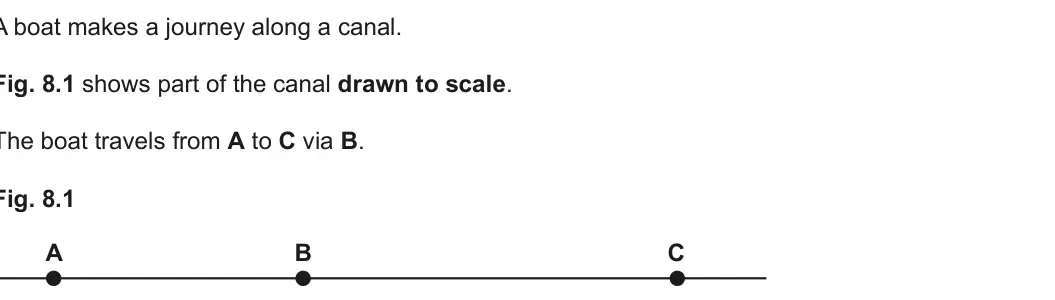
Q8(a)(ii)
The whole paper ↗Q8(b)
The whole paper ↗Q8(c)
The whole paper ↗Q8(d)
The whole paper ↗Q7(e)
The whole paper ↗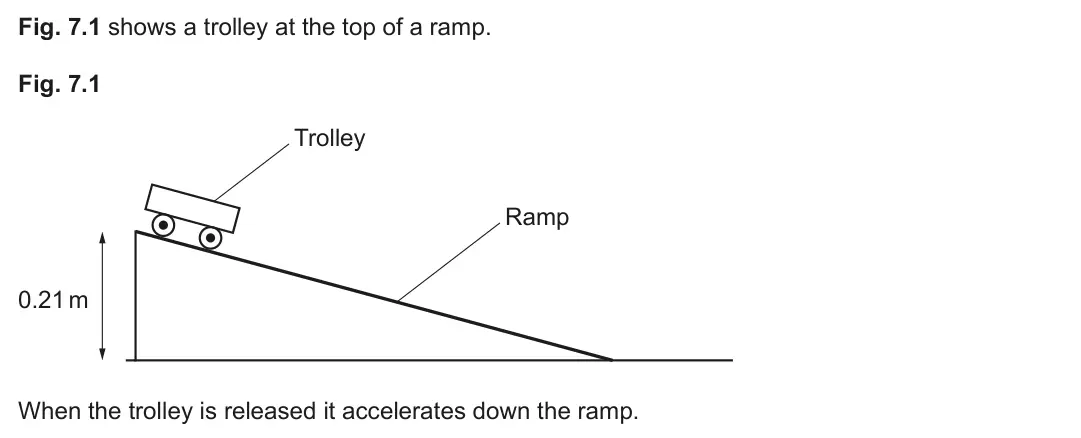
Q1(a)(i)
The whole paper ↗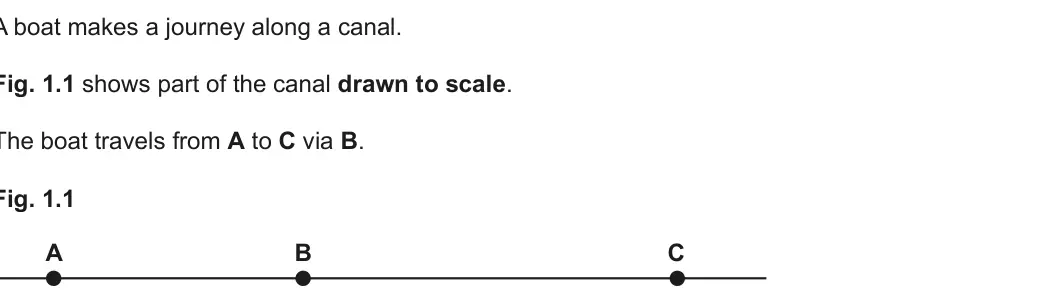
Q1(a)(ii)
The whole paper ↗Q1(b)
The whole paper ↗Q1(c)
The whole paper ↗Q1(d)
The whole paper ↗Q8(a)(i)
The whole paper ↗
Q6(a)(i)
The whole paper ↗Q6(a)(ii)
The whole paper ↗Q6(a)(iii)
The whole paper ↗Q6(b)
The whole paper ↗Q8(b)(i)
The whole paper ↗
Q8(b)(ii)
The whole paper ↗Q6(b)
The whole paper ↗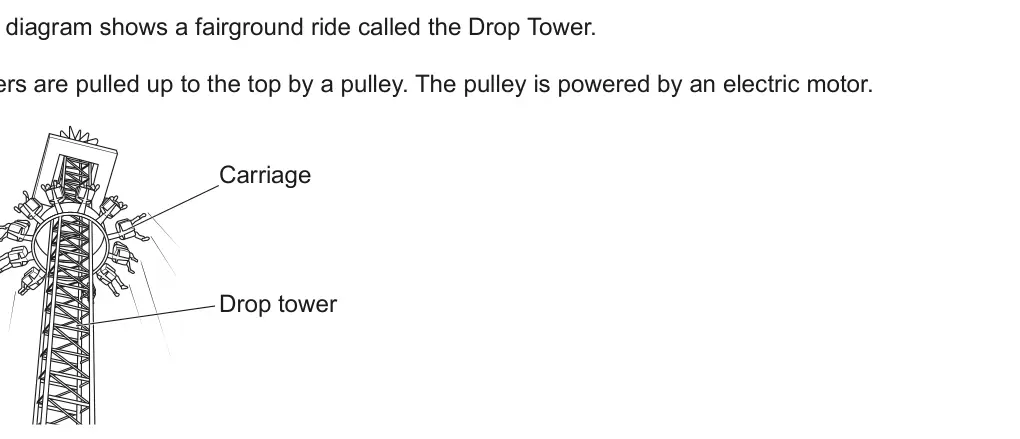
Q7(a)(i)
The whole paper ↗
All 75 questions on How can we describe motion?, as a list
- June 2025, Paper 1 Foundation, Q8(a)(i) (2 marks): Find the distance from A to B. Use: • Fig. 8.1 • a ruler. Distance from A to B = m [2]
- June 2025, Paper 1 Foundation, Q8(a)(ii) (3 marks): When the boat leaves A, the time is 09:23. When the boat reaches B, the time is 09:53. Calculate the average speed of the boat for its journey from A to B. Use
- June 2025, Paper 1 Foundation, Q8(b) (1 mark): The boat sets off from A at constant acceleration and then reaches a constant speed. Which row in the table shows the correct distance-time graph and speed-time
- June 2025, Paper 1 Foundation, Q8(c) (3 marks): Fig. 8.2 shows the speed–time graph for the boat for a short period. Fig. 8.2 1.4 1.2 1 0.8 Speed (m / s) 0.6 0.4 0.2 0 0 1 2 3 4 5 6 7 8 Time (s) Calculate the
- June 2025, Paper 1 Foundation, Q8(d) (1 mark): The boat has a force acting on it from the wind. Which of these is a typical value for the speed of wind? Tick (✓) one box. 0.12 m / s 12 m / s 1200 m / s 120 0
- June 2025, Paper 2 Foundation, Q7(e) (3 marks): A student releases the trolley from rest at the top of the ramp and the trolley travels down the ramp with a constant acceleration. Describe a method to find th
- June 2025, Paper 3 Higher, Q1(a)(i) (2 marks): Find the distance from A to B. Use: • Fig. 1.1 • a ruler. Distance from A to B = m [2]
- June 2025, Paper 3 Higher, Q1(a)(ii) (3 marks): When the boat leaves A, the time is 09:23. When the boat reaches B, the time is 09:53. Calculate the average speed of the boat for its journey from A to B. Use
- June 2025, Paper 3 Higher, Q1(b) (1 mark): The boat sets off from A at constant acceleration and then reaches a constant speed. Which row in the table shows the correct distance-time graph and speed-time
- June 2025, Paper 3 Higher, Q1(c) (3 marks): Fig. 1.2 shows the speed–time graph for the boat for a short period. Fig. 1.2 1.4 1.2 1 0.8 Speed (m / s) 0.6 0.4 0.2 0 0 1 2 3 4 5 6 7 8 Time (s) Calculate the
- June 2025, Paper 3 Higher, Q1(d) (1 mark): The boat has a force acting on it from the wind. Which of these is a typical value for the speed of wind? Tick (✓) one box. 0.12 m / s 12 m / s 1200 m / s 120 0
- June 2024, Paper 1 Foundation, Q8(a)(i) (2 marks): Calculate the car’s acceleration. Use the equation: acceleration = change in speed time taken Acceleration = m / s2 [2]
- June 2024, Paper 2 Foundation, Q6(a)(i) (1 mark): Describe the motion of the car between B and C. [1]
- June 2024, Paper 2 Foundation, Q6(a)(ii) (3 marks): Calculate the acceleration of the car between C and D. Use the equation: acceleration = change in speed time taken Acceleration between C and D = m / s2 [3]
- June 2024, Paper 2 Foundation, Q6(a)(iii) (3 marks): The car also accelerates between A and B. Compare the acceleration of the car between A and B with the acceleration of the car between C and D. Use the graph. [
- June 2024, Paper 2 Foundation, Q6(b) (3 marks): Zayn owns an electric car. He completes a journey of 410 km. It takes 4 hours 30 minutes. Calculate the average speed of the journey. Use the Equation Sheet. Av
- June 2024, Paper 2 Foundation, Q8(b)(i) (2 marks): Calculate the deceleration of car B as its speed reduces from 14 m / s to 0 m / s. Use the equation: acceleration = change in speed time taken Deceleration = m
- June 2024, Paper 2 Foundation, Q8(b)(ii) (1 mark): Find the time taken to stop for car C. Time taken to stop = s [1]
- June 2024, Paper 3 Higher, Q6(b) (4 marks): The ride drops from rest at the top of the tower. The carriage falls under freefall for 40 m before the brakes are applied. Calculate the maximum possible speed
- June 2024, Paper 3 Higher, Q7(a)(i) (3 marks): Calculate the acceleration of the car between 0 and 12 s. Use data from the graph. Acceleration = m / s2 [3]
- June 2024, Paper 3 Higher, Q7(a)(ii) (1 mark): Which feature of the graph will give the distance the car has travelled? Tick (3) one box. Area between the line and the x-axis Area between the line and the y-
- June 2024, Paper 4 Higher, Q5(a)(i) (2 marks): Describe the motion of the car for the first 200 s. [2]
- June 2024, Paper 4 Higher, Q5(a)(ii) (3 marks): Calculate the deceleration of the car between 200 and 250 seconds. Use the Equation Sheet. Deceleration = m / s2 [3]
- June 2024, Paper 4 Higher, Q5(a)(iii) (2 marks): Calculate the distance travelled between 0 and 25 seconds. Distance travelled = m [2]
- June 2024, Paper 4 Higher, Q8(a)(i) (1 mark): Momentum is a vector quantity. Describe what is meant by a vector quantity. [1]
- June 2023, Paper 1 Foundation, Q6(a)(ii) (2 marks): Convert 20 m / s into km / h. 1 km = 1000 m 1 hour = 3600 seconds 20 m / s = km / h [2]
- June 2023, Paper 1 Foundation, Q6(c) (1 mark): The ball’s velocity decreases as it goes upwards. It reaches a maximum height and then its velocity increases as it falls downwards. State the velocity of the b
- June 2023, Paper 1 Foundation, Q7(c)(i) (1 mark): Select one equation from the Equation Sheet which can be used to find the distance the balloon travels, using the variables given. [1]
- June 2023, Paper 1 Foundation, Q7(c)(ii) (1 mark): How can you calculate the distance the balloon travels? Put a ring around the correct calculation. distance = (2 × 0.5) distance = 22 – 02 – (2 × 0.5) (2 – 0) d
- June 2023, Paper 1 Foundation, Q12(a) (2 marks): The trolley is released and accelerates down the ramp. When the trolley passes through the light gate, the instantaneous speed of the trolley is displayed. Desc
- June 2023, Paper 2 Foundation, Q9(a) (1 mark): State Charlie’s maximum speed. Maximum speed = m / s [1]
- June 2023, Paper 2 Foundation, Q9(b) (1 mark): State the time into the race that Charlie reaches a speed of 2 m / s. Time = s [1]
- June 2023, Paper 2 Foundation, Q9(c) (2 marks): Calculate Charlie’s acceleration in the first 3 s. Acceleration = m / s2 [2]
- June 2023, Paper 2 Foundation, Q9(d) (2 marks): In another race, Charlie starts with a greater acceleration and reaches the same maximum speed. Sketch a line on the speed–time graph to show how Charlie’s spee
- June 2023, Paper 2 Foundation, Q10(a) (2 marks): NCAP tests a car travelling at 25 m / s in a head-on crash. The car comes to a stop in 0.1 s. Calculate the deceleration of the car. Use the equation: accelerat
- June 2023, Paper 2 Foundation, Q13(c) (3 marks): Jamal investigates using a ramp instead of a spring to launch the aeroplane. Model aeroplane Trolley Ramp Jamal releases the trolley and the trolley accelerates
- June 2023, Paper 3 Higher, Q3(a) (2 marks): The trolley is released and accelerates down the ramp. When the trolley passes through the light gate, the instantaneous speed of the trolley is displayed. Desc
- June 2023, Paper 4 Higher, Q2(c) (3 marks): Jamal investigates using a ramp instead of a spring to launch the aeroplane. Model aeroplane Trolley Ramp Jamal releases the trolley and the trolley accelerates
- June 2023, Paper 4 Higher, Q5(c) (2 marks): Convert 40 miles per hour to m / s. 1 mile = 1609 m. 40 miles per hour = m / s [2]
- June 2023, Paper 4 Higher, Q5(d) (1 mark): Estimate the typical speed of a cyclist in m / s. m / s [1]
- June 2022, Paper 1 Foundation, Q12(a) (2 marks): Jamal hits the ball and runs along the path from Y to Z shown in Fig. 12.1. Sara The distance travelled by Jamal is different to his displacement. Explain why S
- June 2022, Paper 1 Foundation, Q12(b)(i) (1 mark): Which is the better estimate? Explain your answer. Tick (✓) one box. Sara Jack [1]
- June 2022, Paper 1 Foundation, Q12(b)(ii) (3 marks): Use either estimate to calculate Jamal’s acceleration. Use the Data Sheet. Acceleration = m / s2 [3]
- June 2022, Paper 3 Higher, Q2(a) (2 marks): Jamal hits the ball and runs along the path from Y to Z shown in Fig. 2.1. Sara The distance travelled by Jamal is different to his displacement. Explain why Sa
- June 2022, Paper 3 Higher, Q2(b)(i) (1 mark): Which is the better estimate? Explain your answer. Tick (✓) one box. Sara Jack [1]
- June 2022, Paper 3 Higher, Q2(b)(ii) (3 marks): Use either estimate to calculate Jamal’s acceleration. Use the Data Sheet. Acceleration = m / s2 [3]
- November 2021, Paper 1 Foundation, Q8(b) (3 marks): To measure the speed of the block, Sarah uses a light gate, as shown in Fig. 8.2. 15 cm Direction of motion Block Light gate Timer Table Fig. 8.2 The light gate
- November 2021, Paper 2 Foundation, Q3(a) (3 marks): It takes him 125 seconds to complete one lap of the track. Calculate Jamal’s average speed for the lap. Average Speed = m / s [3]
- November 2021, Paper 2 Foundation, Q3(b) (1 mark): Distance is a scalar quantity. Which statement defines a scalar quantity? Tick (✓) one box. It has both size and direction. It has direction but not size. It ha
- November 2021, Paper 3 Higher, Q7(b)(i) (3 marks): Calculate the acceleration of the van during the first 5 seconds of its motion. Acceleration = m / s2 [3]
- November 2021, Paper 3 Higher, Q11(a)(i) (3 marks): Calculate the average speed of the block as it passes through the light gate. Average speed = m / s [3]
- November 2021, Paper 4 Higher, Q7(a)(ii) (3 marks): The obstacle is 30.0 m away when Ben puts his foot on the brakes. Determine if the car hits the obstacle. Use the graph. 40 mph = 18 m / s [3]
- November 2020, Paper 2 Foundation, Q3(c)(i) (1 mark): Give one other example of a vector quantity. [1]
- November 2020, Paper 2 Foundation, Q3(c)(ii) (1 mark): What is the difference between a vector quantity and a scalar quantity? [1]
- November 2020, Paper 2 Foundation, Q9(a)(i) (1 mark): How many times during the journey was the bus stationary? [1]
- November 2020, Paper 2 Foundation, Q9(a)(ii) (1 mark): How does the graph show that the bus was slower between 15–30 minutes than 35–45 minutes? [1]
- November 2020, Paper 2 Foundation, Q9(b) (2 marks): Calculate the average speed of the bus between 35 and 45 minutes. Use the equation: distance = speed × time Show your working on the graph. Average speed = km /
- November 2020, Paper 3 Higher, Q6(a) (4 marks): In a driving lesson, Jane’s car is moving at 25 mph when she is asked to stop. The car comes to a stop in a total time of 2.5 s. Calculate the deceleration of t
- November 2020, Paper 4 Higher, Q8 (6 marks): 8* Layla is training for a long distance race. She follows two different training sessions in preparation for running the race, and collects some information on
- June 2019, Paper 2 Foundation, Q6(a) (3 marks): The distance against time graph of one van travelling along a straight road is shown in Fig. 6.1. A B C distance 0 time 0 Fig. 6.1 Fig. 6.1 has been divided int
- June 2019, Paper 2 Foundation, Q6(b)(i) (2 marks): Identify which section shows the van speeding up. Explain your answer. Section: Explanation: [2]
- June 2019, Paper 2 Foundation, Q6(b)(ii) (2 marks): Identify which section shows the van slowing down. Explain your answer. Section: Explanation: [2]
- June 2019, Paper 2 Foundation, Q6(c) (3 marks): Data from the GPS tracker device can be used to calculate a van’s average acceleration over the entire journey: • initial speed = 8.5 m / s • final speed = 36.5
- June 2019, Paper 3 Higher, Q8(b)(ii) (4 marks): Calculate the time taken, in minutes, for the cloud of gas to reach the Earth. Time taken = minutes [4]
- June 2019, Paper 4 Higher, Q10(a)(i) (3 marks): Describe the motion of the van in the three sections. Section A: Section B: Section C: [3]
- June 2019, Paper 4 Higher, Q10(a)(ii) (3 marks): Calculate the acceleration of the van in section C. Acceleration = m / s2 [3]
- June 2018, Paper 1 Foundation, Q3(a) (1 mark): Alex usually walks to school. Which is the most likely speed at which Alex walks? Put a ring around the correct answer. 0.12 m/s 1.2 m/s 12 m/s 120 m/s [1]
- June 2018, Paper 1 Foundation, Q3(b) (1 mark): He could travel by car. A car travels at 36 km/h (kilometres per hour). Which is the correct calculation to work out this speed in m/s (metres per second)? Put
- June 2018, Paper 1 Foundation, Q3(c)(i) (2 marks): Put a tick (3) in the one correct box in each row. A B C D In which section does Alex have an average speed of 3.5 m/s? In which section does Alex slow down? [2
- June 2018, Paper 1 Foundation, Q3(c)(ii) (3 marks): Calculate the acceleration in section A of the journey. Use the equation: acceleration = change in speed ÷ time Acceleration = m/s2 [3]
- June 2018, Paper 2 Foundation, Q5(c) (4 marks): Watney sets off on his journey to the rocket. He drives for 4 hours at a steady speed of 25 km/hour. He then stops to let the battery re-charge for 10 hours. Co
- June 2018, Paper 3 Higher, Q4(a) (2 marks): The maximum speed of a racing car is 320 km / hour. Calculate this speed in metres per second. Maximum speed = m / s [2]
- June 2018, Paper 3 Higher, Q4(b)(i) (3 marks): A different racing car is moving with a speed of 80 m / s. Before turning a corner, it slows down to a speed of 20 m / s. While slowing down, it has a constant
- June 2018, Paper 3 Higher, Q4(b)(ii) (2 marks): The car moves at a constant speed around the corner. Explain why its velocity is changing as it moves around the corner. [2]
- June 2018, Paper 4 Higher, Q3(b)(i) (4 marks): Use these data to calculate the smallest number of days it would take to drive to his destination. Number of days = days [4]
Questions, mark schemes and examiner’s reports are © OCR, from their published past papers. Plumi isn’t affiliated with any exam board. Want whole papers? Every OCR GCSE Physics B paper.
Rather write your answers by hand on iPad? Plumi marks them against the same mark schemes.