 plumi
What happens during cellular respiration?: OCR GCSE Combined Science B questions
Every OCR GCSE Combined Science B exam question on B4.1 What happens during cellular respiration?, 2018–2025, with its mark scheme and examiner’s report.
Paper
All papers
Exam
All years
Calculations
Q9(a)
The whole paper ↗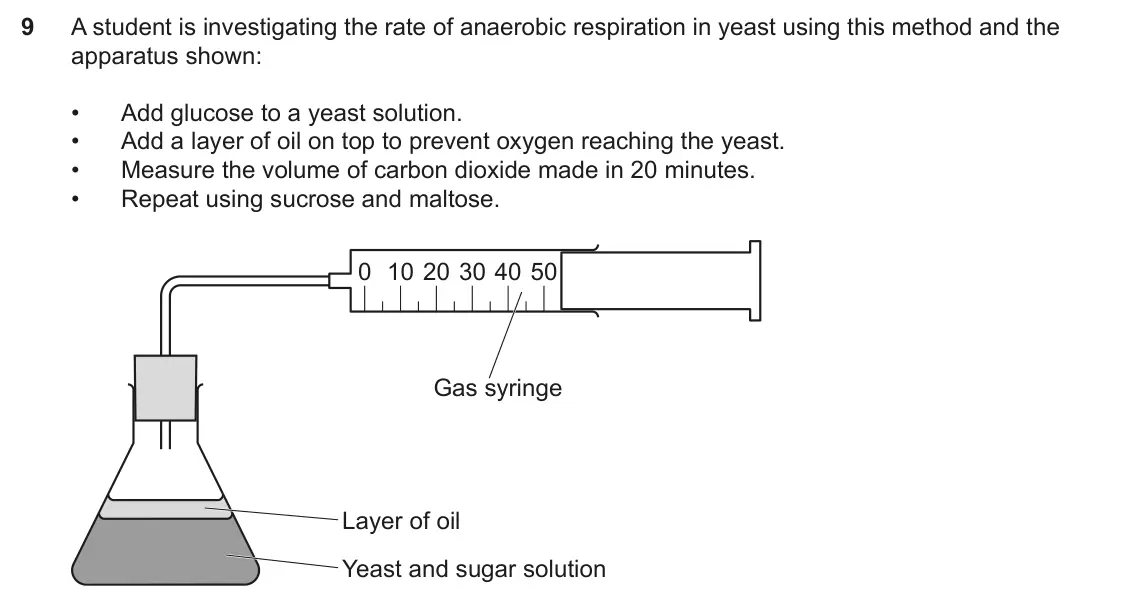
Q9(b)
The whole paper ↗Q9(c)
The whole paper ↗Q4(a)
The whole paper ↗Q4(b)
The whole paper ↗Q4(c)(i)
The whole paper ↗Q4(c)(ii)
The whole paper ↗Q4(c)(iii)
The whole paper ↗Q9(a)(ii)
The whole paper ↗
Q6(a)
The whole paper ↗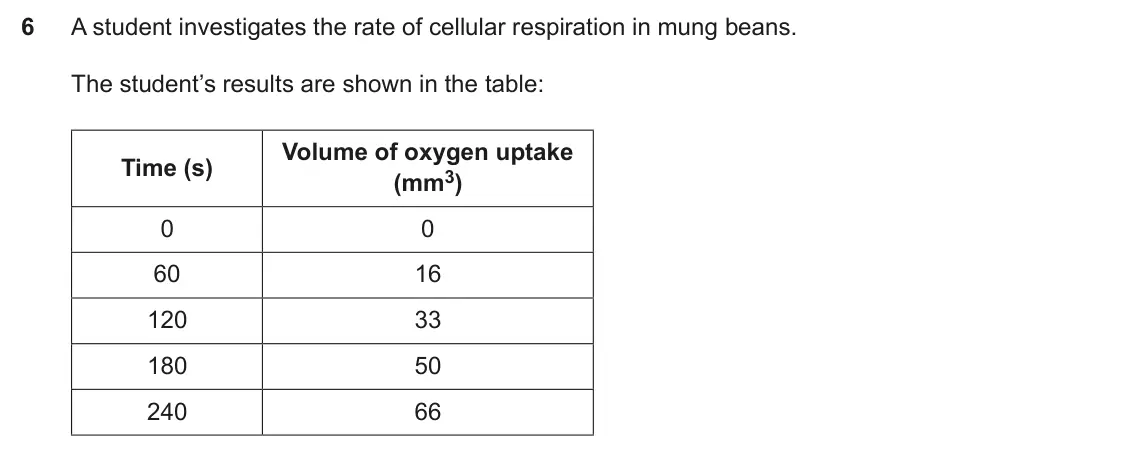
Q6(b)
The whole paper ↗Q6(c)
The whole paper ↗Q6(d)
The whole paper ↗Q2(a)(ii)
The whole paper ↗
Q6(d)(i)
The whole paper ↗
Q6(d)(ii)
The whole paper ↗Q7(a)(i)
The whole paper ↗
Q7(a)(ii)
The whole paper ↗Q7(b)
The whole paper ↗Q6(b)(ii)
The whole paper ↗
All 64 questions on What happens during cellular respiration?, as a list
- June 2025, Combined Science Paper 4 Foundation, Q9(a) (1 mark): The student controls the temperature of the yeast and sugar solution to make sure their comparisons are valid. Describe how the student should control the tempe
- June 2025, Combined Science Paper 4 Foundation, Q9(b) (2 marks): Explain how the student could improve the accuracy of the gas volume measurements. [2]
- June 2025, Combined Science Paper 4 Foundation, Q9(c) (2 marks): Calculate the rate of carbon dioxide production for the yeast and glucose solution. Rate of carbon dioxide production = cm3 / minute [2]
- June 2024, Biology Paper 1 Foundation, Q4(a) (2 marks): Complete the table to compare aerobic and anaerobic respiration. Aerobic respiration Anaerobic respiration Conditions under Low or no oxygen which it happens Am
- June 2024, Biology Paper 1 Foundation, Q4(b) (1 mark): Explain why cellular respiration takes place continuously in living cells. [1]
- June 2024, Biology Paper 1 Foundation, Q4(c)(i) (1 mark): Anaerobic respiration is exothermic. Predict what will happen to the temperature of the mixture over time. [1]
- June 2024, Biology Paper 1 Foundation, Q4(c)(ii) (1 mark): Bubbles of gas appear in the mixture due to anaerobic respiration in the yeast. What is the name of the gas? Tick (✓) one box. Carbon dioxide Hydrogen Nitrogen
- June 2024, Biology Paper 1 Foundation, Q4(c)(iii) (1 mark): Flour contains starch, which is made from glucose. Explain why the flour enables respiration to take place in the yeast. [1]
- June 2024, Biology Paper 1 Foundation, Q9(a)(ii) (2 marks): Small molecules are used by cells in aerobic respiration. Complete the table. Tick (✓) one box in each row. Small molecule Needed Produced by Not needed for for
- June 2024, Combined Science Paper 4 Foundation, Q6(a) (2 marks): Plot the results from the table on the graph. Two points have already been plotted. 80 60 Volume of oxygen 40 uptake (mm3) 20 0 0 30 60 90 120 150 180 210 240 2
- June 2024, Combined Science Paper 4 Foundation, Q6(b) (1 mark): Draw a straight line of best fit. [1]
- June 2024, Combined Science Paper 4 Foundation, Q6(c) (4 marks): Use the graph to calculate the rate of respiration. Use the equation: rate of respiration = change in volume change in time Give your answer to an appropriate n
- June 2024, Combined Science Paper 4 Foundation, Q6(d) (1 mark): Predict the volume of oxygen uptake at 150 seconds. Volume of oxygen uptake = mm3 [1]
- June 2024, Biology Paper 5 Higher, Q2(a)(ii) (2 marks): Small molecules are used by cells in aerobic respiration. Complete the table. Tick (✓) one box in each row. Small molecule Needed Produced by Not needed for for
- June 2024, Biology Paper 5 Higher, Q6(d)(i) (1 mark): Which sub-cellular structure does aerobic respiration take place in? [1]
- June 2024, Biology Paper 5 Higher, Q6(d)(ii) (1 mark): Explain why respiration occurs continuously in all living cells. [1]
- June 2023, Biology Paper 1 Foundation, Q7(a)(i) (1 mark): Why does the mixture feel warmer? Put a ring around the correct option. The mixture feels warmer because the process of respiration is endothermic / exothermic
- June 2023, Biology Paper 1 Foundation, Q7(a)(ii) (1 mark): Why does the mixture bubble after 30 minutes? [1]
- June 2023, Biology Paper 1 Foundation, Q7(b) (2 marks): Another type of respiration is aerobic respiration. Complete the table to compare the processes of aerobic and anaerobic respiration. Tick (3) one box in each r
- June 2023, Biology Paper 5 Higher, Q6(b)(ii) (1 mark): Why do cells react glucose from the digestive system with oxygen from the gaseous exchange system? [1]
- June 2022, Biology Paper 1 Foundation, Q2(c) (2 marks): Describe how glucose and oxygen are used by body cells. [2]
- June 2022, Combined Science Paper 4 Foundation, Q5(b) (1 mark): Plants use glucose in aerobic respiration. Where does aerobic respiration take place in plant cells? Tick one (✓) box. chloroplast mitochondria nucleus ribosome
- June 2022, Biology Paper 5 Higher, Q7(a) (2 marks): Which processes need a supply of ATP? Tick (3) two boxes. Absorption of water in the gut Breakdown and synthesis of molecules Muscle contraction Movement of oxy
- June 2022, Biology Paper 5 Higher, Q7(c)(i) (1 mark): What evidence from the sketch shows that anaerobic respiration increases as running speed increases? [1]
- June 2022, Biology Paper 5 Higher, Q7(c)(ii) (1 mark): Give one disadvantage of increasing anaerobic respiration for the athlete. [1]
- June 2022, Biology Paper 5 Higher, Q7(c)(iii) (4 marks): Explain the changes shown on the sketch when the athlete’s running speed is higher than X. [4]
- June 2022, Biology Paper 5 Higher, Q7(d) (2 marks): Explain why the athlete’s body temperature increases as they run. [2]
- November 2021, Biology Paper 1 Foundation, Q9(a) (1 mark): How much oxygen has been taken up by germinating corn seeds after 15 minutes at 22 °C? Oxygen uptake = ml [1]
- November 2021, Biology Paper 1 Foundation, Q9(b) (2 marks): Some of the oxygen that the germinating corn seeds take up is not used for germination. Explain how we know this from the graph. [2]
- November 2021, Biology Paper 1 Foundation, Q9(c) (1 mark): After 5 minutes, germinating corn seeds at 12 °C have taken up 0.2 ml of oxygen. Calculate the rate of oxygen uptake by germinating corn seeds at 12 °C. oxygen
- November 2021, Biology Paper 1 Foundation, Q9(d) (1 mark): Which equation represents the linear relationships shown in the graph? Tick (✓) one box y = mx + c y = mc + x y = m + cx [1]
- November 2021, Biology Paper 5 Higher, Q9(d)(i) (2 marks): Explain why the oil rises up the right-hand side of the U-tube, as shown with label 3 in Fig. 9.2. [2]
- November 2021, Biology Paper 5 Higher, Q9(d)(ii) (1 mark): Changes in temperature will affect the volume of the gases in the tubes. Why is this a problem when investigating respiration reactions? [1]
- November 2021, Biology Paper 5 Higher, Q9(d)(iii) (1 mark): Suggest one way the experiment could be developed to maintain the temperature. [1]
- November 2021, Biology Paper 5 Higher, Q9(e) (4 marks): Fig. 9.3 shows results from an investigation into the effect of temperature on oxygen uptake by germinating corn seeds. 2.0 1.8 Germinating corn seeds 1.6 at 22
- November 2020, Combined Science Paper 8 Higher, Q5(c) (3 marks): Cellular respiration takes place in both the mitochondria and cytoplasm of animal cells. Which statements about cellular respiration in animal cells are true, a
- November 2020, Combined Science Paper 8 Higher, Q5(d) (2 marks): The number of mitochondria in different body cells of a healthy human is shown in the graph. 4000 3000 Number of mitochondria 2000 per cell 1000 0 Leg Skin Live
- June 2019, Biology Paper 1 Foundation, Q7(a) (2 marks): In which parts of a cell do the reactions of cellular respiration take place? Tick (✓) two boxes. Cell wall Chloroplasts Cytoplasm Mitochondria Nucleus Plasmids
- June 2019, Biology Paper 1 Foundation, Q7(b) (2 marks): Which processes need energy from cellular respiration? Tick (✓) two boxes. Active transport Diffusion Gaseous exchange Muscle contraction Osmosis Transpiration
- June 2019, Biology Paper 5 Higher, Q1(a) (2 marks): In which parts of a cell do the reactions of cellular respiration take place? Tick (✓) two boxes. Cell wall Chloroplasts Cytoplasm Mitochondria Nucleus Plasmids
- June 2019, Biology Paper 5 Higher, Q1(b) (2 marks): Which processes need energy from cellular respiration? Tick (✓) two boxes. Active transport Diffusion Gaseous exchange Muscle contraction Osmosis Transpiration
- June 2018, Biology Paper 1 Foundation, Q4(a) (1 mark): Which piece of equipment should the student use to measure the volume of sugar solution accurately? Put a ring around the correct answer. balance conical flask
- June 2018, Biology Paper 1 Foundation, Q4(b)(i) (1 mark): What is the name of the gas produced by the yeast? Tick (✓) one box. Carbon dioxide Methane Nitrogen Oxygen [1]
- June 2018, Biology Paper 1 Foundation, Q4(b)(ii) (2 marks): The gas is collected in the gas syringe. Explain why using a gas syringe is a better technique to use than counting the bubbles of gas produced. [2]
- June 2018, Biology Paper 1 Foundation, Q4(c)(i) (1 mark): Which conclusion could be made from the graph? Tick (✓) one box. Yeast respires fastest using glucose. Yeast respires at a constant rate using sucrose. Yeast ca
- June 2018, Biology Paper 1 Foundation, Q4(c)(ii) (1 mark): How much gas had been collected after 30 minutes from the yeast in glucose solution? Volume of gas = cm3 [1]
- June 2018, Biology Paper 1 Foundation, Q4(c)(iii) (2 marks): The student makes some suggestions to explain the pattern of results for yeast in glucose solution after 30 minutes. Which statements give the two best explanat
- June 2018, Biology Paper 1 Foundation, Q4(d) (1 mark): The student wanted to prove that it was the yeast producing the gas. Which suggestion would allow the student to prove this? Tick (✓) one box. Add more sugar to
- June 2018, Biology Paper 1 Foundation, Q4(e) (2 marks): Anaerobic respiration also happens in animal cells. Put a ring around the correct option to complete each sentence to describe anaerobic respiration in animal c
- June 2018, Combined Science Paper 4 Foundation, Q3(a) (1 mark): Nina measures the rate of the reaction by recording the volume of ethanol produced by 1 dm3 of beer over a period of time. Suggest one other method for recordin
- June 2018, Combined Science Paper 4 Foundation, Q3(b)(i) (1 mark): What volume of ethanol has been produced after 120 hours in Fig. 3.1? Volume = cm3 [1]
- June 2018, Combined Science Paper 4 Foundation, Q3(b)(ii) (3 marks): Calculate the rate of ethanol produced over the first 120 hours in Fig. 3.1. Rate = cm3 / h [3]
- June 2018, Combined Science Paper 4 Foundation, Q3(c)(i) (1 mark): What was the temperature range of the investigation? Temperature range = °C to °C [1]
- June 2018, Combined Science Paper 4 Foundation, Q3(c)(ii) (1 mark): Using information from Fig. 3.2, estimate the optimum temperature for fermentation. Optimum temperature = °C [1]
- June 2018, Combined Science Paper 4 Foundation, Q3(c)(iii) (2 marks): The students want to find a more accurate estimate of the optimum temperature for fermentation. How could they do this? Tick (✓) two boxes. Carry out the experi
- June 2018, Biology Paper 5 Higher, Q7(a)(iii) (2 marks): Two of the cells also contain an organelle that is not shown in the diagrams. Some of the reactions of aerobic respiration take place in this organelle. Write d
- June 2018, Biology Paper 5 Higher, Q7(b) (3 marks): The students write down simple word summaries of cellular respiration in different types of organisms. Complete the word summaries in the table. Type of Type of
- June 2018, Biology Paper 5 Higher, Q7(c)(i) (2 marks): The students have confidence in the information in the paper. Explain why. [2] The models of anaerobic and aerobic respiration from the paper are shown in the d
- June 2018, Biology Paper 5 Higher, Q7(c)(ii) (2 marks): Calculate the anaerobic:aerobic ratio of ATP produced by cellular respiration in yeast. anaerobic:aerobic ratio of ATP produced = : [2]
- June 2018, Biology Paper 5 Higher, Q7(c)(iii) (2 marks): Look at the diagram showing the models of respiration. Yeast will use anaerobic respiration even when oxygen is available. Which two statements, taken together,
- June 2018, Combined Science Paper 8 Higher, Q3(a) (1 mark): Fermentation of glucose with yeast can be represented by an equation. Balance the chemical equation for the reaction. glucose → ethanol + carbon dioxide C6H12O6
- June 2018, Combined Science Paper 8 Higher, Q3(b)(ii) (5 marks): Nina plots the graph in Fig. 3.1 to show the volume of ethanol produced over a period of time when yeast are added to glucose. 60 50 40 volume of ethanol 30 pro
- June 2018, Combined Science Paper 8 Higher, Q3(c)(i) (3 marks): What conclusions can be made from the graph in Fig. 3.2? Explain your answer. [3]
- June 2018, Combined Science Paper 8 Higher, Q3(c)(ii) (2 marks): Suggest how the optimum temperature could be estimated with more accuracy. [2]
Questions, mark schemes and examiner’s reports are © OCR, from their published past papers. Plumi isn’t affiliated with any exam board. Want whole papers? Full past papers.
Rather write your answers by hand on iPad? Plumi marks them against the same mark schemes.