 plumi
How do we know about mitochondria and other cell structures?: OCR GCSE Combined Science B questions
Every OCR GCSE Combined Science B exam question on B4.2 How do we know about mitochondria and other cell structures?, 2018–2025, with its mark scheme and examiner’s report.
Paper
All papers
Exam
All years
Calculations
Q2(b)
The whole paper ↗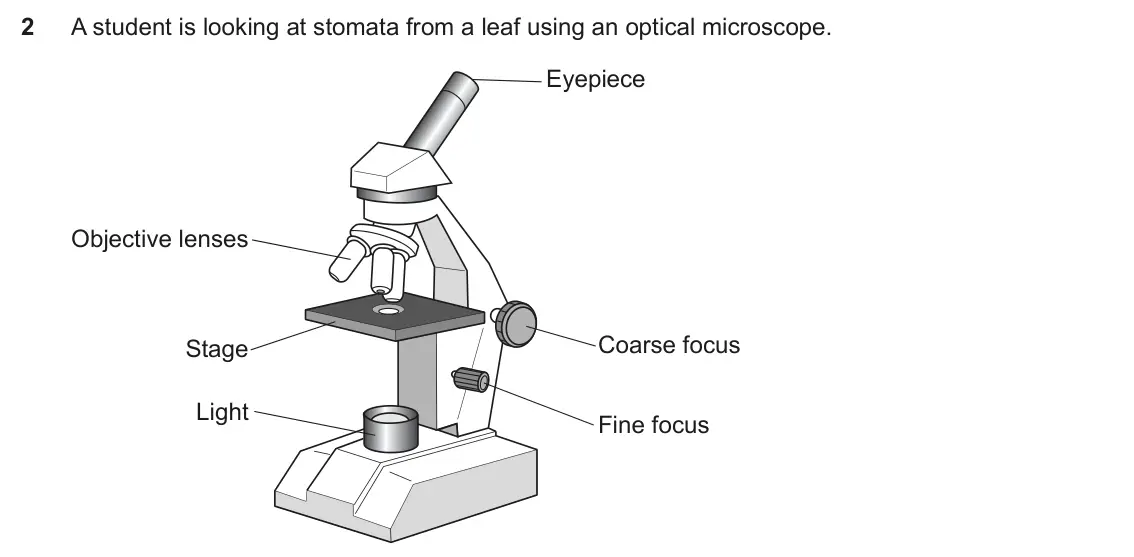
Q3(a)
The whole paper ↗Q3(b)(i)
The whole paper ↗Q3(b)(ii)
The whole paper ↗Q3(c)
The whole paper ↗Q7(c)
The whole paper ↗
Q7(d)(i)
The whole paper ↗Q7(d)(ii)
The whole paper ↗Q10(a)(i)
The whole paper ↗
Q10(a)(ii)
The whole paper ↗Q10(a)(iii)
The whole paper ↗Q1(a)(i)
The whole paper ↗
Q1(a)(ii)
The whole paper ↗Q1(a)(iii)
The whole paper ↗Q1(a)
The whole paper ↗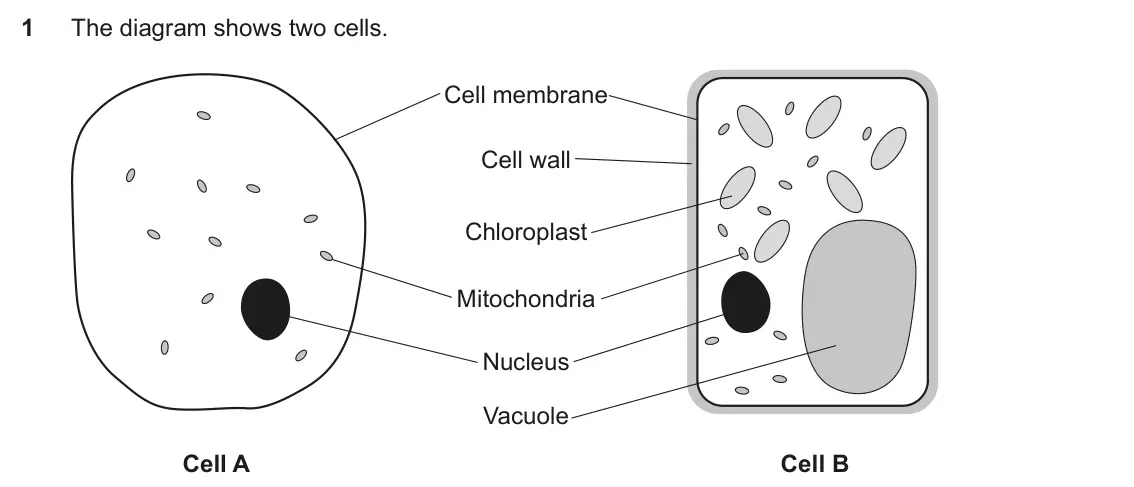
Q1(b)
The whole paper ↗Q10(c)
The whole paper ↗
Q12(a)
The whole paper ↗Q2(a)
The whole paper ↗Q9(a)
The whole paper ↗
All 44 questions on How do we know about mitochondria and other cell structures?, as a list
- June 2025, Combined Science Paper 4 Foundation, Q2(b) (1 mark): The magnification of the microscope’s eyepiece is ×10. The objective lens is ×40. What is the total magnification? Use the equation: total magnification = magni
- June 2024, Biology Paper 5 Higher, Q3(a) (3 marks): Complete the table about sub-cellular structures. Tick (✓) one box for each row. Structure Only found in Only found in Found in both eukaryotic cells prokaryoti
- June 2024, Biology Paper 5 Higher, Q3(b)(i) (2 marks): Draw a scientific drawing of the chloroplast in the box. [2]
- June 2024, Biology Paper 5 Higher, Q3(b)(ii) (2 marks): An electron microscope was used to create the image of the chloroplast. Explain why electron microscopy is needed to increase our understanding of sub-cellular
- June 2024, Biology Paper 5 Higher, Q3(c) (4 marks): The chloroplast has been magnified 11 500 times. In the image, the length of the chloroplast is 65 mm. Calculate the actual length of the chloroplast in µm. ima
- June 2023, Biology Paper 1 Foundation, Q7(c) (1 mark): The teacher uses a light microscope to count the yeast cells in one drop of the mixture. From this the teacher estimates there are 2 million yeast cells in the
- June 2023, Biology Paper 1 Foundation, Q7(d)(i) (2 marks): The length of the mitochondrion in the image is 2 micrometers. Use this information to estimate the height of the mitochondrion. Height of mitochondrion = micro
- June 2023, Biology Paper 1 Foundation, Q7(d)(ii) (2 marks): Complete the sentences to explain how electron microscopes have increased our understanding of sub-cellular structures such as mitochondria. Put a ring around e
- June 2023, Biology Paper 1 Foundation, Q10(a)(i) (1 mark): Draw lines to connect each part of the microscope with its correct name. Part Name Part A Eyepiece lens Part B Objective lens Part C Stage [1]
- June 2023, Biology Paper 1 Foundation, Q10(a)(ii) (1 mark): The doctor uses steps A to D to look at the cells on a slide. The steps are not in the correct order. A Turn the coarse focus until the image is as clear as pos
- June 2023, Biology Paper 1 Foundation, Q10(a)(iii) (1 mark): The chromosomes in the cells are not clearly visible under the microscope. Describe one thing the doctor can add to the slide to improve the visibility of the c
- June 2023, Biology Paper 5 Higher, Q1(a)(i) (1 mark): Draw lines to connect each part of the microscope with its correct name. Part Name Part A Eyepiece lens Part B Objective lens Part C Stage [1]
- June 2023, Biology Paper 5 Higher, Q1(a)(ii) (1 mark): The doctor uses steps A to D to look at the cells on a slide. The steps are not in the correct order. A Turn the coarse focus until the image is as clear as pos
- June 2023, Biology Paper 5 Higher, Q1(a)(iii) (1 mark): The chromosomes in the cells are not clearly visible under the microscope. Describe one thing the doctor can add to the slide to improve the visibility of the c
- June 2022, Biology Paper 1 Foundation, Q1(a) (2 marks): State two pieces of evidence from the diagram that show that cell B is a plant cell. 1 2 [2]
- June 2022, Biology Paper 1 Foundation, Q1(b) (1 mark): Which structure stores the genetic material in an animal cell? Put a ring around the correct answer. Cell membrane Cell wall Nucleus Vacuole [1]
- June 2022, Biology Paper 1 Foundation, Q10(c) (2 marks): Complete the sentences to describe how to set up a light microscope to look at a slide of stomata from a leaf. Put a ring around each correct answer. First, tur
- November 2021, Biology Paper 1 Foundation, Q12(a) (4 marks): A student is given a slide of a cross section of a plant stem. They clip the slide onto the stage of a light microscope and turn on the light. Describe how they
- November 2021, Biology Paper 5 Higher, Q2(a) (4 marks): A student is given a slide of a cross section of a plant stem. They clip the slide onto the stage of a light microscope and turn on the light. Describe how they
- November 2021, Biology Paper 5 Higher, Q9(a) (1 mark): Fig. 9.1 is a diagram of a plant cell. It is not to scale. Chloroplast Nucleus Cell wall Cell membrane Large vacuole Mitochondria Cytoplasm Fig. 9.1 Write down
- November 2021, Biology Paper 5 Higher, Q9(c) (3 marks): The table shows the approximate lengths of three plant cell components. Complete the table by converting the approximate length of each component into metres. 1
- November 2020, Biology Paper 1 Foundation, Q1(b)(i) (3 marks): The method for using a light microscope to see a sample of cells is shown below, but is not in the correct order. A A higher power objective lens is selected an
- November 2020, Biology Paper 1 Foundation, Q1(b)(ii) (1 mark): A student calculates the length of a plant and animal cell using a light microscope. The length of the plant cell is 100 µm. The length of the animal cell is 25
- November 2020, Biology Paper 1 Foundation, Q1(c) (1 mark): Animal cells are approximately 10 times bigger than bacterial cells. Which statement about order of magnitude for animal cells and bacterial cells is true? Tick
- November 2020, Combined Science Paper 4 Foundation, Q1(a)(i) (1 mark): What type of cell is cell A? [1]
- November 2020, Combined Science Paper 4 Foundation, Q1(a)(ii) (1 mark): What is found in all three cells? Tick (✓) one box. Cell membrane Nucleus Mitochondria Chloroplast [1]
- November 2020, Combined Science Paper 4 Foundation, Q1(a)(iii) (1 mark): Cell C has a length of 0.0047 mm. 1 mm = 1000 μm. Calculate the length of cell C in micrometres, μm. Length = μm [1]
- November 2020, Combined Science Paper 4 Foundation, Q1(b) (4 marks): Microscopes can be used to look at cells. Complete the sentences about microscopes. Use words from the list. You can use each word once, more than once, or not
- November 2020, Combined Science Paper 4 Foundation, Q1(c)(i) (3 marks): Sarah uses the microscope in Fig. 1.2 to look at some cells. The steps Sarah takes to look at some cells are listed below but are not in the correct order. A Pl
- November 2020, Combined Science Paper 4 Foundation, Q1(c)(ii) (1 mark): Which combination of eyepiece and objective lens will produce a magnification of × 400? Tick (✓) one box. Eyepiece Objective lens × 10 × 20 × 5 × 40 × 10 × 40 ×
- November 2020, Combined Science Paper 8 Higher, Q5(a) (2 marks): Explain how electron microscopy has increased our understanding of cells. [2]
- November 2020, Combined Science Paper 8 Higher, Q5(b)(i) (1 mark): Which part of the leaf cell contains chlorophyll? Tick (3) one box. A B C D [1]
- November 2020, Combined Science Paper 8 Higher, Q5(b)(ii) (4 marks): The actual distance between lines P and Q is 5.83 µm. Calculate the magnification used to create the image in Fig. 5.1. Use the equation: measured size = actual
- June 2019, Biology Paper 1 Foundation, Q2(b)(i) (1 mark): The field of view and the magnification change depending on the combination of eyepiece lens and objective lens used. Put a ring around the combination of lense
- June 2019, Biology Paper 1 Foundation, Q2(b)(ii) (1 mark): Put a ring around the combination of lenses that produces the largest field of view. Eyepiece Objective lens lens ×10 ×20 ×15 ×20 ×10 ×40 ×15 ×40 [1]
- June 2019, Biology Paper 1 Foundation, Q6(e)(i) (2 marks): What are the advantages of electron microscopes over light microscopes? Tick (✓) two boxes. A higher magnification is possible with electron microscopes. Electr
- June 2019, Biology Paper 1 Foundation, Q6(e)(ii) (2 marks): The virus is 0.1 µm in diameter. It infects a human cell that is 50 µm in diameter. How many times bigger is the human cell than the virus? Number of times bigg
- June 2019, Biology Paper 5 Higher, Q3(c) (1 mark): The diagram in Fig. 3.2 shows a flu virus. The virus is made from four different proteins. M-protein N-protein H-protein R-protein Fig. 3.2 The virus is approxi
- June 2019, Biology Paper 5 Higher, Q5(a)(ii) (1 mark): What must be added to cells so that the nuclei can be seen using a light microscope? [1]
- June 2019, Biology Paper 5 Higher, Q7(b) (2 marks): Fig. 7.2 shows a cross section through a leaf, as seen with a light microscope. Fig. 7.2 Describe how you could make a temporary slide of a cross section throug
- June 2018, Biology Paper 1 Foundation, Q1 (3 marks): The diagrams in the table show different types of cells. Identify the type of cell shown in each diagram. Tick one box in each row. Type of cell Diagram of cell
- June 2018, Biology Paper 1 Foundation, Q5(b)(iii) (1 mark): Kareem uses a ×10 eyepiece lens and a ×40 objective lens to look at the slides using the microscope. What is the total magnification of these two lenses? Total
- June 2018, Biology Paper 5 Higher, Q7(a)(i) (2 marks): Which cell, A, B or C, is a prokaryotic cell? Cell Explanation [2]
- June 2018, Biology Paper 5 Higher, Q7(a)(ii) (2 marks): Which cell, A, B or C, is a yeast cell? Cell Explanation [2]
Questions, mark schemes and examiner’s reports are © OCR, from their published past papers. Plumi isn’t affiliated with any exam board. Want whole papers? Full past papers.
Rather write your answers by hand on iPad? Plumi marks them against the same mark schemes.