 plumi
Why are nanoparticles so useful?: OCR GCSE Chemistry B questions
Every OCR GCSE Chemistry B exam question on C4.4 Why are nanoparticles so useful?, 2018–2025, with its mark scheme and examiner’s report.
Paper
All papers
Exam
All years
Calculations
Q4(a)
The whole paper ↗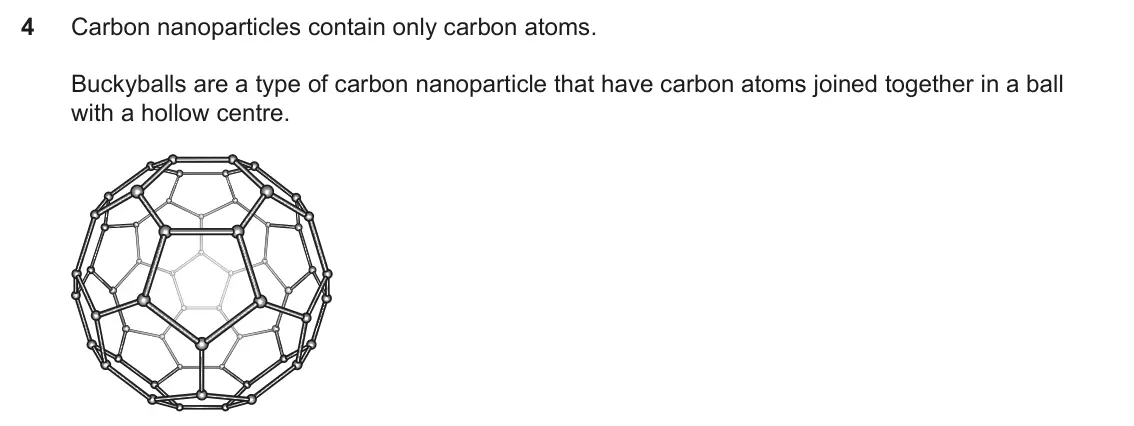
Q4(b)
The whole paper ↗Q4(c)
The whole paper ↗Q7(b)
The whole paper ↗
Q7(c)(i)
The whole paper ↗Q7(c)(ii)
The whole paper ↗Q9(c)(i)
The whole paper ↗Q9(c)(ii)
The whole paper ↗Q6(a)
The whole paper ↗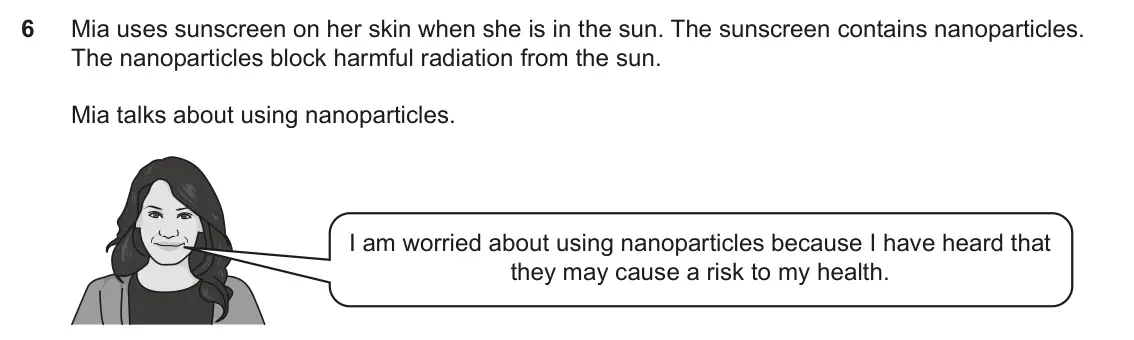
Q6(b)
The whole paper ↗Q6(c)
The whole paper ↗Q6(d)(i)
The whole paper ↗Q6(d)(ii)
The whole paper ↗Q3(a)
The whole paper ↗
Q3(b)
The whole paper ↗Q3(c)
The whole paper ↗Q3(d)(i)
The whole paper ↗Q3(d)(ii)
The whole paper ↗Q3(d)(iii)
The whole paper ↗Q8(d)(i)
The whole paper ↗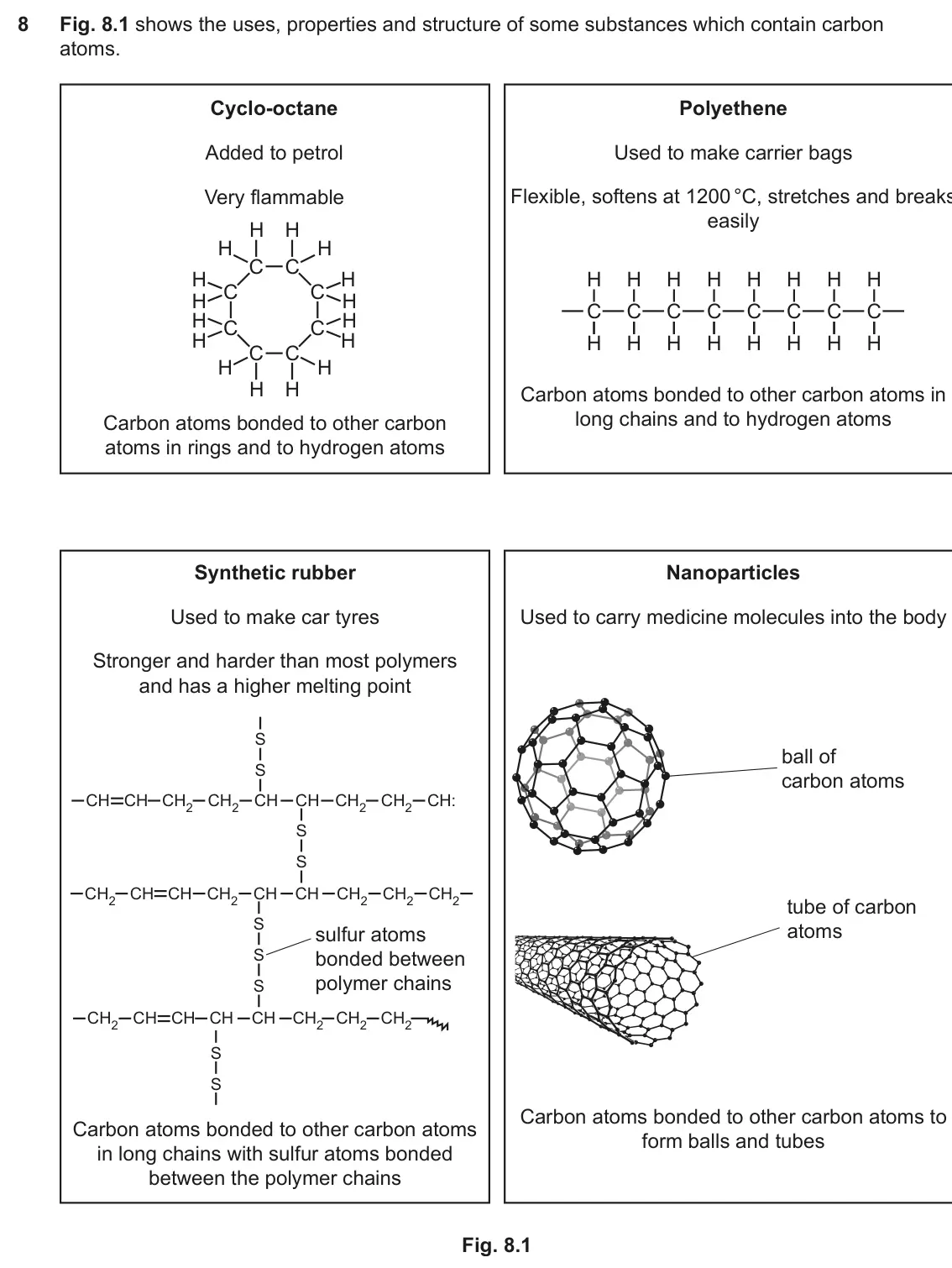
All 39 questions on Why are nanoparticles so useful?, as a list
- June 2025, Paper 2 Foundation, Q4(a) (3 marks): Which statements about buckyballs and other nanoparticles are true and which are false? Tick (✓) one box in each row. True False Buckyballs are chemical compoun
- June 2025, Paper 2 Foundation, Q4(b) (2 marks): The surface area to volume ratio of a buckyball can be calculated using this formula: surface area to volume ratio = 3 r where r is the radius of the buckyball
- June 2025, Paper 2 Foundation, Q4(c) (2 marks): Scientists are developing ways of using nanoparticles to carry medicines into the human body. Some people think that using nanoparticles to carry medicines may
- June 2025, Paper 4 Higher, Q7(b) (3 marks): The radius of a buckyball is half its diameter. The surface area to volume ratio of a buckyball can be calculated using this formula: surface area to volume rat
- June 2025, Paper 4 Higher, Q7(c)(i) (2 marks): Describe two reasons why buckyballs are suitable to carry medicines into the human body. 1 2 [2]
- June 2025, Paper 4 Higher, Q7(c)(ii) (1 mark): Explain one possible risk of using nanoparticles to carry medicines into the human body. [1]
- June 2024, Paper 1 Foundation, Q9(c)(i) (1 mark): Buckminsterfullerene has a diameter of 1 nm. What is its diameter in m? Put a ring around the correct option. 1 × 10¹⁰ 1 × 10⁹ 1 1 × 10⁻⁹ 1 × 10⁻¹⁰ [1]
- June 2024, Paper 1 Foundation, Q9(c)(ii) (2 marks): Buckminsterfullerene is used in medicine to carry drugs into the body. Describe two properties of buckminsterfullerene that make it able to carry drugs into the
- June 2023, Paper 2 Foundation, Q6(a) (2 marks): Give two reasons why using nanoparticles may cause a risk to health. 1 2 [2]
- June 2023, Paper 2 Foundation, Q6(b) (3 marks): Which statements about nanoparticles are true and which are false? Tick (3) one box in each row. True False Fullerenes are examples of nanoparticles. Nanopartic
- June 2023, Paper 2 Foundation, Q6(c) (2 marks): The table shows some data about the diameter of nanoparticles A, B, C and D. Nanoparticle Diameter (m) 8.25 × 10⁻⁹ A 2.10 × 10⁻⁹ B 9.18 × 10⁻⁹ C D 8.26 × 10⁻⁹ P
- June 2023, Paper 2 Foundation, Q6(d)(i) (2 marks): Calculate the volume of the model. Give your answer to one decimal place. Use this formula: volume = h × w × d Volume = cm3 [2]
- June 2023, Paper 2 Foundation, Q6(d)(ii) (2 marks): Calculate the surface area of the model. Use this formula: surface area = 6 × (h × d ) Surface area = cm2 [2]
- June 2023, Paper 4 Higher, Q3(a) (3 marks): Explain the risks and benefits to Mia of using a sunscreen which contains nanoparticles. [3]
- June 2023, Paper 4 Higher, Q3(b) (2 marks): Which statements about nanoparticles are true and which are false? Tick (3) one box in each row. True False Fullerenes and graphite are examples of nanoparticle
- June 2023, Paper 4 Higher, Q3(c) (2 marks): Some data about the diameter of nanoparticles A, B, C and D is shown in the table. Nanoparticle Diameter (m) 8.2 × 10⁻⁹ A 2.1 × 10⁻⁹ B 9.1 × 10⁻¹⁰ C 8.9 × 10⁻⁹
- June 2023, Paper 4 Higher, Q3(d)(i) (1 mark): How many times longer is each side of the model compared to nanoparticle B? Put a ring around the correct option. 1 000 000 000 x 10 000 000 x 900 x 109 x 100 x
- June 2023, Paper 4 Higher, Q3(d)(ii) (2 marks): Calculate the volume of the model of nanoparticle B. Give your answer to 1 decimal place. Volume = cm3 [2]
- June 2023, Paper 4 Higher, Q3(d)(iii) (2 marks): The model of nanoparticle B has 6 sides. Calculate the surface area of the model of nanoparticle B. Surface area = cm2 [2]
- June 2022, Paper 2 Foundation, Q8(d)(i) (1 mark): How are nanoparticles different to the other substances in Fig. 8.1? [1]
- June 2022, Paper 2 Foundation, Q8(d)(ii) (2 marks): Explain why the structure of carbon nanoparticles helps them to carry medicine molecules into the body. [2]
- June 2022, Paper 4 Higher, Q1(d)(i) (1 mark): How are nanoparticles different to the other substances in Fig. 1.1? [1]
- June 2022, Paper 4 Higher, Q1(d)(ii) (2 marks): Explain why the structure of carbon nanoparticles helps them to carry medicine molecules into the body. [2]
- November 2021, Paper 2 Foundation, Q5(c) (2 marks): New types of batteries that contain nanoparticles of graphene have been available for less than 10 years. New products need to have a life cycle assessment. Sug
- November 2021, Paper 4 Higher, Q5(a) (6 marks): Table 5.1 and Table 5.2 show information about the structures and uses of diamond and graphene. Diamond Structure: Giant covalent Many carbon atoms. Each carbon
- November 2021, Paper 4 Higher, Q5(b)(i) (2 marks): Why are people concerned about the health effects of nanoparticles? [2]
- June 2019, Paper 2 Foundation, Q11(a)(i) (3 marks): Complete Table 11.1 by filling in the blank spaces for the eight smaller cubes. Use this space to show your working. [3]
- June 2019, Paper 2 Foundation, Q11(a)(ii) (2 marks): Use ideas about surface area and volume to explain why nanoparticles of silver have a different surface area to volume ratio than larger silver particles. [2]
- June 2019, Paper 2 Foundation, Q11(b)(i) (2 marks): Explain why metal nanoparticles may be able to enter the brain even though metal particles usually cannot. [2]
- June 2019, Paper 2 Foundation, Q11(b)(ii) (3 marks): Use ideas about risk and benefit to evaluate the use of nanoparticles in socks and to treat cancer. [3]
- June 2019, Paper 4 Higher, Q2(a)(i) (3 marks): Complete Table 2.1 by filling in the blank spaces for the eight smaller cubes. Use this space to show your working. [3]
- June 2019, Paper 4 Higher, Q2(a)(ii) (2 marks): Use ideas about surface area and volume to explain why nanoparticles of silver have a different surface area to volume ratio than larger silver particles. [2]
- June 2019, Paper 4 Higher, Q2(b)(i) (2 marks): Explain why metal nanoparticles may be able to enter the brain even though metal particles usually cannot. [2]
- June 2019, Paper 4 Higher, Q2(b)(ii) (3 marks): Use ideas about risk and benefit to evaluate the use of nanoparticles in socks and to treat cancer. [3]
- June 2018, Paper 1 Foundation, Q11(a) (1 mark): What is the size of a nanoparticle? Tick (3) one box. 0.1 nm 10 nm 150 nm 1000 nm [1]
- June 2018, Paper 1 Foundation, Q11(b) (2 marks): Cerium oxide is a very expensive solid. The cerium oxide nanoparticles act as a catalyst. They help the fuel to burn completely so that less pollutant gases are
- June 2018, Paper 3 Higher, Q6(a) (1 mark): Describe a property of nanoparticles that makes them good catalysts. [1]
- June 2018, Paper 3 Higher, Q6(b) (3 marks): The addition of nanoparticles allows more complete combustion of the fuel. Kai talks about nanoparticles in diesel fuel. Using nanoparticles in diesel fuel bene
- June 2018, Paper 3 Higher, Q6(d) (3 marks): A nanoparticle has a volume of 8 × 10–27 m. A molecule has a volume of 4 × 10–30 m. Estimate how many moles of this molecule there are in the nanoparticle. Numb
Questions, mark schemes and examiner’s reports are © OCR, from their published past papers. Plumi isn’t affiliated with any exam board. Want whole papers? Every OCR GCSE Chemistry B paper.
Rather write your answers by hand on iPad? Plumi marks them against the same mark schemes.