 plumi
What are the different types of polymers?: OCR GCSE Chemistry B questions
Every OCR GCSE Chemistry B exam question on C4.2 What are the different types of polymers?, 2018–2025, with its mark scheme and examiner’s report.
Paper
All papers
Exam
All years
Calculations
Q7(a)(i)
The whole paper ↗
Q7(a)(ii)
The whole paper ↗Q7(b)
The whole paper ↗Q7(c)
The whole paper ↗Q1(c)
The whole paper ↗
Q1(d)(i)
The whole paper ↗Q1(d)(ii)
The whole paper ↗Q7(a)
The whole paper ↗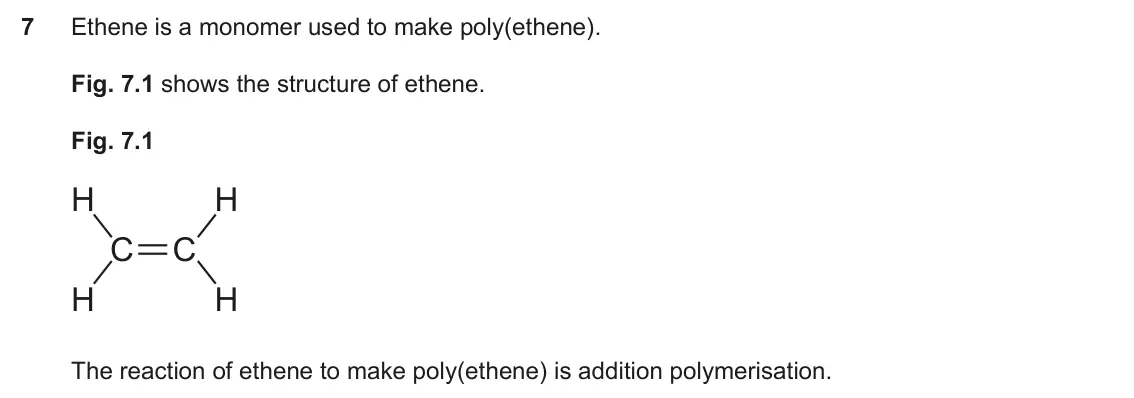
Q7(b)(i)
The whole paper ↗Q7(c)(i)
The whole paper ↗Q7(c)(ii)
The whole paper ↗Q7(d)(ii)
The whole paper ↗Q1(a)
The whole paper ↗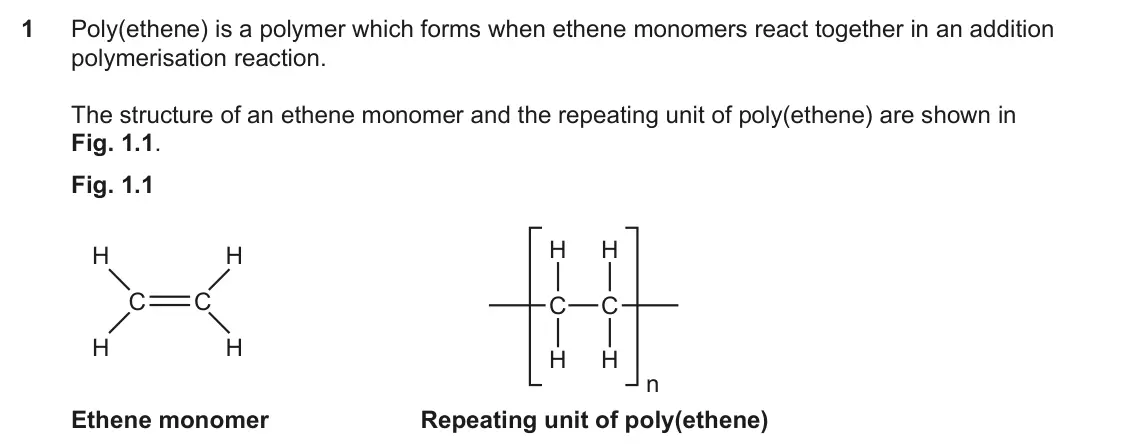
Q1(b)
The whole paper ↗Q6(a)(i)
The whole paper ↗
Q6(a)(ii)
The whole paper ↗Q6(b)(i)
The whole paper ↗Q6(b)(ii)
The whole paper ↗Q6(c)
The whole paper ↗Q12(c)
The whole paper ↗
All 40 questions on What are the different types of polymers?, as a list
- June 2025, Paper 3 Higher, Q7(a)(i) (2 marks): The table shows the addition polymer formed from ethene. Repeating unit of addition polymer Addition polymer formed from ethene formed from ethene H H H H H H C
- June 2025, Paper 3 Higher, Q7(a)(ii) (1 mark): Suggest the name of the addition polymer shown in the table. [1]
- June 2025, Paper 3 Higher, Q7(b) (2 marks): Describe what happens when an addition polymer forms from its monomers. [2]
- June 2025, Paper 3 Higher, Q7(c) (3 marks): Some synthetic polymers are condensation polymers. Which statements about condensation polymers are true and which are false? Tick (✓) one box in each row. True
- June 2024, Paper 1 Foundation, Q1(c) (2 marks): Alkenes are also hydrocarbons. They can be used to make polymers. Which statements about polymers are true and which are false? Tick (✓) one box in each row. Tr
- June 2024, Paper 1 Foundation, Q1(d)(i) (2 marks): Complete the diagram below to show the repeating unit of poly(ethene). C C [2]
- June 2024, Paper 1 Foundation, Q1(d)(ii) (2 marks): Describe what happens when ethene monomers react together to form poly(ethene). [2]
- June 2024, Paper 2 Foundation, Q7(a) (2 marks): Draw the structure of a section of poly(ethene) formed from three ethene monomers. [2]
- June 2024, Paper 2 Foundation, Q7(b)(i) (2 marks): 12 000 ethene monomers join together to make a poly(ethene) molecule. Calculate the number of carbon and hydrogen atoms in this poly(ethene) molecule. Number of
- June 2024, Paper 2 Foundation, Q7(c)(i) (1 mark): The molecular formula of ethene is C2H4. Write the molecular formula of chloroethene. [1]
- June 2024, Paper 2 Foundation, Q7(c)(ii) (2 marks): Fig. 7.3 shows the structure of the repeating unit of poly(ethene). Fig. 7.3 H H C C H H n Draw the structure of the repeating unit of poly(chloroethene). [2]
- June 2024, Paper 2 Foundation, Q7(d)(ii) (1 mark): Use ideas about functional groups to explain why both ethene and chloroethene can form addition polymers. [1]
- June 2023, Paper 2 Foundation, Q1(a) (4 marks): Which statements are true only for an ethene monomer, which are true only for the repeating unit of poly(ethene) and which are true for both? Tick (3) one box i
- June 2023, Paper 2 Foundation, Q1(b) (1 mark): PVC is another addition polymer. The structure of the repeating unit of PVC is shown in Fig. 1.2. Fig. 1.2 H Cl C C H H n Draw the structure of a monomer of PVC
- June 2023, Paper 4 Higher, Q6(a)(i) (2 marks): Put a ring around each of the functional groups in monomer 1 and monomer 2. [2]
- June 2023, Paper 4 Higher, Q6(a)(ii) (1 mark): Explain why monomers of condensation polymers need to contain functional groups. [1]
- June 2023, Paper 4 Higher, Q6(b)(i) (1 mark): How many repeating units of the polymer are shown in Fig. 6.2? [1]
- June 2023, Paper 4 Higher, Q6(b)(ii) (1 mark): Write the name and formula of the other product formed in the reaction between monomer 1 and monomer 2. Name Formula [1]
- June 2023, Paper 4 Higher, Q6(c) (1 mark): Some polymers, such as DNA, are naturally occurring. Which statements about polymers are true and which are false? Tick (3) one box in each row. True False DNA
- June 2022, Paper 1 Foundation, Q12(c) (1 mark): Poly(ethene) is made from ethene. Complete the equation by drawing the structure of the repeating unit of poly(ethene). H H n C C H H Ethene Poly(ethene) [1]
- June 2022, Paper 1 Foundation, Q12(d) (1 mark): Genes are made from the natural polymer DNA. Which monomers make DNA? Tick (✓) one box. Cellulose Nucleotides Sugars Unsaturated hydrocarbons [1]
- June 2022, Paper 2 Foundation, Q8(c) (2 marks): Explain why polyethene and synthetic rubber have different properties. Use ideas about structure from Fig. 8.1 to help you to answer. [2]
- June 2022, Paper 3 Higher, Q2(c) (1 mark): Poly(ethene) is made from ethene. Complete the equation by drawing the structure of the repeating unit of poly(ethene). H H n C C H H Ethene Poly(ethene) [1]
- June 2022, Paper 3 Higher, Q2(d) (1 mark): Genes are made from the natural polymer DNA. Which monomers make DNA? Tick (✓) one box. Cellulose Nucleotides Sugars Unsaturated hydrocarbons [1]
- November 2021, Paper 1 Foundation, Q3(a) (2 marks): Complete the diagram to show the polymerisation of ethene, C2H4. Type of polymerisation: nC2H4 n Poly(ethene) [2]
- November 2021, Paper 3 Higher, Q8(a)(i) (2 marks): Poly(ethene) is made by polymerising ethene, C2H4. Draw the structure of the repeating unit of poly(ethene). [2]
- November 2021, Paper 3 Higher, Q8(a)(ii) (1 mark): What type of polymer is poly(ethene)? [1]
- November 2020, Paper 1 Foundation, Q1(a)(i) (1 mark): Which is the correct displayed formula for propene? Put a ring around the correct answer. H H H H H H H H H C C C OH H C C C H C C C H H H H H H H H H H [1]
- November 2020, Paper 1 Foundation, Q1(a)(ii) (1 mark): Complete Fig. 1.1 to show the repeating unit of poly(propene). Use one term from the list. H CH3 C3H6 H H C C H n Fig. 1.1 [1]
- November 2020, Paper 3 Higher, Q7(a)(ii) (2 marks): Draw the structure for a repeating unit of poly(propene). n [2]
- November 2020, Paper 3 Higher, Q7(c) (3 marks): Which statements about polymers are true, and which are false? Tick (✓) one box in each row. True False When monomers form condensation polymers, a small molecu
- June 2019, Paper 2 Foundation, Q2(a) (2 marks): Complete the table by filling in the missing information. [2]
- June 2019, Paper 2 Foundation, Q2(b) (2 marks): The structure of each polymer can be shown as a repeating unit. Complete the diagram below by drawing the bonds in the repeating unit of poly(ethene). H H C C H
- June 2019, Paper 4 Higher, Q4(a) (1 mark): What is the name for this type of polymer? Put a ring around the correct answer. addition polyamide polyamine polyester oxidised [1]
- June 2019, Paper 4 Higher, Q4(b)(i) (1 mark): Complete the diagram in Fig. 4.2 by drawing the structure of molecule B. [1]
- June 2019, Paper 4 Higher, Q4(b)(ii) (2 marks): The polymer was originally made by reacting monomers, molecule A and molecule B, together. How is the reaction to make the polymer different from the reaction i
- June 2019, Paper 4 Higher, Q4(b)(iii) (2 marks): Explain why molecule A is called a dicarboxylic acid. [2]
- June 2019, Paper 4 Higher, Q4(c) (2 marks): PET is a type of polymer used to make drinks bottles. PET has the repeating unit shown in Fig. 4.3. O O C C O O n Fig. 4.3 In molecules of PET, represents C2H4.
- June 2018, Paper 1 Foundation, Q9(c) (1 mark): Polymer A is an addition polymer. Draw the structure of the monomer that forms polymer A. Repeating unit of polymer A Structure of monomer F F C C F F n [1]
- June 2018, Paper 3 Higher, Q3(c) (1 mark): Polymer A is an addition polymer. Draw the structure of the monomer that forms polymer A. [1] Repeating unit of polymer A Structure of monomer F F C C F F n
Questions, mark schemes and examiner’s reports are © OCR, from their published past papers. Plumi isn’t affiliated with any exam board. Want whole papers? Every OCR GCSE Chemistry B paper.
Rather write your answers by hand on iPad? Plumi marks them against the same mark schemes.