 plumi
What are electrolytes and what happens during electrolysis?: OCR GCSE Chemistry B questions
Every OCR GCSE Chemistry B exam question on C3.3 What are electrolytes and what happens during electrolysis?, 2018–2025, with its mark scheme and examiner’s report.
Paper
All papers
Exam
All years
Calculations
Q9(a)
The whole paper ↗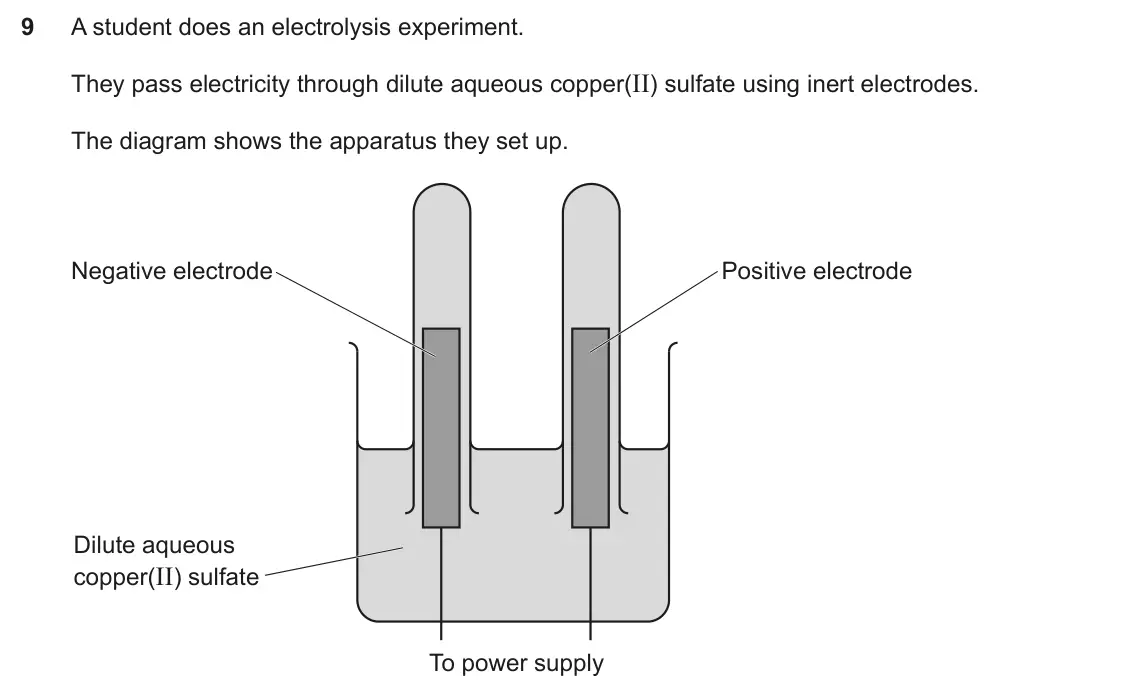
Q9(b)(i)
The whole paper ↗Q9(b)(ii)
The whole paper ↗Q9(c)
The whole paper ↗Q3(b)(ii)
The whole paper ↗Q2(a)
The whole paper ↗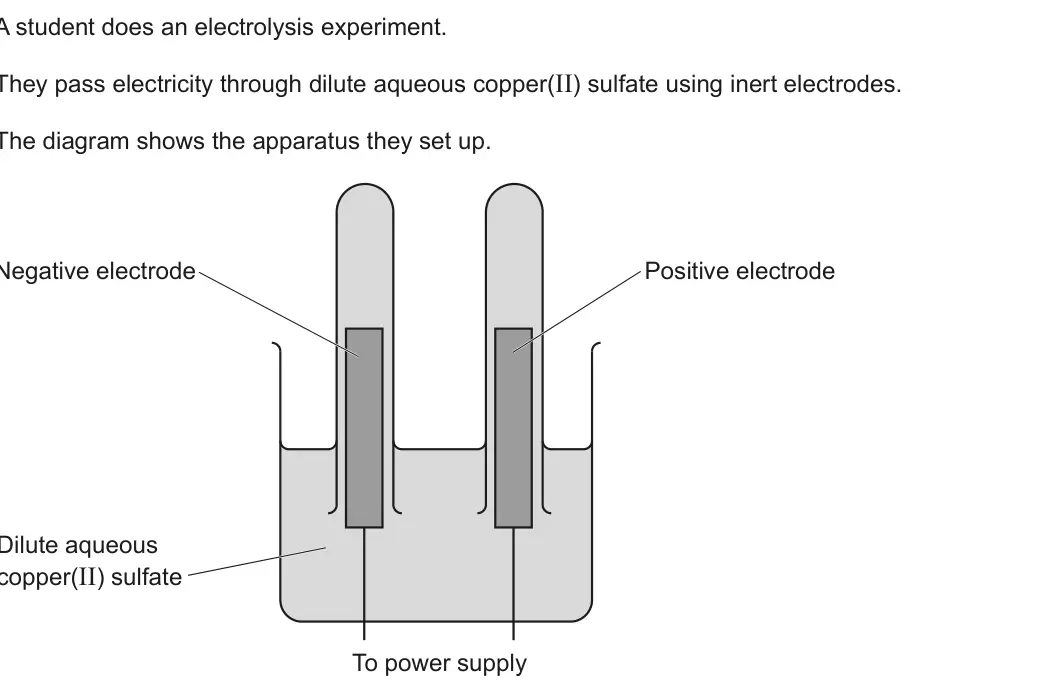
Q2(b)(i)
The whole paper ↗Q2(b)(ii)
The whole paper ↗Q2(c)
The whole paper ↗Q5(a)(i)
The whole paper ↗
Q5(a)(ii)
The whole paper ↗Q5(a)(iii)
The whole paper ↗Q5(a)(iv)
The whole paper ↗Q5(b)(i)
The whole paper ↗Q5(b)(ii)
The whole paper ↗Q5(b)(iii)
The whole paper ↗Q4(b)(i)
The whole paper ↗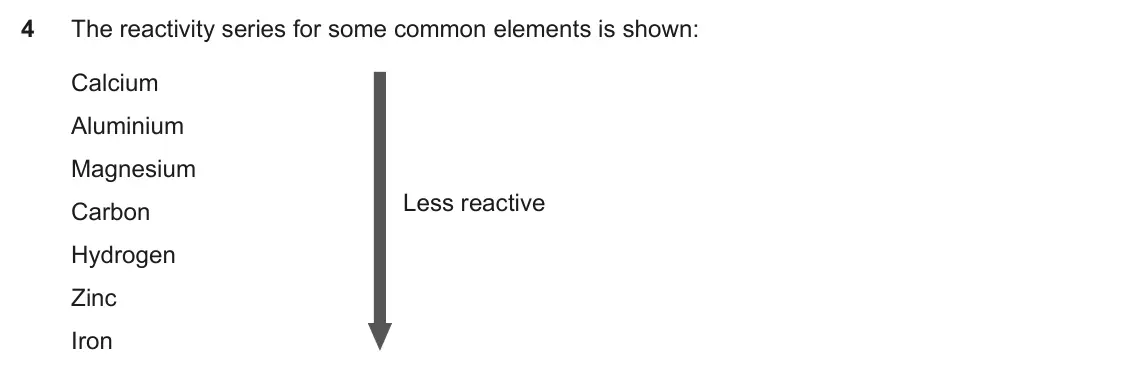
Q4(b)(ii)
The whole paper ↗Q4(c)(i)
The whole paper ↗Q4(c)(ii)
The whole paper ↗
All 57 questions on What are electrolytes and what happens during electrolysis?, as a list
- June 2025, Paper 2 Foundation, Q9(a) (2 marks): Oxygen gas forms at the positive electrode. Which two statements give correct reasons why oxygen forms at the positive electrode? Tick (✓) two boxes. Copper rea
- June 2025, Paper 2 Foundation, Q9(b)(i) (1 mark): Suggest one change to the apparatus so that the volume of oxygen gas can be measured. [1]
- June 2025, Paper 2 Foundation, Q9(b)(ii) (2 marks): Describe how the student uses the new apparatus and a stop watch to find the rate that oxygen gas forms. Include in your answer: • what results they need to col
- June 2025, Paper 2 Foundation, Q9(c) (3 marks): The student measures the mass of the electrodes before and after the electrolysis. The table shows their results. Negative electrode Positive electrode Mass bef
- June 2025, Paper 3 Higher, Q3(b)(ii) (1 mark): Which half equation shows the oxidation of zinc? Tick (✓) one box. Zn2+ + 2e– Zn Zn2+ + e– Zn Zn2+ + e– Zn Zn2+ + 2e– Zn [1]
- June 2025, Paper 4 Higher, Q2(a) (2 marks): Oxygen gas forms at the positive electrode. Which two statements give correct reasons why oxygen forms at the positive electrode? Tick (✓) two boxes. Copper rea
- June 2025, Paper 4 Higher, Q2(b)(i) (1 mark): Suggest one change to the apparatus so that the volume of oxygen gas can be measured. [1]
- June 2025, Paper 4 Higher, Q2(b)(ii) (2 marks): Describe how the student uses the new apparatus and a stop watch to find the rate that oxygen gas forms. Include in your answer: • what results they need to col
- June 2025, Paper 4 Higher, Q2(c) (3 marks): The student measures the mass of the electrodes before and after the electrolysis. The table shows their results. Negative electrode Positive electrode Mass bef
- June 2024, Paper 3 Higher, Q5(a)(i) (2 marks): anode. [2]
- June 2024, Paper 3 Higher, Q5(a)(ii) (1 mark): Why is the formation of copper from copper ions a reduction reaction? [1]
- June 2024, Paper 3 Higher, Q5(a)(iii) (2 marks): Explain why copper and not hydrogen is formed at the cathode. [2]
- June 2024, Paper 3 Higher, Q5(a)(iv) (1 mark): Describe one observation that can be seen as the electrolysis proceeds. [1]
- June 2024, Paper 3 Higher, Q5(b)(i) (2 marks): Complete the balanced symbol equation for the electrolysis of aluminium oxide. Al 2O3 Al + O2 [2]
- June 2024, Paper 3 Higher, Q5(b)(ii) (2 marks): Which two statements explain why the industrial electrolysis of aluminium oxide is very expensive? Tick (✓) two boxes. A high temperature is needed for the proc
- June 2024, Paper 3 Higher, Q5(b)(iii) (2 marks): Describe a test to identify oxygen. [2]
- June 2023, Paper 1 Foundation, Q4(b)(i) (2 marks): Which two statements about the electrolysis of aluminium oxide are correct? Tick (3) two boxes. Al 3+ ions move to the positive electrode. Oxygen is also formed
- June 2023, Paper 1 Foundation, Q4(b)(ii) (2 marks): Complete the sentence to explain how the aluminium is formed. Use words from the list. atoms ions gain lose molecules share Al 3+ ions electrons to form alumini
- June 2023, Paper 1 Foundation, Q4(c)(i) (1 mark): Why does the process of making aluminium by the electrolysis of molten aluminium oxide use a lot of energy? [1]
- June 2023, Paper 1 Foundation, Q4(c)(ii) (2 marks): A student states that aluminium can be extracted by the electrolysis of aluminium sulfate solution. Explain why the student is wrong. Use the reactivity series:
- June 2023, Paper 3 Higher, Q6(a) (1 mark): Why is the aluminium oxide molten? [1]
- June 2023, Paper 3 Higher, Q6(b)(i) (1 mark): Explain why the reaction is described as oxidation. [1]
- June 2023, Paper 3 Higher, Q6(b)(ii) (1 mark): Name the species which is oxidised in the equation. [1]
- June 2023, Paper 3 Higher, Q6(b)(iii) (1 mark): Explain why carbon dioxide is also produced at the anode. [1]
- June 2023, Paper 3 Higher, Q6(c) (2 marks): Write the balanced half equation for the production of aluminium at the cathode. [2]
- June 2023, Paper 3 Higher, Q6(e) (2 marks): A solution of aluminium sulfate contains aluminium ions. Amit says it should give aluminium at the cathode when it is electrolysed. Explain why Amit is wrong. [
- June 2022, Paper 1 Foundation, Q9(a) (2 marks): When molten compounds are electrolysed: • the metal is made at the negative electrode • the non-metal is made at the positive electrode. State what is made at e
- June 2022, Paper 1 Foundation, Q9(b)(i) (1 mark): Draw a line to connect the box labelled electrode with the correct part of the diagram. [1]
- June 2022, Paper 1 Foundation, Q9(b)(ii) (2 marks): Explain why Nina places a measuring cylinder containing sodium chloride solution over each electrode. [2]
- June 2022, Paper 1 Foundation, Q9(b)(iii) (1 mark): Sodium is not made at the negative electrode when sodium chloride solution is electrolysed. Name the gas made at the negative electrode. [1]
- June 2022, Paper 2 Foundation, Q3(b) (1 mark): The fuel cell is filled with potassium hydroxide solution rather than pure water. This is because potassium hydroxide solution is a better electrical conductor
- June 2022, Paper 3 Higher, Q11(a)(i) (1 mark): At which electrode is aluminium formed? [1]
- June 2022, Paper 3 Higher, Q11(a)(ii) (1 mark): Give one reason for your answer to (a)(i). [1]
- June 2022, Paper 3 Higher, Q11(b)(i) (1 mark): Explain why hydrogen, not sodium, is made at the negative electrode when sodium chloride solution is electrolysed. [1]
- June 2022, Paper 3 Higher, Q11(b)(ii) (2 marks): Write the half equation for the formation of hydrogen at the negative electrode. [2]
- June 2022, Paper 3 Higher, Q11(c) (2 marks): Kareem electrolyses sodium chloride solution. Hydrogen gas and chlorine gas are made. Describe what Kareem needs to do to measure the volumes of hydrogen gas an
- June 2022, Paper 4 Higher, Q5(c)(iii) (1 mark): The reaction of copper in Stage 2 can be represented by a half equation: Cu2+ + 2e– Cu Is copper oxidised or reduced in this half equation? Explain your answer.
- November 2021, Paper 2 Foundation, Q3(a) (2 marks): Explain why molten aluminium oxide conducts electricity but solid aluminium oxide does not. [2]
- November 2021, Paper 2 Foundation, Q3(b)(i) (2 marks): Give the name of the product formed at each electrode in Fig. 3.1. Product at positive electrode Product at negative electrode [2]
- November 2021, Paper 4 Higher, Q8(a)(i) (2 marks): Before electrolysis, solid aluminium oxide is dissolved in a hot, molten compound called cryolite. The formula for cryolite is Na3Al F6. Explain why the formula
- November 2021, Paper 4 Higher, Q8(a)(ii) (2 marks): The hot cryolite dissolves the aluminium oxide to form a molten solution. Explain why solid aluminium oxide has to be made into a molten solution before electro
- November 2021, Paper 4 Higher, Q8(b)(i) (4 marks): Describe what happens at each electrode during the electrolysis. [4]
- November 2021, Paper 4 Higher, Q8(b)(ii) (1 mark): The melting point of aluminium metal is 660 °C. What temperature should the inside of the tank be to make sure that aluminium leaves the tank as a liquid? Put a
- November 2020, Paper 1 Foundation, Q5(b) (2 marks): Lithium is made by the electrolysis of molten lithium chloride. Which substance is formed at each electrode? Put a ring around each correct answer. Anode (posit
- November 2020, Paper 2 Foundation, Q10(a)(i) (3 marks): Complete the table by predicting the products formed at each electrode when electricity is passed through concentrated copper chloride and dilute sodium sulfate
- November 2020, Paper 2 Foundation, Q10(a)(iii) (2 marks): Explain why, at the negative electrode: • copper metal is formed when electricity is passed through dilute copper chloride, but • hydrogen gas is formed when el
- November 2020, Paper 2 Foundation, Q10(b) (2 marks): This is a list of apparatus Sundip uses to pass electricity through the solution of dilute sodium chloride: • electrodes • leads and clips • a battery • a beake
- November 2020, Paper 3 Higher, Q10(c) (2 marks): Lithium is made by the electrolysis of molten lithium chloride. Name the product formed at each electrode. Cathode Anode [2]
- November 2020, Paper 4 Higher, Q2(a)(i) (3 marks): Complete the table by predicting the products formed at each electrode when electricity is passed through concentrated copper chloride and dilute sodium sulfate
- November 2020, Paper 4 Higher, Q2(a)(ii) (2 marks): Sundip uses tests to identify the gases formed in her experiments. Draw lines to connect each gas to its correct test and result. Gas Test and result relights a
- November 2020, Paper 4 Higher, Q2(a)(iii) (2 marks): Explain why, at the negative electrode: • copper metal is formed when electricity is passed through dilute copper chloride, but • hydrogen gas is formed when el
- November 2020, Paper 4 Higher, Q2(b) (2 marks): This is a list of apparatus Sundip uses to pass electricity through the solution of dilute sodium chloride: • electrodes • leads and clips • a battery • a beake
- June 2018, Paper 1 Foundation, Q6(a) (3 marks): The electrolysis produces chlorine. Complete the sentence by putting a ring around one word in each pair. The chlorine / chloride ions are attracted to the posi
- June 2018, Paper 1 Foundation, Q6(b) (3 marks): Nina electrolyses a solution of sodium chloride. She uses this apparatus. sodium chloride solution Nina thinks that the experiment makes chlorine gas at one ele
- June 2018, Paper 3 Higher, Q10(a) (1 mark): Which statements about the electrolysis of water are correct? Ticks (3) two boxes. The equation for the formation of hydrogen gas is 2H+ + 2e– H. Hydrogen is pr
- June 2018, Paper 3 Higher, Q11(a) (2 marks): The ions present in molten aluminium oxide are Al 3+ and O2–. Write half-equations for the formation of aluminium and oxygen in the electrolysis cell. Formation
- June 2018, Paper 3 Higher, Q11(b) (3 marks): Aluminium oxide does not conduct electricity when it is solid. It conducts electricity when it is molten. Explain why. [3]
Questions, mark schemes and examiner’s reports are © OCR, from their published past papers. Plumi isn’t affiliated with any exam board. Want whole papers? Every OCR GCSE Chemistry B paper.
Rather write your answers by hand on iPad? Plumi marks them against the same mark schemes.