 plumi
How do we know about mitochondria and other cell structures?: OCR GCSE Biology B questions
Every OCR GCSE Biology B exam question on B4.2 How do we know about mitochondria and other cell structures?, 2018–2025, with its mark scheme and examiner’s report.
Paper
All papers
Exam
All years
Calculations
Q4(d)(i)
The whole paper ↗
Q4(d)(ii)
The whole paper ↗Q4(d)(iii)
The whole paper ↗Q11(b)(ii)
The whole paper ↗Q6(d)(i)
The whole paper ↗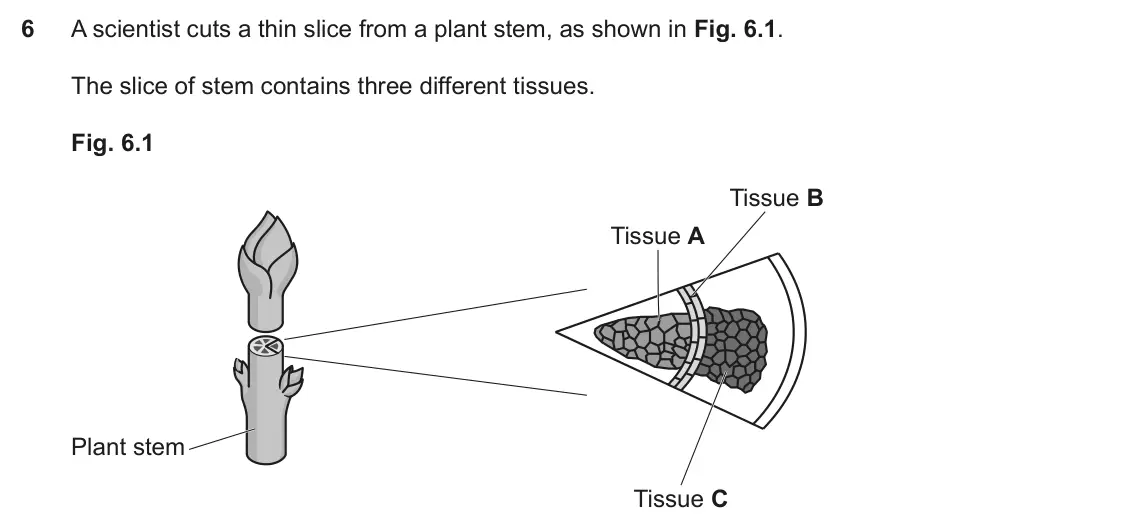
Q6(d)(ii)
The whole paper ↗Q1(b)(ii)
The whole paper ↗Q1(d)(i)
The whole paper ↗
Q1(d)(ii)
The whole paper ↗Q3(d)
The whole paper ↗
Q3(e)
The whole paper ↗
Q3(f)
The whole paper ↗Q12(b)(i)
The whole paper ↗
Q12(b)(ii)
The whole paper ↗Q5(d)
The whole paper ↗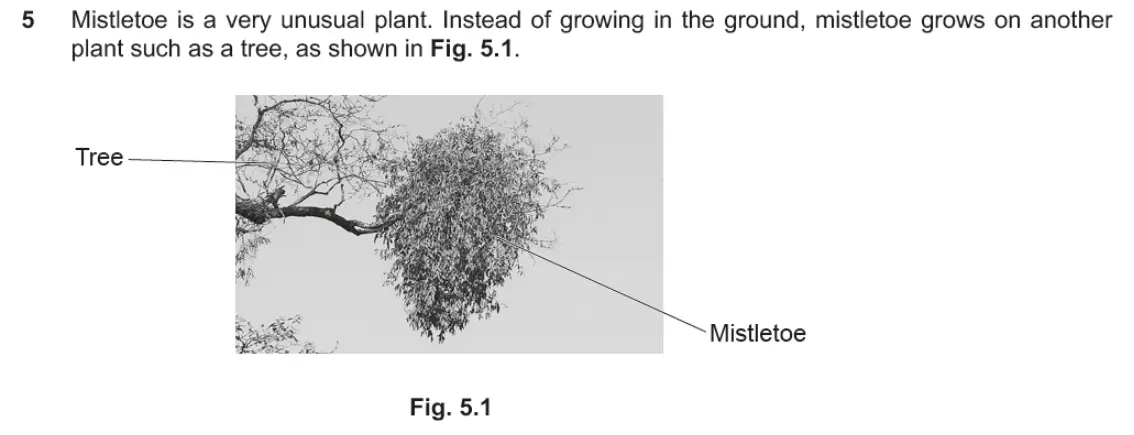
Q6(b)(i)
The whole paper ↗
Q6(b)(ii)
The whole paper ↗Q4(c)(i)
The whole paper ↗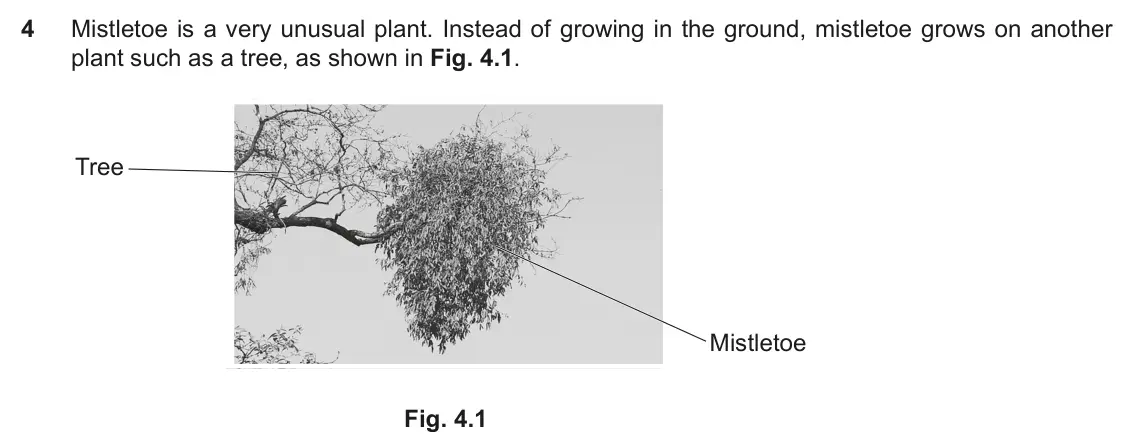
Q4(c)(ii)
The whole paper ↗Q2(d)
The whole paper ↗
All 29 questions on How do we know about mitochondria and other cell structures?, as a list
- June 2025, Paper 4 Higher, Q4(d)(i) (1 mark): Suggest which type of microscope was used to produce the image in Fig. 4.3. [1]
- June 2025, Paper 4 Higher, Q4(d)(ii) (1 mark): Explain why this type of microscope can show the structure of stomata in great detail. [1]
- June 2025, Paper 4 Higher, Q4(d)(iii) (1 mark): The length of one of the stomata is 10 µm, which is 1 × 10⁻² mm. Which of these is the same as 1 × 10⁻² mm? Tick (3) one box. 0.001 mm 0.01 mm 10.00 mm 100 mm [
- June 2023, Paper 1 Foundation, Q11(b)(ii) (1 mark): The image shows the mitochondria in a section of heart muscle. The mitochondria are different sizes. One of the mitochondria is labelled. A mitochondria Estimat
- June 2023, Paper 2 Foundation, Q6(d)(i) (1 mark): What is 10 μm to the nearest order of magnitude? Put a ring around the correct option. 100μm 101μm 102μm 103μm [1]
- June 2023, Paper 2 Foundation, Q6(d)(ii) (1 mark): In the dividing cell, a single chromosome has a width of 0.01 μm. How many orders of magnitude larger is the cell than the single chromosome? Put a ring around
- June 2023, Paper 3 Higher, Q1(b)(ii) (1 mark): The image shows the mitochondria in a section of heart muscle. The mitochondria are different sizes. One of the mitochondria is labelled. A mitochondria Estimat
- June 2023, Paper 4 Higher, Q1(d)(i) (1 mark): What is 10 μm to the nearest order of magnitude? Put a ring around the correct option. 100μm 101μm 102μm 103μm [1]
- June 2023, Paper 4 Higher, Q1(d)(ii) (1 mark): In the dividing cell, a single chromosome has a width of 0.01 μm. How many orders of magnitude larger is the cell than the single chromosome? Put a ring around
- June 2022, Paper 1 Foundation, Q3(d) (1 mark): State one reason why an electron microscope can be used to see the detailed structure of mitochondria. [1]
- June 2022, Paper 4 Higher, Q3(e) (1 mark): The length of a cell is 0.00002 m. How is the length of the cell written in standard form? Put a ring around the correct answer. 2 × 10⁻⁵ m 2 × 10⁻⁴ m 2 × 10⁴ m
- June 2022, Paper 4 Higher, Q3(f) (1 mark): The length of a mitochondrion is 3 × 10⁻⁶ m. What is another way to write the length of the mitochondrion? Put a ring around the correct answer. 0.0003 m 0.0000
- November 2021, Paper 3 Higher, Q12(b)(i) (2 marks): The actual size of this cell from points A to B is 80 µm. Calculate the magnification used to produce this drawing. Use the equation: magnification = measured s
- November 2021, Paper 3 Higher, Q12(b)(ii) (3 marks): The magnification of a light microscope is 1.5 × 10³. The magnification of an electron microscope is 5 × 10⁵. Calculate the difference in magnification. Give yo
- November 2020, Paper 2 Foundation, Q5(d) (2 marks): Fig. 5.5 shows an image of some of the microorganisms from the mistletoe. Microorganism A 0.003 mm Fig. 5.5 The actual length of microorganism A is 0.003 mm. In
- November 2020, Paper 3 Higher, Q6(b)(i) (1 mark): What type of microscope would be used to take this image? [1]
- November 2020, Paper 3 Higher, Q6(b)(ii) (2 marks): Explain how this type of microscope has increased our understanding of structures such as mitochondria. [2]
- November 2020, Paper 4 Higher, Q4(c)(i) (2 marks): The actual length of bacterium A is 3 μm. In the image in Fig. 4.3 it appears to be 4.5 cm long. 1 μm = 0.0001 cm Calculate the magnification of the image. Use
- November 2020, Paper 4 Higher, Q4(c)(ii) (2 marks): Each bacterium from the tree is 3 × 10⁻⁴ cm long. Is it possible that the bacteria from the tree are the same bacteria as bacterium A from the mistletoe? Yes No
- June 2019, Paper 1 Foundation, Q2(d) (1 mark): Electron microscopes can be used to see small cell structures such as mitochondria. Which statement explains why? Tick (3) one box. They are easy to use. They a
- June 2019, Paper 4 Higher, Q4(a)(ii) (2 marks): The length of the stoma in Ling’s photograph is 15 mm. The photograph has a magnification of ×400. Calculate the length of the original stoma. Give your answer
- June 2018, Paper 2 Foundation, Q3(d)(i) (1 mark): What is the diameter of the bacterium, in m, in standard form? Put a ring around the correct answer. 2 × 10⁶ m 206 m 2 × 10⁻⁶ m 20−6 m [1]
- June 2018, Paper 2 Foundation, Q3(d)(ii) (1 mark): What is the diameter of the plant cell, in μm? Put a ring around the correct answer. 80−6μm 80 μm 75 μm 40 μm 0.00008 μm [1]
- June 2018, Paper 2 Foundation, Q3(d)(iii) (2 marks): Amir knows that: • most viruses measure less than 250 nm in diameter • his light microscope will not allow him to see objects smaller than 1 μm in diameter. Can
- June 2018, Paper 2 Foundation, Q3(d)(iv) (2 marks): Suggest a piece of apparatus that Amir could use to see viruses in the infected plant cells. Explain your answer. [2]
- June 2018, Paper 4 Higher, Q4(d)(i) (1 mark): Give the mean diameter of the plant cell in μm. Mean diameter = μm [1]
- June 2018, Paper 4 Higher, Q4(d)(ii) (1 mark): Give the mean diameter of the bacterium in m. Give your answer in standard form. Mean diameter = m [1]
- June 2018, Paper 4 Higher, Q4(d)(iii) (2 marks): Give the mean diameter of the plant cell, in m, to the nearest order of magnitude. Mean diameter = m [2]
- June 2018, Paper 4 Higher, Q4(d)(iv) (2 marks): Show that the sizes of the bacterium and the virus are the same order of magnitude. [2]
Questions, mark schemes and examiner’s reports are © OCR, from their published past papers. Plumi isn’t affiliated with any exam board. Want whole papers? Every OCR GCSE Biology B paper.
Rather write your answers by hand on iPad? Plumi marks them against the same mark schemes.