 plumi
Lenses and image formation: OCR A‑Level Physics B questions
OCR A-Level Physics B past-paper questions on 3.1.1.1 Lenses and image formation, 2016–2025, with mark schemes and examiner’s reports where available.
Paper
All papers
Exam
All years
Calculations
- Your answer
- Your answer
- Your answer
- Your answer
Q23(a)
The whole paper ↗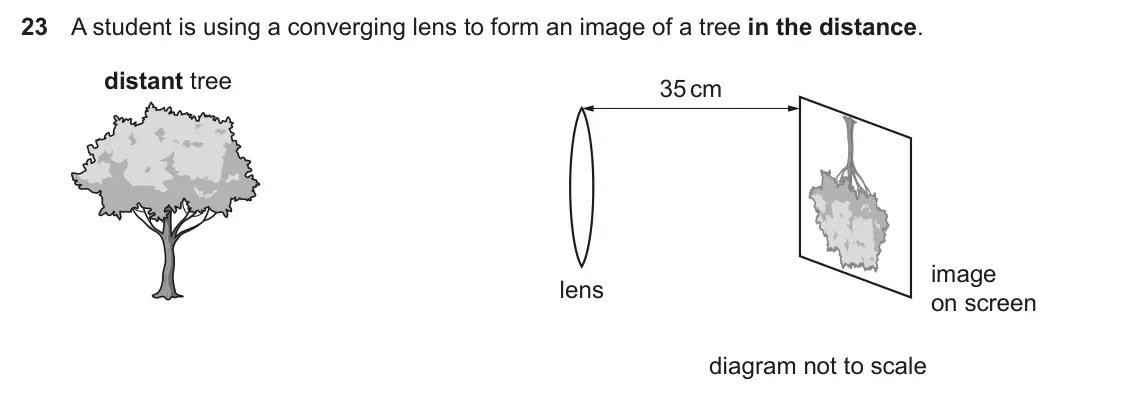
Q23(b)
The whole paper ↗- Your answer
- Your answer
Q3(a)
The whole paper ↗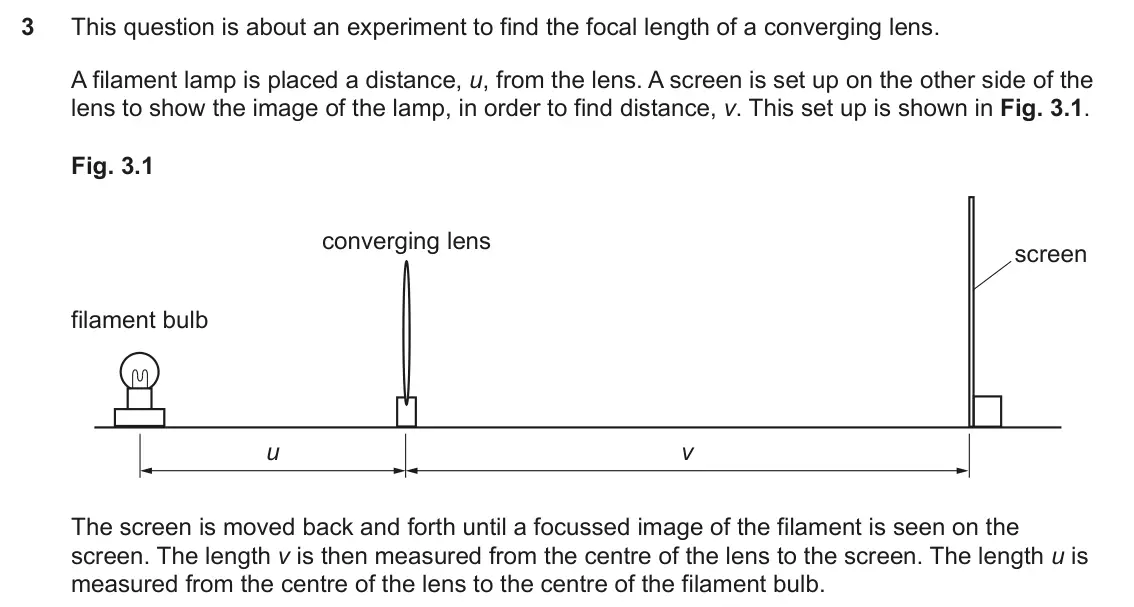
Q3(c)
The whole paper ↗Q3(d)
The whole paper ↗- Your answer
Q1(b)
The whole paper ↗- Your answer
Q6(a)(i)
The whole paper ↗
Q6(a)(ii)
The whole paper ↗Q6(a)(iii)
The whole paper ↗Q6(b)(ii)
The whole paper ↗Q6(c)(i)
The whole paper ↗Q6(c)(ii)
The whole paper ↗
All 58 questions on Lenses and image formation, as a list
- June 2025, Paper 1, Q3 (1 mark): What is the magnification of the image? A –167 B –0.0060 C +0.0060 D +167 [1] Your answer
- June 2025, Paper 1, Q4 (1 mark): What is the focal length of the lens? A –3.02 cm B –2.98 cm C 2.98 cm D 3.02 cm [1] Your answer
- June 2025, AS Paper 1, Q2 (1 mark): The diagram shows two rays of light passing through a converging lens. z The distance z is called the: A Focal length B Focus C Image length D Power Your answer
- June 2025, AS Paper 1, Q5 (1 mark): A typical value for the linear magnification achieved by a light microscope used in a secondary school is: 10–6 A 10–2 B 102 C 106 D Your answer [1]
- June 2025, AS Paper 1, Q23(a) (3 marks): Use the lens formula to show that the power of the lens is about +3D. 1 v = 1 u + 1 f [3]
- June 2025, AS Paper 1, Q23(b) (3 marks): Light reflected from the tree is refracted as it passes through the lens. Draw wavefronts on the diagram below to show how the curvature of wavefronts is affect
- June 2024, Paper 1, Q3 (1 mark): What is the power of the lens? A 4 D B 5 D C 6 D D 7 D Your answer [1]
- June 2024, Paper 1, Q4 (1 mark): What is the length of the image? A 2.5 cm B 5.0 cm C 7.5 cm D 10.0 cm Your answer [1]
- June 2024, Paper 3, Q3(a) (2 marks): Measurements of u and v are recorded in Table 3.1. Complete the table by calculating the missing values of 1 u and 1 v . Table 3.1 1 1 /m–1 /m–1 u / m v / m u v
- June 2024, Paper 3, Q3(c) (3 marks): Determine a value for the focal length of the lens. Use your line on the graph. focal length = m [3] 11 Fig. 3.2
- June 2024, Paper 3, Q3(d) (6 marks): Describe the sources of uncertainties and the limitations of this method to find the focal length of a lens. Describe and explain methods to improve the experim
- June 2024, AS Paper 1, Q4 (1 mark): A spacecraft takes an image of Saturn’s moon Enceladus. The image of the full moon fills the imaging sensor which has diameter 5 mm. The moon’s diameter is 500
- June 2024, AS Paper 2, Q1(b) (2 marks): Fig. 1.3 shows two rays and three wave-fronts in a beam of light that is incident on a thin converging lens. The focal length of the lens is f. Fig. 1.3 f ray r
- June 2023, Paper 1, Q13 (1 mark): A pencil of length 0.15 m is placed 1.20 m from a lens of power +5.00 D and forms a clear image. What is the length of the image of the pencil? A 0.02 m B 0.03
- June 2023, Paper 2, Q6(a)(i) (1 mark): What feature of Fig. 6.1 shows that the object producing the wavefronts is a long way from the lens? [1]
- June 2023, Paper 2, Q6(a)(ii) (1 mark): Add wavefronts to the right of the lens which focus at point P. [1]
- June 2023, Paper 2, Q6(a)(iii) (2 marks): The lens adds curvature of +1.8 D to the waves. Calculate the distance from the lens to point P. Explain your reasoning. distance to P = m Reasoning: [2]
- June 2023, Paper 2, Q6(b)(ii) (2 marks): Explain why the power of the lens will be greater for shorter wavelength light and the effect this will have on the focal length of the lens for light of differ
- June 2023, Paper 2, Q6(c)(i) (2 marks): This letter X is approximately 4 mm high. Calculate the height of the image of the X on the retina of a person with normal vision when viewed from the near poin
- June 2023, Paper 2, Q6(c)(ii) (2 marks): Calculate the power of a lens required to allow a person with a near point of 50 cm to focus an object at a distance of 25 cm. lens power = D [2]
- June 2023, Paper 2, Q6(d) (3 marks): Here are some data about two materials used for spectacle lenses. density / kg m–3 material refractive index 3.2 × 10³ high-index glass 1.70 1.2 × 10³ plastic (
- June 2023, AS Paper 1, Q25(a) (2 marks): Show that the focal length of the lens is approximately 4 cm. [2] The diagram below shows wavefronts from an object in front of the dashcam incident on the lens
- June 2023, AS Paper 1, Q25(b) (2 marks): Add to the diagram to show the wavefronts between the lens and the sensor. [2] 17 The dashcam requires a memory card to store the video it captures. The dashcam
- June 2022, Paper 1, Q1 (1 mark): In an experiment to determine the focal length of a converging lens, a student sets up the apparatus shown in the diagram and observes a clear image on the scre
- June 2022, Paper 1, Q3 (1 mark): The diagram shows how the wavefronts and rays leave a converging lens. The focal length of the lens is f and the distance between the object that produced the w
- June 2022, AS Paper 1, Q10 (1 mark): From which of these can you determine the power of a thin converging lens? A diameter B focal length C image distance D magnification Your answer [1]
- June 2022, AS Paper 2, Q4(a) (2 marks): Calculate the power P of the lens. P = D [2]
- June 2022, AS Paper 2, Q4(b) (3 marks): The diagram below shows the light ray in region A. Two wavefronts to the left of the lens are shown. Draw wavefronts on this diagram to show how the shape and s
- June 2022, AS Paper 2, Q6(b)(ii) (2 marks): When the camera records an image of a distant object, the image distance v from the lens to the CCD sensor is 19.5 mm. Show that the camera can resolve two poin
- November 2021, Paper 1, Q5 (1 mark): Which adjustments need to be made to produce a more magnified image? Screen Lens A closer to the lens closer to the slide B closer to the lens further from the
- November 2021, Paper 1, Q6 (1 mark): The power of the projecting lens in dioptres, D is A 0.040 B 0.071 C 25.0 D 25.1 Your answer [1]
- November 2021, AS Paper 1, Q24(a) (2 marks): Calculate the curvature of the wavefront on the right of the lens. curvature = m–1 [2] The candle is moved further away from the lens (to the left) and the imag
- November 2021, AS Paper 1, Q24(b) (1 mark): State how to move the card to re-focus the image. [1]
- November 2021, AS Paper 1, Q24(c) (2 marks): Describe two differences in the appearance of this image compared to the original image. 1 [1] 2 . [1]
- November 2020, Paper 1, Q2 (1 mark): A real image is formed by a lens of power 20 D. Which statement is correct? A All wavefronts passing through the lens have a final curvature of 20 D. B The foca
- November 2020, Paper 2, Q4(a) (1 mark): The lens system of the camera acts like a single lens of focal length 3.85 mm. Calculate the curvature added to waves when they pass through the lens. curvature
- November 2020, Paper 2, Q4(b) (2 marks): Use ideas about curvature of waves to explain why the lens cannot form an image of an object closer than or equal to 3.85 mm from the lens. [2]
- November 2020, Paper 2, Q4(c) (3 marks): The light-sensitive surface in the camera is fixed 3.85 mm behind the lens. The image recorded on this surface will be clear if the true position of the image i
- November 2020, Paper 2, Q4(d) (2 marks): The camera is used to form an image of a resin chess piece Fig. 4 a. The chess piece is 0.090 m long. It is 0.35 m from the lens. Image recorded by camera Proce
- June 2019, Paper 1, Q5 (1 mark): A slide projector has a lens of focal length f. It is set up to give a large, magnified focused image on a screen. The screen is further than 2 f from the lens
- June 2019, AS Paper 2, Q8(c) (2 marks): Show that the lens equation for a converging lens of power P should result in a straight-line graph with gradient 1 and y-axis intercept P if 1 v is plotted on
- June 2018, Paper 1, Q31(a) (3 marks): Calculate the power of the lens. power of the lens = D [3]
- June 2018, Paper 1, Q31(b) (1 mark): State the magnification of the lens in this example. magnification = [1]
- June 2018, AS Paper 1, Q12 (1 mark): A converging lens produces a focused image at a distance of 0.40 m from the lens. The magnification of the image is 2.0. What is the power of the lens? A 0.13 D
- June 2018, AS Paper 1, Q27(b)(ii) (2 marks): The image was taken with a sensor of square pixels of width 5 μm. Fig. 27.2 shows the formation of this image (not to scale). CCD lens Enceladus (not to scale)
- June 2018, AS Paper 2, Q1(a) (2 marks): Calculate the power P of the combination of the cornea and the lens. P = D [2]
- June 2018, AS Paper 2, Q1(b) (2 marks): The sensitive cells at the centre of the retina are separated by 2.5 μm. Calculate the distance d on the book that would correspond to this separation in the im
- June 2018, AS Paper 2, Q1(c) (2 marks): A long-sighted person cannot focus on an object 25 cm from the eye. Carol is long-sighted and the closest object that forms a sharp image on her retina is 1.5 m
- June 2017, Paper 3, Q4(b)(i) (2 marks): The last two points from Fig. 4.2 have not been plotted. Complete Fig. 4.5 below, adding the last two magnification values. u / m v / m m −0.225 0.480 −0.200 0.
- June 2017, Paper 3, Q4(b)(iii) (2 marks): Use v to show that m + . 1 = + =- u f f [2]
- June 2017, Paper 3, Q4(b)(iv) (2 marks): Use data from the graph to calculate the focal length f of the lens. f = m [2]
- June 2017, Paper 3, Q4(c)(i) (1 mark): Use Fig. 4.6 to determine the power of this lens. Power = dioptre [1]
- June 2017, AS Paper 1, Q22 (3 marks): The lens in a digital camera has focal length, f = 2.0 cm. The camera is used to take a picture of a cat that is 50 cm away. Calculate the distance between the
- June 2016, AS Paper 1, Q6 (1 mark): Waves from an object 0.5 m away pass through a lens of focal length 0.2 m. Which of the following give the curvature of the waves entering the lens and leaving
- June 2016, AS Paper 2, Q1(a) (1 mark): Show that the power of the lens is 250 D. [1]
- June 2016, AS Paper 2, Q1(b)(i) (3 marks): Show that the lens needs to move less than 0.1 mm from its original position, 4.0 mm from the CCD detector, to give a sharp image of the object page. [3]
- June 2016, AS Paper 2, Q1(b)(ii) (2 marks): Explain why a letter 3 mm long on the object page, 24 cm from the lens, will result in an image on the CCD detector which is about 0.05 mm long. [2]
- June 2016, AS Paper 2, Q1(b)(iii) (2 marks): The 5 megapixel CCD detector in the camera is shown in Fig. 1. Calculate the distance in mm on the object page corresponding to 1 pixel on the detector. 6.4 mm
Questions, mark schemes and examiner’s reports are © OCR, from their published past papers. Plumi isn’t affiliated with any exam board. Want whole papers? OCR A-Level Physics B past papers.
The Plumi iPad app also offers exam-style questions with AI feedback on your handwritten working.