 plumi
The expanding universe and the big bang: OCR A‑Level Physics B questions
OCR A-Level Physics B past-paper questions on 5.1.3.3 The expanding universe and the big bang, 2016–2025, with mark schemes and examiner’s reports where available.
Paper
All papers
Exam
All years
Calculations

- Your answer
Q10(a)
The whole paper ↗
Q10(c)
The whole paper ↗Q33(a)
The whole paper ↗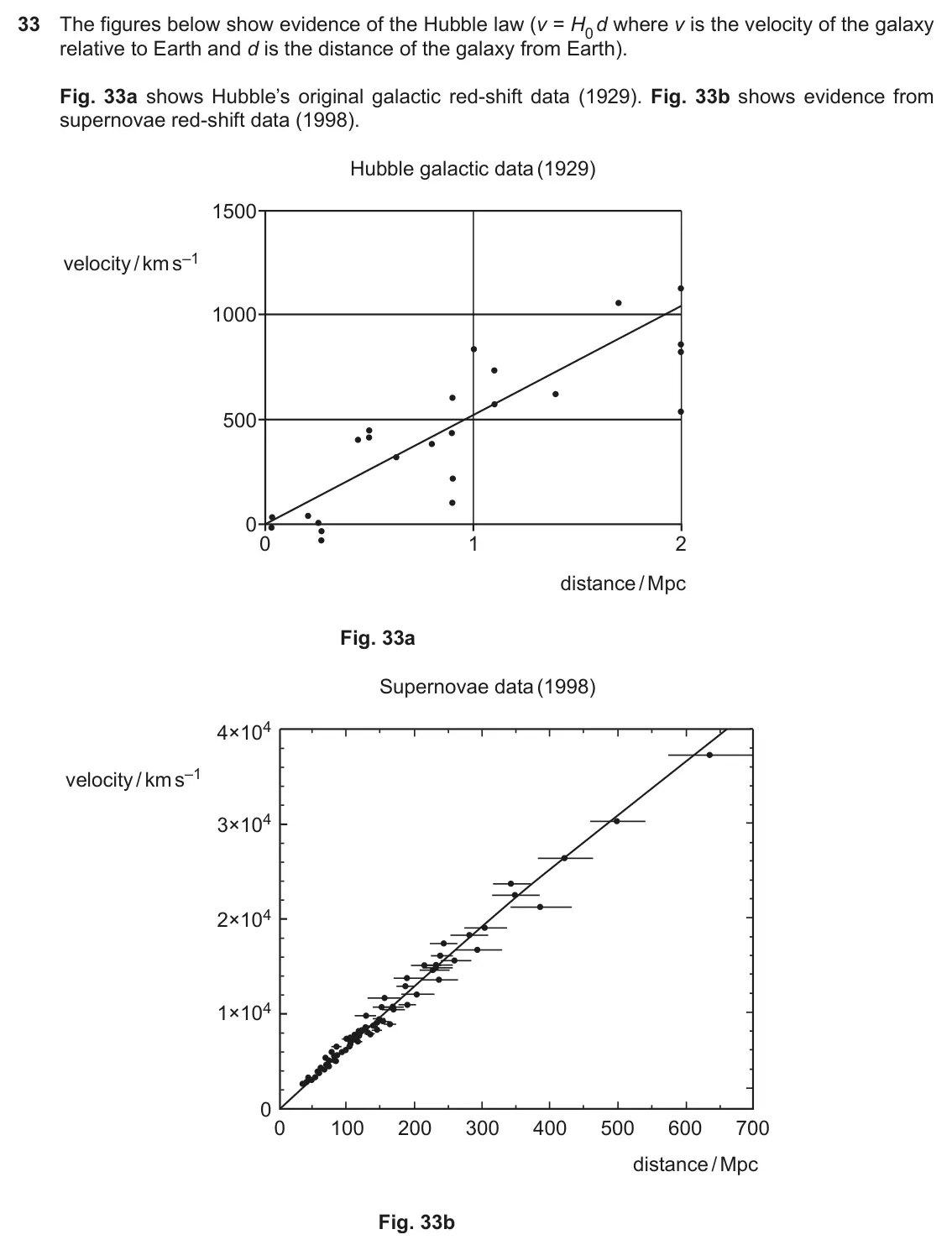
Q33(b)(i)
The whole paper ↗Q33(b)(ii)
The whole paper ↗Q3(b)
The whole paper ↗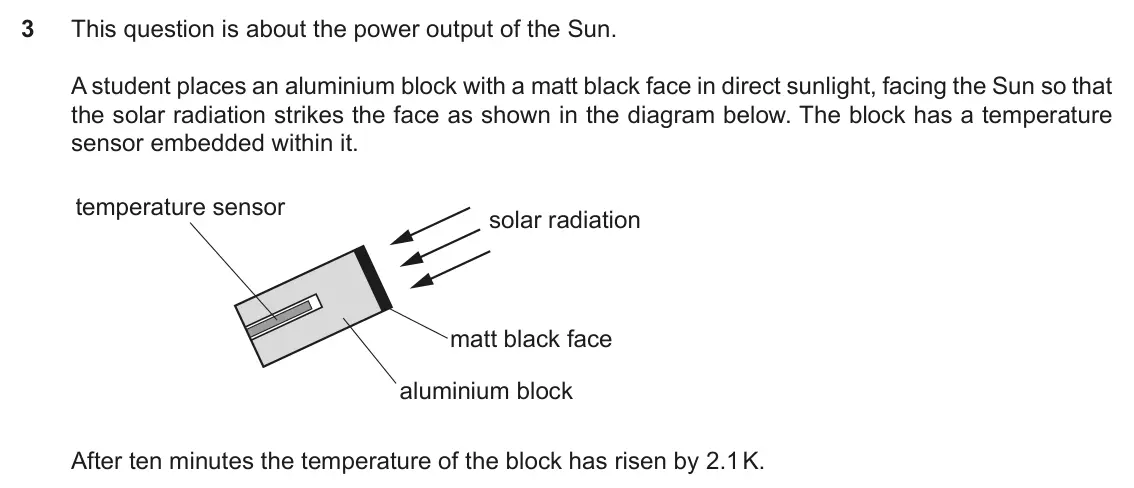
Q38(a)
The whole paper ↗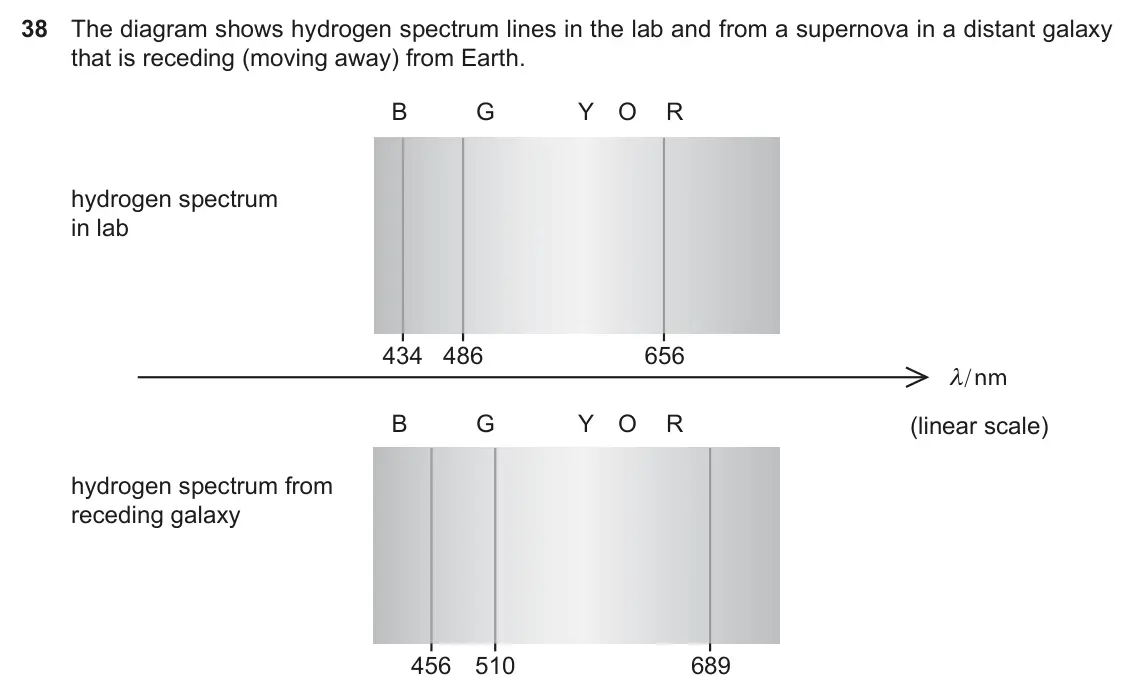
Q38(b)
The whole paper ↗Q38(c)
The whole paper ↗Q38(b)(i)
The whole paper ↗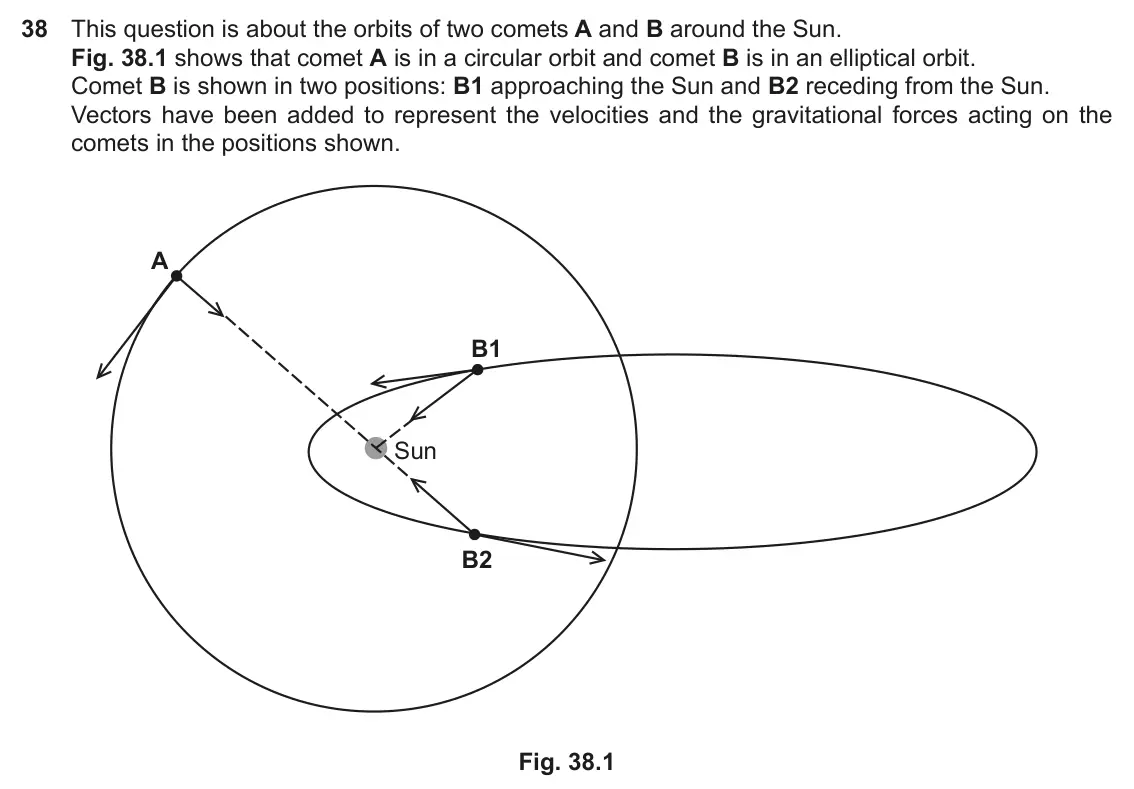
- Your answer
Q36(a)(i)
The whole paper ↗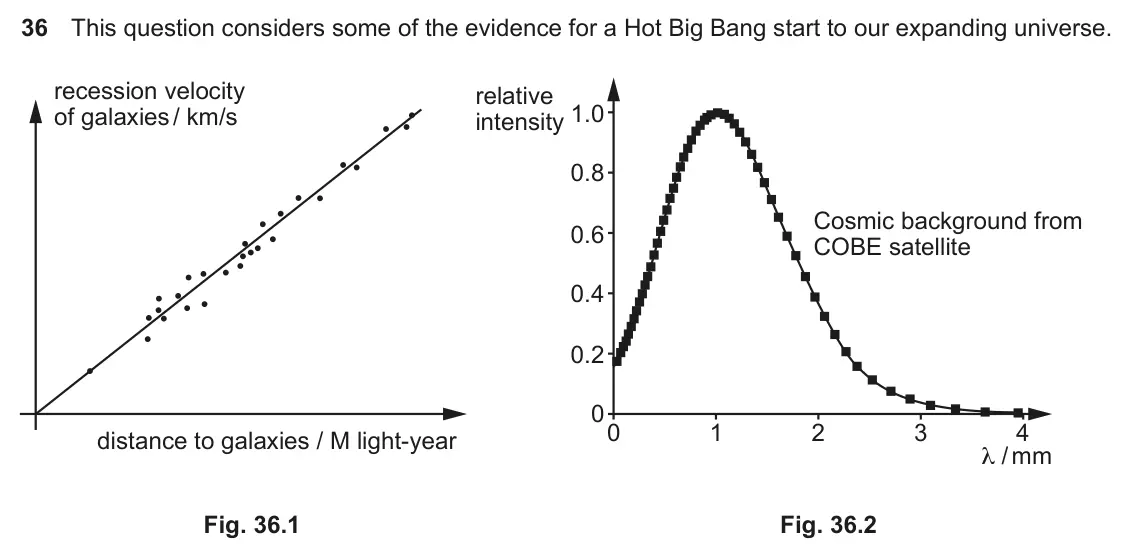
Q36(a)(ii)
The whole paper ↗Q36(b)
The whole paper ↗
All 20 questions on The expanding universe and the big bang, as a list
- June 2024, Paper 2, Q8(b)(ii) (6 marks): This question is about the resolution of the James Webb Space Telescope (JWST) (lines 19–25 and lines 47–51). (ii)* Light emitted from the galaxy at wavelength
- June 2023, Paper 1, Q5 (1 mark): Which of the following statements about the Universe is correct? A Hubble’s Law shows that our galaxy is at the centre of the Universe. B The age of a galaxy ca
- June 2022, Paper 2, Q10(a) (2 marks): The Earth orbits the Sun at a distance of 1.5 × 10¹¹ m. At this distance the intensity of solar radiation is 1400 W m–2. Calculate the intensity at the distance
- June 2022, Paper 2, Q10(b) (1 mark): Use your answer to (a) and Stefan’s Law (line 125) to estimate the temperature of a body in thermal equilibrium at 1.4 × 10¹⁰ m from the Sun. temperature = K [1
- June 2022, Paper 2, Q10(c) (2 marks): Explain why missions investigating the Sun such as the Parker Solar Probe can have an importance beyond scientific discovery. [2]
- November 2021, Paper 1, Q33(a) (2 marks): Three of the nearer galaxies in Fig. 33a have a negative velocity. Suggest and explain the effect this has on the wavelength shift for these galaxies. [2]
- November 2021, Paper 1, Q33(b)(i) (2 marks): Show from the lines of best fit that the best estimate for the Hubble constant H0 was more than eight times (× 8) larger in 1929 than in 1998. [2]
- November 2021, Paper 1, Q33(b)(ii) (2 marks): Show that the data from Fig. 33b indicate that the ‘big bang’ happened more than 10 billion years ago. 1 Mpc (megaparsec) = 3.1 × 10²² m [2]
- November 2021, Paper 2, Q3(b) (2 marks): The power per m2 of solar radiation of all wavelengths striking the top of the Earth’s atmosphere is 1.4 kW m–2. The distance from the Earth to the Sun is 1.5 ×
- November 2020, Paper 1, Q38(a) (1 mark): Explain why the spectrum from the receding galaxy is described as red-shifted. [1]
- November 2020, Paper 1, Q38(b) (2 marks): Choose any two lines in the spectrum to show that the shift in wavelength Δλ is proportional to the wavelength in the lab λ. [2]
- November 2020, Paper 1, Q38(c) (1 mark): For non-relativistic recession velocities v, the red-shift is given by the equation: λ = v Δλ c Use this formula to show that the recession velocity of the gala
- June 2019, Paper 1, Q38(b)(i) (2 marks): Show that the radius of the S1 orbit is more than 2 × 10¹⁴ m. 1 light year ≈ 9.5 × 10¹⁵ m. [2]
- June 2018, Paper 1, Q2 (1 mark): Which of these ages is estimated correctly? A The Earth is about 4 billion years old. B The Sun is about 14 billion years old. C The Milky Way Galaxy is about 2
- June 2018, Paper 1, Q36(a)(i) (2 marks): a big bang expansion [2]
- June 2018, Paper 1, Q36(a)(ii) (2 marks): a hot state. [2]
- June 2018, Paper 1, Q36(b) (4 marks): The intensity spectrum of thermal radiation depends on temperature T. Photons at the peak of intensity have energy ε ≈ 5 kT. Use this approximation and data fro
- June 2017, Paper 2, Q7 (2 marks): State the feature of the diagram in Fig. 1 in the article which shows that the distance scale is logarithmic and suggest a possible disadvantage of representing
- June 2017, Paper 2, Q10 (3 marks): This question is about measuring stellar distances by parallax. The parallax of the star Sirius is 0.38 arc seconds. One light year is the distance light travel
- June 2017, Paper 2, Q12 (6 marks): 12* This question is about spectroscopic measurements of stellar distances. Describe how absorption spectra are formed and how they are useful in establishing t
Questions, mark schemes and examiner’s reports are © OCR, from their published past papers. Plumi isn’t affiliated with any exam board. Want whole papers? OCR A-Level Physics B past papers.
The Plumi iPad app also offers exam-style questions with AI feedback on your handwritten working.