 plumi
Resistivity, conductivity and charge carriers: OCR A‑Level Physics B questions
OCR A-Level Physics B past-paper questions on 3.1.2.5 Resistivity, conductivity and charge carriers, 2016–2025, with mark schemes and examiner’s reports where available.
Paper
All papers
Exam
All years
Calculations
- Your answer
Q4(c)
The whole paper ↗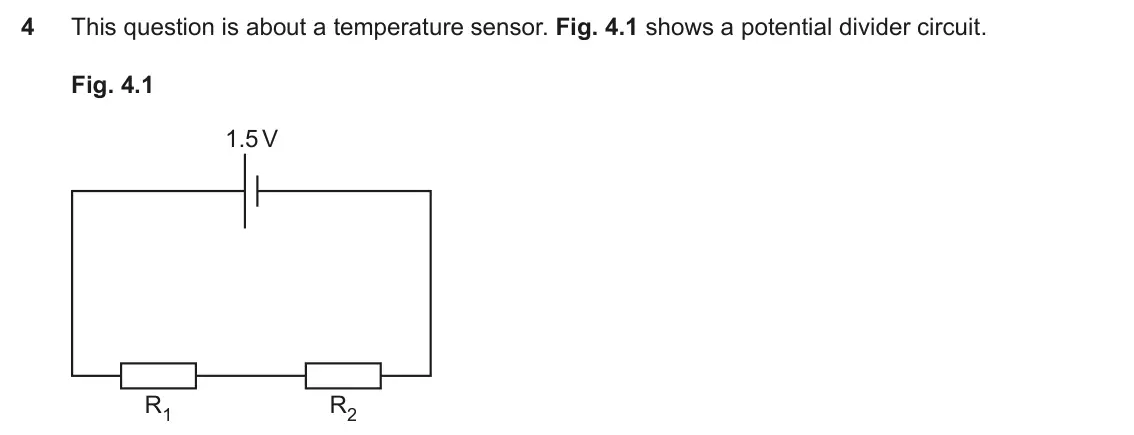
Q24(a)
The whole paper ↗Q24(c)
The whole paper ↗Q5(b)(i)
The whole paper ↗Q5(b)(iii)
The whole paper ↗Q2(b)
The whole paper ↗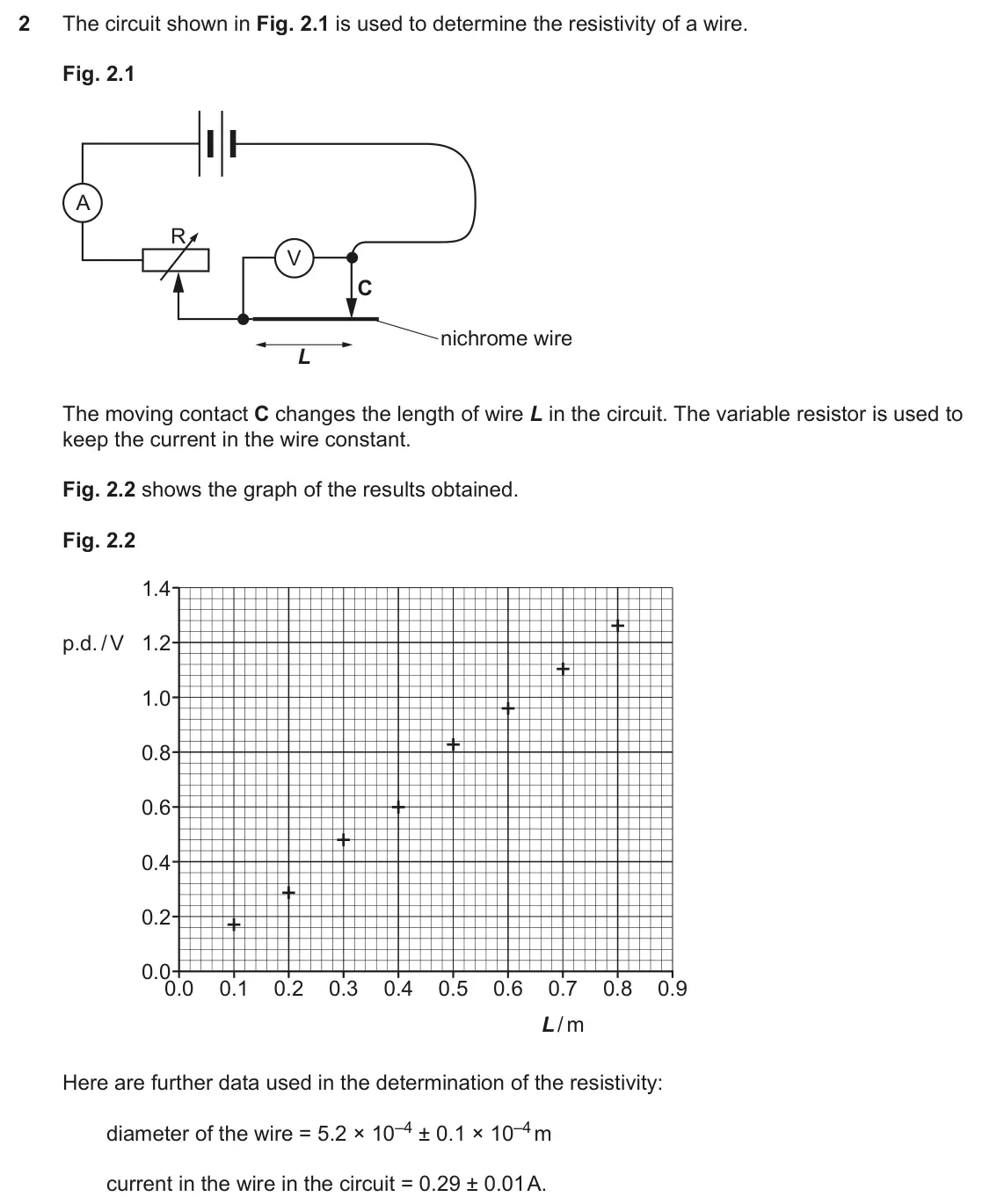
Q2(d)
The whole paper ↗Q26(d)
The whole paper ↗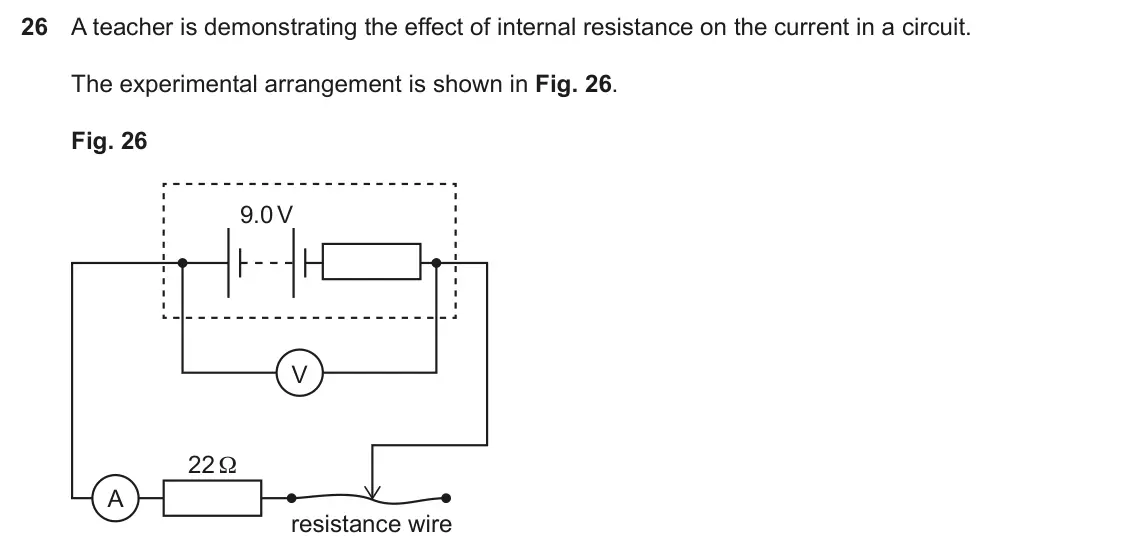
- Your answer
Q34(b)
The whole paper ↗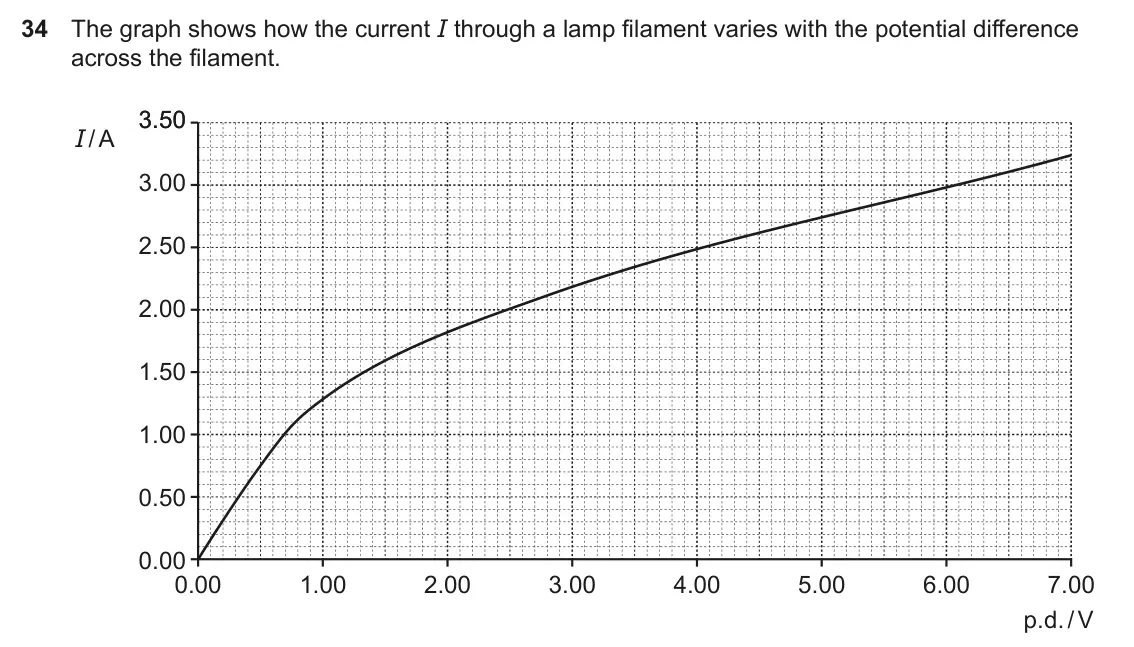
Q34(c)
The whole paper ↗Q24(a)
The whole paper ↗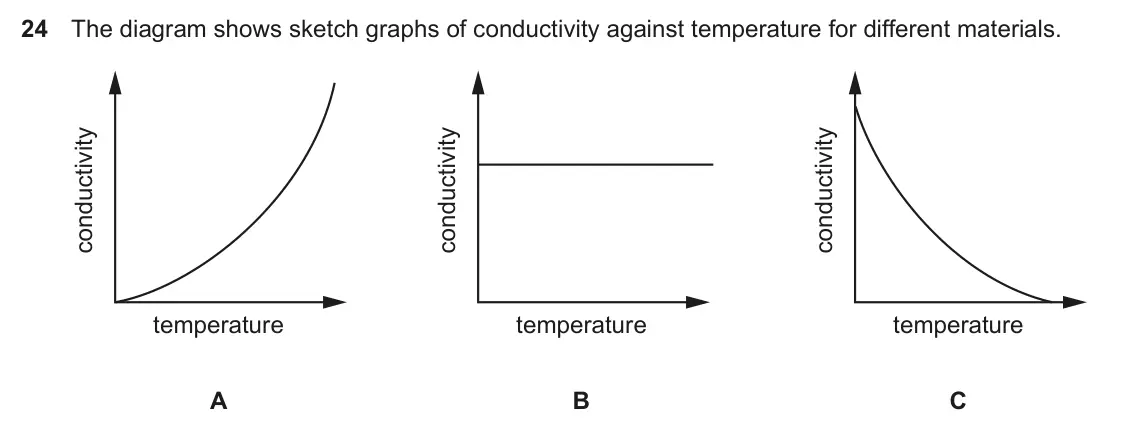
Q24(b)(i)
The whole paper ↗Q24(b)(ii)
The whole paper ↗Q5(a)
The whole paper ↗
Q3(b)
The whole paper ↗
- Your answer
Q6(a)
The whole paper ↗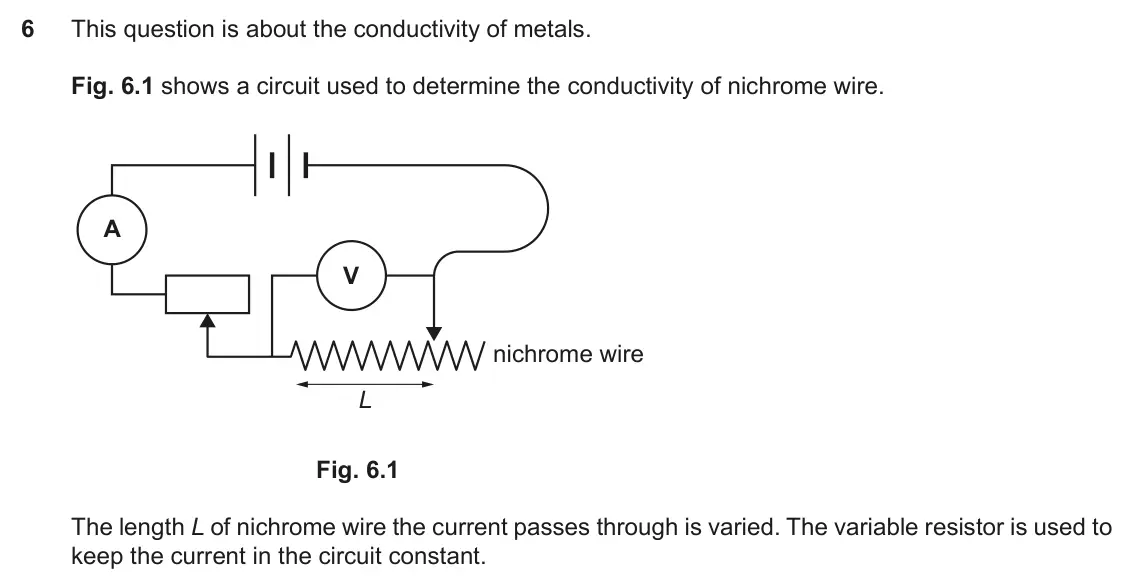
Q6(b)(iii)
The whole paper ↗
All 48 questions on Resistivity, conductivity and charge carriers, as a list
- June 2025, Paper 1, Q8 (1 mark): Wires P and Q have circular cross sections. The table gives information about wires P and Q. Wire Diameter / mm Metal Resistivity / Ω m 4.9 × 10⁹ P 0.25 constan
- June 2025, Paper 2, Q4(c) (3 marks): The resistance of the thermistor (a semiconductor) decreases when its temperature increases. Explain this by considering the behaviour and number density of the
- June 2025, AS Paper 1, Q24(a) (2 marks): Draw lines to connect the dots to describe how the number density of mobile charge carriers varies with the class of material. Class of Mobile charge carriers p
- June 2025, AS Paper 1, Q24(c) (2 marks): The compound is used to obtain pure molybdenum metal. Around 1 in 20 molybdenum atoms contributes a free electron. Calculate an approximate value for the number
- June 2025, AS Paper 2, Q5(b)(i) (2 marks): Show that the length of wire needed is about 18 cm. [2]
- June 2025, AS Paper 2, Q5(b)(iii) (4 marks): A resistor of the same value can be made using a thicker wire of the same nichrome alloy. Explain the advantages and disadvantages of using thicker wire to make
- June 2024, Paper 2, Q2(b) (2 marks): Use the value of the gradient and the further data to determine the resistivity of the material. Ignore the uncertainties at this stage. resistivity = Ω m [2]
- June 2024, Paper 2, Q2(d) (3 marks): A student repeats the experiment but does not control the current. This leads to higher current values for shorter lengths of wire. Describe and explain the cha
- June 2024, AS Paper 1, Q26(d) (4 marks): Calculate the resistivity of the resistance wire. Use data from the table of results for 120 cm of wire. The wire has cross-sectional area 2.84 × 10⁻⁸ m2. resis
- June 2023, Paper 1, Q14 (1 mark): Two wires X and Y are compared. Wire X has resistivity ρ, length L and cross-sectional area A. Wire Y has resistivity ρ /2, length L /2 and cross-sectional area
- June 2023, Paper 1, Q34(b) (2 marks): The conductivity of the filament at a resistance of 0.93 Ω is 1.8 × 10⁷ S m–1. Calculate the conductivity of the filament when carrying a current of 2.5 A. cond
- June 2023, Paper 1, Q34(c) (2 marks): Suggest and explain why the conductivity changes as the current through the filament increases. [2]
- June 2023, AS Paper 1, Q24(a) (2 marks): State and explain which graph shows the relationship between conductivity and temperature for a semiconductor material. [2] Graphene is a form of carbon with un
- June 2023, AS Paper 1, Q24(b)(i) (1 mark): Suggest why this property would make graphene nanoribbon an attractive replacement for the narrow metal wires used in electronic circuits. [1] 15 A graphene nan
- June 2023, AS Paper 1, Q24(b)(ii) (3 marks): Calculate the conductivity of the graphene nanoribbon. conductivity = S m–1 [3]
- June 2023, AS Paper 2, Q5(a) (2 marks): Calculate the length L of nichrome wire of diameter 0.508 mm required to give a resistance of 15 Ω. electrical resistivity of nichrome = 1.10 × 10⁻⁶Ω m L = m [2
- June 2022, Paper 2, Q3(b) (4 marks): Two gauges are fixed on a beam, clamped at one end, as indicated in Fig. 3.3a. gauge 1 clamp beam gauge 2 Fig. 3.3a (not to scale) Fig. 3.3b (not to scale) When
- June 2022, AS Paper 1, Q14 (1 mark): Which statement about the number density of mobile charge carriers in a material is correct? A It depends on the amount of material. B It depends on the current
- November 2021, Paper 2, Q6(a) (2 marks): State and explain why it is important to keep the current constant when determining the resistivity of the nichrome wire. [2]
- November 2021, Paper 2, Q6(b)(iii) (3 marks): Use the value from (ii) and the data below to calculate the conductivity of the wire. current through wire = 0.30 A diameter of wire = 5.6 × 10⁻⁴ m conductivity
- November 2021, Paper 2, Q6(c) (2 marks): The experiment was repeated with nichrome wire of diameter 4.2 × 10⁻⁴ m carrying the same current of 0.30 A. The repeated experiment gave a different value for
- November 2021, Paper 2, Q6(d) (3 marks): Metals have far higher electrical conductivities than insulators. Explain this difference by referring to the microscopic properties of both classes of material
- November 2021, AS Paper 1, Q9 (1 mark): The diagram shows a sample of pure silicon. 1.0 mm 2.0 cm 2.0 cm The charge carrier number density of pure silicon is 1.0 × 10¹⁶ m–3. The number of charge carri
- November 2021, AS Paper 1, Q12 (1 mark): A wire has resistance R. Another wire made of the same material has half the diameter and twice the length of the first wire. The resistance of this wire is 1 A
- November 2021, AS Paper 2, Q4 (3 marks): A 230 V electric kettle has a power of 2.0 kW and a resistance of 26 Ω. The heating element contains coiled nichrome wire of total length 4.8 m. The electrical
- November 2020, Paper 1, Q1 (1 mark): Which is the correct unit for electrical conductivity? A V−1 A C V−1 B S m−1 C D Ω m Your answer [1]
- June 2019, Paper 1, Q10 (1 mark): A student is calculating the charge carrier number density of a metal. She knows how many free electrons each atom contributes, the density of the metal and the
- June 2019, Paper 1, Q11 (1 mark): A nickel wire has conductance of 0.43 S, a length of 2.0 m and a cross-sectional area of 5.0 × 10⁻⁷ m2. What is the conductivity of nickel in S m−1? 1.1 × 10⁻⁷
- June 2019, Paper 3, Q3(a) (6 marks): This question is about the electrical conductivity of a metal. (a)* Describe a suitable experimental procedure which could be used to determine the electrical c
- June 2019, Paper 3, Q3(b)(i) (3 marks): Calculate the current I in the wire. I = A [3]
- June 2019, Paper 3, Q3(b)(ii) (1 mark): Use the relationship I = nAvq and the data below to estimate the mean drift velocity, v, of electrons in the wire. number density of free electrons in the metal
- June 2019, Paper 3, Q3(b)(iii) (3 marks): The temperature of the metal wire is now increased. State and explain qualitatively the change, if any, to the mean drift velocity v of the electrons in the wir
- June 2019, AS Paper 1, Q21(b) (2 marks): Show that the total charge, ΔQ, in the cylinder above is nALe, where e is the charge of an electron. [2]
- June 2019, AS Paper 1, Q21(c) (3 marks): The current in a cylindrical wire is related to the number density of charge carriers (electrons) by the equation I = nAve where I is the current and v is the d
- June 2019, AS Paper 1, Q26(c)(i) (1 mark): State the shape of graph expected if R were directly proportional to l. [1]
- June 2019, AS Paper 1, Q26(c)(ii) (4 marks): The graph is a curve for small lengths because the higher current heats the wire and its resistivity increases. The resistivity of the metal increases by 0.4% f
- June 2019, AS Paper 1, Q26(c)(iii) (1 mark): State one other variable, apart from temperature, that should be controlled in this investigation. [1] Another student repeats the experiment. The crocodile cli
- June 2018, Paper 2, Q6(a) (3 marks): A copper wire of length 1.5 m and radius 2.5 × 10⁻⁴ m has a resistance of 0.13 Ω at 20 °C. Calculate the conductivity of copper at this temperature. conductivit
- June 2018, Paper 2, Q6(b) (2 marks): A simple model of conduction suggests that each copper atom in the wire contributes one or more electrons to a cloud of free electrons that behave rather like p
- June 2018, Paper 2, Q6(c) (6 marks): This question is about conduction in metals and in semiconductors. (c)* The conductivity σ of semiconductors such as ntc thermistors increases dramatically with
- June 2018, Paper 3, Q1(a)(iii) (3 marks): The filament is removed from the bulb housing and the length is measured to be 20 cm. Using your answer from (a)(i) calculate the conductivity σ of the filament
- June 2018, Paper 3, Q1(b) (6 marks): (b)* A new working identical bulb is put in the circuit in Fig. 1. The resistor X is changed to one with a resistance of 6.9 Ω. A student calculates that the vo
- June 2018, AS Paper 1, Q16 (1 mark): Two wires of the same material have the dimensions shown in the diagram. 2 L L d 2 d wire X wire Y conductance of wire X What is the ratio conductance of wire Y
- June 2017, Paper 1, Q15 (1 mark): Which one of A to D below is equal to the ratio resistance of X ? resistance of Y 1 A 4 1 B 2 C 2 D 4 Your answer [1]
- June 2017, Paper 1, Q16 (1 mark): Which one of A to D below is equal to the ratio diameter of wire X ? diameter of wire Y 1 A 4 1 B 2 C 2 D 4 Your answer [1] 10 The following information is for
- June 2017, Paper 1, Q31(a) (1 mark): State why air needs to be ionised to carry an electric current. [1]
- June 2017, AS Paper 2, Q2(a) (3 marks): The gold wire has length L = 3.2 × 10⁻³ m and diameter d = 2.0 × 10⁻⁵ m. It carries a current I = 4.5 × 10⁻⁵ A. Calculate the p.d. V1 across the length L of wir
- June 2016, AS Paper 1, Q18 (1 mark): The rear window of a car is heated by passing an electric current through a grid of wires that are fixed to the glass. The grid is made up of five wires connect
Questions, mark schemes and examiner’s reports are © OCR, from their published past papers. Plumi isn’t affiliated with any exam board. Want whole papers? OCR A-Level Physics B past papers.
The Plumi iPad app also offers exam-style questions with AI feedback on your handwritten working.