 plumi
Matter: hot or cold: OCR A‑Level Physics B questions
Every OCR A-Level Physics B exam question on 5.2.2 Matter: hot or cold, 2016–2025, with its mark scheme and examiner’s report.
Find questions1,881
Calculations

Q35(a)
The whole paper ↗
Q35(b)
The whole paper ↗
Q1(a)(i)
The whole paper ↗
Q1(a)(ii)
The whole paper ↗
Q1(b)(i)
The whole paper ↗
Q1(b)(ii)
The whole paper ↗

Q35(a)
The whole paper ↗
Q35(b)
The whole paper ↗
Q40(a)(i)
The whole paper ↗
Q40(a)(ii)
The whole paper ↗
Q40(a)(iii)
The whole paper ↗
Q40(a)(iv)
The whole paper ↗
Q40(b)
The whole paper ↗


Q39(b)(ii)
The whole paper ↗
Q6(c)
The whole paper ↗
All 25 questions on Matter: hot or cold, as a list
- June 2025, Paper 1, Q21 (1 mark): The activation energy required to remove a water molecule from a body of water is 6.88 × 10⁻²⁰ J. What temperature will produce a Boltzmann factor of 0.200 for
- June 2024, Paper 1, Q35(a) (3 marks): Calculate the energy required to break all the H-H bonds in one mole of hydrogen. energy = J [3]
- June 2024, Paper 1, Q35(b) (2 marks): The average energy of hydrogen molecules at 300 K is below the energy needed to break the H-H bonds. Explain why hydrogen still reacts at a reasonable rate at 3
- June 2023, Paper 2, Q1(a)(i) (1 mark): Calculate the Boltzmann factor for this process. Human body temperature = 310 K Boltzmann factor = [1]
- June 2023, Paper 2, Q1(a)(ii) (2 marks): Explain how an individual particle can gain sufficient energy to complete a reaction when the energy required is far greater than the average energy of the part
- June 2023, Paper 2, Q1(b)(i) (3 marks): Explain why this change to the Boltzmann factor affects the rate at which the digestion reaction takes place. Include a description of the information the Boltz
- June 2023, Paper 2, Q1(b)(ii) (3 marks): The enzyme increases the Boltzmann factor at 310 K to a value of 6.7 × 10⁻⁷ by reducing the activation energy required for the reaction. Calculate the activatio
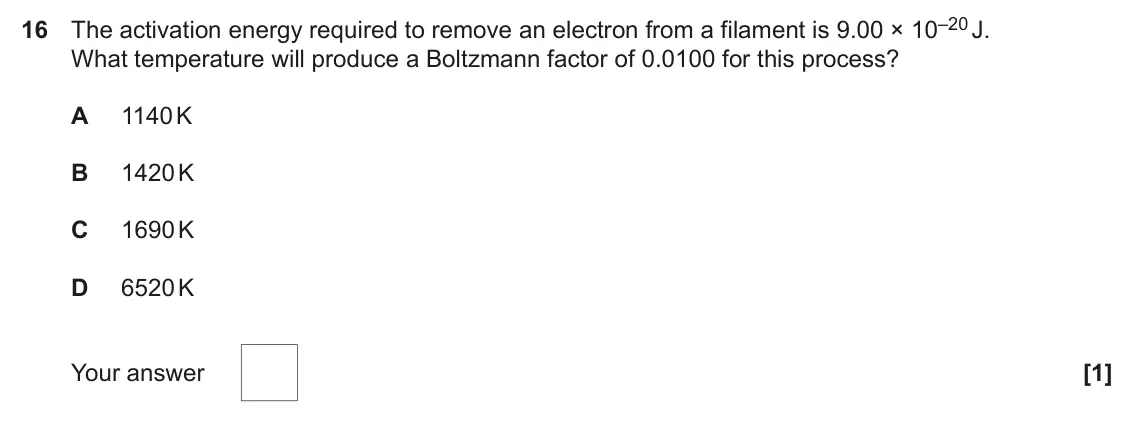
- June 2022, Paper 1, Q16 (1 mark): The activation energy required to remove an electron from a filament is 9.00 × 10⁻²⁰ J. What temperature will produce a Boltzmann factor of 0.0100 for this proc
- June 2022, Paper 2, Q9 (6 marks): 9* This question is about the slow rate of fusion in the Sun (lines 33 – 47). The temperature of the core of the Sun is 1.5 × 10⁷ K. Assuming that two protons n
- November 2021, Paper 1, Q35(a) (2 marks): Use the graph to estimate the temperature T when E = kT for this process. temperature T = K [2]
- November 2021, Paper 1, Q35(b) (2 marks): Explain why the process completes at this temperature, but may occur at a significant rate at temperatures as low as T 20. [2]
- November 2020, Paper 1, Q40(a)(i) (2 marks): Show that the energy per hydrogen bond is about 7 × 10⁻²⁰ J. [2] To set the custard, the hydrogen bonds have to be broken by baking it in an oven at 70°C.
- November 2020, Paper 1, Q40(a)(ii) (1 mark): Calculate the typical thermal energy of molecules at 70°C (343 K). thermal energy = J [1]
- November 2020, Paper 1, Q40(a)(iii) (2 marks): Breaking hydrogen bonds alters the protein molecules and thickens the custard. Calculate the fraction of water molecules at 70°C that have sufficient thermal en
- November 2020, Paper 1, Q40(a)(iv) (2 marks): Only a low fraction of molecules has enough energy to break hydrogen bonds. Explain how the cooking reaction can still proceed at a reasonable rate at 70°C. [2]
- November 2020, Paper 1, Q40(b) (1 mark): To lightly burn the sugar on top of the custard, much stronger covalent bonds must be broken. The graph shows how the Boltzmann factor changes with temperature
- June 2019, Paper 1, Q30 (1 mark): The graph shows how the Boltzmann factor f = e−E /kT varies with absolute temperature T for an excitation process involving activation energy E. 1 f =e –E/kT 0.
- June 2019, Paper 2, Q9 (4 marks): An estimate of the atmospheric pressure p at height h above the surface of Mars can be found from the equation ln p = ln ps – mgh kT where ps is the pressure at
- June 2018, Paper 1, Q39(b)(ii) (4 marks): The escape velocity for planet Earth is 11.2 km s−1. Use the Boltzmann factor to estimate the number of H2 molecules per mole with sufficient energy to escape t
- June 2018, Paper 2, Q6(c) (6 marks): This question is about conduction in metals and in semiconductors. (c)* The conductivity σ of semiconductors such as ntc thermistors increases dramatically with
- June 2017, Paper 1, Q20 (1 mark): At 300 K a process has an activation energy E 10 kT . = The temperature is raised to 330 K. Which statement about the rate of the process is correct? It will in
- June 2017, Paper 2, Q5(a) (3 marks): Explain how the graphs in Fig. 5.1 show that line C represents the process with the greatest activation energy E. [3]
- June 2017, Paper 2, Q5(b)(i) (3 marks): The Boltzmann factor for water molecules escaping the liquid and entering the vapour state is 4.9 × 10⁻⁸ at 310 K. Calculate the activation energy required for
- June 2017, Paper 2, Q5(b)(ii) (2 marks): Explain how particles with an average energy lower than the activation energy gain enough energy to escape into the vapour. [2]
- June 2017, Paper 2, Q5(b)(iii) (6 marks): This question is about the Boltzmann factor, f = e–E/kT. 5 Fig. 5.1 shows how the Boltzmann factor varies with temperature for three processes: A, B and C. 1 Bo
Questions, mark schemes and examiner’s reports are © OCR, from their published past papers. Plumi isn’t affiliated with any exam board. Want whole papers? Every OCR A-Level Physics B paper.
Rather write your answers by hand on iPad? Plumi marks them against the same mark schemes.