 plumi
Activation energy and temperature: OCR A‑Level Physics B questions
OCR A-Level Physics B past-paper questions on 5.2.2.2 Activation energy and temperature, 2016–2025, with mark schemes and examiner’s reports where available.
Paper
All papers
Exam
All years
Calculations
Q35(b)
The whole paper ↗
Q1(a)(ii)
The whole paper ↗
Q1(b)(i)
The whole paper ↗Q35(b)
The whole paper ↗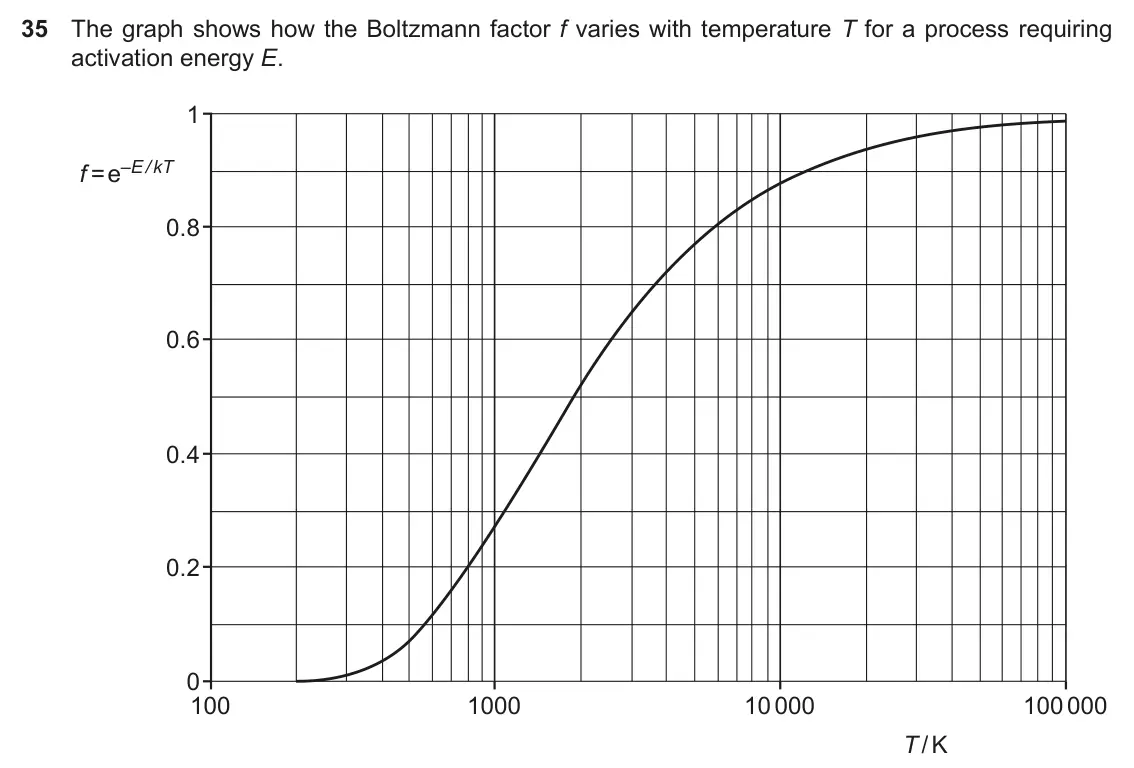
Q40(a)(i)
The whole paper ↗
Q40(a)(ii)
The whole paper ↗Q40(a)(iv)
The whole paper ↗Q37(b)(i)
The whole paper ↗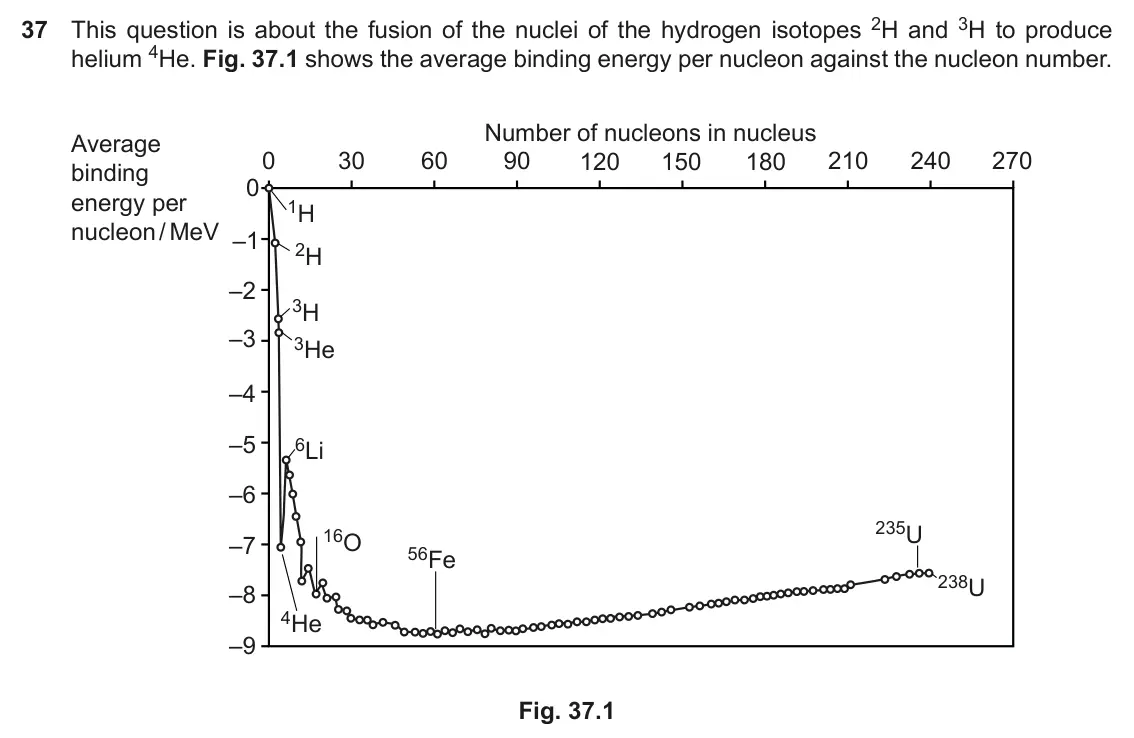
Q37(b)(ii)
The whole paper ↗Q6(c)
The whole paper ↗
- Your answer
Q5(b)(ii)
The whole paper ↗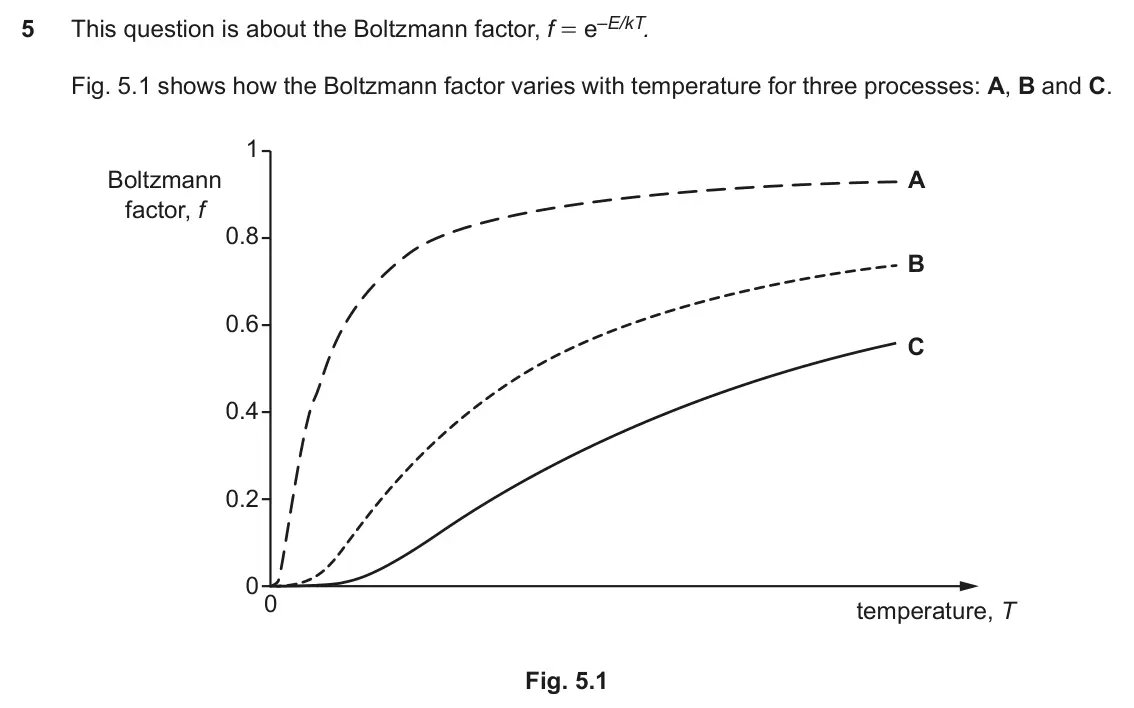
Q5(b)(iii)
The whole paper ↗
All 13 questions on Activation energy and temperature, as a list
- June 2024, Paper 1, Q35(b) (2 marks): The average energy of hydrogen molecules at 300 K is below the energy needed to break the H-H bonds. Explain why hydrogen still reacts at a reasonable rate at 3
- June 2023, Paper 2, Q1(a)(ii) (2 marks): Explain how an individual particle can gain sufficient energy to complete a reaction when the energy required is far greater than the average energy of the part
- June 2023, Paper 2, Q1(b)(i) (3 marks): Explain why this change to the Boltzmann factor affects the rate at which the digestion reaction takes place. Include a description of the information the Boltz
- November 2021, Paper 1, Q35(b) (2 marks): Explain why the process completes at this temperature, but may occur at a significant rate at temperatures as low as T 20. [2]
- November 2020, Paper 1, Q40(a)(i) (2 marks): Show that the energy per hydrogen bond is about 7 × 10⁻²⁰ J. [2] To set the custard, the hydrogen bonds have to be broken by baking it in an oven at 70°C.
- November 2020, Paper 1, Q40(a)(ii) (1 mark): Calculate the typical thermal energy of molecules at 70°C (343 K). thermal energy = J [1]
- November 2020, Paper 1, Q40(a)(iv) (2 marks): Only a low fraction of molecules has enough energy to break hydrogen bonds. Explain how the cooking reaction can still proceed at a reasonable rate at 70°C. [2]
- June 2019, Paper 1, Q37(b)(i) (2 marks): To estimate the temperature at which 2H and 3H nuclei will fuse, a student writes down the formula: e2 4πε0R ≈ k T Explain what the two sides of the approximati
- June 2019, Paper 1, Q37(b)(ii) (1 mark): Use the equation in (b)(i) to estimate this temperature when R ≈ 2 × 10⁻¹⁴ m. temperature = K [1]
- June 2018, Paper 2, Q6(c) (6 marks): This question is about conduction in metals and in semiconductors. (c)* The conductivity σ of semiconductors such as ntc thermistors increases dramatically with
- June 2017, Paper 1, Q20 (1 mark): At 300 K a process has an activation energy E 10 kT . = The temperature is raised to 330 K. Which statement about the rate of the process is correct? It will in
- June 2017, Paper 2, Q5(b)(ii) (2 marks): Explain how particles with an average energy lower than the activation energy gain enough energy to escape into the vapour. [2]
- June 2017, Paper 2, Q5(b)(iii) (6 marks): This question is about the Boltzmann factor, f = e–E/kT. 5 Fig. 5.1 shows how the Boltzmann factor varies with temperature for three processes: A, B and C. 1 Bo
Questions, mark schemes and examiner’s reports are © OCR, from their published past papers. Plumi isn’t affiliated with any exam board. Want whole papers? OCR A-Level Physics B past papers.
The Plumi iPad app also offers exam-style questions with AI feedback on your handwritten working.