 plumi
Radioactivity: OCR A‑Level Physics A questions
Every OCR A-Level Physics A exam question on 6.4.3 Radioactivity, 2016–2025, with its mark scheme and examiner’s report.
Find questions1,877
Calculations


Q19(c)
The whole paper ↗
Q5(a)
The whole paper ↗
Q5(b)(i)
The whole paper ↗
Q5(b)(ii)
The whole paper ↗
Q21(b)(i)
The whole paper ↗
Q21(b)(ii)
The whole paper ↗
Q21(c)
The whole paper ↗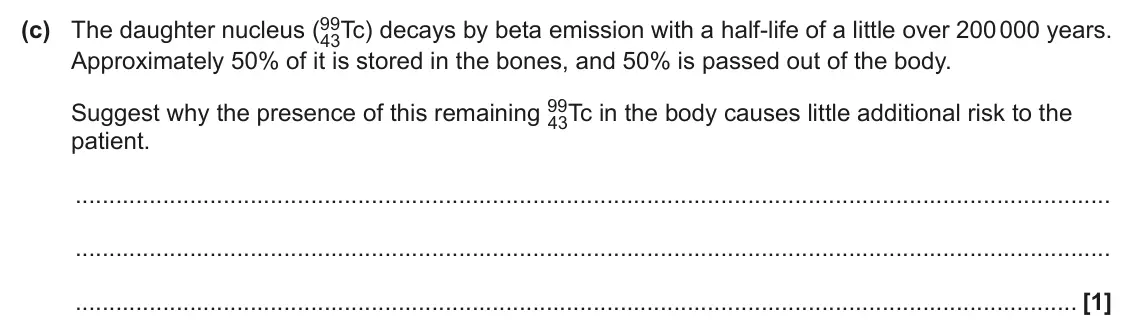
Q21(d)
The whole paper ↗
Q22(a)
The whole paper ↗
Q22(c)
The whole paper ↗


Q3(a)
The whole paper ↗
Q3(b)
The whole paper ↗


All 44 questions on Radioactivity, as a list
- June 2025, Paper 2, Q5 (1 mark): An isotope has a half-life of 243 years. One sample of this isotope has activity A1. A second sample of the same isotope has activity A2. mass of isotope in fir
- June 2025, Paper 2, Q6 (1 mark): A student wants to determine the count-rate from a beta-emitting source in the laboratory. Which procedure would be the best to determine the count-rate? A Meas
- June 2025, Paper 2, Q19(c) (3 marks): The above decay takes place within a nucleus of carbon-11. The half-life of this isotope of carbon is 1220 s. A sample of carbon-11 has an activity of 800 Bq. C
- June 2025, Paper 3, Q5(a) (1 mark): Suggest why exposing an insect to ionising radiation may cause it to become infertile. [1]
- June 2025, Paper 3, Q5(b)(i) (2 marks): Suggest why alpha radiation is not suitable for irradiating large numbers of insects. [2]
- June 2025, Paper 3, Q5(b)(ii) (6 marks): To control insect populations, sterilised male insects can be released into the wild. They mate with females, who then produce no offspring, reducing the future
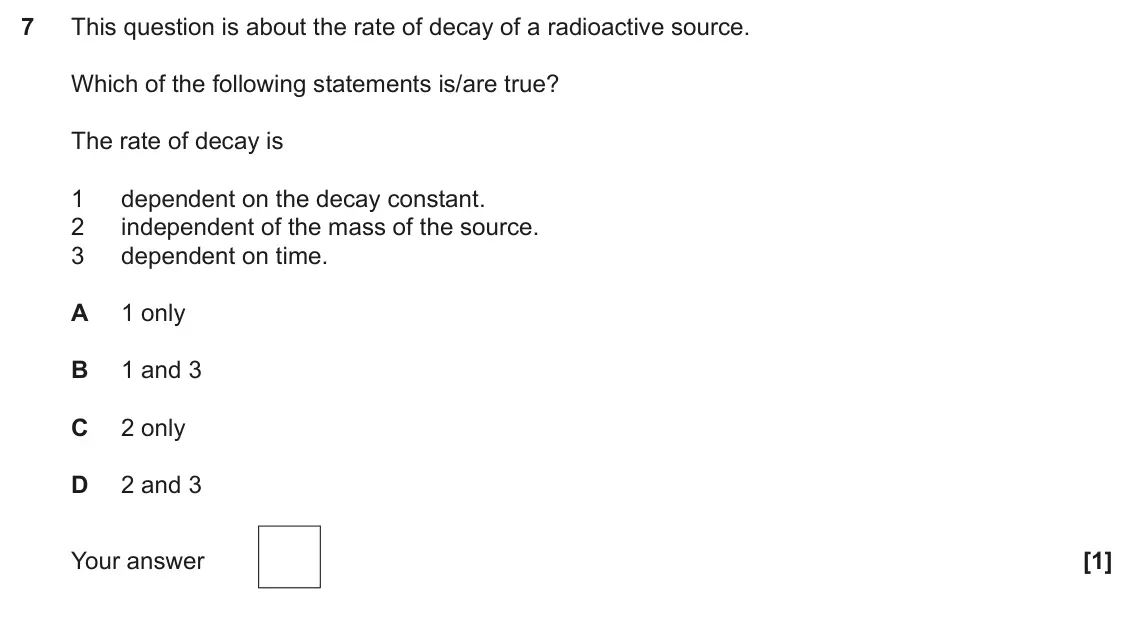
- June 2024, Paper 2, Q7 (1 mark): This question is about the rate of decay of a radioactive source. Which of the following statements is/are true? The rate of decay is 1 dependent on the decay c
- June 2024, Paper 2, Q21(b)(i) (3 marks): A technetium‑99m tracer with an activity of 900 MBq is injected into a body. The half‑life of technetium‑99m is 6.01 hours. Calculate the number of technetium‑9
- June 2024, Paper 2, Q21(b)(ii) (3 marks): Calculate the time in hours taken for the activity of the tracer to have fallen to 3.0% of its initial activity. time = hours [3]
- June 2024, Paper 2, Q21(c) (1 mark): The daughter nucleus (99 43Tc) decays by beta emission with a half‑life of a little over 200 000 years. Approximately 50% of it is stored in the bones, and 50%
- June 2024, Paper 2, Q21(d) (6 marks): Technetium‑99m (99 43Tcm) is a metastable radioisotope which can be used as a tracer in medical diagnosis. It is injected into the body and decays by gamma emis
- June 2023, Paper 2, Q22(a) (2 marks): Write the equation for the decay of a nucleus of F-18 using nuclear notation. [2]
- June 2023, Paper 2, Q22(c) (2 marks): X-rays and gamma-rays are produced by different physical processes. Briefly describe both processes. [2]
- June 2022, Paper 2, Q2 (1 mark): The half-life of fluorine-18 isotope is T. After time t = 4T the number of fluorine-18 nuclei in a source is N. How many fluorine-18 nuclei have decayed in the
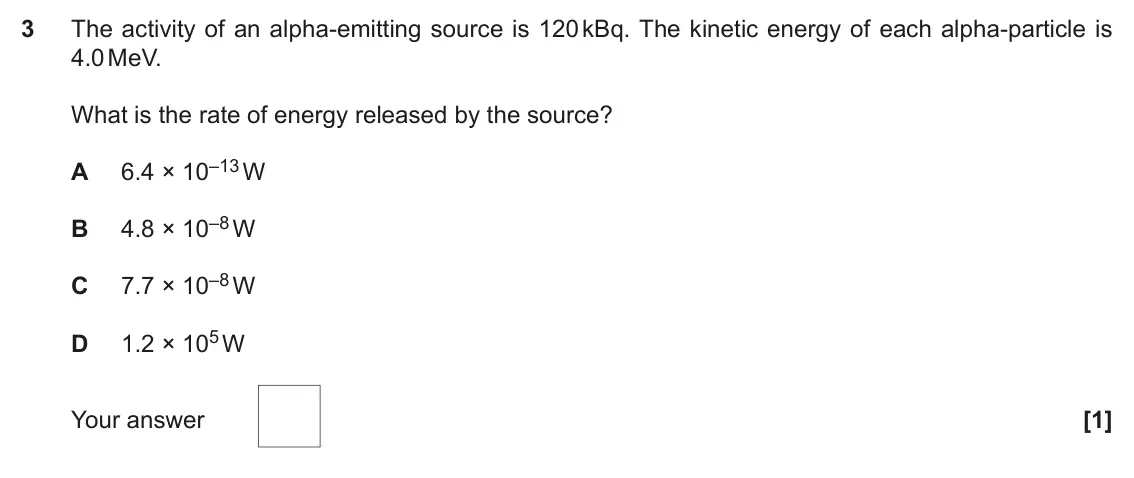
- June 2022, Paper 2, Q3 (1 mark): The activity of an alpha-emitting source is 120 kBq. The kinetic energy of each alpha-particle is 4.0 MeV. What is the rate of energy released by the source? 6.
- June 2022, Paper 2, Q4 (1 mark): Which of the following statement(s) correctly describe radioactive decay? 1 Radioactive decay can be modelled using dice. 2 Radioactive decay of nuclei is rando
- June 2022, Paper 3, Q3(a) (2 marks): In beta-plus decay, a proton decays into three other particles. Write a nuclear equation for this process. [2]
- June 2022, Paper 3, Q3(b) (6 marks): (b)* A student, supervised by their teacher, carries out an experiment with three unlabelled radioactive sources. The student is told that each source emits onl
- November 2021, Paper 2, Q13 (1 mark): The nucleus of thorium-232 (232 90Th) emits two alpha particles and two beta-minus particles to become a nucleus of an isotope of radium. What is the nucleon nu
- November 2021, Paper 2, Q15 (1 mark): A radiation detector is placed in front of a beta-emitting source. The count-rate is measured and recorded every 10 minutes. The results are shown below. 311 s–
- November 2021, Paper 2, Q25(a)(i) (1 mark): State and explain which material has the greatest activity at the start. [1]
- November 2021, Paper 2, Q25(a)(ii) (1 mark): State why it is dangerous for the researcher to handle the test tube with bare hands. [1]
- November 2021, Paper 2, Q25(b)(i) (1 mark): State the proton number of particle X. proton number = [1]
- November 2021, Paper 3, Q3(c)(i) (3 marks): Calculate the number N of plutonium-238 nuclei needed to provide the power of 470 W. N = [3]
- November 2021, Paper 3, Q3(c)(ii) (3 marks): Calculate the power P still available from the plutonium-238 source 100 years later. P = W [3]
- November 2020, Paper 2, Q9 (1 mark): A student is modelling the decay of a radioactive source using the equation ΔN / Δt = −0.5 N. The student decides to use Δt = 0.10 s. The number N of radioactiv
- November 2020, Paper 2, Q21(b)(i) (1 mark): Show that the decay constant λ for this isotope is about 1.2 × 10⁻⁴ y−1. [1]
- November 2020, Paper 2, Q21(b)(ii) (3 marks): Carbon-dating is a technique used to date an ancient wooden axe. The ratio of carbon-14 to carbon-12 in the axe material is 78% of the current ratio of carbon-1
- November 2020, Paper 2, Q21(b)(iii) (1 mark): State one assumption made in the calculation in (ii). [1]
- June 2019, Paper 2, Q20(b)(i) (1 mark): Name the two leptons emitted in the decay of a rubidium-87 nucleus. 1. 2. [1]
- June 2019, Paper 2, Q20(b)(ii) (3 marks): The percentage of rubidium left in a sample of an ancient rock is 95%. Estimate the age of the Earth in billion years. age = billion years [3]
- June 2019, Paper 2, Q21(a)(i) (1 mark): a beta-minus particle [1]
- June 2019, Paper 2, Q21(a)(ii) (1 mark): a beta-plus particle. [1]
- June 2019, Paper 3, Q2(a) (3 marks): Complete the nuclear equations for these two processes. 59 60 27Co + n 27Co Ni + e + + 2γ [3]
- June 2019, Paper 3, Q2(b)(i) (1 mark): The 60 27Co source emits beta radiation as well as gamma radiation. Explain why this would not affect the experiment. [1] Question 2 continues on page 6
- June 2019, Paper 3, Q2(b)(ii) (11 marks): The students record the number N of gamma photons detected by T in 10 minutes for each different thickness d of lead. The background count is negligible. The re
- June 2018, Paper 2, Q24(a)(i) (1 mark): the polonium isotope 213 209 84 Po 82 Pb + [1]
- June 2018, Paper 2, Q24(a)(ii) (2 marks): the lead isotope. 209 0 82 Pb 83 Bi + - e + [2] 1
- June 2018, Paper 2, Q24(b)(i) (2 marks): Briefly describe and explain an experiment that can be carried out to confirm the beta-minus radiation emitted from the lead nuclei. [2]
- June 2018, Paper 2, Q24(b)(ii) (4 marks): The activity of the sample of 209 82Pb after 7.0 hours is 12 kBq. The half-life of 209 82Pb is 3.3 hours. Calculate the initial number of lead-209 nuclei in thi
- June 2017, Paper 2, Q12 (1 mark): A proton collides with a stationary oxygen-18 nucleus. The collision produces a fluorine-18 nucleus and particle X. 1 1p + 18 18 8O 9F + X What is particle X? A
- June 2017, Paper 2, Q25(b) (3 marks): The half-life of fluorine-18 is 110 minutes. Calculate the time t in minutes for the activity of the radiopharmaceutical to decrease to 30% of its initial activ
- June 2017, Paper 3, Q1(a) (2 marks): The chemical symbol for thorium is Th. Write a nuclear equation for this decay. [2]
- June 2017, Paper 3, Q1(c) (3 marks): The uranium-238 92U a k. 206 lead-206 82Pb Show that 14 particles are emitted during this decay chain. Explain your reasoning. [3]
Questions, mark schemes and examiner’s reports are © OCR, from their published past papers. Plumi isn’t affiliated with any exam board. Want whole papers? Every OCR A-Level Physics A paper, or our free OCR-style practice pack.
Rather write your answers by hand on iPad? Plumi marks them against the same mark schemes.