 plumi
Nuclear fission and fusion: OCR A‑Level Physics A questions
Every OCR A-Level Physics A exam question on 6.4.4 Nuclear fission and fusion, 2016–2025, with its mark scheme and examiner’s report.
Find questions1,877
Calculations

Q20(a)
The whole paper ↗
Q20(b)
The whole paper ↗
Q20(c)(i)
The whole paper ↗
Q20(c)(ii)
The whole paper ↗
Q20(c)(iii)
The whole paper ↗

Q21(b)
The whole paper ↗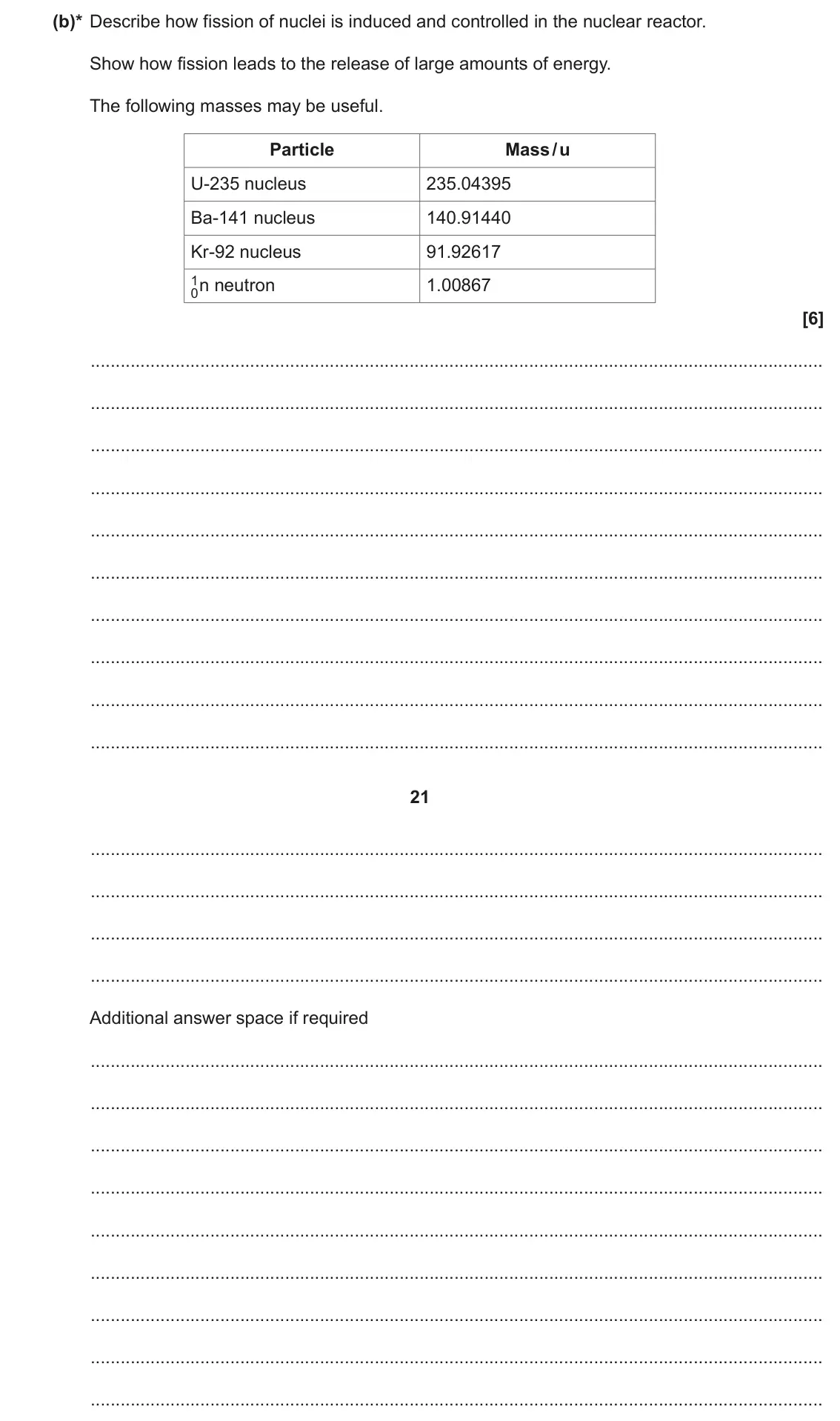
Q21(c)
The whole paper ↗
Q22(b)
The whole paper ↗
Q5(c)
The whole paper ↗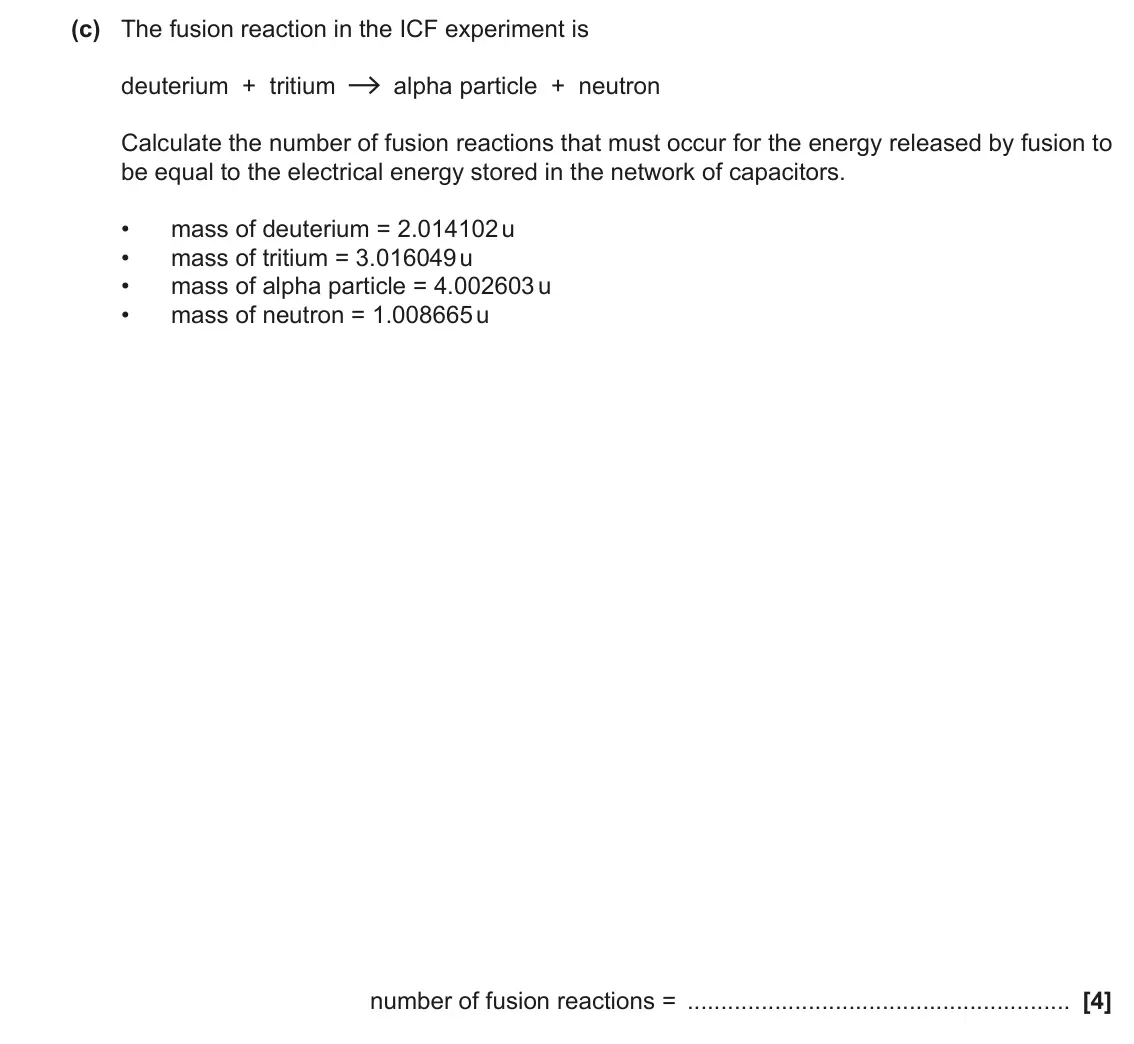


Q23(a)
The whole paper ↗
Q23(b)
The whole paper ↗
Q25(b)(ii)
The whole paper ↗

Q3(b)
The whole paper ↗
Q21(b)(i)
The whole paper ↗
All 27 questions on Nuclear fission and fusion, as a list
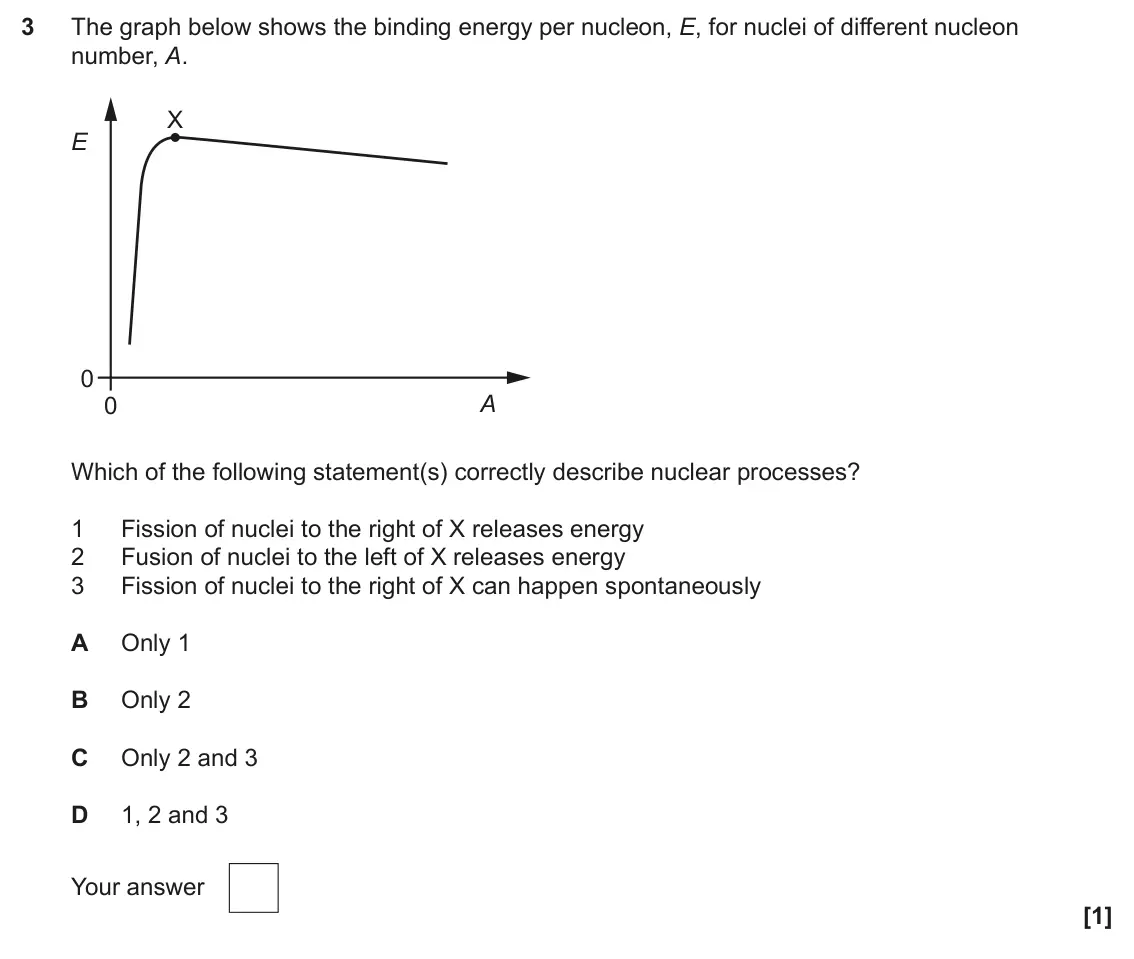
- June 2025, Paper 2, Q3 (1 mark): The graph below shows the binding energy per nucleon, E, for nuclei of different nucleon number, A. X E 0 A 0 Which of the following statement(s) correctly desc
- June 2025, Paper 2, Q12 (1 mark): The intensity of the Sun’s radiation at the surface of the Earth is 1400 W m–2. The distance between the centre of the Sun and the surface of the Earth is 1.5 ×
- June 2024, Paper 2, Q20(a) (1 mark): Explain what is meant by nuclear binding energy of a nucleus. [1]
- June 2024, Paper 2, Q20(b) (1 mark): Suggest why the 1 1H isotope of hydrogen has not been included on the above diagram. [1]
- June 2024, Paper 2, Q20(c)(i) (1 mark): Explain why isotopes with low mass numbers, such as hydrogen, are those which undergo nuclear fusion. [1]
- June 2024, Paper 2, Q20(c)(ii) (3 marks): Use the diagram given at the start of this question to show that, for the reaction of deuterium and tritium, the energy released in each fusion event is approxi
- June 2024, Paper 2, Q20(c)(iii) (2 marks): The Sun’s mass deceases by 4.3 × 10⁹ kg every second. Assume that the mass loss is only due to this reaction. Calculate the number of fusion events per second o
- June 2023, Paper 2, Q21(a) (2 marks): Complete the labels on the diagram [2]
- June 2023, Paper 2, Q21(b) (6 marks): The diagram shows a simplified layout of a nuclear fission reactor used in a nuclear power station. (b)* Describe how fission of nuclei is induced and controlle
- June 2023, Paper 2, Q21(c) (4 marks): The energy released from the fusion of 1 kg of hydrogen is more than seven times the energy released by the fission of 1 kg of uranium. Compare the practicaliti
- June 2023, Paper 2, Q22(b) (3 marks): The β+ particle (positron) produced travels only a short distance in the patient before it meets an electron and is annihilated. Calculate the wavelength λ of g
- June 2023, Paper 3, Q5(c) (4 marks): The fusion reaction in the ICF experiment is deuterium + tritium alpha particle + neutron Calculate the number of fusion reactions that must occur for the energ
- June 2022, Paper 2, Q5 (1 mark): A gamma-ray photon of frequency 6.76 × 10²² Hz creates a particle-antiparticle pair. The 5 particle-antiparticle pair have zero kinetic energy. What is the mass
- June 2022, Paper 2, Q13 (1 mark): 3H) 13 The mass of a proton is mp, the mass of a neutron is mn, and the mass of a hydrogen-3 (1 nucleus is M. The speed of light in a vacuum is c. Which express
- November 2021, Paper 2, Q23(a) (2 marks): Explain the function of the control rods and the moderator in a nuclear fission reactor. [2]
- November 2021, Paper 2, Q23(b) (6 marks): (b)* Some nuclear fission reactors use uranium-235 as fuel. In the future, there is possibility of using hydrogen-2 as fuel in fusion reactors. Here is some inf
- November 2021, Paper 2, Q25(b)(ii) (4 marks): Use the data below to determine the binding energy per nucleon of the 14 6C nucleus. Write your answer to 3 significant figures. mass of neutron = 1.675 × 10⁻²⁷
- November 2020, Paper 2, Q10 (1 mark): The total energy released in a single fusion reaction is 4.0 MeV. What is the change in mass in this fusion reaction? 7.1 × 10−36 kg A 7.1 × 10⁻³⁰ kg B 2.1 × 10
- November 2020, Paper 3, Q3(b) (6 marks): A student attends a lecture about the Sun and makes the following notes. The Sun loses more than 4 × 10⁹ kg of its mass every second to maintain its luminosity.
- June 2019, Paper 2, Q21(b)(i) (2 marks): Describe what is meant by chain reaction. [2]
- June 2019, Paper 2, Q21(b)(ii) (2 marks): Explain how chain reactions are prevented inside a nuclear reactor. [2]
- June 2019, Paper 2, Q21(b)(iii) (4 marks): The energy released in each fission reaction is equivalent to a decrease in mass of 0.19 u. A fuel rod in a nuclear reactor contains 3.0% of uranium-235 by mass
- June 2018, Paper 2, Q25(a)(i) (2 marks): Explain why a high-speed proton is necessary to trigger the nuclear reaction shown above. [2]
- June 2018, Paper 2, Q25(a)(ii) (3 marks): Estimate the minimum wavelength m of the gamma ray photon (γ). m = m [3]
- June 2017, Paper 2, Q24(a) (2 marks): Only one of the particles shown in the reaction has binding energy. Determine the binding energy per nucleon of this particle. Explain your answer. [2]
- June 2017, Paper 2, Q24(b) (2 marks): Explain why high temperatures are necessary for fusion reactions to occur in stars. [2]
- June 2017, Paper 2, Q24(c) (3 marks): A gamma photon in a star can spontaneously create an electron-positron pair. Calculate the maximum wavelength of a gamma photon for this creation event. maximum
Questions, mark schemes and examiner’s reports are © OCR, from their published past papers. Plumi isn’t affiliated with any exam board. Want whole papers? Every OCR A-Level Physics A paper, or our free OCR-style practice pack.
Rather write your answers by hand on iPad? Plumi marks them against the same mark schemes.