 plumi
Planetary motion: OCR A‑Level Physics A questions
Every OCR A-Level Physics A exam question on 5.4.3 Planetary motion, 2016–2025, with its mark scheme and examiner’s report.
Find questions1,877
Calculations
Q22(a)(i)
The whole paper ↗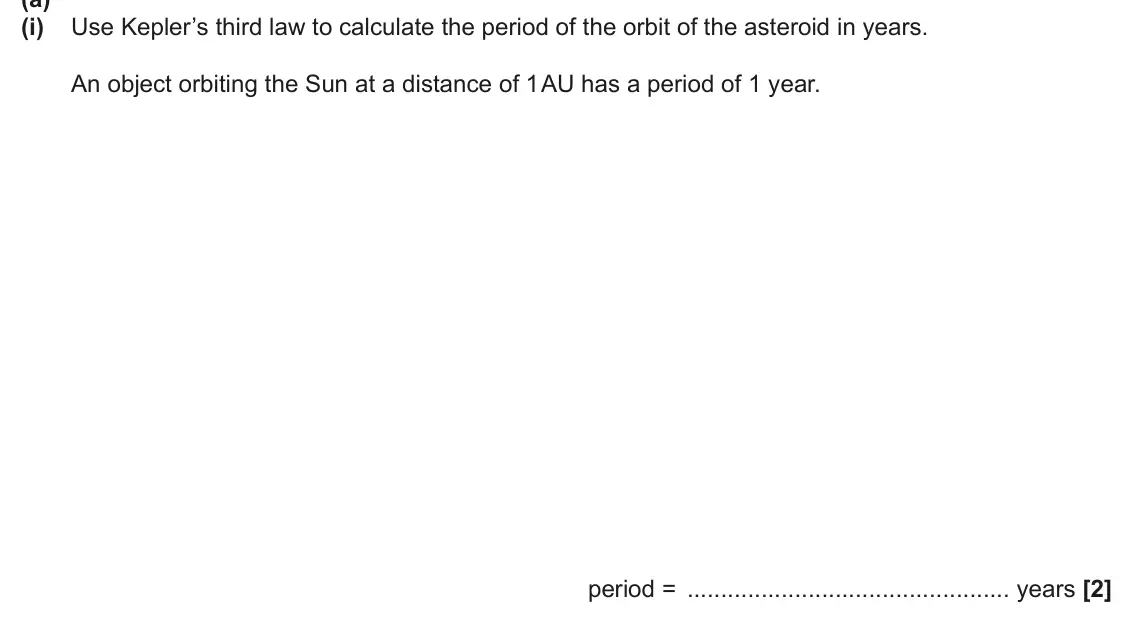
Q22(a)(ii)
The whole paper ↗
Q22(b)(ii)
The whole paper ↗
Q22(a)(i)
The whole paper ↗
Q22(a)(ii)
The whole paper ↗

Q1(a)(ii)
The whole paper ↗
Q1(b)(i)
The whole paper ↗
Q1(b)(ii)
The whole paper ↗
Q23(a)
The whole paper ↗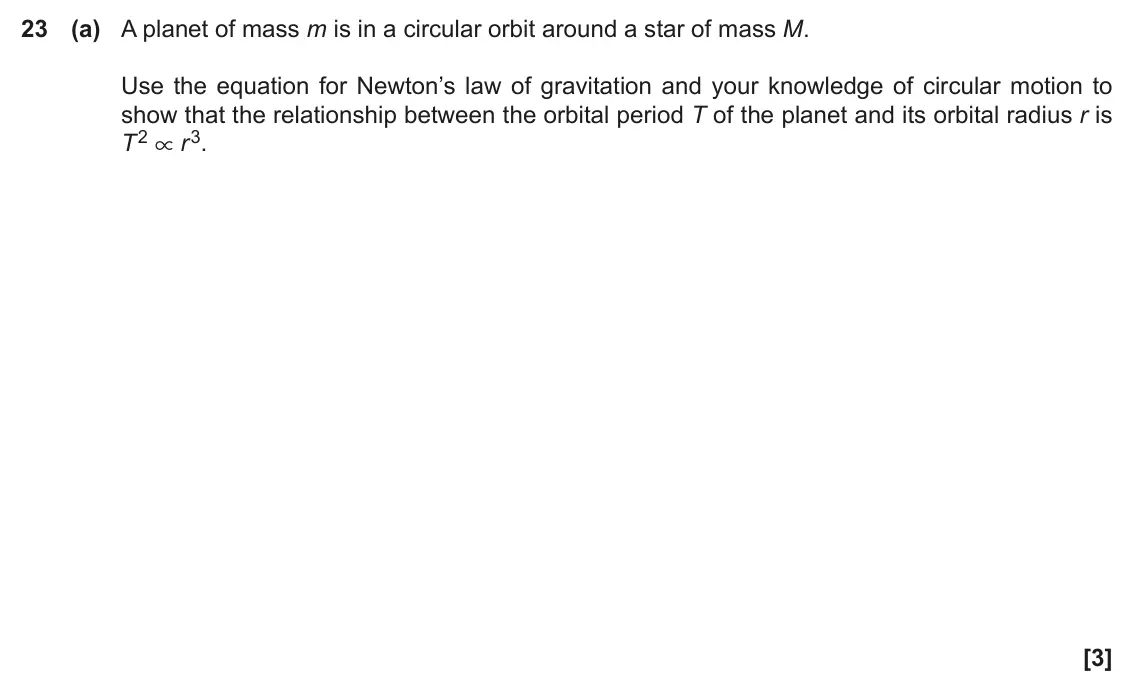
Q23(b)(i)
The whole paper ↗

Q3(b)(ii)
The whole paper ↗
Q23(a)(i)
The whole paper ↗
Q23(a)(ii)
The whole paper ↗
Q4(a)
The whole paper ↗

Q23(b)(i)
The whole paper ↗
Q23(b)(ii)
The whole paper ↗
Q17(a)(i)
The whole paper ↗
All 25 questions on Planetary motion, as a list
- June 2025, Paper 1, Q22(a)(i) (2 marks): Use Kepler’s third law to calculate the period of the orbit of the asteroid in years. An object orbiting the Sun at a distance of 1 AU has a period of 1 year. p
- June 2025, Paper 1, Q22(a)(ii) (3 marks): Calculate the kinetic energy of the asteroid. kinetic energy = J [3]
- June 2025, Paper 1, Q22(b)(ii) (1 mark): Eventually, the asteroid falls into a new orbit around the Sun. This orbit is elliptical. State the other feature of this orbit predicted by Kepler’s first law.
- June 2024, Paper 1, Q22(a)(i) (1 mark): State one condition required for an orbit to be geostationary. [1]
- June 2024, Paper 1, Q22(a)(ii) (3 marks): Calculate the orbital radius of the geostationary satellite. The mass of the Earth is 6.0 × 1024 kg. orbital radius = m [3]
- June 2023, Paper 1, Q11 (1 mark): A satellite is in geostationary orbit 36 000 km above the Earth’s surface. The Earth has a radius of 6400 km. At what speed is the satellite moving relative to
- June 2023, Paper 3, Q1(a)(ii) (2 marks): Explain how Kepler’s 1st law applies to MAVEN’s orbit around Mars. [2]
- June 2023, Paper 3, Q1(b)(i) (2 marks): Show that Kepler’s 3rd law applies to this data. [2]
- June 2023, Paper 3, Q1(b)(ii) (2 marks): Suggest two reasons why MAVEN was not placed in an areostationary orbit. 1 2 [2]
- June 2022, Paper 1, Q23(a) (3 marks): A planet of mass m is in a circular orbit around a star of mass M. Use the equation for Newton’s law of gravitation and your knowledge of circular motion to sho
- June 2022, Paper 1, Q23(b)(i) (2 marks): The Earth has a mean orbital distance of 1.50 × 10¹¹ m around the Sun and an orbital period of 365 days. Use Kepler’s third law to calculate the mean orbital di
- November 2021, Paper 1, Q11 (1 mark): Kepler-90 is a star with several planets orbiting it. The two outermost planets are Kepler-90g and Kepler-90h. Kepler-90g has an orbital period of 210 days and
- November 2021, Paper 3, Q3(b)(ii) (3 marks): Show that the kinetic energy of the space probe is half the value of your answer to (b)(i). [3]
- November 2020, Paper 1, Q23(a)(i) (1 mark): Indicate with a letter X on the orbit where the asteroid would be moving at maximum speed. [1]
- November 2020, Paper 1, Q23(a)(ii) (2 marks): Use Kepler’s second law to explain your answer to (a)(i). [2]
- November 2020, Paper 3, Q4(a) (1 mark): Both the ISS and the astronauts inside it are in free fall. Explain why this makes the astronauts feel weightless. [1]
- June 2019, Paper 1, Q11 (1 mark): A student has collected some data on the Solar System. The student plots a graph, but only two data points are shown below. y 0 r 0 The distance from the centre
- June 2019, Paper 1, Q23(b)(i) (1 mark): Complete the equation for Kepler’s third law below. You do not need to define any of the terms. = 4π2 GM [1]
- June 2019, Paper 1, Q23(b)(ii) (2 marks): The mass of Earth is 6.0 × 1024 kg. Calculate the radius of the circular path of a satellite in a geostationary orbit around the Earth. radius = m [2]
- June 2018, Paper 1, Q17(a)(i) (1 mark): On Fig. 17.1, draw an arrow to show the direction of the force which keeps Phobos in its orbit. [1]
- June 2018, Paper 1, Q17(a)(ii) (2 marks): Calculate the orbital period T of Phobos. T = s [2]
- June 2018, Paper 1, Q17(a)(iii) (3 marks): Calculate the mass M of Mars. M = kg [3]
- June 2018, Paper 3, Q3(a)(i) (2 marks): Explain why the stars of equal mass must always be diametrically opposite as they travel in the circular orbit. [2]
- June 2018, Paper 3, Q3(a)(ii) (3 marks): The centres of the two stars are separated by a distance of 2R equal to 3.6 × 10¹⁰ m, where R is the radius of the orbit. The stars have an orbital period T of
- June 2018, Paper 3, Q3(b)(i) (1 mark): The centre of mass of the binary star lies at the surface of the star of mass 4m. Draw on Fig. 3.2 two circles to represent the orbits of both stars. [1]
Questions, mark schemes and examiner’s reports are © OCR, from their published past papers. Plumi isn’t affiliated with any exam board. Want whole papers? Every OCR A-Level Physics A paper, or our free OCR-style practice pack.
Rather write your answers by hand on iPad? Plumi marks them against the same mark schemes.