 plumi
Gravitational potential and energy: OCR A‑Level Physics A questions
Every OCR A-Level Physics A exam question on 5.4.4 Gravitational potential and energy, 2016–2025, with its mark scheme and examiner’s report.
Find questions1,877
Calculations
Q22(b)(i)
The whole paper ↗
Q6(b)(ii)
The whole paper ↗
Q6(b)(iv)
The whole paper ↗
Q22(b)(i)
The whole paper ↗
Q22(b)(ii)
The whole paper ↗
Q22(c)
The whole paper ↗
Q23(b)(ii)
The whole paper ↗
Q23(b)(iii)
The whole paper ↗
Q23(b)(ii)
The whole paper ↗
Q23(b)(iii)
The whole paper ↗
Q20(a)(ii)
The whole paper ↗
Q20(b)
The whole paper ↗
Q3(a)
The whole paper ↗
Q3(b)(i)
The whole paper ↗
Q3(b)(iii)
The whole paper ↗
Q23(b)(i)
The whole paper ↗
Q23(b)(ii)
The whole paper ↗
Q23(b)(iii)
The whole paper ↗
All 26 questions on Gravitational potential and energy, as a list
- June 2025, Paper 1, Q22(b)(i) (2 marks): Use the graph to calculate the change in gravitational potential energy of the satellite from the moment of collision until it crosses the Earth’s orbit. change
- June 2025, Paper 3, Q6(b)(ii) (3 marks): The total orbital energy, E, of the black holes is the sum of their kinetic energy and gravitational potential energy. Show that E is given by the expression: E
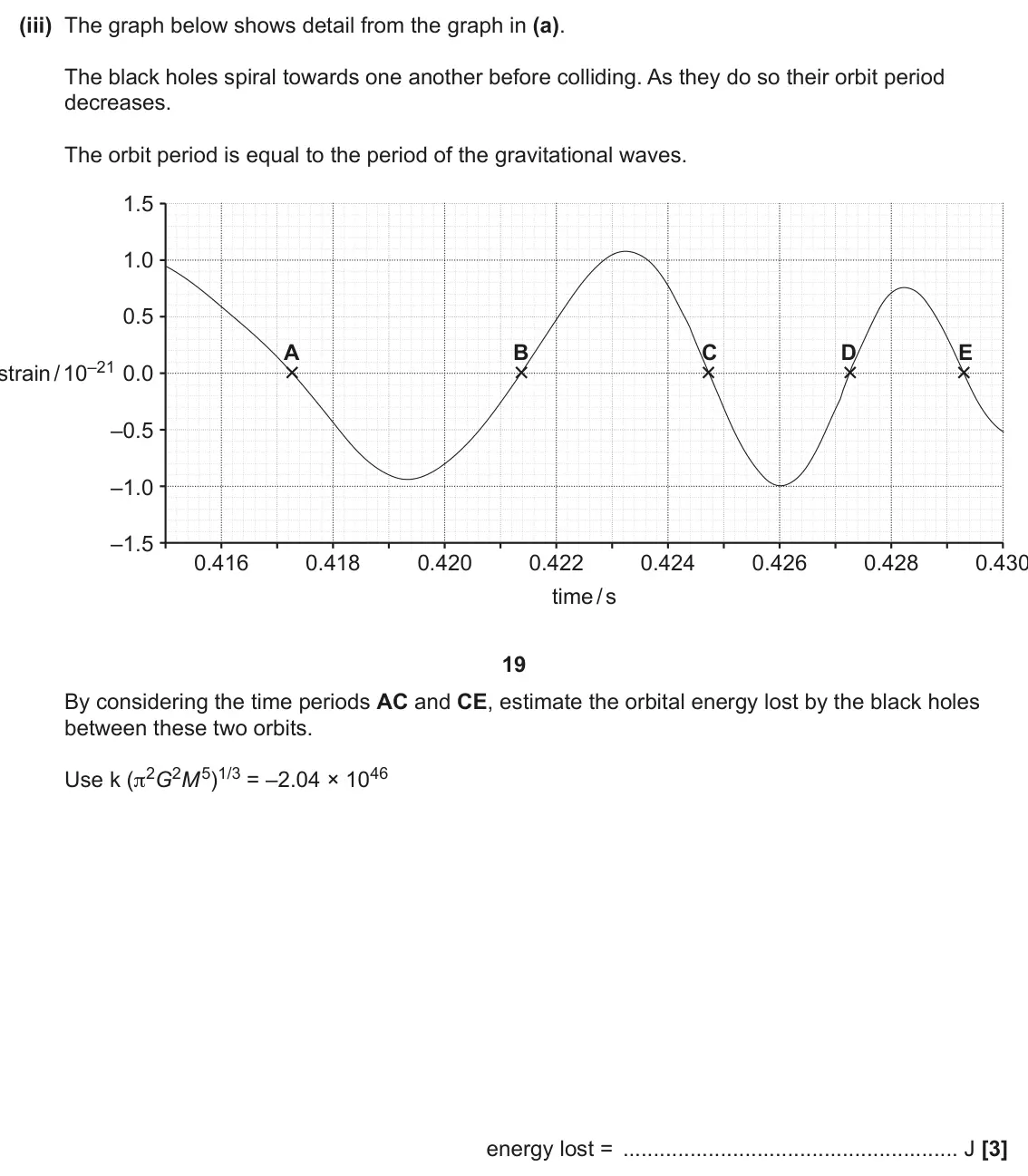
- June 2025, Paper 3, Q6(b)(iii) (3 marks): The graph below shows detail from the graph in (a). The black holes spiral towards one another before colliding. As they do so their orbit period decreases. The
- June 2025, Paper 3, Q6(b)(iv) (2 marks): By considering times B and D, use your answer to (iii) to estimate the power radiated as gravitational waves in this time interval. power = W [2]
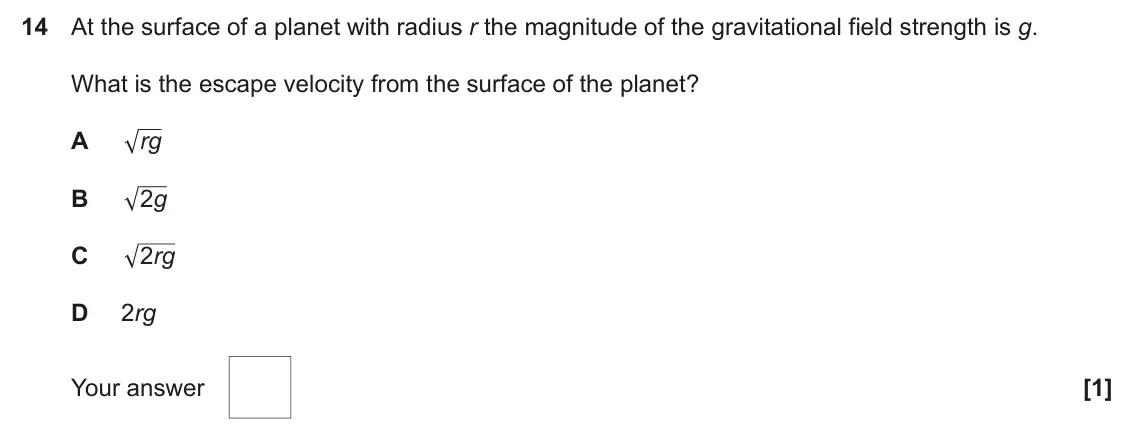
- June 2024, Paper 1, Q14 (1 mark): At the surface of a planet with radius r the magnitude of the gravitational field strength is g. What is the escape velocity from the surface of the planet? A r
- June 2024, Paper 1, Q22(b)(i) (2 marks): By considering the cause of the centripetal force on the satellite, show that the kinetic energy of the satellite is equal to half the magnitude of its gravitat
- June 2024, Paper 1, Q22(b)(ii) (2 marks): A tiny satellite of mass 1.0 kg is to be launched from rest from the surface of the Earth into a low Earth orbit. The gravitational potential at any point in th
- June 2024, Paper 1, Q22(c) (6 marks): (c)* Large satellites are often launched by rockets from sites near the equator. The rotation of the Earth increases the initial kinetic energy of the rocket an
- June 2023, Paper 1, Q23(b)(ii) (1 mark): The gravitational potential energy of a helium nucleus in the outer layer of the star is –2.3 × 10⁻¹⁶ J. Calculate the gravitational potential energy U at the m
- June 2023, Paper 1, Q23(b)(iii) (3 marks): Calculate the distance from the centre of the star reached by this helium nucleus. distance = m [3]
- June 2022, Paper 1, Q23(b)(ii) (3 marks): The total kinetic and gravitational potential energy of the satellite in its orbit remains constant. Calculate the change in the kinetic energy of the satellite
- June 2022, Paper 1, Q23(b)(iii) (1 mark): Suggest why the total energy of the satellite in its orbit around the Sun is not the same as the total energy of the satellite during its launch from the surfac
- November 2021, Paper 1, Q20(a)(ii) (1 mark): On the same diagram above, show two different points where the gravitational potential is the same. Label these points X and Y. [1]
- November 2021, Paper 1, Q20(b) (6 marks): (b)* A satellite is in a circular geostationary orbit around the centre of the Earth. The satellite has both kinetic energy and gravitational potential energy.
- November 2021, Paper 3, Q3(a) (1 mark): Define gravitational potential energy of an object at a point in a gravitational field. [1]
- November 2021, Paper 3, Q3(b)(i) (2 marks): Show that the magnitude of the gravitational potential energy of the space probe is about 7 × 10¹¹ J. [2]
- November 2021, Paper 3, Q3(b)(iii) (1 mark): Calculate the total energy of the space probe. total energy = J [1]
- November 2020, Paper 1, Q23(b)(i) (1 mark): Define gravitational potential. [1]
- November 2020, Paper 1, Q23(b)(ii) (1 mark): Show that the magnitude of the gradient of the graph is equal to GM, where M is the mass of the asteroid and G is the gravitational constant. [1]
- November 2020, Paper 1, Q23(b)(iii) (2 marks): Use the gradient of the graph to show that the mass M of the asteroid is about 4.6 × 10¹¹ kg. M = kg [2]
- November 2020, Paper 1, Q23(c) (3 marks): In October 2018, the probe Mobile Asteroid Surface Scout (MASCOT) was released from rest from the Hayabusa2 spacecraft from a distance of 600 m from the centre
- June 2018, Paper 1, Q13 (1 mark): Earth has a mass of 6.0 × 1024 kg and a radius of 6400 km. A satellite of mass 320 kg is lifted from the Earth’s surface to an orbit 1200 km above its surface.
- June 2017, Paper 1, Q23(a) (1 mark): Write an expression for the gravitational potential Vg at the surface of a planet of mass M and radius r. [1]
- June 2017, Paper 1, Q23(b)(i) (2 marks): Show that the escape velocity v of a gas molecule on the surface of Pluto is given by the equation 2 GM v = r where M is the mass of Pluto and r is its radius.
- June 2017, Paper 1, Q23(b)(ii) (1 mark): Calculate the escape velocity v of gas molecules on the surface of Pluto. v = m s−1 [1]
- June 2017, Paper 1, Q23(b)(iii) (3 marks): Explain why Mercury has no atmosphere whilst Pluto still has a thin atmosphere. Use data from the table to support your explanation. [3]
Questions, mark schemes and examiner’s reports are © OCR, from their published past papers. Plumi isn’t affiliated with any exam board. Want whole papers? Every OCR A-Level Physics A paper, or our free OCR-style practice pack.
Rather write your answers by hand on iPad? Plumi marks them against the same mark schemes.