 plumi
Collisions: OCR A‑Level Physics A questions
Every OCR A-Level Physics A exam question on 3.5.2 Collisions, 2016–2025, with its mark scheme and examiner’s report.
Find questions1,877
Calculations

Q6(a)
The whole paper ↗
Q6(b)(iii)
The whole paper ↗
Q6(c)
The whole paper ↗


Q2(c)(i)
The whole paper ↗
Q2(c)(ii)
The whole paper ↗


Q23(b)
The whole paper ↗
Q23(c)
The whole paper ↗
Q16(b)(iii)
The whole paper ↗
Q3(a)
The whole paper ↗
Q18(d)(i)
The whole paper ↗
Q18(d)(ii)
The whole paper ↗

Q6(d)(ii)
The whole paper ↗
Q21(a)
The whole paper ↗
All 31 questions on Collisions, as a list
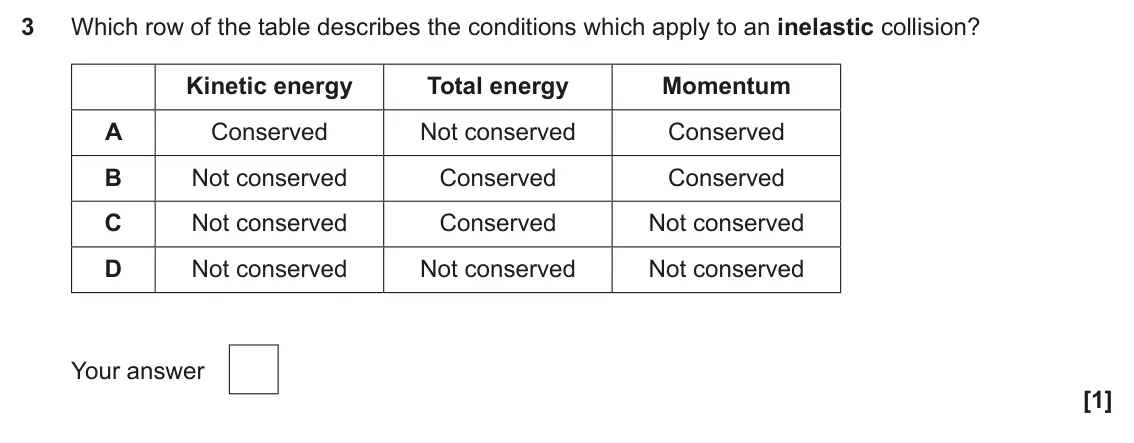
- June 2025, Paper 1, Q3 (1 mark): Which row of the table describes the conditions which apply to an inelastic collision? Kinetic energy Total energy Momentum A Conserved Not conserved Conserved
- June 2025, AS Paper 1, Q14 (1 mark): Two identical particles are travelling at the same speed v in opposite directions. They collide head on. The collision is elastic. What happens to the two parti
- June 2025, AS Paper 2, Q6(a) (2 marks): State the principle of conservation of momentum. [2]
- June 2025, AS Paper 2, Q6(b)(iii) (1 mark): Calculate the velocity v of R after the collision. v = m s–1 [1]
- June 2025, AS Paper 2, Q6(c) (4 marks): The teacher changes one of the magnets to a cork and the other magnet to a pin and repeats the experiment. Glider L moves from left to right. The time for the c
- June 2024, Paper 1, Q13 (1 mark): An object of mass 1.0 kg is moving in a straight line at velocity 10 m s–1. It collides with an identical object also travelling at 10 m s–1 in a straight line.
- June 2024, AS Paper 1, Q10 (1 mark): A particle X collides with a stationary particle Y. No external forces act and the collision is inelastic. Which quantity is conserved in the collision? A momen
- June 2024, AS Paper 2, Q2(c)(i) (1 mark): Explain what is meant by a perfectly elastic collision. [1]
- June 2024, AS Paper 2, Q2(c)(ii) (3 marks): After the collision B travels across the surface of the ice with a velocity of 8.0 m s–1. The velocity of the single puck after the collision is –12 m s–1. Dete
- June 2023, Paper 1, Q8 (1 mark): A particle P of mass m and moving at velocity u collides elastically with a stationary particle Q also of mass m. After the collision particle P moves with velo
- June 2022, Paper 1, Q6 (1 mark): A particle X of mass m collides with a stationary particle Y of mass 4m. Immediately after the collision the particle X is moving at velocity v1 at an angle of
- June 2022, AS Paper 1, Q23(b) (2 marks): Use the graphs to show that momentum is conserved in the collision. [2]
- June 2022, AS Paper 1, Q23(c) (2 marks): Calculate the magnitude of the horizontal velocity v of the combined objects immediately after the collision. v = m s–1 [2]
- November 2021, Paper 1, Q16(b)(iii) (2 marks): The mass of the trapdoor is 100 g. Calculate the final speed v of the trapdoor immediately after the collision. v = m s–1 [2]
- November 2021, AS Paper 2, Q3(a) (6 marks): (a)* A linear air track is used to investigate the collision of two gliders A and B, as shown in Fig. 3.1. to data-logger light gate 1 light gate 2 v = 0.200 m
- November 2020, Paper 1, Q18(d)(i) (1 mark): Explain what is meant by an inelastic collision. [1]
- November 2020, Paper 1, Q18(d)(ii) (2 marks): The target is mounted on wheels. The target has a much larger mass than the mass of the arrow. Using ideas of momentum, explain the velocity of the target immed
- November 2020, Paper 1, Q19 (6 marks): 19* A student makes a pendulum using a length of string with a ball of adhesive putty which acts as a bob. The mass of this bob is M. A similar second pendulum
- November 2020, Paper 3, Q6(d)(ii) (2 marks): Draw a vector in the space below to represent the momentum of the nucleus N when the α-particle reaches B. Explain how you determined this momentum. [2]
- November 2020, AS Paper 1, Q21(a) (2 marks): Two objects collide. The collision is perfectly elastic. State two quantities that are conserved in this type of collision. 1 2 [2]
- November 2020, AS Paper 1, Q21(b) (3 marks): The diagram below shows a person on a horizontal skateboard holding a heavy ball. The person is initially stationary. The person throws the ball horizontally to
- June 2018, Paper 1, Q22(a)(i) (1 mark): Explain what is meant by an elastic collision. [1]
- June 2018, Paper 1, Q22(a)(ii) (3 marks): The mass of a helium atom is 6.64 × 10⁻²⁷ kg. Calculate the magnitude of the momentum p of Y after the collision. p = kg m s−1 [3]
- June 2018, AS Paper 1, Q4 (1 mark): An object P is travelling to the right with a momentum of 40 kg m s−1. It collides with another object 4 Q travelling to the left along the same path. The final
- June 2018, AS Paper 2, Q5(b)(iii) (2 marks): State what is meant by an elastic collision and explain how your answer to (ii) shows that this collision is not elastic. [2]
- June 2017, Paper 3, Q1(b) (4 marks): The mass of the uranium nucleus is 4.0 × 10⁻²⁵ kg. After the decay the thorium nucleus has a speed of 2.4 × 10⁵ m s–1. Calculate the kinetic energy, in MeV, of
- June 2017, AS Paper 1, Q23(a) (2 marks): A massive ball is released from rest above the ground. According to a student, the principle of conservation of momentum is violated because the ball gains mome
- June 2017, AS Paper 1, Q23(b)(ii) (3 marks): The momentum of ball Y before the collision is 8.0 kg m s–1. On Fig. 23 sketch a graph to show the variation of the momentum of Y with time t. Label this graph
- June 2016, AS Paper 1, Q10 (1 mark): A trolley M collides head-on with a trolley L. The mass of trolley M is greater than the mass of trolley L. The trolleys join together after the collision. M L
- June 2016, AS Paper 1, Q24(b)(i) (1 mark): State two physical quantities conserved in this collision. 1 2 [1]
- June 2016, AS Paper 1, Q24(c) (3 marks): A hydrogen atom travelling at 500 m s–1 makes a head-on collision with a stationary carbon atom. The collision is perfectly elastic. After the collision the hyd
Questions, mark schemes and examiner’s reports are © OCR, from their published past papers. Plumi isn’t affiliated with any exam board. Want whole papers? Every OCR A-Level Physics A paper, or our free OCR-style practice pack.
Rather write your answers by hand on iPad? Plumi marks them against the same mark schemes.