 plumi
Linear motion: OCR A‑Level Physics A questions
Every OCR A-Level Physics A exam question on 3.1.2 Linear motion, 2016–2025, with its mark scheme and examiner’s report.
Find questions1,877
Calculations

Q21(b)(ii)
The whole paper ↗
Q1(b)
The whole paper ↗


Q24(b)
The whole paper ↗
Q24(c)
The whole paper ↗
Q24(d)
The whole paper ↗

Q16(a)(iii)
The whole paper ↗
Q16(b)(ii)
The whole paper ↗

Q1(a)(iii)
The whole paper ↗
Q1(b)
The whole paper ↗
Q1(c)(i)
The whole paper ↗
Q1(c)(ii)
The whole paper ↗
Q17(c)
The whole paper ↗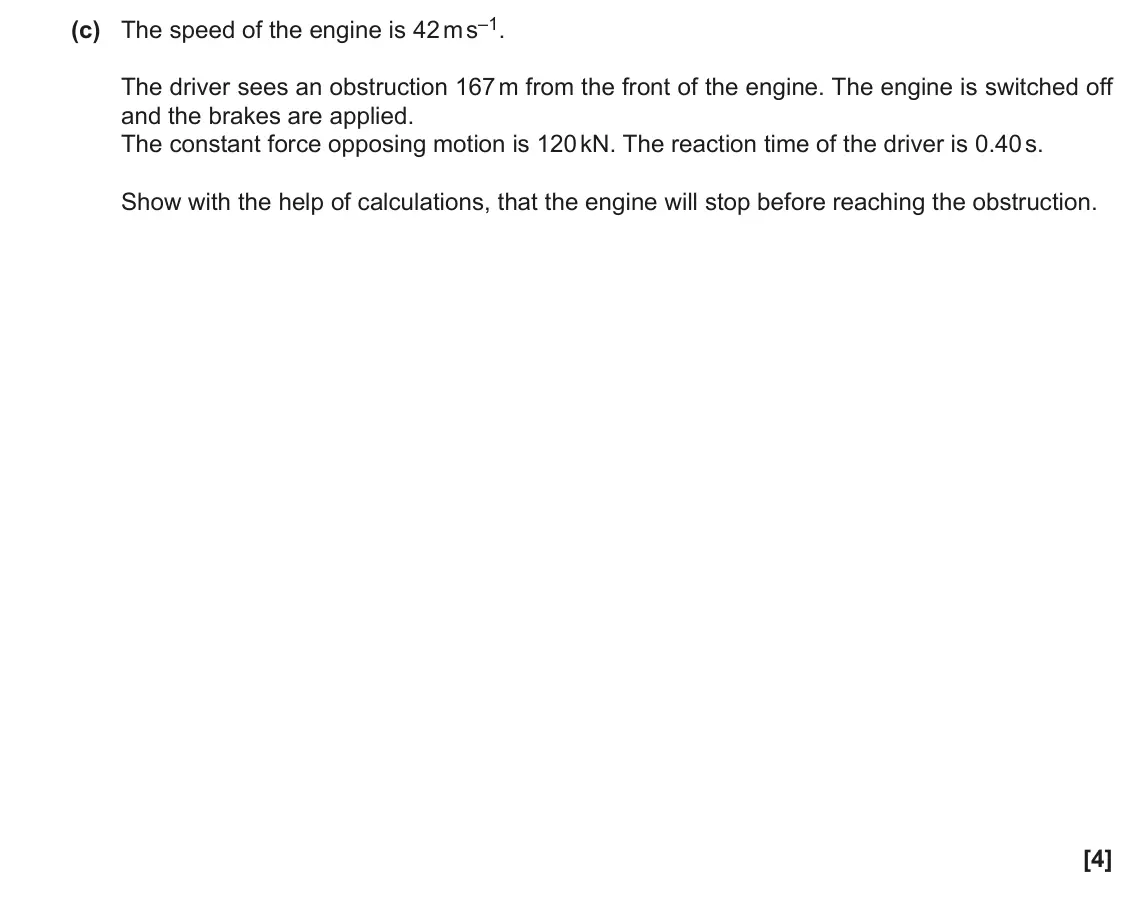


All 46 questions on Linear motion, as a list
- June 2025, AS Paper 1, Q11 (1 mark): An object, initially at rest, falls from a height of 4.5 m above the ground. Assume that air resistance is negligible. Calculate the speed of the object when it
- June 2025, AS Paper 1, Q21(b)(ii) (3 marks): Calculate the time taken by the lift to reach a height of 8.5 m. time = s [3]
- June 2025, AS Paper 2, Q1(b) (2 marks): Use the graph to determine the total stopping distance d of the train from t = 0. d = m [2]
- June 2024, Paper 1, Q4 (1 mark): To determine the acceleration of free fall g, a ball is dropped from rest from a point vertically above a light gate. The ball has a diameter of 5.0 cm. It is d
- June 2024, Paper 1, Q7 (1 mark): The graph shows a velocity-time graph for a vehicle. At time t = 0 the driver observes an obstruction in the road. A short time later the brakes are applied, an
- June 2024, AS Paper 1, Q24(b) (3 marks): The student now releases a heavy ball and allows it to fall from a height of 2.0 m. Calculate its expected speed when it hits the ground. Assume that air resist
- June 2024, AS Paper 1, Q24(c) (3 marks): The student measures the time for the heavy ball to fall from a height of 2.0 m. They release the ball and, at the same time, start a stopwatch. They stop the s
- June 2024, AS Paper 1, Q24(d) (2 marks): Suggest one improvement the student could make to the investigation described in (c). [2]
- June 2024, AS Paper 2, Q3 (6 marks): 3* In an experiment, a trapdoor and electromagnet are used to determine the acceleration of free fall of a ball. The distance the ball falls is h and the time t
- June 2023, Paper 1, Q16(a)(iii) (3 marks): Using the table, explain why having markings 40 m apart helps prevent collisions. [3]
- June 2023, Paper 1, Q16(b)(ii) (2 marks): Explain the effect on the distance required to bring the vehicle to rest if the road has an upwards slope. [2]
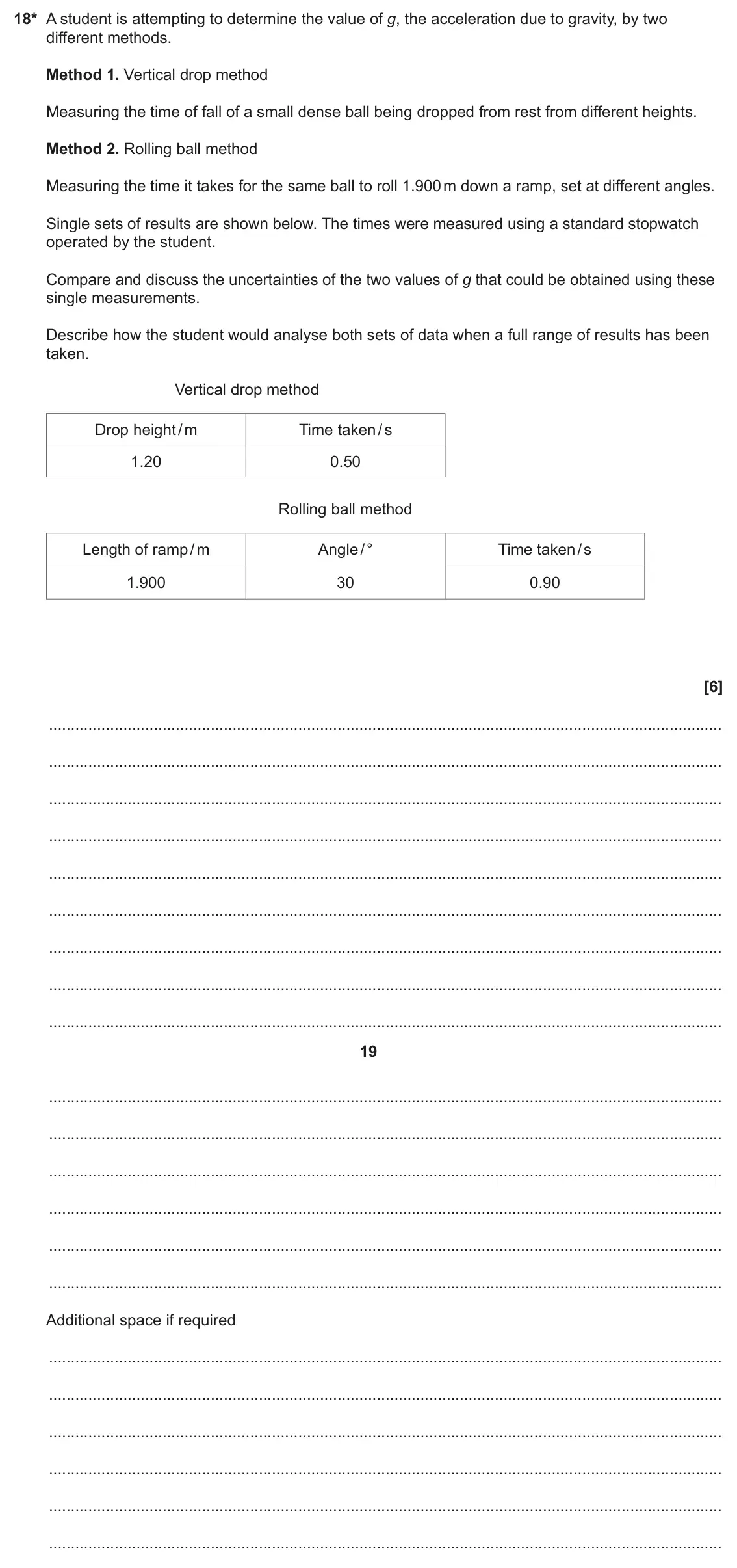
- June 2023, Paper 1, Q18 (6 marks): 18* A student is attempting to determine the value of g, the acceleration due to gravity, by two different methods. Method 1. Vertical drop method Measuring the
- June 2023, AS Paper 1, Q14 (1 mark): An object is released from rest and then falls freely under gravity. Air resistance is negligible. Which graph shows how the velocity v of the object varies wit
- June 2023, AS Paper 2, Q1(a)(iii) (2 marks): Calculate the total stopping distance d of the car. d = m [2]
- June 2023, AS Paper 2, Q1(b) (2 marks): The same driver in the same car repeats the test at half the initial velocity. The braking force is constant. On the graph, draw the variation of velocity of th
- June 2023, AS Paper 2, Q1(c)(i) (1 mark): the driver was tired [1]
- June 2023, AS Paper 2, Q1(c)(ii) (1 mark): the surface of the track was more resistive. [1]
- June 2022, Paper 1, Q17(c) (4 marks): The speed of the engine is 42 m s–1. The driver sees an obstruction 167 m from the front of the engine. The engine is switched off and the brakes are applied. T
- June 2022, AS Paper 2, Q2 (6 marks): 2* A student is investigating the motion of a trolley as it accelerates from rest along a horizontal surface. The diagram shows the trolley on a horizontal surf
- November 2021, Paper 1, Q3 (1 mark): The table shows some data for a car travelling on a straight road with an initial speed of 13 m s–1. 3 Thinking distance / m 9.0 Braking distance / m 14 Stoppin
- November 2021, Paper 1, Q16(a)(ii) (4 marks): Describe how the student could use standard laboratory equipment to take accurate measurements of the distance s and the time t. [4]
- November 2021, Paper 3, Q1(a)(ii) (2 marks): Calculate the distance s that the train travels to reach a speed of 6.0 m s–1. s = m [2]
- November 2021, AS Paper 1, Q22(a) (1 mark): Name the instrument the student should use to measure d. [1]
- November 2020, AS Paper 1, Q13 (1 mark): A driver sees an obstacle ahead in the road at time t = 0 and then applies the brakes. The velocity v against time t graph for the car is shown below. 10 v / m
- November 2020, AS Paper 2, Q5(e) (3 marks): Describe and explain the variation of the displacement with time when the same driver applies the brakes in the same car when the initial speed of the car is 10
- June 2019, Paper 1, Q19(a) (3 marks): A car is travelling along a straight road at 18 m s–1. The driver sees an obstacle and after 0.50 s applies the brakes. The stopping distance of the car is 38 m
- June 2019, AS Paper 1, Q18 (1 mark): A ball of diameter 2.50 cm is held above the ground. The bottom of the ball is 10.2 cm above the ground. The ball is released from rest. Air resistance has negl
- June 2019, AS Paper 1, Q22(b) (2 marks): Use an equation of motion to show that the speed of the ball is 4.9 m s–1 just before it hits the ground. [2]
- June 2018, Paper 1, Q20(b)(iii) (4 marks): During the downward journey of the load, the string breaks at t = 4.0 s. It then falls vertically towards the ground. The mass of the load is 120 g. Air resista
- June 2018, AS Paper 1, Q10 (1 mark): A car is driven at constant velocity until the driver sees an obstruction ahead at time t = 0. The velocity against time graph below shows the motion of the car
- June 2018, AS Paper 1, Q21(a) (2 marks): Describe how a metre rule and a stopwatch can be used to determine the final velocity v of the trolley at the bottom of the ramp. [2]
- June 2018, AS Paper 1, Q21(b)(i) (2 marks): Calculate the acceleration a of the trolley. a = m s−2 [2]
- June 2018, AS Paper 2, Q3(a) (4 marks): Describe and explain how the student could use standard laboratory equipment to make accurate measurements of h and t. [4]
- June 2018, AS Paper 2, Q3(b) (1 mark): Complete the table for the missing value of t2. [1]
- June 2018, AS Paper 2, Q3(c)(i) (2 marks): Plot the missing data point and draw the straight line of best fit. [2]
- June 2018, AS Paper 2, Q3(c)(ii) (1 mark): Determine the gradient of the straight line of best fit. gradient = s2 m–1 [1] 5 0.20 t 2/ s2 0.19 0.18 0.17 0.16 0.15 0.14 0.13 0.5 0.6 0.7 0.8 0.9 1.0 h / m F
- June 2018, AS Paper 2, Q3(d)(i) (1 mark): Use the equations of motion for constant acceleration to show that the relationship between t and h is J N 2 2 = KK OO t g h L P where g is the acceleration of
- June 2018, AS Paper 2, Q3(d)(ii) (1 mark): Use your answer to (c)(ii) to determine the experimental value for g. g = m s–2 [1]
- June 2017, Paper 1, Q4 (1 mark): A ball is dropped from rest above the ground. Air resistance has negligible effect on the motion of the ball. The speed of the ball is v after it has fallen a d
- June 2017, Paper 1, Q12 (1 mark): An object above the ground is released from rest at time t = 0. Air resistance is negligible. What is the distance travelled by the object between t = 0.20 s an
- June 2017, Paper 1, Q18(b) (2 marks): The cylinder is released from rest from a trapdoor. The base of the cylinder is at a height h = 0.30 m above the water surface. Calculate the speed of the cylin
- June 2017, AS Paper 1, Q21(c) (2 marks): The student assumes that the deceleration of the trolley is constant during the crash. Use Fig. 21 to determine the magnitude of the deceleration. deceleration
- June 2017, AS Paper 2, Q1(a) (1 mark): Define what is meant by the stopping distance of a vehicle. [1]
- June 2017, AS Paper 2, Q1(b)(ii) (7 marks): The brakes of the train are applied and the train is brought to rest in a distance of 310 m. Calculate 1. the initial kinetic energy Ek of the train Ek = J [2]
- June 2016, AS Paper 1, Q21(b)(ii) (2 marks): The string is cut at time t = 0. The trolley travels down the ramp with a constant acceleration of 3.0 m s–2. Calculate the time t taken by the trolley to trave
- June 2016, AS Paper 1, Q22(b) (3 marks): The mass of the car is 920kg. Use the gradient of the line drawn in Fig. 22 to determine the braking force F acting on the car. F = N [3]
Questions, mark schemes and examiner’s reports are © OCR, from their published past papers. Plumi isn’t affiliated with any exam board. Want whole papers? Every OCR A-Level Physics A paper, or our free OCR-style practice pack.
Rather write your answers by hand on iPad? Plumi marks them against the same mark schemes.