Skip to content

Counting and combinatorics: OCR A‑Level Further Maths questions

Every OCR A-Level Further Maths exam question on D.7 Counting and combinatorics, 2018–2025, with its mark scheme and examiner’s report.

Find questions648

648 questions

  1. Q7

    June 2025 · Discrete Mathematics

    The whole paper ↗
    June 2025 Discrete Mathematics, question 7: Charlie has a set of 100 cards. On each card one of the integers from 1 to 100 is printed without any repeats. (a) Use the inclusion-exclusion principle to dete
  2. Q2

    June 2025 · AS Discrete Mathematics

    The whole paper ↗
    June 2025 AS Discrete Mathematics, question 2: A student has six cards numbered from 1– 6. The cards are shown below. 1 2 3 4 5 6 (a) The student chooses four cards at random. Use the Pigeonhole Principle to
  3. Q1

    June 2024 · Discrete Mathematics

    The whole paper ↗
    June 2024 Discrete Mathematics, question 1: At the end of each year the workers at an office take part in a gift exchange. Each worker randomly chooses the name of one other worker and buys a small gift f
  4. Q4

    June 2023 · Discrete Mathematics

    The whole paper ↗
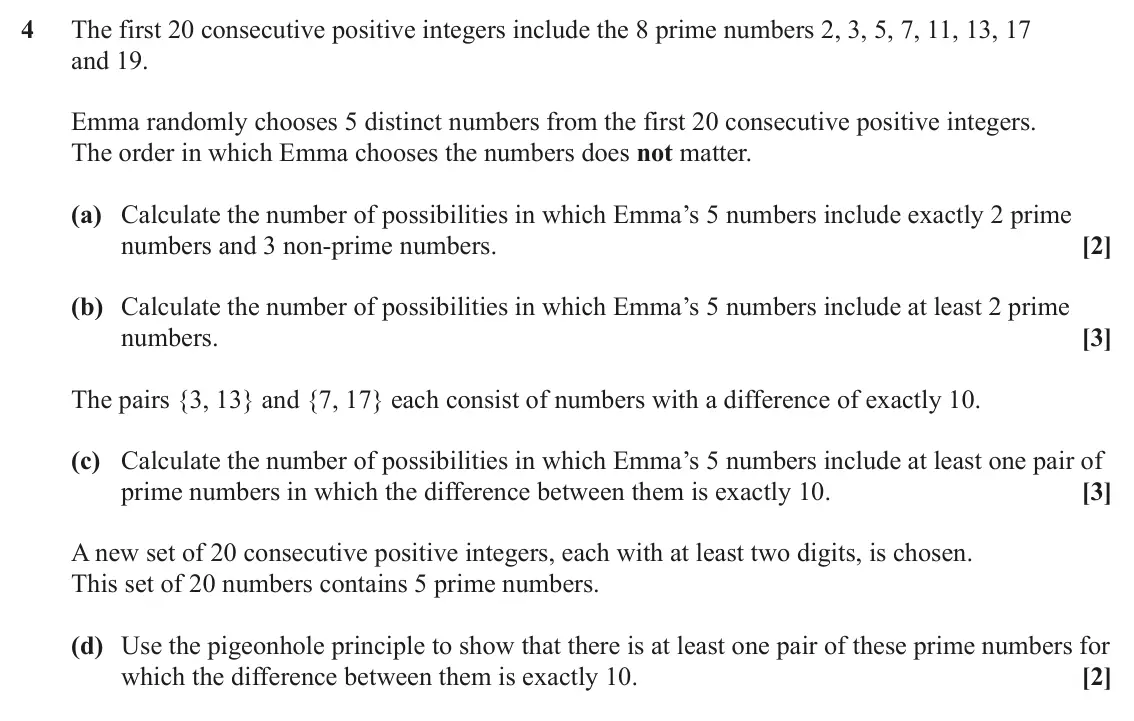
    June 2023 Discrete Mathematics, question 4: The first 20 consecutive positive integers include the 8 prime numbers 2, 3, 5, 7, 11, 13, 17 and 19. Emma randomly chooses 5 distinct numbers from the first 20
  5. Q1

    June 2023 · AS Discrete Mathematics

    The whole paper ↗
    June 2023 AS Discrete Mathematics, question 1: Jane wants to travel from home to the local town. Jane can do this by train, by bus or by both train and bus. (a) Give an example of a problem that Jane could b
  6. Q3

    June 2022 · Discrete Mathematics

    The whole paper ↗
    June 2022 Discrete Mathematics, question 3: A para relay team of 4 swimmers needs to be chosen from a group of 7 swimmers. (a) How many ways are there to choose 4 swimmers from 7? [1] There are no restric
  7. Q7

    June 2022 · AS Discrete Mathematics

    The whole paper ↗
    June 2022 AS Discrete Mathematics, question 7: (a) List the 15 partitions of the set {A, B, C, D, E} in which A and E are in the same subset. [3] (b) By considering the number of subsets in each of the parti
  8. Q3

    November 2021 · Discrete Mathematics

    The whole paper ↗
    November 2021 Discrete Mathematics, question 3: Six people play a game with 150 cards. Each player has a stack of cards in front of them and the remainder of the cards are in another stack on the table. (a) U
  9. Q1

    November 2021 · AS Discrete Mathematics

    The whole paper ↗
    November 2021 AS Discrete Mathematics, question 1: A set consists of five distinct non-integer values, A, B, C, D and E. The set is partitioned into non-empty subsets and there are at least two subsets in each p
  10. Q4

    November 2020 · Discrete Mathematics

    The whole paper ↗
    November 2020 Discrete Mathematics, question 4: (a) Show that there are 127 ways to partition a set of 8 distinct elements into two non-empty subsets. [3] A group of 8 people (A, B, …) have 8 reserved seats (
  11. Q2

    June 2018 · AS Discrete Mathematics

    The whole paper ↗
    June 2018 AS Discrete Mathematics, question 2: Mo eats exactly 6 doughnuts in 4 days. (i) What does the pigeonhole principle tell you about the number of doughnuts Mo eats in a day? [1] Mo eats exactly 6 dou
All 11 questions on Counting and combinatorics, as a list
  1. June 2025, Discrete Mathematics, Q7 (6 marks): Charlie has a set of 100 cards. On each card one of the integers from 1 to 100 is printed without any repeats. (a) Use the inclusion-exclusion principle to dete
  2. June 2025, AS Discrete Mathematics, Q2 (6 marks): A student has six cards numbered from 1– 6. The cards are shown below. 1 2 3 4 5 6 (a) The student chooses four cards at random. Use the Pigeonhole Principle to
  3. June 2024, Discrete Mathematics, Q1 (7 marks): At the end of each year the workers at an office take part in a gift exchange. Each worker randomly chooses the name of one other worker and buys a small gift f
  4. June 2023, Discrete Mathematics, Q4 (10 marks): The first 20 consecutive positive integers include the 8 prime numbers 2, 3, 5, 7, 11, 13, 17 and 19. Emma randomly chooses 5 distinct numbers from the first 20
  5. June 2023, AS Discrete Mathematics, Q1 (3 marks): Jane wants to travel from home to the local town. Jane can do this by train, by bus or by both train and bus. (a) Give an example of a problem that Jane could b
  6. June 2022, Discrete Mathematics, Q3 (8 marks): A para relay team of 4 swimmers needs to be chosen from a group of 7 swimmers. (a) How many ways are there to choose 4 swimmers from 7? [1] There are no restric
  7. June 2022, AS Discrete Mathematics, Q7 (7 marks): (a) List the 15 partitions of the set {A, B, C, D, E} in which A and E are in the same subset. [3] (b) By considering the number of subsets in each of the parti
  8. November 2021, Discrete Mathematics, Q3 (8 marks): Six people play a game with 150 cards. Each player has a stack of cards in front of them and the remainder of the cards are in another stack on the table. (a) U
  9. November 2021, AS Discrete Mathematics, Q1 (10 marks): A set consists of five distinct non-integer values, A, B, C, D and E. The set is partitioned into non-empty subsets and there are at least two subsets in each p
  10. November 2020, Discrete Mathematics, Q4 (10 marks): (a) Show that there are 127 ways to partition a set of 8 distinct elements into two non-empty subsets. [3] A group of 8 people (A, B, …) have 8 reserved seats (
  11. June 2018, AS Discrete Mathematics, Q2 (7 marks): Mo eats exactly 6 doughnuts in 4 days. (i) What does the pigeonhole principle tell you about the number of doughnuts Mo eats in a day? [1] Mo eats exactly 6 dou

Questions, mark schemes and examiner’s reports are © OCR, from their published past papers. Plumi isn’t affiliated with any exam board. Want whole papers? Every OCR A-Level Further Maths paper.

Rather write your answers by hand on iPad? Plumi marks them against the same mark schemes.