 plumi
Algorithms and sorting: OCR A‑Level Further Maths questions
Every OCR A-Level Further Maths exam question on D.1 Algorithms and sorting, 2018–2025, with its mark scheme and examiner’s report.
Find questions648




All 16 questions on Algorithms and sorting, as a list
- June 2025, Discrete Mathematics, Q3 (8 marks): Hiro uses a sorting algorithm to sort the heights in cm of 8 people into ascending order. At the end of the first pass through the algorithm, Hiro ends up with
- June 2025, AS Discrete Mathematics, Q1 (6 marks): A builder has some pieces of wood that are 6 m in length. The builder needs to cut smaller pieces to use in a project. The lengths of the smaller pieces require
- June 2024, AS Discrete Mathematics, Q7 (13 marks): Six items need to be packed into bins. Each bin has size k, where k is an integer. The sizes of the items are 8 5 4 7 3 3 (a) Show a way to pack the items into
- June 2023, Discrete Mathematics, Q5 (12 marks): A list of 8 values is given below. 3 24 8 1 4 20 30 18 The list is to be sorted into increasing order using quick sort, as given in the Formulae Booklet. (a) Ca
- June 2023, AS Discrete Mathematics, Q3 (12 marks): The list of numbers below is to be sorted into increasing order. 23 10 18 7 62 54 31 82 (a) Sort the list using bubble sort. You do not need to show intermediat
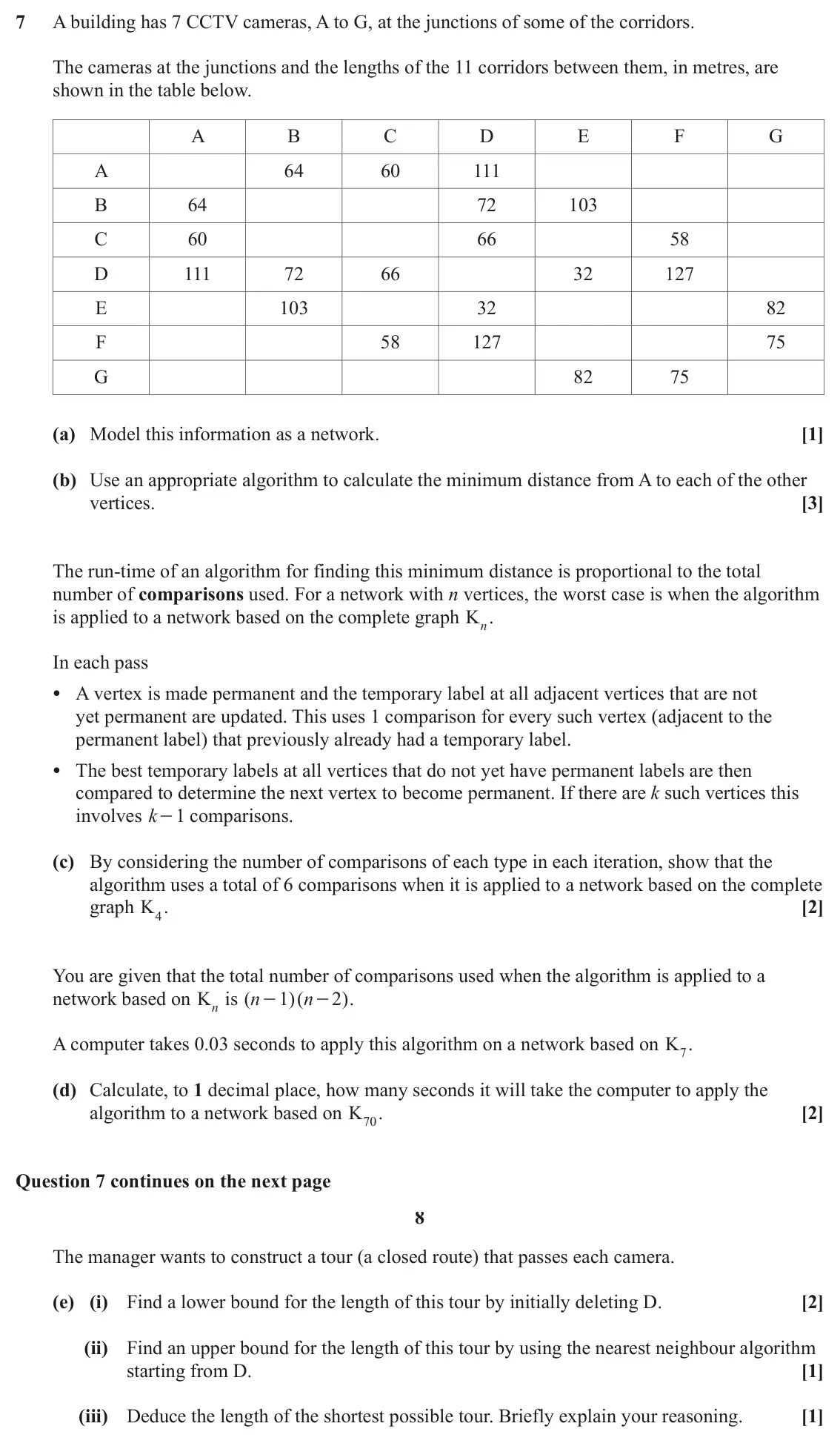
- June 2022, Discrete Mathematics, Q7 (12 marks): A building has 7 CCTV cameras, A to G, at the junctions of some of the corridors. The cameras at the junctions and the lengths of the 11 corridors between them,
- June 2022, AS Discrete Mathematics, Q1 (4 marks): The flowchart below has positive inputs X, Y and M. Input X, Y N = 0 Input a positive integer M H = 1 ÷ M D = (X2 + Y2) ÷ (5X) X = X + H Y = Y + H×D N = N + 1 Y
- June 2022, AS Discrete Mathematics, Q3 (10 marks): (a) The list below is to be sorted into increasing order using bubble sort. 52 38 15 61 27 49 10 33 96 74 (i) Determine the list that results at the end of the
- November 2021, Discrete Mathematics, Q1 (8 marks): Sam is packing for a holiday. The table shows the mass of each item to be packed. Item A B C D E F G H Mass (kg) 3 4 3.5 2.5 6 7.5 8 5 Sam’s bags can each carry
- November 2021, Discrete Mathematics, Q7 (15 marks): A network is formed by weighting the graph below using the listed arc weights. 2.9 0.9 1.5 3.5 4.2 5.3 4.7 2.3 (a) (i) Show the result after the first pass and
- November 2021, AS Discrete Mathematics, Q2 (11 marks): Seven items need to be packed into bins. Each bin has capacity 30 kg. The sizes of the items, in kg, in the order that they are received, are as follows. 12 23
- November 2020, AS Discrete Mathematics, Q1 (10 marks): Algorithm X is given below: STEP 1: Let A = 0 STEP 2: Input the value of B [B must be a positive integer] C = INT(B ÷ 3) STEP 3: STEP 4: D = B + 3C STEP 5: Repl
- November 2020, AS Discrete Mathematics, Q2 (8 marks): Jameela needs to store ten packages in boxes. She has a list showing the size of each package. The boxes are all the same size and Jameela can use up to six of
- June 2019, Discrete Mathematics, Q4 (12 marks): An algorithm must have an input, an output, be deterministic and finite. (a) Why is a counter sometimes used in an algorithm? [1] A computer takes 0.2 seconds t
- June 2019, AS Discrete Mathematics, Q3 (11 marks): (a) Give an example of a standard sorting algorithm that can be used when some of the values are not known until after the sorting has been started. [1] Becky n
- June 2018, AS Discrete Mathematics, Q1 (6 marks): Some jars need to be packed into small crates. There are 17 small jars, 7 medium jars and 3 large jars to be packed. • A medium jar takes up the same space as f
Questions, mark schemes and examiner’s reports are © OCR, from their published past papers. Plumi isn’t affiliated with any exam board. Want whole papers? Every OCR A-Level Further Maths paper.
Rather write your answers by hand on iPad? Plumi marks them against the same mark schemes.