 plumi
Organic reactions: OCR A‑Level Chemistry B questions
Every OCR A-Level Chemistry B exam question on WM Organic reactions (specification points WM(c)–(g)), 2016–2025, with its mark scheme and examiner’s report.
Find questions2,049
Calculations

Q31(d)(i)
The whole paper ↗
Q31(d)(ii)
The whole paper ↗
Q32(a)(i)
The whole paper ↗
Q32(a)(ii)
The whole paper ↗
Q32(b)(i)
The whole paper ↗
Q32(b)(ii)
The whole paper ↗
Q32(c)(i)
The whole paper ↗
Q32(c)(iii)
The whole paper ↗

Q21(b)
The whole paper ↗
Q21(c)
The whole paper ↗
Q2(c)(i)
The whole paper ↗
Q4(a)(ii)
The whole paper ↗
Q4(a)(iii)
The whole paper ↗

Q34(d)
The whole paper ↗
Q1(b)
The whole paper ↗
Q2(b)
The whole paper ↗
All 137 questions on Organic reactions, as a list
- June 2025, Paper 1, Q3 (1 mark): An organic compound A is oxidised to a different compound which forms a silver mirror with Tollens’ reagent. Which could be compound A? A propanal B propan-1-ol
- June 2025, Paper 1, Q31(d)(i) (1 mark): State the type of reaction that occurs between oleic acid and glycerol. [1]
- June 2025, Paper 1, Q31(d)(ii) (2 marks): Write a balanced equation for the reaction between oleic acid, C17H33COOH, and glycerol. [2]
- June 2025, Paper 1, Q32(a)(i) (2 marks): Complete the equation below by drawing the skeletal formula of a suitable carboxylic acid and suggesting a suitable catalyst. catalyst: O HO + butan-1-ol O + H2
- June 2025, Paper 1, Q32(a)(ii) (3 marks): After synthesis, the ester can be separated from the reaction mixture by distillation. Draw a labelled diagram to show how equipment is set up for distillation.
- June 2025, Paper 1, Q32(b)(i) (3 marks): They react with acid anhydrides to form esters. Ethanoic anhydride reacts with phenol to form an ester and one other product. Show the structures of these compo
- June 2025, Paper 1, Q32(b)(ii) (1 mark): Sodium phenoxide can be made from phenol. Explain whether sodium carbonate or sodium hydroxide should be used for this synthesis. [1]
- June 2025, Paper 1, Q32(c)(i) (1 mark): Give suitable conditions for this reaction. [1]
- June 2025, Paper 1, Q32(c)(iii) (3 marks): The dehydration of butan-2-ol also makes but-1-ene. Suggest, with reasons, whether butan-1-ol or butan-2-ol would be better for making but-1-ene. [3]
- June 2025, AS Paper 1, Q16 (1 mark): What is a reaction of methanol, CH3OH? A It can be dehydrated to an alkene. B It can be esterified using another alcohol. C It can be oxidised to a ketone. D It
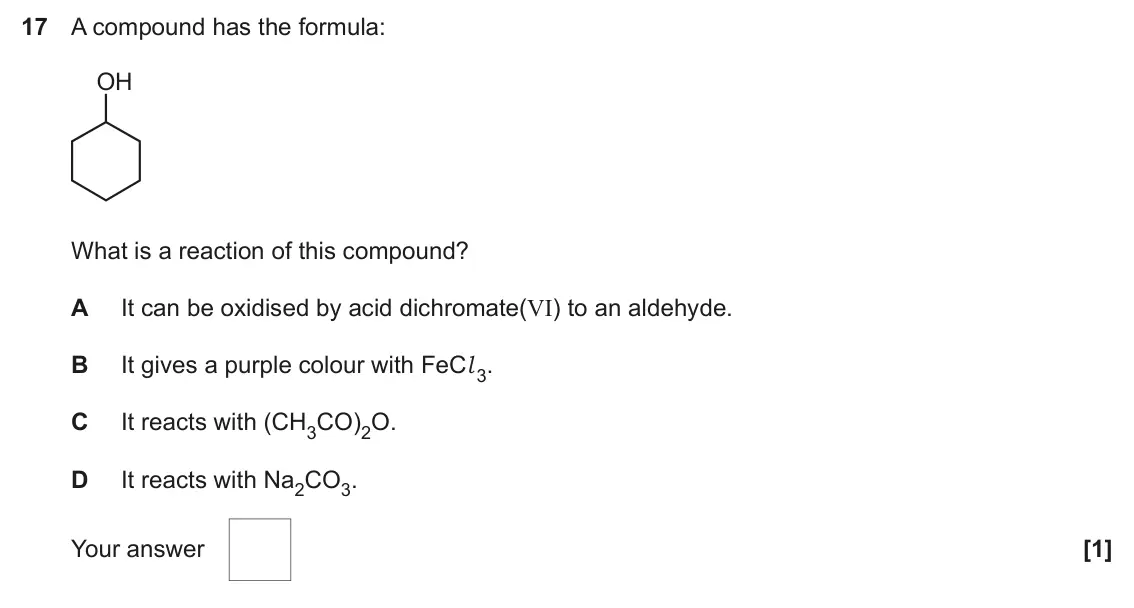
- June 2025, AS Paper 1, Q17 (1 mark): A compound has the formula: OH What is a reaction of this compound? A It can be oxidised by acid dichromate(VI) to an aldehyde. B It gives a purple colour with
- June 2025, AS Paper 1, Q21(b) (2 marks): An aromatic product is formed when bisphenol A reacts with ethanoic anhydride, (CH3CO)2O. Complete the skeletal formula of this aromatic product. [2]
- June 2025, AS Paper 1, Q21(c) (5 marks): Bisphenol A can be purified by recrystallisation from dilute ethanoic acid. Describe the steps in this procedure, stating where soluble and insoluble impurities
- June 2025, AS Paper 2, Q2(c)(i) (1 mark): The alkene has a boiling point of 30 °C and is highly flammable. Suggest a practical arrangement that the student should use to avoid loss of the alkene as a va
- June 2025, AS Paper 2, Q4(a)(ii) (1 mark): Give the reaction conditions that the student should use for this esterification reaction. [1]
- June 2025, AS Paper 2, Q4(a)(iii) (1 mark): Write a structural formula for the ester produced in this reaction. [1]
- June 2024, Paper 1, Q9 (1 mark): Which compound will react with sodium carbonate? A CH3COCH3 B CH3COOCH3 C CH3CH2CH2OH D CH3CH2COOH Your answer [1]
- June 2024, Paper 1, Q34(d) (3 marks): Alcohols can be dehydrated by heating with concentrated sulfuric acid. When dehydrated, CH3CH2CH(OH)CH3 produces a mixture of three isomeric products. Draw the
- June 2024, Paper 2, Q1(b) (2 marks): Long-chain carboxylic acids can be identified by converting them to their methyl esters and then using gas–liquid chromatography. Write the equation for the con
- June 2024, Paper 3, Q2(b) (2 marks): Describe a simple test-tube test that could confirm the formation of oil of wintergreen. [2]
- June 2024, Paper 3, Q2(c) (6 marks): ‘Oil of wintergreen’ is used by athletes to warm their muscles. It can be synthesised in the laboratory from aspirin tablets. The reaction is shown. O CH3 H3C O
- June 2024, Paper 3, Q2(d)(i) (2 marks): The students shake the impure product with sodium hydrogencarbonate solution in a separating funnel. Which impurities are removed by doing this and what is seen
- June 2024, Paper 3, Q2(d)(ii) (2 marks): The students then add ether to the separating funnel. Oil of wintergreen and aspirin are insoluble in cold water, but very soluble in ether. The density of ethe
- June 2024, Paper 3, Q2(d)(iii) (1 mark): Ether is volatile and very flammable. How could oil of wintergreen be obtained from the ether layer? [1]
- June 2024, AS Paper 1, Q8 (1 mark): An impure organic liquid is being purified after preparation. The liquid is insoluble in water. Why is a separating funnel used? A To complete the distillation.
- June 2024, AS Paper 1, Q15 (1 mark): What is a property of the compound shown? CO2H OH A It can be oxidised to a carbonyl compound. It gives a purple colour with neutral FeCl 3. B C It is neutral i
- June 2024, AS Paper 1, Q16 (1 mark): An impure solid is purified by recrystallisation. What is correct? A Insoluble impurities are removed by filtration at the end of the process. B Soluble impurit
- June 2024, AS Paper 1, Q23(e)(ii) (1 mark): Explain why the Cativa process is ‘greener’ than the Monsanto process. [1]
- June 2024, AS Paper 2, Q2(f) (2 marks): 1-chloropropane, CH3CH2CH2Cl, is another organic compound containing chlorine. 1-chloropropane is made by reacting propan-1-ol, CH3CH2CH2OH, with concentrated h
- June 2023, Paper 1, Q4 (1 mark): One of the principles of green chemistry in industrial processes involves the use of a selective catalyst. Which of the following makes a selective catalyst ‘gr
- June 2023, Paper 1, Q16 (1 mark): Which compound can undergo an elimination reaction to produce an alkene? A (CH3)3CH B C6H5OH C C6H5CH2OH D CH3CH(CH3)CH2OH Your answer [1]
- June 2023, Paper 1, Q17 (1 mark): An organic liquid is being purified. The liquid does not mix with water and contains a small aqueous acidic impurity. What is the correct order for the followin
- June 2023, AS Paper 1, Q12 (1 mark): A liquid is insoluble in water. It is purified from an aqueous solution in which it has been prepared. One stage in the purification is allowing the liquid to s
- June 2023, AS Paper 2, Q3(b)(i) (2 marks): Describe and explain how the student should modify this part of their technique in order to obtain more recrystallised product. [2]
- June 2023, AS Paper 2, Q3(b)(ii) (1 mark): Name a practical technique that the student could use to check the purity of a recrystallised product. [1]
- June 2023, AS Paper 2, Q3(d)(i) (1 mark): When C6H5CH2CH2OH is oxidised with acidified potassium dichromate(VI), an aldehyde and a carboxylic acid are formed. Name the practical technique that should be
- June 2023, AS Paper 2, Q3(d)(iii) (1 mark): Give the structural formula of the ester formed when C6H5CH2CH2OH reacts with ethanoic acid. [1]
- June 2023, AS Paper 2, Q3(d)(iv) (3 marks): C6H5CH2CH2OH undergoes a dehydration reaction when heated with concentrated sulfuric acid. However, phenylmethanol, C6H5CH2OH, does not undergo this reaction. •
- June 2022, Paper 1, Q11 (1 mark): Which of the following alcohols cannot undergo dehydration? A CH3CH2CH2CH2OH B (CH3)2CHCH2OH C (CH3)3COH D CH3CH(OH)CH2CH3 Your answer [1]
- June 2022, Paper 1, Q33(b) (2 marks): A student shakes some 4-HBA with sodium hydroxide solution. A reaction occurs forming a soluble product. Write the equation for the reaction of solid 4-HBA, HOC
- June 2022, Paper 1, Q33(c)(i) (1 mark): Describe two things that the student would observe. 1 2 [1]
- June 2022, Paper 1, Q33(c)(ii) (1 mark): Write a formula for the organic product that is formed when 4-HBA reacts with aqueous sodium carbonate. [1]
- June 2022, Paper 1, Q33(d) (5 marks): The student prepares an impure sample of ethyl paraben by reacting 4-HBA with ethanol. Describe how the student could purify the ethyl paraben. You should make
- June 2022, Paper 1, Q35(d) (2 marks): Further reactions are then carried out to convert methylbenzene into 4-aminobenzoic acid. COOH NH2 4-aminobenzoic acid Complete the following equation to show a
- June 2022, Paper 1, Q35(e)(i) (1 mark): Give the reagents and conditions that a student could use to bring about the reaction in Step 1. [1]
- June 2022, Paper 1, Q35(e)(v) (1 mark): The conversion in Step 3 is brought about by heating 4-nitrobenzoic acid with tin and concentrated hydrochloric acid under reflux. Explain why the heating is ca
- June 2022, AS Paper 1, Q9 (1 mark): What is the final stage in the purification of a liquid organic product? A distillation B drying C neutralisation D separation Your answer [1]
- June 2022, AS Paper 1, Q14 (1 mark): A compound has the structure shown. CH2OH HOOC What is a correct property of this compound? A It fizzes with NaOH(aq). B It gives a purple colour with neutral i
- June 2022, AS Paper 2, Q3(a)(ii) (1 mark): Give the reagents and conditions required for reaction 1. Reagents Conditions [1] 10 Reaction 1 (repeated) CH2CH2OH CH2COOH Reaction 1 Compound A Compound B
- June 2022, AS Paper 2, Q3(c) (1 mark): Reaction 3 Compound A can be reacted with hydrochloric acid. An incomplete equation is shown below. CH2CH2OH CH2CH2Cl Reaction 3 Complete the balanced equation
- June 2022, AS Paper 2, Q3(d) (6 marks): This question concerns some reactions of compound A. CH2CH2OH Compound A Compound A is found in extract of orange blossom. A group of chemists carry out some re
- November 2021, Paper 1, Q15 (1 mark): A compound has the formula C6H5CH2OH. What is a correct reaction of this compound? A dehydration to an alkene B oxidation to a ketone C oxidation to an aldehyde
- November 2021, Paper 1, Q16 (1 mark): An organic liquid is contaminated with acid. The liquid is placed in a separating funnel. What is the correct sequence for the operations that follow? separate
- November 2021, Paper 1, Q28 (1 mark): Which of the following changes will result in a more sustainable process? 1 Increasing the temperature to get the products as fast as possible. 2 Reducing the n
- November 2021, Paper 1, Q30 (1 mark): A substance Z reacts with aqueous sodium carbonate to produce carbon dioxide. Which of the following could be substance Z? O C OH 1 OH OH 2 OH 3 A 1, 2 and 3 B
- November 2021, Paper 1, Q34(d) (3 marks): The students’ product, compound C, is a solid. Explain how they could purify this solid by recrystallisation. [3] 26 The first step from part (a) is: R' OC2H5 R
- November 2021, Paper 3, Q1(a) (4 marks): Complete the flow diagram by writing on the dotted lines and drawing skeletal formulae in the empty boxes. Silver mirror formed reagent butan-1-ol skeletal form
- November 2021, Paper 3, Q1(d) (6 marks): Alcohols are useful intermediates and react to give a variety of products. For example, butan-1-ol can be oxidised to other useful products as shown below. (d)*
- November 2021, AS Paper 1, Q4 (1 mark): A chemical company is looking for a new ‘greener’ process. Which feature of the new process, compared with the old one, would the company choose? A It has more
- November 2021, AS Paper 1, Q12 (1 mark): What is a correct property of a phenol? A It fizzes with sodium carbonate solution. B It is neutralised by sodium hydroxide. C It reacts with carboxylic acids t
- November 2021, AS Paper 1, Q13 (1 mark): Which statement about recrystallisation is correct? A Insoluble impurities remain until the end. B Soluble impurities are filtered off at the start. C The cryst
- November 2021, AS Paper 1, Q22(a)(i) (1 mark): Draw the skeletal formula for phenyl ethanoate. [1]
- November 2021, AS Paper 1, Q22(b) (1 mark): After some other purification stages, the students end up with phenyl ethanoate (boiling point 196 °C) dissolved in a liquid of boiling point 170 °C. Name the s
- November 2021, AS Paper 1, Q24(d) (2 marks): Butan-1-ol reacts with carboxylic acids to form esters in the presence of concentrated sulfuric acid. Complete the equation for the formation of the ester and a
- November 2020, Paper 1, Q13 (1 mark): What happens when the compound shown is distilled with acidified potassium dichromate(VI)? OH A No new product is formed. B An aldehyde is formed. C A ketone is
- November 2020, Paper 1, Q22 (1 mark): Which esterification reaction is correct? A (CH3CO)2O + C2H5OH CH3COOC2H5 + CH3COOH B (CH3CO)2O + 2CH3OH 2CH3COOCH3 C CH3COOH + C6H5OH CH3COOC6H5 + H2O D CH3COC
- November 2020, Paper 1, Q28 (1 mark): A manufacturer is producing a medicine. The manufacturer considers the following ways of improving the process. 1 Raising the temperature to get the product mor
- November 2020, Paper 2, Q4(g)(ii) (1 mark): Suggest another reason why the reaction selected in (g)(i) is preferred. [1]
- November 2020, Paper 3, Q2(b)(i) (1 mark): adding cyclohexane [1]
- November 2020, Paper 3, Q2(b)(ii) (1 mark): adding sodium carbonate solution [1]
- November 2020, Paper 3, Q2(b)(iii) (1 mark): standing the cyclohexane layer over solid anhydrous sodium sulfate [1]
- November 2020, Paper 3, Q2(b)(iv) (1 mark): collecting the distillate above 190 °C [1]
- November 2020, AS Paper 1, Q14 (1 mark): Which statement about the reactions of methanol is correct? A It cannot be oxidised to methanal. B It reacts with acid anhydrides to form methyl esters. C It re
- November 2020, AS Paper 1, Q15 (1 mark): Which colour change is correct? A Acidified dichromate(VI) changes from orange to green when reduced. B Alkenes turn bromine from colourless to brown. C Chlorop
- November 2020, AS Paper 1, Q16 (1 mark): Which statement about the purification of a solid by recrystallisation is correct? A Insoluble impurities are removed in the last stage of the process. B Solubl
- November 2020, AS Paper 2, Q3(a) (3 marks): 4-hydroxybenzoic acid has the following structural formula. O HO C OH 4-hydroxybenzoic acid reacts with both sodium hydroxide and sodium carbonate solutions. Th
- November 2020, AS Paper 2, Q3(b)(i) (1 mark): Explain why the heating is carried out under reflux. [1] 10 The reaction from (b) is shown again here. O H3C O HO C + (CH3CO)2O C O C + CH3COOH OH OH O 4-hydrox
- November 2020, AS Paper 2, Q3(e) (1 mark): Describe a simple test-tube reaction that would distinguish between 4-hydroxybenzoic acid and 4-acetoxybenzoic acid. [1]
- November 2020, AS Paper 2, Q3(f) (4 marks): 4-acetoxybenzoic acid is much more soluble in hot ethanol than cold ethanol. Using this information, describe how to obtain a pure dry sample of 4-acetoxybenzoi
- November 2020, AS Paper 2, Q3(g) (6 marks): Parabens are compounds used as preservatives in some cosmetics. A paraben can be made from the reaction between 4-hydroxybenzoic acid and ethanoic anhydride. (g
- June 2019, Paper 1, Q4 (1 mark): What is a principle of green chemistry? A Heating a reaction to speed it up B Improving the atom economy of a process C Disposing of waste efficiently D Using o
- June 2019, Paper 1, Q13 (1 mark): Which reaction does not occur? A C6H5COOH + NaOH C6H5COONa + H2O B C6H5OH + NaOH C6H5ONa + H2O C 2C6H5COOH + CaCO3 (C6H5COO)2Ca + CO2 + H2O D 2C6H5OH + Na2CO3 2
- June 2019, Paper 1, Q35(c) (1 mark): Compound A contains a phenol group. How do the students identify the phenol group? Test Expected result [1]
- June 2019, Paper 1, Q35(d)(i) (3 marks): Fill in the table to show the reagents, conditions and colour changes for their tests. Reagent(s) Conditions Colour change Oxidation of alcohol Identification o
- June 2019, Paper 1, Q35(e)(ii) (2 marks): The students want to make the ethanoate ester of compound A. Give the equation for a reaction to do this. Use structural formulae for the organic molecules. [2]
- June 2019, Paper 1, Q35(f)(i) (2 marks): Complete the reaction sequence by writing on the dotted lines. [2]
- June 2019, Paper 1, Q35(f)(ii) (2 marks): Comment on the student’s method of changing the position of the double bond. [2]
- June 2019, Paper 3, Q2(c) (3 marks): Fig. 2.2 shows some information found on a bottle of ethanoic anhydride. The students use the information in Fig. 2.2 to write a risk assessment for ethanoic an
- June 2019, Paper 3, Q2(e)(i) (3 marks): Name the technique in Fig. 2.4 and explain how this apparatus is used to get a sample of impure solid paracetamol. [3]
- June 2019, Paper 3, Q2(e)(ii) (1 mark): Suggest a reason for using the technique in Fig. 2.4 rather than simple filtration. [1] 7 Fig. 2.1 is repeated below. O O O H HO NH2 + C C HO N + C H3C O CH3 HO
- June 2019, AS Paper 1, Q18 (1 mark): What is not a reaction of 2-methylpropan-2-ol? A Reaction with an acid anhydride to form an ester B Oxidation to a ketone C Dehydration to an alkene D Reaction
- June 2019, AS Paper 1, Q24(b) (2 marks): Suggest laboratory reagents and conditions for converting salicyl alcohol to salicylic acid. Reagents Conditions [2]
- June 2019, AS Paper 1, Q24(c)(i) (2 marks): Give the first step in the recrystallisation process. [2]
- June 2019, AS Paper 1, Q24(c)(ii) (1 mark): How would the students show that their recrystallised product was purer than the impure sample? [1]
- June 2019, AS Paper 1, Q24(d) (3 marks): The students make some predictions about salicyl alcohol. They predict that salicyl alcohol will fizz with sodium carbonate solution. They also predict that sal
- June 2019, AS Paper 1, Q24(e)(i) (1 mark): When salicyl alcohol reacts with concentrated hydrochloric acid, only one –OH group reacts. Write the formula of the product formed. [1]
- June 2019, AS Paper 1, Q24(e)(ii) (1 mark): Salicyl alcohol reacts with ethanoic acid in the presence of concentrated sulfuric acid. Draw the skeletal formula of the product formed. [1]
- June 2018, Paper 1, Q10 (1 mark): The reaction below produces a chloroalkane. R–OH + HCl R–Cl + H2O Which row shows the steps to purify the liquid product in the correct order? Use a separating
- June 2018, Paper 1, Q19 (1 mark): Which compound will react with acidified potassium dichromate(VI)? A CH3CH(OH)COOH B (CH3)3COH C CH3COOH D CH3COCH3 Your answer [1]
- June 2018, Paper 1, Q25 (1 mark): Which molecule will not be made when water is eliminated from CH3CH2C(CH3)(OH)CH2CH2CH3? A CH3C(CH3)=CHCH2CH2CH3 B CH3CH=C(CH3)CH2CH2CH3 C CH2=C(CH2CH3)CH2CH2CH
- June 2018, Paper 1, Q31(e) (1 mark): The alcohol from (d) can be oxidised to a carbonyl compound. Give the reagents and conditions to carry out this oxidation. Reagents Conditions [1]
- June 2018, Paper 3, Q4(b)(ii) (1 mark): Suggest and explain the reason for step 13 in the procedure. [1]
- June 2018, Paper 3, Q4(b)(iii) (3 marks): Describe the practical procedure used to measure the melting point of an organic solid. You do not need to discuss the type of melting point apparatus you use.
- June 2018, Paper 3, Q4(b)(iv) (1 mark): What information can the students get from their melting point? [1]
- June 2018, Paper 3, Q4(b)(v) (1 mark): The recrystallisation procedure uses ethanol as the solvent. Give the key properties needed by a solvent to be effective in recrystallisation. [1]
- June 2018, Paper 3, Q4(c) (4 marks): The students carry out thin layer chromatography of the phenyl benzoate formed. One student states that this will enable them to assess the purity of their prod
- June 2018, AS Paper 1, Q6 (1 mark): A company makes a cleaning product and is looking for a ‘greener’ method of making the product. Which one of the following would the company consider? A Finding
- June 2018, AS Paper 1, Q17 (1 mark): Which statement about carboxylic acids is correct? A They can be made by oxidising secondary alcohols. B They react with phenols. C They do not fizz with sodium
- June 2018, AS Paper 1, Q21(a) (1 mark): Before the students start the preparation, they test the salicylic acid with iron(III) chloride. What colour would they see? [1]
- June 2018, AS Paper 1, Q21(b)(i) (1 mark): Balance the equation by writing the structural formula of the other product on the dotted line. [1]
- June 2018, AS Paper 1, Q21(c)(i) (1 mark): State the properties of a suitable solvent for recrystallisation. [1]
- June 2018, AS Paper 1, Q21(c)(ii) (1 mark): Name a method for testing the purity of the aspirin formed. [1]
- June 2018, AS Paper 1, Q21(e) (1 mark): Some other students make the liquid ester ethyl ethanoate. Name the final stage in their purification of the ester. [1]
- June 2018, AS Paper 1, Q21(f) (2 marks): The students also carry out some tests on phenol, C6H5OH. They find that it is not very soluble in water but fully dissolves when sodium hydroxide solution is a
- June 2018, AS Paper 2, Q2(g) (6 marks): Bioethanol is a well-known biofuel. Biobutanol is another biofuel and can be used in some combustion engines. Biobutanol can be produced in the UK from sugar be
- June 2017, Paper 1, Q17 (1 mark): Which row gives correct statements for both distillation and heating under reflux? Distillation Heating under reflux A collects volatile product collects invola
- June 2017, Paper 2, Q2(b)(v) (4 marks): The students purify the product from step 3 by recrystallisation from water. Describe the steps in the recrystallisation of a solid product from water. Indicate
- June 2017, Paper 2, Q5(a) (3 marks): The article says that hydroxyl groups in cellulose can be oxidised to aldehydes, ketones and carboxylic acids. The structures below each show part of a cellulos
- June 2017, Paper 3, Q1(a) (1 mark): The students crush a sweetener tablet and dissolve it in 1 cm3 of water in a test tube. They add a similar volume of 6.0 mol dm–3 hydrochloric acid and some ant
- June 2017, Paper 3, Q3(a) (2 marks): Acidified dichromate solution can be used to distinguish between these two compounds. Only cinnamyl alcohol can be oxidised using acid dichromate. Explain why t
- June 2017, Paper 3, Q3(b) (4 marks): The products of the oxidation of cinnamyl alcohol by acid dichromate differ depending on the conditions. Two experiments are shown below. Name, in the appropria
- June 2017, AS Paper 1, Q5 (1 mark): For which purpose is distillation used? A to allow a liquid to boil without the loss of vapour B to purify a liquid product C to remove an involatile impurity D
- June 2017, AS Paper 1, Q6 (1 mark): What is correct about a ‘green chemistry’ process? A It makes waste products that are easier to separate. B It makes processes cheaper. C It uses organic solven
- June 2017, AS Paper 1, Q11 (1 mark): What will react with a phenol? A sodium carbonate B sodium hydroxide C ethanoic acid D acidified potassium dichromate [1] Your answer
- June 2017, AS Paper 1, Q12 (1 mark): When are insoluble impurities removed during recrystallisation? A when the hot solution is filtered B as the solution cools C when the crystals are filtered off
- June 2017, AS Paper 2, Q2(e)(iv) (1 mark): 1-phenylethanol is reacted with potassium dichromate(VI) in sulfuric acid. Draw the structural formula of the product of this reaction. [1]
- June 2016, AS Paper 1, Q16 (1 mark): Propan-1-ol is heated with Al2O3. The organic product is then reacted with bromine. What is the final outcome of these two reactions? A 1-bromopropane B 1-bromo
- June 2016, AS Paper 1, Q17 (1 mark): Which pair of compounds will react to form the ester CH3CH2COOCH2CH2CH2CH3? A CH3CH2CH2OH and CH3CH2CH2COOH B CH3CH2CH2OH and (CH3CO)2O C CH3CH2COOH and CH3CH2C
- June 2016, AS Paper 1, Q22(c)(iii) (2 marks): There are several alcohols that are structural isomers of alcohol A. Give a laboratory test that would distinguish alcohol A from its isomeric alcohols. [2]
- June 2016, AS Paper 2, Q3(a)(i) (1 mark): Complete the equation above by drawing the other product in the box. [1]
- June 2016, AS Paper 2, Q3(b) (1 mark): The crude aspirin is filtered off. It is then washed, dried and weighed. Student A tests a small amount of the crude aspirin with neutral iron(III) chloride sol
- June 2016, AS Paper 2, Q3(c) (4 marks): Describe the essential steps that the student would carry out in order to purify the aspirin by recrystallisation from ethanol as solvent. [4]
- June 2016, AS Paper 2, Q3(d) (1 mark): The melting point of aspirin is 138 –140 °C. How would the melting point of the crude aspirin product compare with that of the recrystallised (purer) aspirin? [
- June 2016, AS Paper 2, Q3(f) (6 marks): * Student A investigates the composition of both the crude and recrystallised products using thin-layer chromatography. The student applies separate samples of
- June 2016, AS Paper 2, Q3(g) (3 marks): Paracetamol is another widely used painkiller. The structures of paracetamol and aspirin are shown below. H O OH N O O HO O paracetamol aspirin A student adds s
- June 2016, AS Paper 2, Q4(a)(i) (1 mark): Give the reagents and the conditions for the laboratory oxidation of ethanol to ethanoic acid. Reagents Conditions [1]
- June 2016, AS Paper 2, Q4(a)(ii) (1 mark): Write a balanced equation for the oxidation of ethanol to ethanoic acid. Use structural formulae for the organic compounds and use [O] to represent the oxidisin
Questions, mark schemes and examiner’s reports are © OCR, from their published past papers. Plumi isn’t affiliated with any exam board. Want whole papers? Every OCR A-Level Chemistry B paper.
Rather write your answers by hand on iPad? Plumi marks them against the same mark schemes.