 plumi
Modern analytical techniques: OCR A‑Level Chemistry B questions
Every OCR A-Level Chemistry B exam question on EL Modern analytical techniques (specification points EL(x)), 2016–2025, with its mark scheme and examiner’s report.
Find questions2,049
Calculations

Q3(e)
The whole paper ↗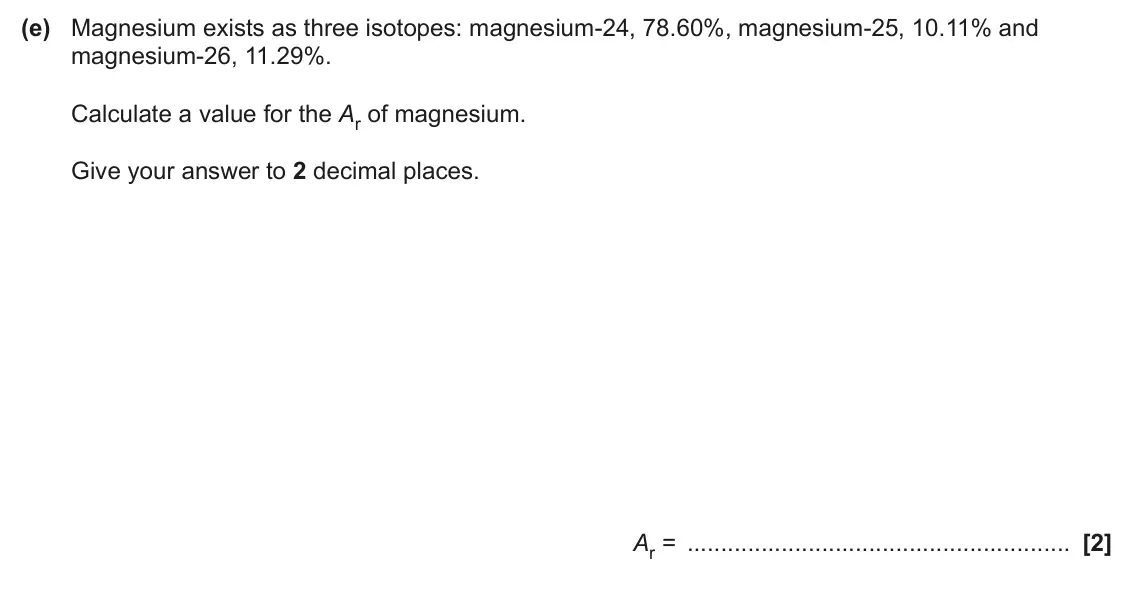
Q31(a)
The whole paper ↗
Q21(d)(ii)
The whole paper ↗
Q1(h)(ii)
The whole paper ↗
Q1(c)
The whole paper ↗
Q23(d)(i)
The whole paper ↗

Q22(b)(i)
The whole paper ↗
Q2(c)(ii)
The whole paper ↗
Q3(c)
The whole paper ↗
Q22(d)
The whole paper ↗
Q21(b)
The whole paper ↗
Q21(c)(ii)
The whole paper ↗
Q21(b)
The whole paper ↗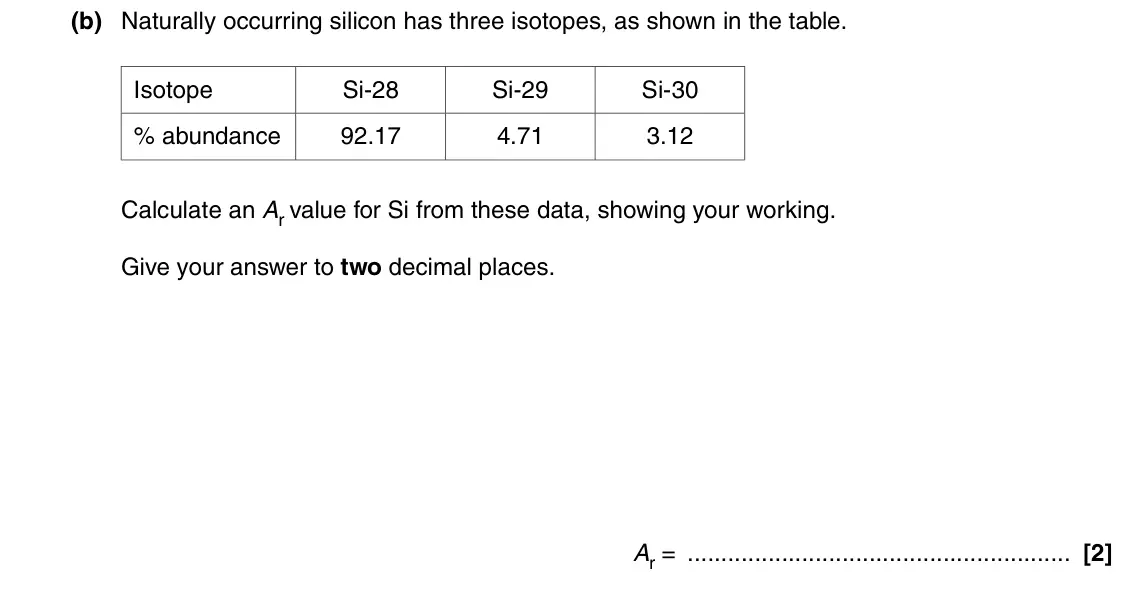
All 16 questions on Modern analytical techniques, as a list
- June 2025, Paper 1, Q27 (1 mark): A sample of strontium contains two isotopes, strontium-86 and strontium-88. The relative atomic mass of the sample is 87.82. What is the % abundance of the stro
- June 2025, AS Paper 2, Q3(e) (2 marks): Magnesium exists as three isotopes: magnesium-24, 78.60%, magnesium-25, 10.11% and magnesium-26, 11.29%. Calculate a value for the Ar of magnesium. Give your an
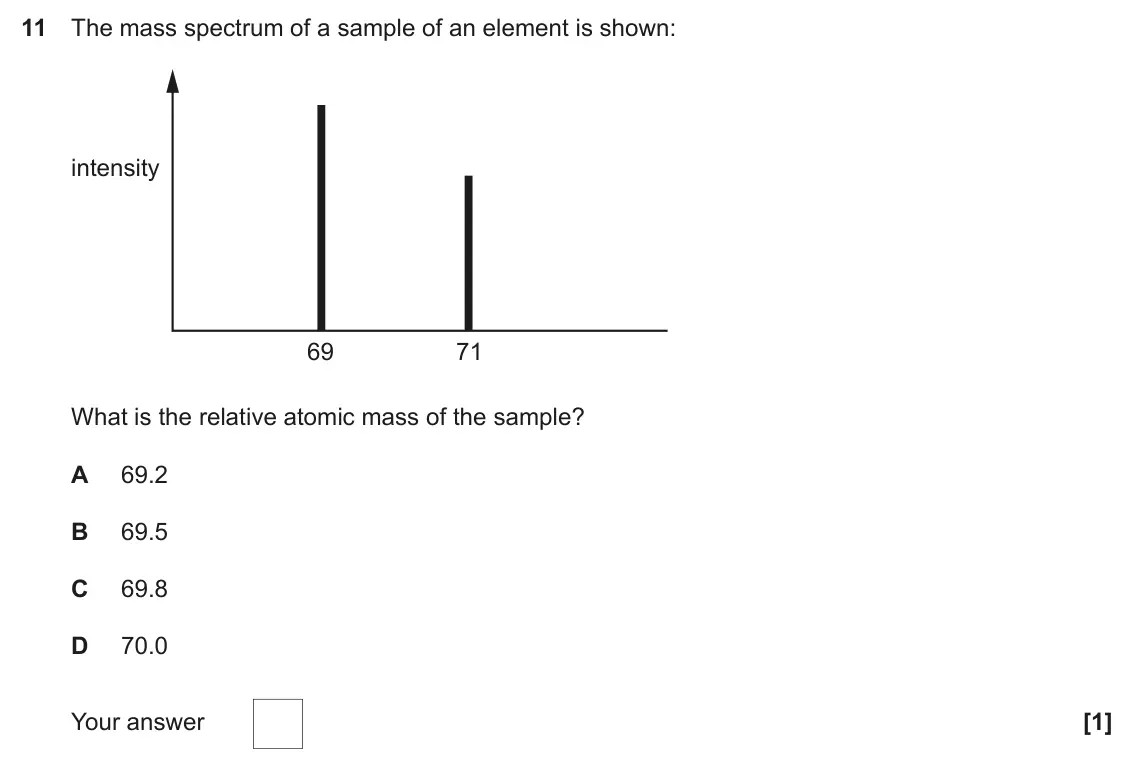
- June 2024, Paper 1, Q11 (1 mark): The mass spectrum of a sample of an element is shown: intensity 69 71 What is the relative atomic mass of the sample? A 69.2 B 69.5 C 69.8 D 70.0 Your answer [1
- June 2023, Paper 1, Q31(a) (2 marks): Strontium is one of the elements in Group 2. Compounds of strontium are used in fireworks to give a crimson colour. Analysis of the mass spectrum of a sample of
- June 2023, AS Paper 1, Q21(d)(ii) (2 marks): Use the data in Table 21.2 to calculate a value for the relative atomic mass of this calcium sample. Give your answer to 2 decimal places. relative atomic mass
- June 2022, Paper 2, Q1(h)(ii) (1 mark): Explain, without doing a calculation, how this data shows that the relative atomic mass of iron is below 56. [1]
- June 2022, AS Paper 2, Q1(c) (2 marks): The mass spectrum of magnesium shows that it has three stable isotopes as shown below. Isotope Abundance / % 24Mg 78.60 25Mg 10.11 26Mg 11.29 Calculate a value
- November 2021, AS Paper 1, Q23(d)(i) (2 marks): Table 23.2 shows the stable isotopes of titanium and their abundances. 46Ti 47Ti 48Ti 49Ti 50Ti Isotope Percentage 8.25 7.44 73.72 5.41 5.18 abundance Table 23.
- November 2020, Paper 1, Q2 (1 mark): The mass spectrum of a sample of an element is shown below. 100 relative abundance 50 (%) 2 4 6 8 10 12 m / z What is the relative atomic mass of the element? A
- November 2020, AS Paper 1, Q22(b)(i) (2 marks): Calculate the relative atomic mass of naturally-occurring carbon. Give your answer to 2 decimal places. relative atomic mass = [2]
- June 2019, Paper 2, Q2(c)(ii) (2 marks): Use the data to calculate the relative atomic mass of the strontium sample. Give your answer to 2 decimal places. relative atomic mass = [2]
- June 2019, AS Paper 2, Q3(c) (2 marks): The element indium was discovered in 1863 from an emission spectrum. Indium has two naturally occurring isotopes as shown in the table. Isotope Isotopic mass 11
- June 2018, AS Paper 1, Q22(d) (2 marks): Gallium has two isotopes, 69Ga and 71Ga. The Ar of gallium is 69.7. Calculate the relative abundance of 69Ga as a percentage. relative abundance of 69Ga = % [2]
- June 2017, AS Paper 1, Q21(b) (2 marks): Calculate a value for the Ar of chlorine. Give your answer to two decimal places. Ar = [2]
- June 2017, AS Paper 1, Q21(c)(ii) (2 marks): Explain the ratio of the heights of the peaks at m/z 64 and m/z 66. [2]
- June 2016, AS Paper 1, Q21(b) (2 marks): Naturally occurring silicon has three isotopes, as shown in the table. Isotope Si-28 Si-29 Si-30 % abundance 92.17 4.71 3.12 Calculate an Ar value for Si from t
Questions, mark schemes and examiner’s reports are © OCR, from their published past papers. Plumi isn’t affiliated with any exam board. Want whole papers? Every OCR A-Level Chemistry B paper.
Rather write your answers by hand on iPad? Plumi marks them against the same mark schemes.