 plumi
Energy and matter: OCR A‑Level Chemistry B questions
Every OCR A-Level Chemistry B exam question on EL Energy and matter (specification points EL(v)–(w)), 2016–2025, with its mark scheme and examiner’s report.
Find questions2,049
Calculations
Q1(b)
The whole paper ↗
Q31(a)
The whole paper ↗
Q31(b)
The whole paper ↗
Q31(c)
The whole paper ↗
Q22(a)
The whole paper ↗
Q1(b)
The whole paper ↗
Q31(b)
The whole paper ↗

Q21(b)
The whole paper ↗
Q1(c)(i)
The whole paper ↗
Q1(c)(ii)
The whole paper ↗
Q1(c)(iii)
The whole paper ↗
Q1(a)(i)
The whole paper ↗
Q33(a)
The whole paper ↗
Q5(b)(i)
The whole paper ↗
Q5(b)(ii)
The whole paper ↗
Q23(a)
The whole paper ↗
All 38 questions on Energy and matter, as a list
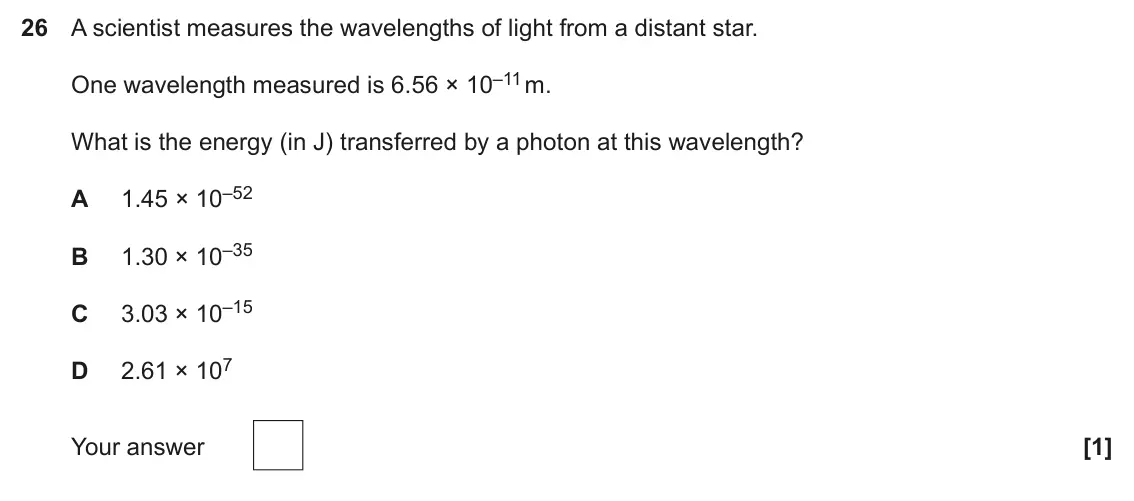
- June 2025, Paper 1, Q26 (1 mark): A scientist measures the wavelengths of light from a distant star. One wavelength measured is 6.56 × 10⁻¹¹ m. What is the energy (in J) transferred by a photon
- June 2025, Paper 3, Q1(b) (3 marks): Strontium sulfate is used in fireworks. Strontium gives a red colour when ignited. A frequency of red light from the strontium spectrum is 4.62 × 10¹⁴ Hz. Calcu
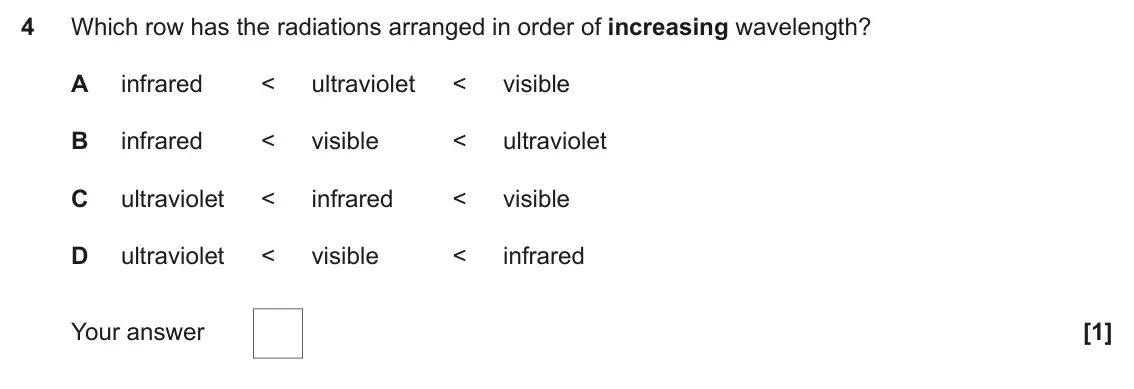
- June 2024, Paper 1, Q4 (1 mark): Which row has the radiations arranged in order of increasing wavelength? A infrared < ultraviolet < visible B infrared < visible < ultraviolet C ultraviolet < i
- June 2024, Paper 1, Q31(a) (1 mark): Give the colour from a firework containing barium carbonate. [1]
- June 2024, Paper 1, Q31(b) (2 marks): The atomic emission spectrum of barium appears as a series of coloured lines at specific frequencies on a black background. Describe the appearance of the atomi
- June 2024, Paper 1, Q31(c) (2 marks): One line in the barium spectrum has a wavelength of 5.54 × 10⁻⁵ cm. Calculate the frequency of this line (in Hz). frequency = Hz [2]
- June 2024, AS Paper 1, Q22(a) (5 marks): Atomic spectra can be either absorption spectra or emission spectra. Describe the appearance of an atomic absorption spectrum and explain how it is formed. Give
- June 2024, AS Paper 2, Q1(b) (3 marks): Sodium chloride and potassium chloride are both white crystalline solids. A student wants to distinguish between these two solids. Name a simple laboratory test
- June 2023, Paper 1, Q31(b) (3 marks): The atomic emission spectrum of strontium shows a series of coloured lines against a black background. The diagram shows the line of shortest frequency in the s
- June 2023, AS Paper 1, Q15 (1 mark): Which of the following represents the wavelength of radiation in terms of its energy, ∆E, the Planck constant, h, and the speed of light, c? A ch /∆E B ∆E /hc C
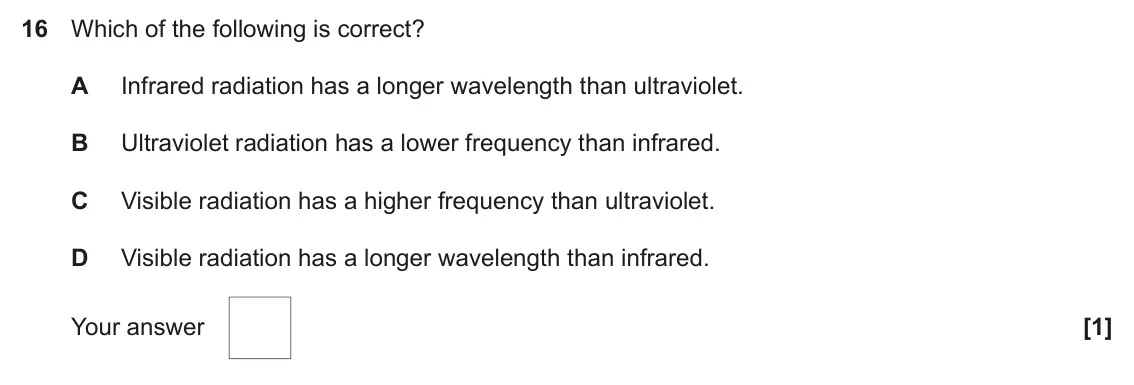
- June 2023, AS Paper 1, Q16 (1 mark): Which of the following is correct? A Infrared radiation has a longer wavelength than ultraviolet. B Ultraviolet radiation has a lower frequency than infrared. C
- June 2023, AS Paper 1, Q21(b) (1 mark): The students do a flame test on plaster of Paris, hydrated calcium sulfate. What colour would they see? [1]
- June 2022, Paper 2, Q1(c)(i) (1 mark): What is the flame colour of calcium? [1]
- June 2022, Paper 2, Q1(c)(ii) (2 marks): The flame colour is caused by bright lines in the atomic emission spectrum of calcium. Explain how these lines are formed. [2]
- June 2022, Paper 2, Q1(c)(iii) (2 marks): Calculate the frequency of a line of wavelength 6.16 × 10⁻⁷ m. frequency = Hz [2]
- June 2022, AS Paper 2, Q1(a)(i) (2 marks): The atomic emission spectrum of an element shows a series of coloured lines on a black background. Describe how the appearance of the absorption spectrum of the
- November 2021, Paper 1, Q33(a) (2 marks): In their first experiment they heat some crystals of copper(II) sulfate in a hot flame. State the colour of the flame they see and explain how the heating produ
- November 2021, Paper 2, Q5(b)(i) (1 mark): Describe the appearance of an atomic emission spectrum. [1]
- November 2021, Paper 2, Q5(b)(ii) (3 marks): Describe how emission spectra are formed and explain how they allow different elements to be distinguished. [3]
- November 2021, AS Paper 1, Q23(a) (5 marks): Describe the appearance of an atomic emission spectrum and explain how such a spectrum is caused. [5]
- November 2021, AS Paper 1, Q23(b)(i) (3 marks): Calculate the frequency of this line. (1 nm = 1 × 10⁻⁹ m) Give your answer to an appropriate number of significant figures. frequency = Hz [3]
- November 2021, AS Paper 1, Q23(b)(ii) (2 marks): Another line has a frequency of 5.00 × 10¹⁴ Hz. Calculate the electron energy change corresponding to this frequency and give its units. energy change units [2]
- November 2021, AS Paper 1, Q23(b)(iii) (1 mark): The line in part (b)(ii) is in the visible region of the spectrum. Name a region of the electromagnetic spectrum that has less energy associated with it. [1]
- November 2020, Paper 1, Q1 (1 mark): Which statement about electromagnetic radiation is correct? A Infrared radiation has a shorter wavelength than visible light. B The frequency of infrared radiat
- November 2020, AS Paper 1, Q6 (1 mark): A solution of X gives a green flame colour and a white precipitate with aqueous silver nitrate. What is X? A Barium chloride B Barium sulfate C Iron(II) chlorid
- November 2020, AS Paper 2, Q2(c)(i) (1 mark): Give the flame colour for calcium. [1]
- November 2020, AS Paper 2, Q2(c)(ii) (2 marks): The visible atomic emission spectrum of an element consists of a series of coloured lines on a black background. A section of this spectrum for calcium is shown
- November 2020, AS Paper 2, Q2(c)(iii) (3 marks): Calculate the energy change of an electron, in kJ, that causes the line at 6.20 × 10⁻⁷ m in the spectrum of calcium. energy change = kJ [3]
- June 2019, Paper 2, Q2(a) (3 marks): The red colour comes from lines of specific frequency in the atomic emission spectrum of strontium. Explain how these lines are formed. [3]
- June 2019, AS Paper 2, Q3(b) (3 marks): The presence of different elements in stars is shown by absorption or emission atomic spectra. The diagrams below represent parts of an absorption spectrum and
- June 2018, Paper 1, Q3 (1 mark): Which statement about an atomic emission spectrum is correct? A It occurs when electrons absorb energy. B The wavelength of a line is proportional to the energy
- June 2018, AS Paper 1, Q1 (1 mark): What is the correct order of radiation in order of increasing wavelength? A ultraviolet < visible < infrared B ultraviolet < infrared < visible C visible < infr
- June 2018, AS Paper 1, Q13 (1 mark): Which statement about the flame colour of lithium is correct? A It is yellow. B It is caused by electrons absorbing visible light. C It is the result of bright
- June 2018, AS Paper 1, Q22(a) (4 marks): Explain why each element has a characteristic emission spectrum. [4]
- June 2017, Paper 1, Q32(d) (6 marks): One suggested method of carbon capture and storage is reacting carbon dioxide with naturally occurring metal oxides in the Earth’s crust. Magnesium oxide and ca
- June 2017, AS Paper 1, Q22(a) (1 mark): Name salt A. [1]
- June 2017, AS Paper 1, Q22(b)(i) (1 mark): Describe the appearance of an atomic emission spectrum. [1]
- June 2017, AS Paper 1, Q22(b)(ii) (3 marks): The lilac line in the spectrum of the salt occurs at 405 nm. Calculate the energy associated with this wavelength in kJ mol–1. (1 nm = 10–9 m) energy = kJ mol–1
Questions, mark schemes and examiner’s reports are © OCR, from their published past papers. Plumi isn’t affiliated with any exam board. Want whole papers? Every OCR A-Level Chemistry B paper.
Rather write your answers by hand on iPad? Plumi marks them against the same mark schemes.