 plumi
Reaction mechanisms: OCR A‑Level Chemistry B questions
Every OCR A-Level Chemistry B exam question on CD Reaction mechanisms (specification points CD(k)–(l)), 2016–2025, with its mark scheme and examiner’s report.
Find questions2,049
Calculations

Q34(e)
The whole paper ↗
Q4(a)
The whole paper ↗
Q4(g)(i)
The whole paper ↗
Q35(e)(iii)
The whole paper ↗
Q4(d)
The whole paper ↗
Q34(a)(i)
The whole paper ↗
Q3(e)(i)
The whole paper ↗
Q1(c)
The whole paper ↗
Q4(e)(i)
The whole paper ↗
Q4(e)(iii)
The whole paper ↗
Q2(b)
The whole paper ↗
Q2(d)
The whole paper ↗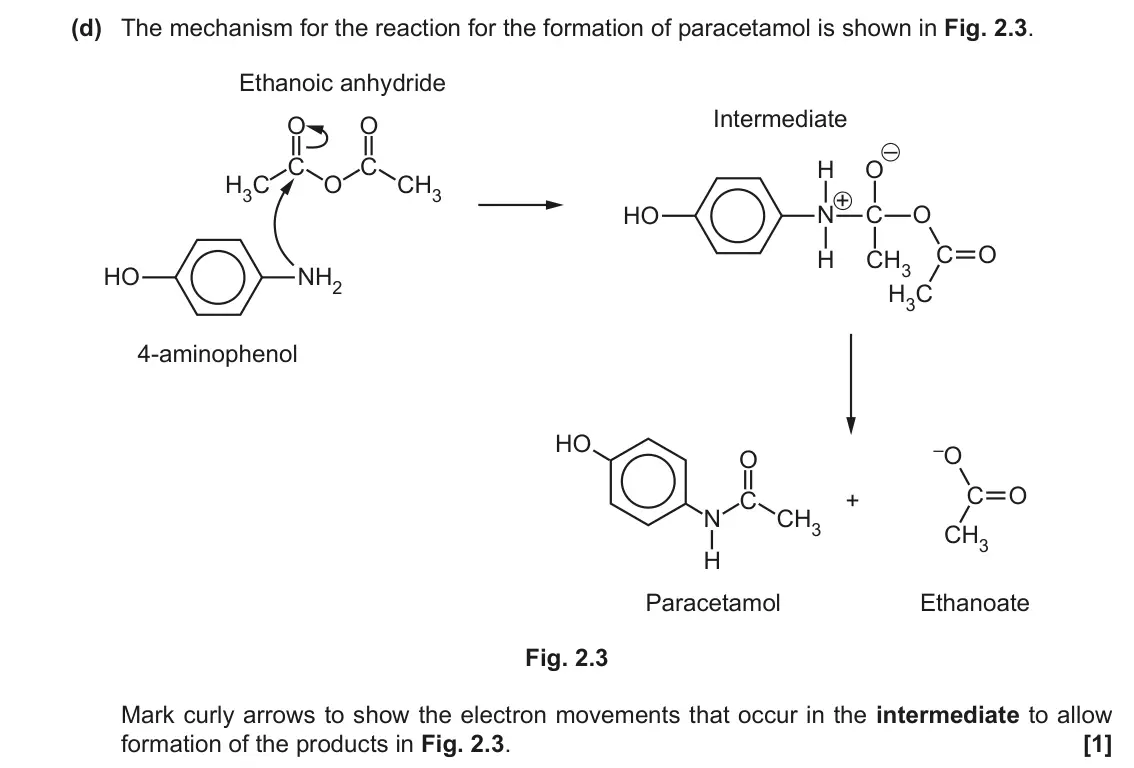
Q31(f)
The whole paper ↗
Q34(d)
The whole paper ↗
Q2(b)(iii)
The whole paper ↗
Q3(a)(v)
The whole paper ↗
Q3(a)(vi)
The whole paper ↗
All 18 questions on Reaction mechanisms, as a list
- June 2024, Paper 1, Q27 (1 mark): Ethanal, CH3CHO, reacts with cyanide in a two-step mechanism. What is correct about this mechanism? A In step 1 the nitrogen on the cyanide ion attacks the carb
- June 2024, Paper 1, Q34(e) (2 marks): The mechanism for the dehydration of a cyclic alcohol using concentrated sulfuric acid takes place in two steps. Step 1: H O+ O H H + H+ Step 2: H H H O+ H H+ +
- June 2023, Paper 2, Q4(a) (1 mark): Name the type of reaction by which 3-oxybutanoic acid is converted to 3-hydroxybutanoic acid. [1]
- June 2023, Paper 2, Q4(g)(i) (3 marks): Complete the mechanism for this reaction. Show curly arrows, charges, lone pairs and the product. O C H3C CH3 [3]
- June 2022, Paper 1, Q35(e)(iii) (3 marks): The reaction of benzaldehyde with hydrogen cyanide can be written as follows: C6H5CHO + HCN C6H5CH(OH)CN Write out the two-step mechanism for this reaction. Use
- June 2022, Paper 2, Q4(d) (3 marks): Chymotrypsin catalyses the hydrolysis of proteins in the small intestine. The active site of chymotrypsin consists of the amino acids serine, histidine and aspa
- November 2021, Paper 1, Q34(a)(i) (1 mark): Name the type of reaction that occurs in reaction 1. [1]
- November 2021, Paper 2, Q3(e)(i) (2 marks): Draw the mechanism for the attack of a cyanide ion on benzaldehyde, followed by attack by H+ to give compound C. [2]
- November 2021, Paper 3, Q1(c) (2 marks): Alcohols can also undergo substitution reactions. The following sequence shows an incomplete mechanism for the reaction between (CH3)3COH and concentrated hydro
- November 2020, Paper 2, Q4(e)(i) (2 marks): Draw ‘curly arrows’ on Fig. 4.2 to complete the mechanism. H COOH COOH Step 1 Step 2 COOH H COOH C C HOOC C C C C + H H H HOOC H +H+ H+ H maleic acid fumaric ac
- November 2020, Paper 2, Q4(e)(iii) (2 marks): The student then reads that if 2H+ ions are used for the isomerisation, then there isn’t any 2H found in the fumaric acid formed. Does this support the student’
- June 2019, Paper 3, Q2(b) (2 marks): The reactant 4-aminophenol can be made from phenol in the two-step synthesis shown below. OH OH OH dil. H2SO4 NaBH4 NaNO3 NO2 NH2 Name the type of reaction for
- June 2019, Paper 3, Q2(d) (1 mark): The mechanism for the reaction for the formation of paracetamol is shown in Fig. 2.3. Ethanoic anhydride Intermediate O O – C C H O H3C O CH3 + N C O HO C O H C
- June 2018, Paper 1, Q31(f) (4 marks): The carbonyl compound from (e) can be reacted further to produce other raw materials. For example, it reacts with HCN. The formula of a carbonyl compound is sho
- June 2017, Paper 1, Q34(d) (3 marks): Another dye is used as an acid-base indicator. It is red in acidic conditions and yellow in neutral or alkaline conditions. The equation for the reaction produc
- June 2017, Paper 2, Q2(b)(iii) (1 mark): Name the type of reaction that occurs in step 2 and name the functional group that has been formed. Type of reaction Functional group formed [1]
- June 2017, Paper 2, Q3(a)(v) (1 mark): Explain why the reaction in which the linear form changes to the ring form is not condensation. [1]
- June 2017, Paper 2, Q3(a)(vi) (1 mark): Complete the equation that shows the reaction when the linear form changes to the ring form. –CHO + HO– → [1]
Questions, mark schemes and examiner’s reports are © OCR, from their published past papers. Plumi isn’t affiliated with any exam board. Want whole papers? Every OCR A-Level Chemistry B paper.
Rather write your answers by hand on iPad? Plumi marks them against the same mark schemes.