 plumi
Organic reactions: OCR A‑Level Chemistry B questions
Every OCR A-Level Chemistry B exam question on CD Organic reactions (specification points CD(g)–(j)), 2016–2025, with its mark scheme and examiner’s report.
Find questions2,049
Calculations
Q2(b)(iii)
The whole paper ↗

Q35(a)(i)
The whole paper ↗
Q35(a)(ii)
The whole paper ↗
Q35(b)
The whole paper ↗
Q35(c)
The whole paper ↗
Q35(d)
The whole paper ↗

Q4(f)
The whole paper ↗
Q4(g)(ii)
The whole paper ↗
Q3(d)(i)
The whole paper ↗
Q3(d)(ii)
The whole paper ↗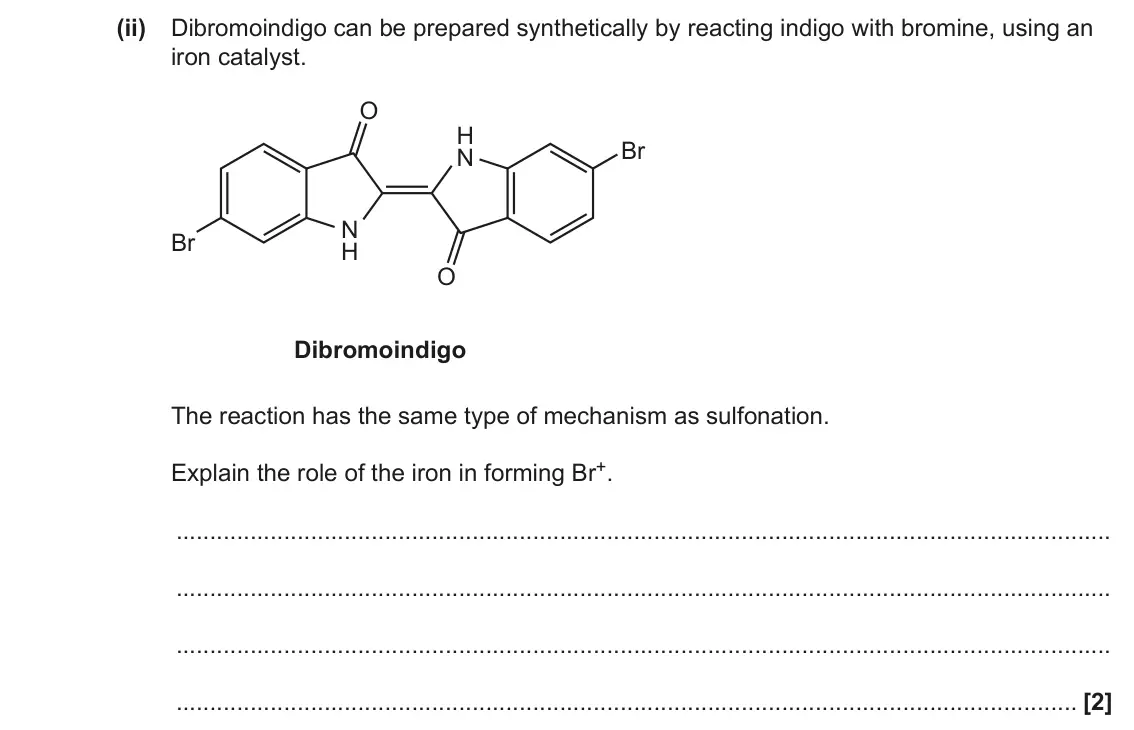

Q35(c)(i)
The whole paper ↗
Q35(c)(ii)
The whole paper ↗
Q35(e)(ii)
The whole paper ↗
Q35(e)(iv)
The whole paper ↗
Q34(e)(i)
The whole paper ↗
Q3(e)(ii)
The whole paper ↗

All 30 questions on Organic reactions, as a list
- June 2025, Paper 3, Q2(b)(iii) (1 mark): Suggest a type of useful compound that can be made using compound X. [1]
- June 2024, Paper 1, Q19 (1 mark): What is correct about propanal, CH3CH2CHO, and propanone, CH3COCH3? A Only propanal can be oxidised by acidified dichromate. B Only propanal forms a ‘silver mir
- June 2024, Paper 1, Q35(a)(i) (1 mark): Name compound C. [1]
- June 2024, Paper 1, Q35(a)(ii) (1 mark): Reaction 1 is an electrophilic substitution using concentrated sulfuric acid. Give the formula of the electrophile. [1]
- June 2024, Paper 1, Q35(b) (1 mark): Use the Data Sheet to give reagents and conditions for reaction 3. [1]
- June 2024, Paper 1, Q35(c) (3 marks): Reaction 4 forms a diazonium salt. Give the reagents and conditions for this reaction. Reagents: Conditions: [3]
- June 2024, Paper 1, Q35(d) (1 mark): Reaction 5 is a coupling reaction, using a phenol and sodium hydroxide. Give the formula of the phenol. [1]
- June 2023, Paper 1, Q29 (1 mark): Which statement(s) is/are correct for a Friedel-Crafts alkylation reaction? 1 An alkyl group bonds with a benzene ring by an addition reaction. 2 Al Cl 3 is use
- June 2023, Paper 2, Q4(f) (2 marks): Propan-1-ol is oxidised to an aldehyde rather than a ketone. Describe a laboratory test, and its result, that would distinguish this aldehyde from propanone. [2
- June 2023, Paper 2, Q4(g)(ii) (1 mark): Name the functional group formed in the product from (i). [1]
- June 2023, Paper 3, Q3(d)(i) (4 marks): The dye direct blue 15 does not fade, whereas indigo does. NH2 H2N OH HO NaO3S SO3Na N N N N SO3Na NaO3S CH3O OCH3 Direct blue 15 This dye is made by sulfonatio
- June 2023, Paper 3, Q3(d)(ii) (2 marks): Dibromoindigo can be prepared synthetically by reacting indigo with bromine, using an iron catalyst. O H Br N N Br H O Dibromoindigo The reaction has the same t
- June 2022, Paper 1, Q25 (1 mark): The formation of an azo dye is shown in Reaction 25.1 below. + N2 Cl NH –2H+ O O + 2 O Cl N N H O N N O Cl Reaction 25.1 N + N2 Cl O HN Compound X Compound Y Co
- June 2022, Paper 1, Q35(c)(i) (1 mark): Explain why this reaction must be carried out in anhydrous conditions. [1]
- June 2022, Paper 1, Q35(c)(ii) (1 mark): Name the mechanism of the reaction involved in this first step. [1]
- June 2022, Paper 1, Q35(e)(ii) (2 marks): The conversion in Step 1 occurs through the intermediate formation of benzaldehyde. CHO benzaldehyde Describe a test-tube reaction that a student could carry ou
- June 2022, Paper 1, Q35(e)(iv) (1 mark): In Step 2, the benzoic acid is reacted with a nitrating mixture of concentrated nitric and concentrated sulfuric acids. Write an equation to show the formation
- November 2021, Paper 1, Q34(e)(i) (1 mark): Use your Data Sheet to suggest a possible reagent for Reaction 3. [1]
- November 2021, Paper 2, Q3(e)(ii) (1 mark): Name the functional group attached to the benzene ring in compound C. [1]
- November 2020, Paper 1, Q29 (1 mark): Which compound(s) can be made from benzene in one step? 1 C6H5Cl 2 C6H5NO2 3 C6H5NH2 A 1, 2 and 3 B Only 1 and 2 C Only 2 and 3 D Only 1 Your answer [1]
- November 2020, Paper 1, Q34(a) (3 marks): The students synthesise dye C, shown below, in two steps. Complete the reaction sequence by filling in the boxes. NH2 Reagents for step 1: NaNO2 + HCl Condition
- November 2020, Paper 1, Q34(b)(i) (1 mark): Suggest a reagent and the conditions that would turn dye C into dye D. [1]
- June 2019, Paper 1, Q33(f)(ii) (1 mark): Give the equation for the reaction of HCN with the functional group identified in (f)(i). [1]
- June 2019, Paper 1, Q35(d)(i) (3 marks): Fill in the table to show the reagents, conditions and colour changes for their tests. Reagent(s) Conditions Colour change Oxidation of alcohol Identification o
- June 2019, Paper 2, Q1(d) (2 marks): A synthetic route for making compound B is shown in Fig. 1.3. Cl NO2 H2N NO2 H2N NH2 step 1 step 2 compound B Fig. 1.3 Use your chemical knowledge and the Data
- June 2018, Paper 3, Q1(a) (3 marks): The student initially makes a small amount of a solution of the diazonium compound shown below, starting from an aromatic amine. + N Cl – N diazonium compound N
- June 2018, Paper 3, Q1(b)(i) (1 mark): Complete the structure of the azo dye formed in this coupling reaction. OH [1]
- June 2017, Paper 1, Q34(b)(i) (2 marks): This is an electrophilic substitution reaction. Give the conditions for the reaction and an equation to show how the electrophile is formed. Conditions Equation
- June 2017, Paper 1, Q34(b)(ii) (4 marks): The nitrobenzene is then changed to phenylamine. The flow diagram shows how the student could produce the red dye shown from phenylamine. Complete the diagram b
- June 2017, Paper 2, Q3(a)(iii) (2 marks): Describe a laboratory test for the functional group identified in (a)(ii). [2]
Questions, mark schemes and examiner’s reports are © OCR, from their published past papers. Plumi isn’t affiliated with any exam board. Want whole papers? Every OCR A-Level Chemistry B paper.
Rather write your answers by hand on iPad? Plumi marks them against the same mark schemes.