 plumi
Bonding and structure: OCR A‑Level Chemistry B questions
Every OCR A-Level Chemistry B exam question on CD Bonding and structure (specification points CD(a)–(b)), 2016–2025, with its mark scheme and examiner’s report.
Find questions2,049
Calculations
Q4(e)(i)
The whole paper ↗
Q35(e)(i)
The whole paper ↗
Q35(e)(ii)
The whole paper ↗
Q3(a)(ii)
The whole paper ↗


Q34(b)(ii)
The whole paper ↗
Q34(d)
The whole paper ↗
Q1(c)(i)
The whole paper ↗
Q1(c)(ii)
The whole paper ↗
Q1(d)
The whole paper ↗
Q34(c)
The whole paper ↗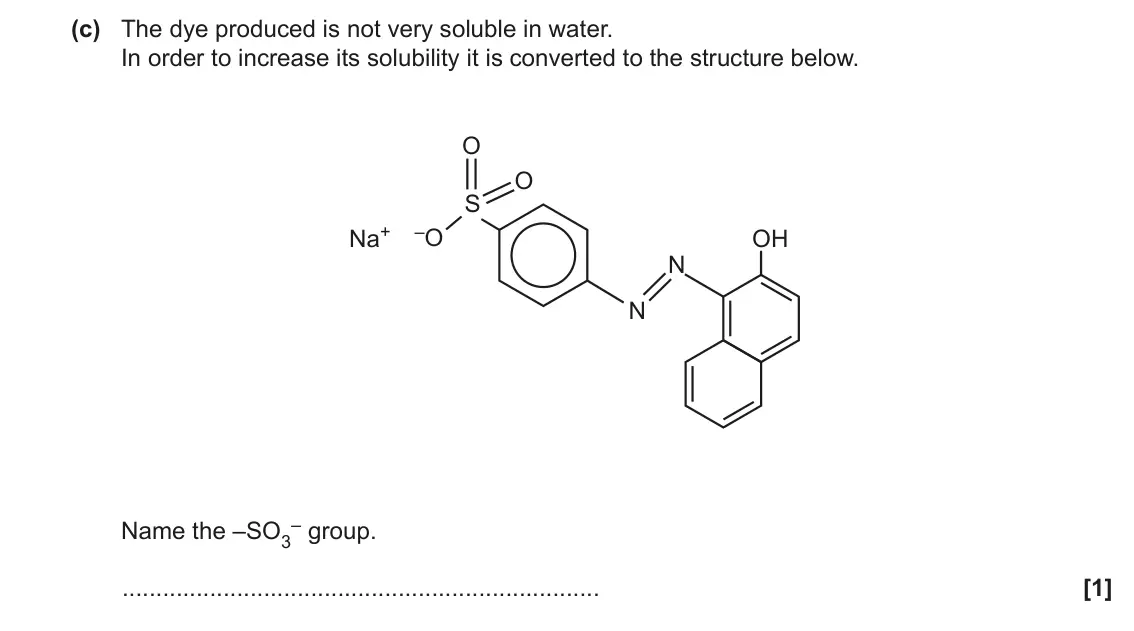
All 12 questions on Bonding and structure, as a list
- June 2025, Paper 2, Q4(e)(i) (2 marks): Acid dyes have –SO3 conditions. Explain how this occurs. [2]
- June 2024, Paper 1, Q35(e)(i) (1 mark): Draw a ring around the chromophore of acid orange. OH N = N SO3Na acid orange [1]
- June 2024, Paper 1, Q35(e)(ii) (1 mark): One part of its structure makes acid orange more soluble than many other azo dyes. Give the formula of this part. [1]
- June 2023, Paper 3, Q3(a)(ii) (1 mark): Indigo is used to dye cotton. The cotton structure has many –OH groups. Suggest the strongest type of intermolecular bond that binds indigo to cotton. [1]
- June 2022, Paper 1, Q18 (1 mark): A dye molecule is shown below. HO N N What is correct about this dye molecule? A Delocalisation extends over the whole dye molecule. B The dye molecule will att
- November 2021, Paper 1, Q29 (1 mark): The molecule below is an orange dye. N HO N Which group(s), when attached to a benzene ring in the dye, could change its colour? 1 OH 2 NH2 3 CH3 A 1, 2 and 3 B
- November 2020, Paper 1, Q34(b)(ii) (4 marks): Comment on the solubility of the two dyes in water. In your answer consider intermolecular bonds and their relative strengths. Solubility of dye C Solubility of
- November 2020, Paper 1, Q34(d) (2 marks): Wool is based on protein structures. Explain how dye D might bind to the wool fibres in weakly acidic conditions. [2]
- June 2018, Paper 3, Q1(c)(i) (1 mark): Give one property of the dye that might be affected if nitro, NO2 , groups are attached. [1]
- June 2018, Paper 3, Q1(c)(ii) (1 mark): Give a different property affected by the attachment of sulfonate, SO3 [1]
- June 2018, Paper 3, Q1(d) (2 marks): Attractions between dye molecules and polymer molecules in fabric fibres can be ionic, covalent or intermolecular bonds. Use your knowledge of molecular interac
- June 2017, Paper 1, Q34(c) (1 mark): The dye produced is not very soluble in water. In order to increase its solubility it is converted to the structure below. O O S Na+ –O OH N N – group. Name the
Questions, mark schemes and examiner’s reports are © OCR, from their published past papers. Plumi isn’t affiliated with any exam board. Want whole papers? Every OCR A-Level Chemistry B paper.
Rather write your answers by hand on iPad? Plumi marks them against the same mark schemes.