 plumi
Nucleophilic substitution mechanism and rates: OCR A‑Level Chemistry A questions
OCR A-Level Chemistry A past-paper questions on 4.2.2.2 Nucleophilic substitution mechanism and rates, 2016–2025, with mark schemes and examiner’s reports where available.
Paper
All papers
Exam
All years
Calculations
Q19(a)(i)
The whole paper ↗
Q19(a)(ii)
The whole paper ↗- Your answer
Q5(d)(ii)
The whole paper ↗
Q5(a)(iii)
The whole paper ↗
Q25(d)(ii)
The whole paper ↗
Q3(c)
The whole paper ↗
Q3(d)(ii)
The whole paper ↗- Your answer
- Your answer
Q26(a)
The whole paper ↗
Q1(f)
The whole paper ↗
Q5(d)(ii)
The whole paper ↗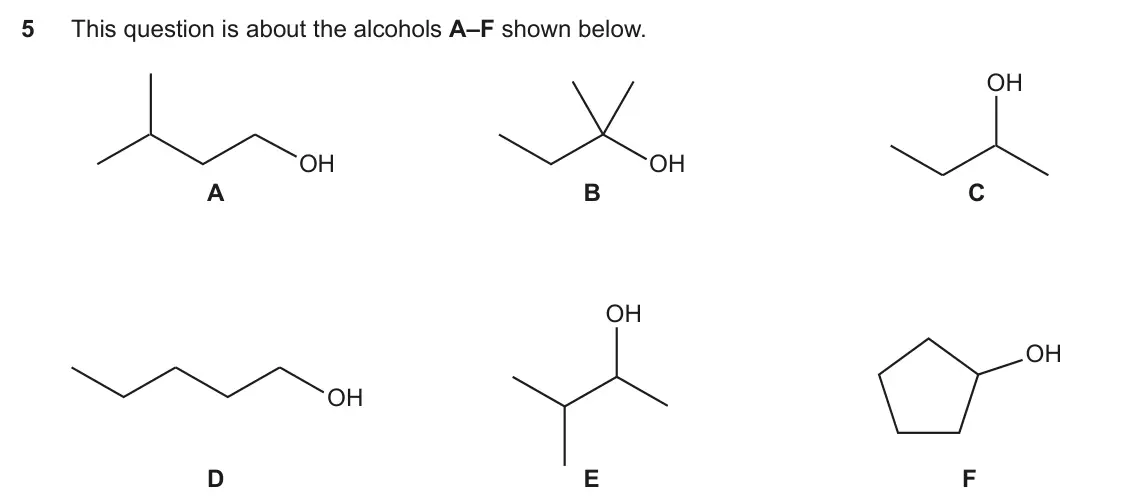
Q5(d)(iii)
The whole paper ↗Q5(e)
The whole paper ↗Q3(a)(i)
The whole paper ↗
Q3(a)(iii)
The whole paper ↗Q19(a)
The whole paper ↗
Q19(b)
The whole paper ↗
All 23 questions on Nucleophilic substitution mechanism and rates, as a list
- June 2025, Paper 2, Q19(a)(i) (3 marks): Outline the mechanism for the reaction of 2-bromopropane with cyanide ions. Show curly arrows, relevant dipoles and products. Br [3]
- June 2025, Paper 2, Q19(a)(ii) (1 mark): Name this type of mechanism. [1]
- June 2025, AS Paper 1, Q18 (1 mark): The hydrolysis of 1-iodopropane by aqueous potassium hydroxide takes place at a faster rate than 1-bromopropane. Which statement explains the different rates of
- June 2025, AS Paper 2, Q5(d)(ii) (1 mark): State the name of the mechanism of the reaction in Stage 2. [1]
- June 2024, Paper 3, Q5(a)(iii) (3 marks): A student investigates the alkaline hydrolysis of 1-chloropropane using the same method as for 1-bromopropane. Predict, with reasons, how the appearance of the
- June 2024, AS Paper 1, Q25(d)(ii) (2 marks): A student hydrolyses a chloroalkane, RCl, a bromoalkane, RBr, and an iodoalkane, RI. For a fair comparison, the student has chosen the same R group for each hal
- June 2023, AS Paper 2, Q3(c) (3 marks): A student is studying the hydrolysis of haloalkanes. The equation for the alkaline hydrolysis of 2-bromopropane, CH3CHBrCH3, is shown below. CH3CHBrCH3 + OH– CH
- June 2023, AS Paper 2, Q3(d)(ii) (1 mark): Predict which precipitate would form first and explain the difference in the rates of hydrolysis of 2-bromopropane and 2-iodopropane. [1]
- June 2022, Paper 2, Q1 (1 mark): Which statement is correct for the different rates of hydrolysis of RCl and RBr? A RBr is hydrolysed faster because Cl is more electronegative than Br. B RBr is
- June 2022, Paper 2, Q21 (6 marks): 21* Carbon-carbon bond formation is used in synthesis to increase the length of a carbon chain. Describe the formation of carbon–carbon bonds in aliphatic compo
- June 2022, AS Paper 1, Q18 (1 mark): When heated with NaOH(aq), 1-chlorobutane is hydrolysed at a slower rate than 1-bromobutane. Which statement explains the different rates? A The C–Br bond entha
- June 2022, AS Paper 1, Q26(a) (3 marks): 1-Chloropropane, C2H5CH2Cl , can be hydrolysed with aqueous sodium hydroxide, NaOH. Outline the mechanism for this reaction. The structure of 1-chloropropane ha
- November 2021, Paper 3, Q1(f) (3 marks): The ester, methyl ethanoate, can be synthesised by reacting a haloalkane with a carboxylate ion. The mechanism is nucleophilic substitution. Outline the mechani
- November 2020, AS Paper 2, Q5(d)(ii) (3 marks): Outline the mechanism for the alkaline hydrolysis of (CH3)2CHCH2CH2Br. The structure of (CH3)2CHCH2CH2Br has been provided. Show curly arrows, relevant lone pai
- November 2020, AS Paper 2, Q5(d)(iii) (1 mark): Name this type of mechanism. [1]
- November 2020, AS Paper 2, Q5(e) (2 marks): The student decides to prepare alcohol A using the same method as in (d) but using the chloroalkane (CH3)2CHCH2CH2Cl instead of the bromoalkane, (CH3)2CHCH2CH2B
- June 2019, AS Paper 2, Q3(a)(i) (3 marks): Outline the mechanism for this reaction. Include curly arrows, relevant dipoles and the final product(s). H CH3CH2CH2CH2 C I H [3]
- June 2019, AS Paper 2, Q3(a)(iii) (2 marks): 1-Iodopentane was found to react faster than 1-bromopentane. Explain why. [2]
- June 2018, Paper 2, Q19(a) (2 marks): The rate of hydrolysis of a haloalkane depends on the halogen present. State and explain how the halogen in the haloalkane affects the rate of hydrolysis. [2]
- June 2018, Paper 2, Q19(b) (3 marks): Chlorocyclohexane is hydrolysed with aqueous sodium hydroxide. Outline the mechanism for this reaction. Show curly arrows, relevant dipoles and the products. Cl
- June 2018, AS Paper 1, Q25(b)(i) (3 marks): Outline the mechanism for this reaction. Show curly arrows and relevant dipoles. [3]
- June 2016, AS Paper 1, Q19 (1 mark): A reaction sequence is shown below: → Step 1 CH3CH=CHCH3 + HBr CH3CH2CHBrCH3 → Step 2 CH3CH2CHBrCH3 + NaOH CH3CH2CH(OH)CH3 + NaBr Which type of reaction mechani
- June 2016, AS Paper 1, Q20 (1 mark): When heated with NaOH(aq), 1-iodobutane is hydrolysed at a much faster rate than 1-chlorobutane. Which statement explains the different rates? The C–I bond enth
Questions, mark schemes and examiner’s reports are © OCR, from their published past papers. Plumi isn’t affiliated with any exam board. Want whole papers? OCR A-Level Chemistry A past papers, or our free OCR-style practice pack.
The Plumi iPad app also offers exam-style questions with AI feedback on your handwritten working.