 plumi
How far?: OCR A‑Level Chemistry A questions
Every OCR A-Level Chemistry A exam question on 5.1.2 How far?, 2016–2025, with its mark scheme and examiner’s report.
Find questions1,820
Calculations
Q17(c)(i)
The whole paper ↗
Q17(c)(ii)
The whole paper ↗
Q17(c)(iii)
The whole paper ↗
Q3(a)
The whole paper ↗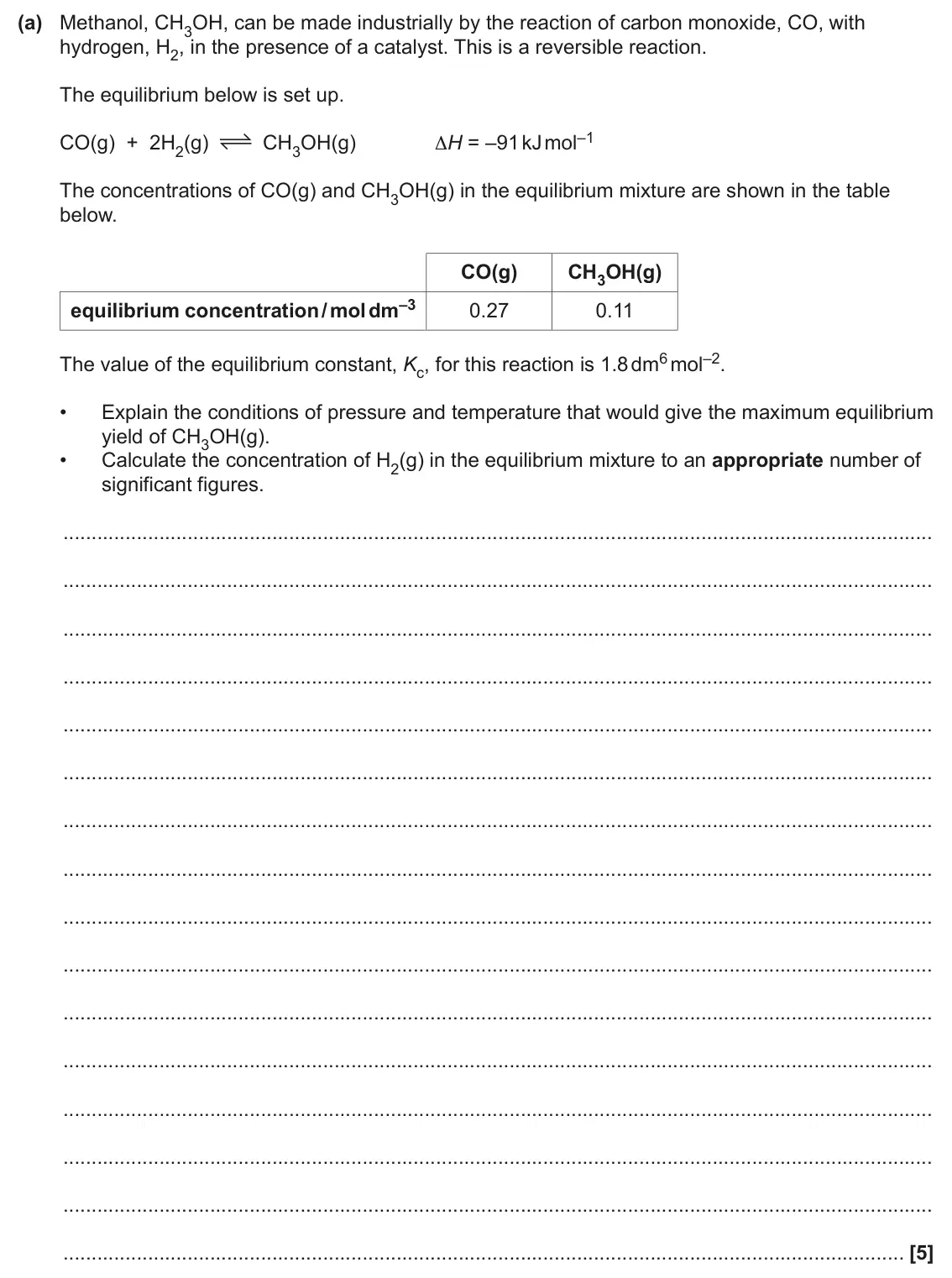
Q18(a)(i)
The whole paper ↗
Q18(a)(ii)
The whole paper ↗
Q18(a)(iii)
The whole paper ↗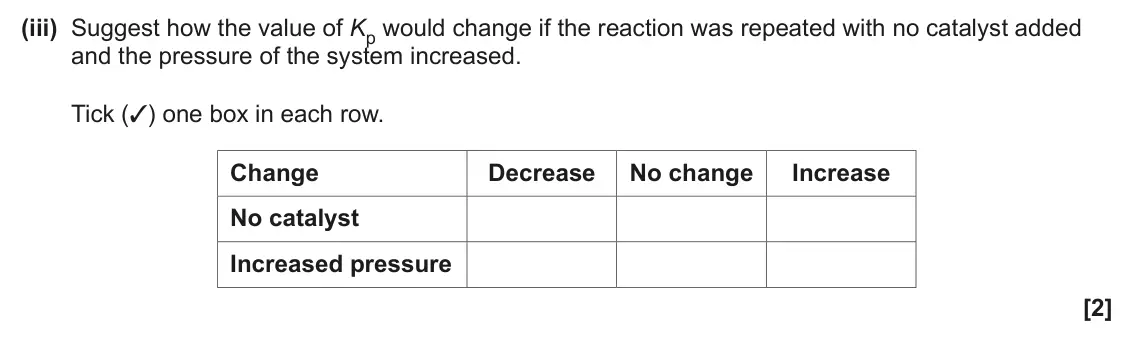
Q19(a)(i)
The whole paper ↗
Q19(a)(ii)
The whole paper ↗
Q6(d)
The whole paper ↗
Q20(a)
The whole paper ↗
Q20(b)(i)
The whole paper ↗
Q20(b)(ii)
The whole paper ↗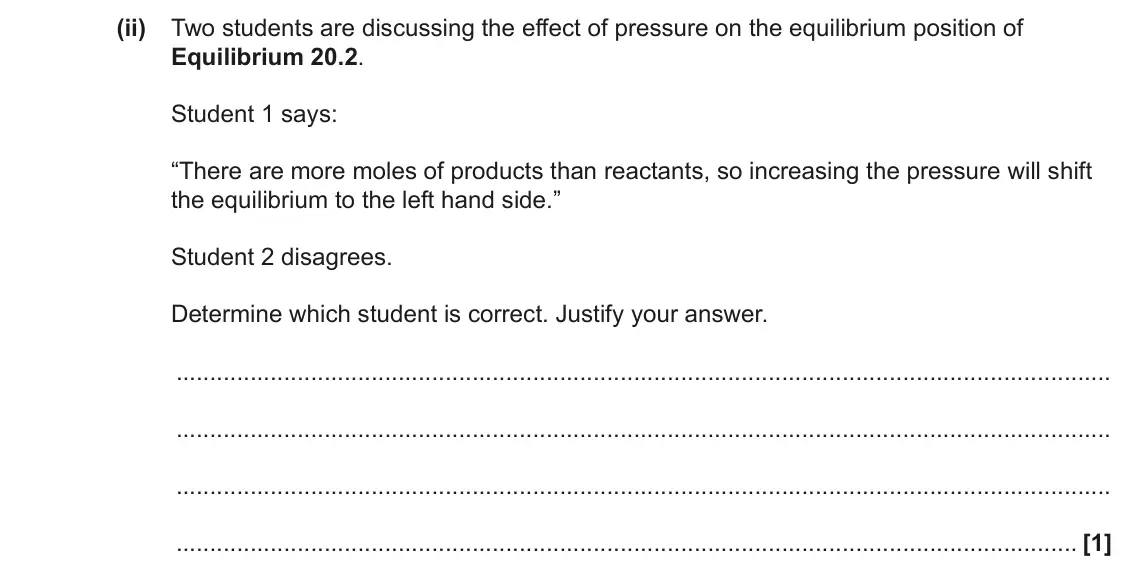
Q20(c)(i)
The whole paper ↗
Q20(c)(ii)
The whole paper ↗
Q1(a)
The whole paper ↗
Q1(b)
The whole paper ↗

Q20(b)
The whole paper ↗
Q5(a)
The whole paper ↗
All 41 questions on How far?, as a list
- June 2025, Paper 1, Q17(c)(i) (1 mark): Explain why Kp for Equilibrium 17.3 has no units. [1]
- June 2025, Paper 1, Q17(c)(ii) (3 marks): An equal number of moles of steam and carbon monoxide are left at 700 K in a sealed container until equilibrium is reached. At equilibrium, both H2 and CO2 have
- June 2025, Paper 1, Q17(c)(iii) (2 marks): At a second temperature the value of Kp for Equilibrium 17.3 is 129. Explain whether the second temperature is higher or lower than 700 K. [2]
- June 2025, Paper 3, Q3(a) (5 marks): Methanol, CH3OH, can be made industrially by the reaction of carbon monoxide, CO, with hydrogen, H2, in the presence of a catalyst. This is a reversible reactio
- June 2024, Paper 1, Q18(a)(i) (5 marks): 2.25 moles of SO3 is heated to 550 °C in the presence of a catalyst and the resulting mixture allowed to reach equilibrium. The equilibrium mixture contains 0.9
- June 2024, Paper 1, Q18(a)(ii) (2 marks): The numerical values of Kp for Equilibrium 18.1 at temperatures T1 and T2 are shown below. Temperature Kp 3.3 × 10⁻⁵ T1 7.7 × 10⁻² T2 Explain why T2 is a higher
- June 2024, Paper 1, Q18(a)(iii) (2 marks): Suggest how the value of Kp would change if the reaction was repeated with no catalyst added and the pressure of the system increased. Tick (✓) one box in each
- June 2023, Paper 1, Q19(a)(i) (5 marks): A sealed flask containing 6.00 moles of NO2(g) is heated to a constant temperature and allowed to reach equilibrium. The equilibrium mixture contains 5.40 mol o
- June 2023, Paper 1, Q19(a)(ii) (3 marks): The sealed flask in (a)(i) is then heated to a higher temperature at an increased pressure. The system is allowed to reach equilibrium again. Explain why it is
- June 2023, Paper 3, Q6(d) (5 marks): In the UK, most sulfuric acid, H2SO4, is manufactured by the Contact process. One stage in the Contact process involves the equilibrium between sulfur dioxide,
- June 2022, Paper 1, Q20(a) (6 marks): This question is about equilibria involving hydrogen. (a)* Hydrogen is used industrially to manufacture ammonia. The equilibrium is shown below. 2NH3(g) ∆H = –9
- June 2022, Paper 1, Q20(b)(i) (1 mark): When the temperature is decreased, the value of Kp decreases. Determine whether the forward reaction is exothermic or endothermic. Explain your answer. [1]
- June 2022, Paper 1, Q20(b)(ii) (1 mark): Two students are discussing the effect of pressure on the equilibrium position of Equilibrium 20.2. Student 1 says: “There are more moles of products than react
- November 2021, Paper 1, Q20(c)(i) (4 marks): Calculate Kp, in MPa–1, for Equilibrium 20.1. Give your answer to 3 significant figures. Kp = MPa–1 [4]
- November 2021, Paper 1, Q20(c)(ii) (3 marks): The chemist then repeats the experiment three times. In each experiment, the chemist makes one change but uses the same initial amounts of NO and O2. Complete t
- November 2021, Paper 3, Q1(a) (2 marks): A flask contains 110 g CO2 and 120 g O2 at a pressure of 50.0 atm. What is the partial pressure of the CO2? partial pressure of CO2 = atm [2]
- November 2021, Paper 3, Q1(b) (2 marks): Pure PCl5 is placed in a sealed container which is heated to 200 ºC. An equilibrium is set up: PCl5(g) PCl3(g) + Cl2(g) Under these conditions: Kc = 8.00 × 10⁻³
- November 2020, Paper 1, Q9 (1 mark): The reversible reaction of nitrogen and hydrogen to form ammonia is shown below. N2(g) + 3H2(g) 2NH3(g) In the equilibrium mixture, the partial pressure of N2 i
- November 2020, Paper 1, Q20(b) (4 marks): The student carries out a second experiment to determine the value of Kc for this reaction. The student mixes 9.6 g of CH3OH with 12.0 g of CH3COOH and adds the
- November 2020, Paper 3, Q5(a) (2 marks): The table shows the values of Kp at different temperatures for an equilibrium. Complete the table by adding the missing values of 1 T and ln Kp. Temperature, T
- November 2020, Paper 3, Q5(b) (1 mark): State and explain how increasing the temperature affects the position of this equilibrium and whether the forward reaction is exothermic or endothermic. [1]
- November 2020, Paper 3, Q5(c) (4 marks): Plot a graph of ln Kp against 1 T using the axes provided on the opposite page. Use your graph and equation 5.1 to determine ∆H, in kJ mol−1, for this equilibri
- June 2019, Paper 1, Q19(b)(i) (2 marks): Write an expression for Kp for Equilibrium 1. Include the units. units = [2]
- June 2019, Paper 1, Q19(b)(ii) (5 marks): Determine the value of Kp for Equilibrium 1 at 1000 K. Show all your working. Give your answer to 3 significant figures. Kp = [5]
- June 2019, Paper 1, Q19(b)(iii) (2 marks): The chemist repeats the experiment in (b) at a different temperature. The chemist finds that the value of Kp is greater than the answer to (b)(ii). Explain whet
- June 2019, Paper 1, Q19(b)(iv) (1 mark): Explain the significance of the expression: Kp & 1. [1]
- June 2019, Paper 3, Q1(c) (1 mark): What is the partial pressure of O2 (in Pa) in a gas mixture containing 21% O2 by volume and with a total pressure of 1.0 × 10⁵ Pa? partial pressure of O2 = Pa [
- June 2018, Paper 1, Q9 (1 mark): The reversible reaction of sulfur dioxide and oxygen to form sulfur trioxide is shown below. 2SO2(g) + O2(g) 2SO3(g) An equilibrium mixture contains 2.4 mol SO2
- June 2018, Paper 1, Q18(a) (2 marks): Write an expression for Kc for this equilibrium and state the units. Kc = Units = [2]
- June 2018, Paper 1, Q18(b) (4 marks): A chemist mixes together nitrogen and oxygen and pressurises the gases so that their total gas volume is 4.0 dm3. • The mixture is allowed to reach equilibrium
- June 2018, Paper 1, Q18(c)(i) (1 mark): Predict, with a reason, whether the forward reaction is exothermic or endothermic. [1]
- June 2018, Paper 1, Q18(c)(ii) (3 marks): The chemist increases the pressure of the equilibrium mixture at the same temperature. State, and explain in terms of Kp, how you would expect the equilibrium p
- June 2018, Paper 3, Q5(b)(i) (1 mark): Which technique could be used to determine the equilibrium amount of succinic acid? [1]
- June 2018, Paper 3, Q5(b)(iv) (1 mark): Kc is the equilibrium constant in terms of equilibrium concentrations. Why can expression 5.1 be used to calculate Kc for this equilibrium? [1]
- June 2018, Paper 3, Q5(b)(v) (3 marks): Calculate the value of Kc for this reaction. Show your working. Kc = [3]
- June 2017, Paper 1, Q13 (1 mark): A mixture of N2 and O2 gases has a total pressure of 1.42 atm. The mole fraction of N2 is 0.700. What is the partial pressure, in atm, of O2 in the mixture? A 0
- June 2017, Paper 1, Q18(b)(i) (1 mark): Why is equilibrium 18.1 a heterogeneous equilibrium? [1]
- June 2017, Paper 1, Q18(b)(ii) (1 mark): Write the expression for Kp for equilibrium 18.1. [1]
- June 2017, Paper 1, Q20(b)(i) (2 marks): Write the expression for Kc and the units of Kc for this equilibrium. [2]
- June 2017, Paper 1, Q20(b)(ii) (4 marks): Determine the amount, in mol, of SO3 in the equilibrium mixture at this temperature. Give your final answer to an appropriate number of significant figures. Sho
- June 2017, Paper 3, Q3(c)(ii) (3 marks): Peroxyethanoic acid can be prepared by reacting hydrogen peroxide with ethanoic acid. This is a heterogeneous equilibrium. CH3COOOH(aq) + H2O(l) Kc = 0.37 dm3 m
Questions, mark schemes and examiner’s reports are © OCR, from their published past papers. Plumi isn’t affiliated with any exam board. Want whole papers? Every OCR A-Level Chemistry A paper, or our free OCR-style practice pack.
Rather write your answers by hand on iPad? Plumi marks them against the same mark schemes.