 plumi
Acids, bases and buffers: OCR A‑Level Chemistry A questions
Every OCR A-Level Chemistry A exam question on 5.1.3 Acids, bases and buffers, 2016–2025, with its mark scheme and examiner’s report.
Find questions1,820
Calculations

Q19(a)
The whole paper ↗
Q19(b)(i)
The whole paper ↗
Q19(c)
The whole paper ↗
Q2(c)
The whole paper ↗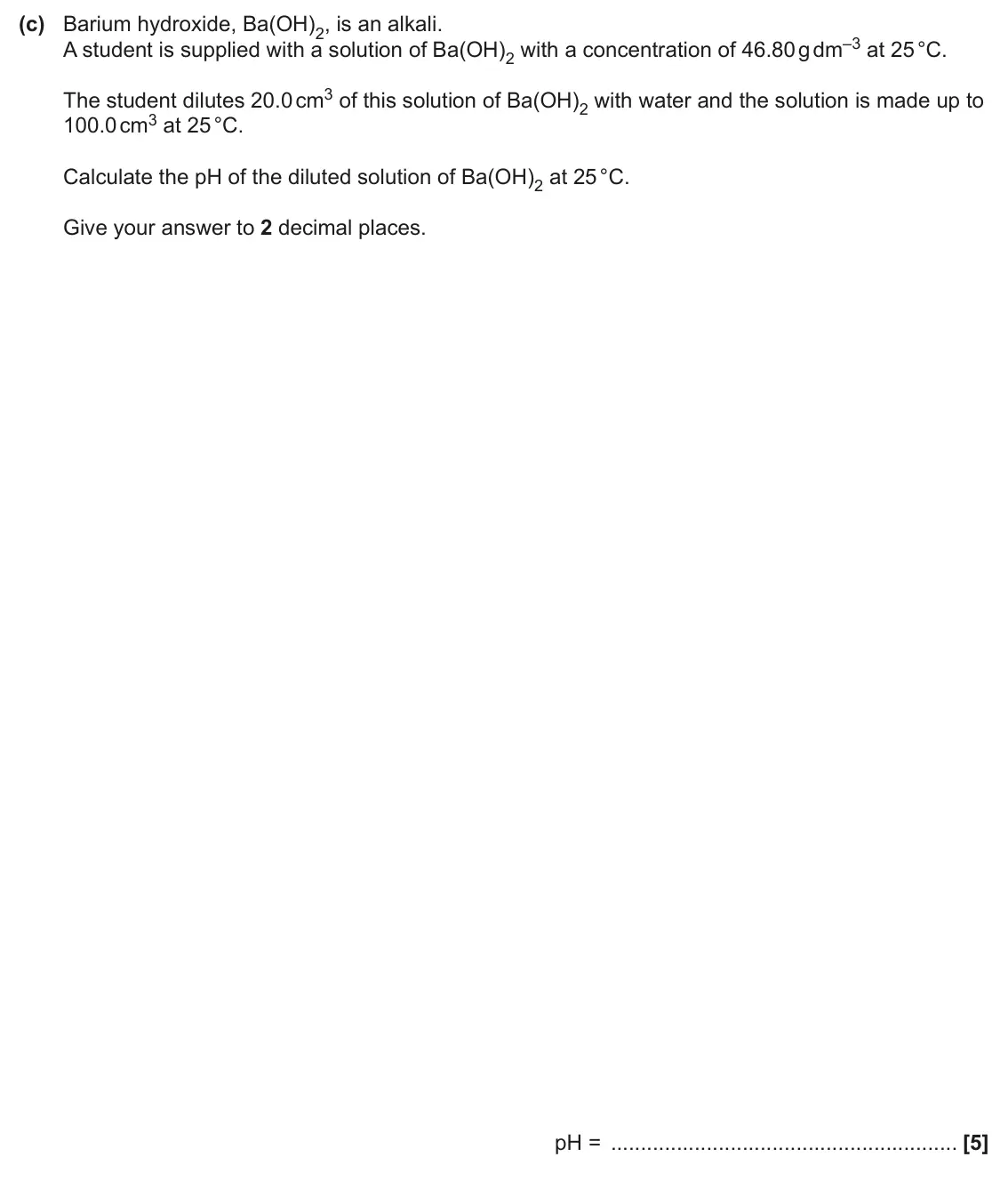

Q19(a)(i)
The whole paper ↗
Q19(a)(ii)
The whole paper ↗
Q19(a)(iii)
The whole paper ↗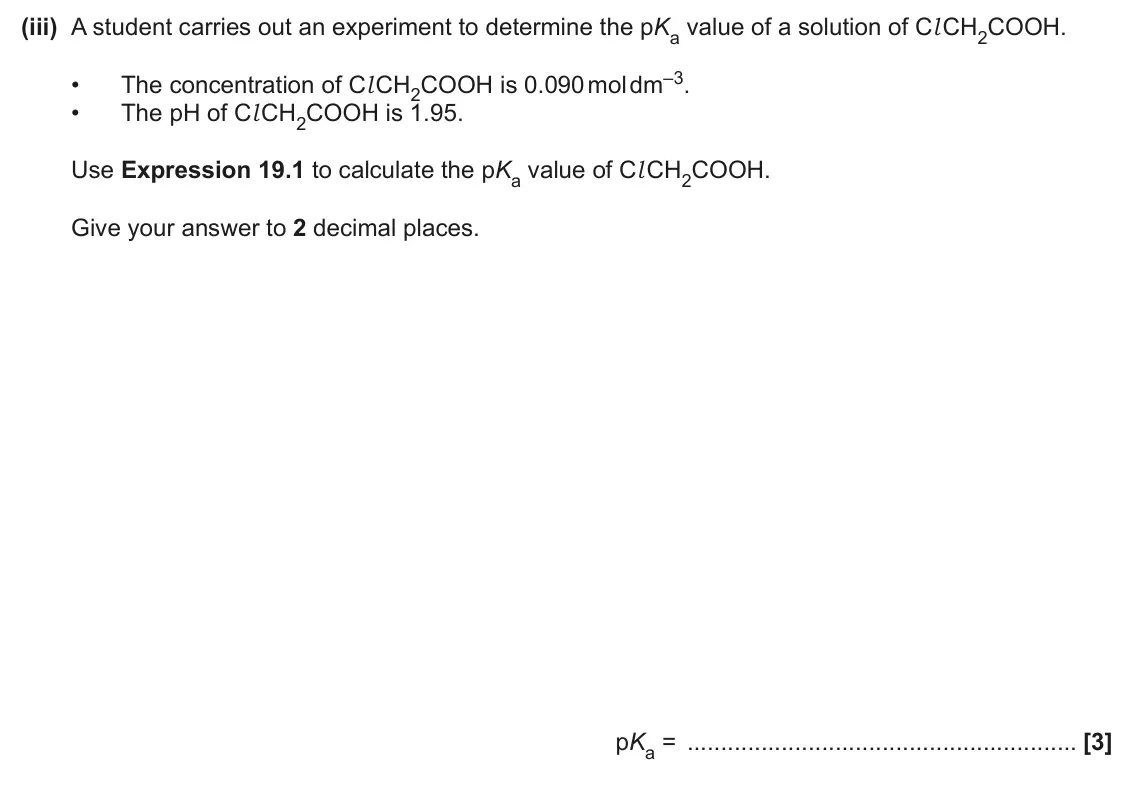
Q19(b)(i)
The whole paper ↗
Q19(b)(ii)
The whole paper ↗
Q22(c)
The whole paper ↗
Q1(a)
The whole paper ↗
Q1(b)
The whole paper ↗
Q1(c)
The whole paper ↗
Q4(a)(i)
The whole paper ↗

Q20(a)(i)
The whole paper ↗
Q20(a)(ii)
The whole paper ↗
Q20(b)
The whole paper ↗
All 63 questions on Acids, bases and buffers, as a list
- June 2025, Paper 1, Q13 (1 mark): A mixture of ethanoic acid and ethanol is left to reach equilibrium. A student determines the amount of ethanoic acid remaining in the equilibrium mixture by ti
- June 2025, Paper 1, Q19(a) (1 mark): Nitric acid, HNO3, is a strong monobasic acid. Calculate the pH of 0.150 mol dm–3 HNO3. Give your answer to 2 decimal places. pH = [1]
- June 2025, Paper 1, Q19(b)(i) (2 marks): Nitrous acid, HNO2, is a weak monobasic acid. Predict whether the pH of 0.150 mol dm–3 HNO2 is higher, lower or the same as the pH of 0.150 mol dm–3 nitric acid
- June 2025, Paper 1, Q19(c) (6 marks): This question is about monobasic acids and buffer solutions. (c)* A student plans to prepare a buffer solution with a pH of 4.85 using propanoic acid, CH3CH2COO
- June 2025, Paper 3, Q2(c) (5 marks): Barium hydroxide, Ba(OH)2, is an alkali. A student is supplied with a solution of Ba(OH)2 with a concentration of 46.80 g dm–3 at 25 °C. The student dilutes 20.
- June 2024, Paper 1, Q12 (1 mark): Which solution can be added to CH3COOH(aq) to make a buffer solution? A CH3COONa(aq) B HCOOH(aq) C HCl (aq) D NaCl (aq) Your answer [1]
- June 2024, Paper 1, Q19(a)(i) (1 mark): Write the expression for the acid dissociation constant, Ka, of Cl CH2COOH. [1]
- June 2024, Paper 1, Q19(a)(ii) (1 mark): The expression for the acid dissociation constant, Ka, of Cl CH2COOH can be simplified to: [H+]2 Ka = [Cl CH2COOH] Expression 19.1 State one approximation that
- June 2024, Paper 1, Q19(a)(iii) (3 marks): A student carries out an experiment to determine the pKa value of a solution of Cl CH2COOH. The concentration of Cl CH2COOH is 0.090 mol dm–3. • • The pH of Cl
- June 2024, Paper 1, Q19(b)(i) (5 marks): Draw a best-fit curve on the graph and calculate the concentration of the CH3COOH solution. CH3COOH concentration = mol dm–3 [5]
- June 2024, Paper 1, Q19(b)(ii) (1 mark): The end point of the titration can also be found by observing the colour change of an indicator. The pH ranges of some indicators are shown in the table. Indica
- June 2024, Paper 1, Q22(c) (5 marks): Red blood cells contain haemoglobin which transports oxygen around the body. For efficient transportation of oxygen, healthy human blood must be maintained at a
- June 2024, Paper 3, Q1(a) (2 marks): What is the pH of 1.00 dm3 of 0.400 mol dm–3 of NaOH(aq) at 298 K? pH = [2]
- June 2024, Paper 3, Q1(b) (1 mark): Water is added to 10.0 cm3 of 0.750 mol dm–3 HCl (aq) to produce 100 cm3 of diluted HCl (aq). What is the pH of the diluted HCl (aq)? Give your answer to 2 deci
- June 2024, Paper 3, Q1(c) (2 marks): A solution has concentrations of 0.300 mol dm–3 CH3COOH(aq) and 0.100 mol dm–3 CH3COONa(aq). Ka for CH3COOH = 1.75 × 10⁻⁵ mol dm–3 at 298 K. What is the pH of t
- June 2024, Paper 3, Q4(a)(i) (2 marks): During the equilibria, H2PO4 Explain this statement, using the equilibria 1, 2 and 3, as required. [2]
- June 2023, Paper 1, Q10 (1 mark): What is the percentage dissociation of a 0.015 mol dm–3 solution of methanoic acid, HCOOH (Ka = 1.60 × 10⁻⁴ mol dm–3)? A 0.016% B 1.1% C 1.82% D 10.3% Your answ
- June 2023, Paper 1, Q20(a)(i) (2 marks): Calculate the pH of water at 40 °C. Give your answer to 2 decimal places. pH = [2]
- June 2023, Paper 1, Q20(a)(ii) (1 mark): Table 20.1 shows different Kw values at 25 °C and at 40 °C. A student suggests that water is neutral at these temperatures. Explain why this student is correct.
- June 2023, Paper 1, Q20(b) (5 marks): A student reacts strontium metal with water to make a 250.0 cm3 solution of aqueous strontium hydroxide, Sr(OH)2. The solution contains 0.145 g of strontium hyd
- June 2023, Paper 1, Q20(e)(i) (1 mark): Explain what is meant by the term monobasic acid. [1]
- June 2023, Paper 1, Q20(e)(ii) (4 marks): A buffer solution is prepared by dissolving 3.39 g of potassium hydroxide in 250 cm3 of 0.376 mol dm–3 butanoic acid. This buffer solution has a pH of 5.07 at 2
- June 2023, Paper 1, Q20(f) (1 mark): A buffer solution has a pH of 4.50. When a small volume of water is added to this buffer solution, the pH does not change. Explain why the pH does not change. [
- June 2023, Paper 3, Q2(b) (3 marks): A student investigates the rate of a reaction that is 1st order with respect to hydrochloric acid, HCl (aq). The student carries out a reaction using 0.680 mol
- June 2022, Paper 1, Q11 (1 mark): The equilibrium equation for an indicator, HA, is shown below. A–(aq) H+(aq) Equation: HA(aq) + Colour: Blue Yellow The indicator is added to a solution. The in
- June 2022, Paper 1, Q12 (1 mark): Ammonia and water react to set up an acid–base equilibrium. What are the Brønsted–Lowry acids in the equilibrium mixture? H2O and OH– A OH– and NH3 B + and H2O
- June 2022, Paper 1, Q19(b)(i) (1 mark): Explain why a buffer solution is formed. [1]
- June 2022, Paper 1, Q19(b)(ii) (4 marks): Calculate the pH of the buffer solution that has been prepared. Give your answer to 2 decimal places. pH = [4]
- June 2022, Paper 1, Q19(b)(iii) (2 marks): A small amount of aqueous ammonia, NH3(aq), is added to the buffer solution. Explain, in terms of equilibrium, how the buffer solution would respond to the adde
- June 2022, Paper 1, Q21(b)(i) (5 marks): Determine the mass of barium oxide that was used. Give your answer to 3 significant figures. mass of barium oxide = g [5]
- June 2022, Paper 3, Q6(c)(ii) (3 marks): The student dissolves 0.150 mol of vitamin C in water and makes the solution up to 250 cm3 in a volumetric flask. Calculate the pH of this solution of vitamin C
- November 2021, Paper 1, Q10 (1 mark): An aqueous solution of ethanoic acid, CH3COOH, has a concentration of 0.50 mol dm–3. pKa for CH3COOH = 4.76 at 25 °C. What is the pH of the ethanoic acid soluti
- November 2021, Paper 1, Q22(a) (2 marks): Sodium hydroxide, NaOH, is a strong base. Calculate the pH of 0.140 mol dm–3 NaOH(aq) at 298 K. Give your answer to 2 decimal places. pH = [2]
- November 2021, Paper 1, Q22(c) (6 marks): This question is about acids, bases and buffers. (c)* Nitrous acid, HNO2, is a weak Brønsted–Lowry acid with a pKa value of 3.34 at room temperature. HNO2 can b
- November 2021, Paper 3, Q5(b)(i) (2 marks): Calculate the pH of 0.125 mol dm–3 hydrazoic acid. Give your answer to 2 decimal places. pH = [2]
- November 2021, Paper 3, Q5(b)(ii) (2 marks): When added to water, hydrazoic acid forms an equilibrium mixture containing conjugate acid–base pairs. Complete the equation for this equilibrium and label the
- November 2020, Paper 1, Q11 (1 mark): 20 cm3 of 0.10 mol dm−3 hydrochloric acid is added to 10 cm3 of 0.10 mol dm−3 sodium hydroxide. What is the pH of the resulting mixture? A 1.00 B 1.18 C 1.30 D
- November 2020, Paper 1, Q18(b) (2 marks): The Ka values of HCOOH and CH3COOH are shown in Table 18.1. Ka / mol dm−3 Weak acid 1.82 × 10⁻⁴ HCOOH 1.78 × 10⁻⁵ CH3COOH Table 18.1 A student adds methanoic ac
- November 2020, Paper 1, Q18(c)(i) (2 marks): The student measures the pH of CH3COOH(aq) as 2.72. Show that the concentration of the CH3COOH(aq) is 0.204 mol dm−3. [2]
- November 2020, Paper 1, Q18(c)(ii) (4 marks): The student plans to make a buffer solution of pH 4.00 from a mixture of CH3COOH(aq) and sodium ethanoate, CH3COONa(aq). The student mixes 400 cm3 of 0.204 mol
- November 2020, Paper 3, Q6(b) (4 marks): Ethanoic acid, CH3COOH, and methanesulfonic acid, CH3SO2OH, are both monobasic acids. The pKa values are shown in the table. Acid pKa Ethanoic acid CH3COOH 4.76
- June 2019, Paper 1, Q12 (1 mark): The equation shows the dissociation of the acid H3AsO4 in water. – + H3O+ H3AsO4 + H2O H2AsO4 Which pair is a conjugate acid–base pair? A H3AsO4 and H2O − and H
- June 2019, Paper 1, Q17(a) (6 marks): Healthy human blood needs to be maintained at a pH of 7.40 for the body to function normally. −, (a)* Carbonic acid, H2CO3, is a weak acid which, together with
- June 2019, Paper 1, Q20(a) (2 marks): Calculate the pH of 0.0800 mol dm−3 C2H5COOH(aq). Give your answer to 2 decimal places. pH = [2]
- June 2019, Paper 1, Q20(b)(i) (1 mark): Show by calculation that 20.0 cm3 of NaOH(aq) is required to reach the end point. [1]
- June 2019, Paper 1, Q20(b)(ii) (4 marks): Calculate the pH of the final solution. Give your answer to 2 decimal places. pH = [4]
- June 2019, Paper 1, Q20(b)(iii) (3 marks): On the axes below, sketch a pH curve for the pH changes during the addition of 45.0 cm3 of 0.100 mol dm−3 NaOH(aq) to 25.0 cm3 of 0.0800 mol dm−3 C2H5COOH(aq).
- June 2019, Paper 1, Q20(b)(iv) (1 mark): The student considers using the four indicators in Table 20.2 for the titration. Indicator pH range Cresol red 0.2 – 1.8 Bromophenol blue 3.0 – 4.6 Cresol purpl
- June 2019, Paper 1, Q20(b)(v) (2 marks): The student repeats the experiment starting with 25.0 cm3 of 0.0800 mol dm−3 HCN(aq) and adding a total of 45.0 cm3 of 0.100 mol dm−3 NaOH(aq). Predict one simi
- June 2019, Paper 1, Q20(c) (1 mark): The student calculates the pH of 0.0800 mol dm−3 HIO3(aq). The student assumes that the equilibrium concentration of HIO3(aq) is the same as the initial concent
- June 2019, Paper 3, Q2(a) (1 mark): In Step 1, sodium carbonate, Na2CO3, makes the reaction mixture alkaline. Write an ionic equation to show how carbonate ions form an alkaline solution in water.
- June 2019, Paper 3, Q4(a)(iv) (5 marks): A student measures the pH of the contents in a bottle of Dettol® as 5.14. The label on the bottle shows the percentage of chloroxylenol in Dettol® as 4.80% i.e.
- June 2018, Paper 1, Q10 (1 mark): A buffer solution is prepared by mixing 200 cm3 of 2.00 mol dm–3 propanoic acid, CH3CH2COOH, with 600 cm3 of 1.00 mol dm–3 sodium propanoate, CH3CH2COONa. Ka fo
- June 2018, Paper 1, Q19(a)(i) (1 mark): Write the expression for the acid dissociation constant, Ka, of CH3COOH. [1]
- June 2018, Paper 1, Q19(a)(ii) (3 marks): Calculate the pKa value of CH3COOH. Give your answer to two decimal places. pKa = [3]
- June 2018, Paper 1, Q19(a)(iii) (1 mark): Determine the percentage dissociation of ethanoic acid in the vinegar. Give your answer to three significant figures. percentage dissociation = % [1]
- June 2018, Paper 1, Q19(b) (4 marks): Many solid drain cleaners are based on sodium hydroxide, NaOH. • A student dissolves 1.26 g of a drain cleaner in water and makes up the solution to 100.0 cm3.
- June 2018, Paper 3, Q6(a)(iii) (3 marks): Reaction 6.1 takes place in two steps. OH– ions act as a catalyst. In step 1, ethanal reacts with OH– ions to set up an acid–base equilibrium. In step 2, compou
- June 2017, Paper 1, Q21(a) (3 marks): A student uses a pH meter to measure the pH of a solution of CH3COOH at 25 °C. The measured pH is 2.440. Calculate the concentration of ethanoic acid in the sol
- June 2017, Paper 1, Q21(b) (2 marks): Ethanoic acid is added to another weak acid, fluoroethanoic acid, FCH2COOH (Ka = 2.19 × 10⁻³ mol dm–3). An equilibrium is set up containing two acid-base pairs.
- June 2017, Paper 1, Q21(c)(i) (5 marks): Show by calculation whether, or not, the student’s experimental method would produce the required pH. Show all your working. [5]
- June 2017, Paper 1, Q21(c)(ii) (2 marks): When the student prepares the buffer solution, the volume of solution increases slightly. Suggest whether the pH of the buffer solution would be the same, great
- June 2017, Paper 3, Q5(a)(i) (1 mark): Thiols are weak acids. Write the expression for the acid dissociation constant, Ka, for butane-1-thiol. [1]
Questions, mark schemes and examiner’s reports are © OCR, from their published past papers. Plumi isn’t affiliated with any exam board. Want whole papers? Every OCR A-Level Chemistry A paper, or our free OCR-style practice pack.
Rather write your answers by hand on iPad? Plumi marks them against the same mark schemes.