 plumi
Enthalpy changes: OCR A‑Level Chemistry A questions
Every OCR A-Level Chemistry A exam question on 3.2.1 Enthalpy changes, 2016–2025, with its mark scheme and examiner’s report.
Find questions1,820
Calculations

Q17(a)(i)
The whole paper ↗
Q17(a)(ii)
The whole paper ↗


Q23(b)
The whole paper ↗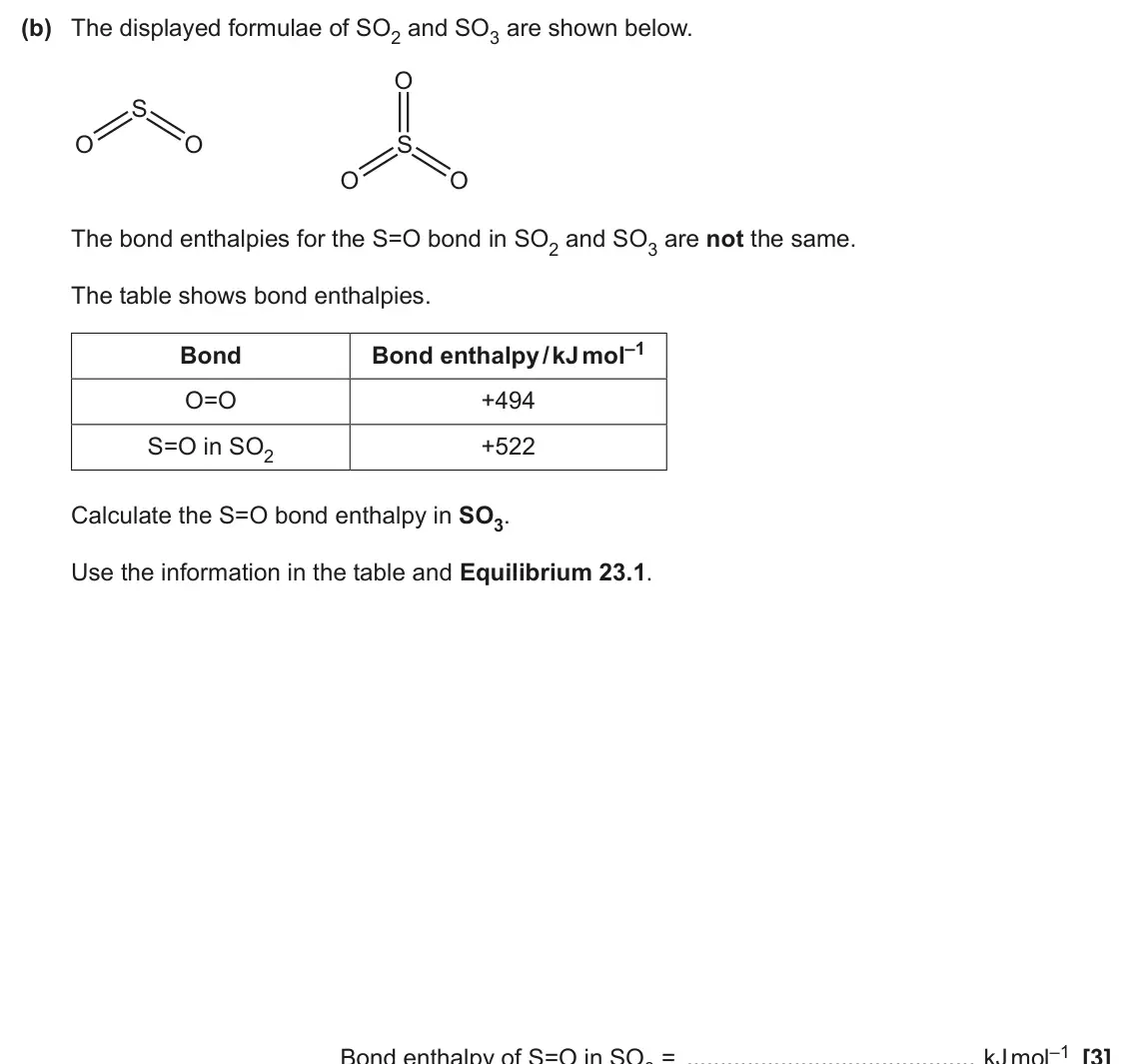
Q1(c)(i)
The whole paper ↗
Q1(c)(ii)
The whole paper ↗
Q4(b)(ii)
The whole paper ↗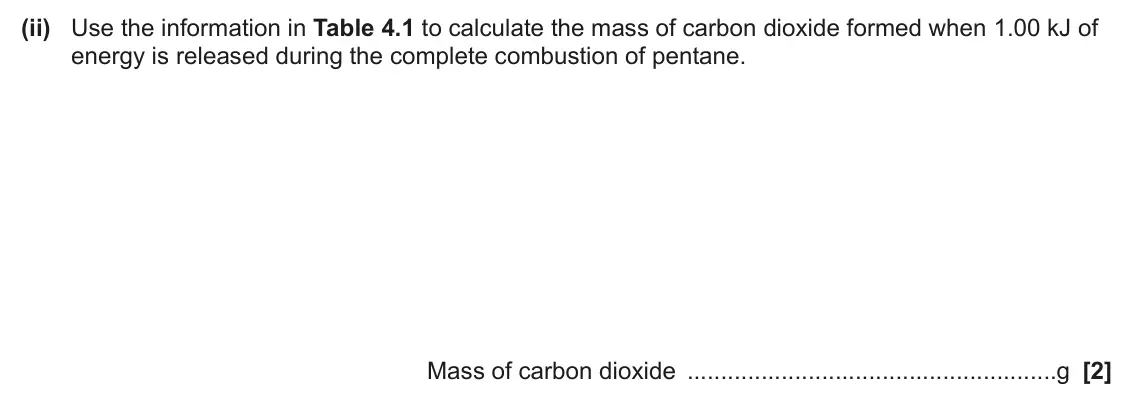
Q4(b)(iii)
The whole paper ↗
Q4(b)(iv)
The whole paper ↗
Q2(a)(i)
The whole paper ↗
Q2(a)(ii)
The whole paper ↗
Q2(a)(iii)
The whole paper ↗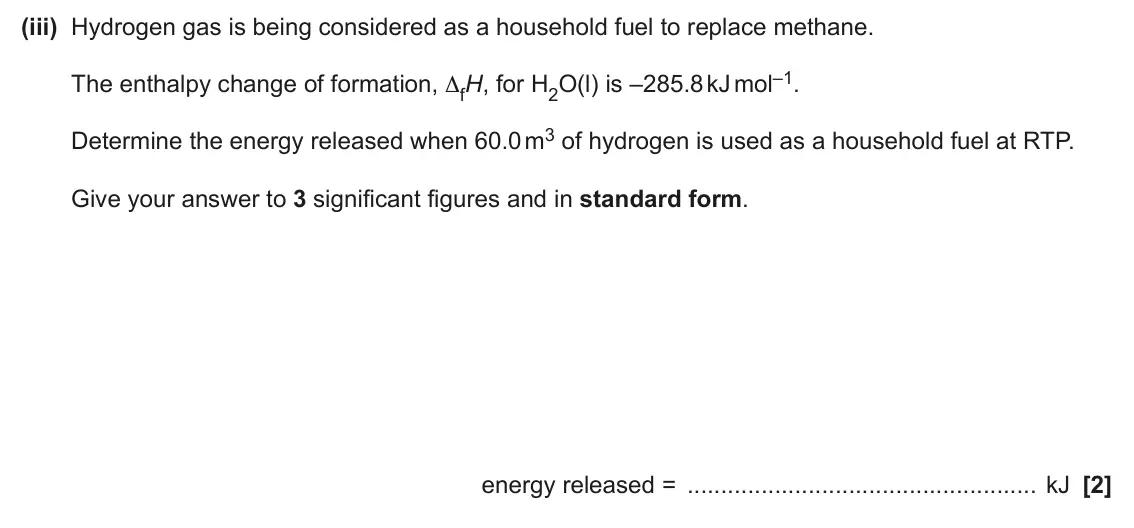

Q23(b)
The whole paper ↗
Q3(a)
The whole paper ↗
Q3(b)
The whole paper ↗
Q3(c)
The whole paper ↗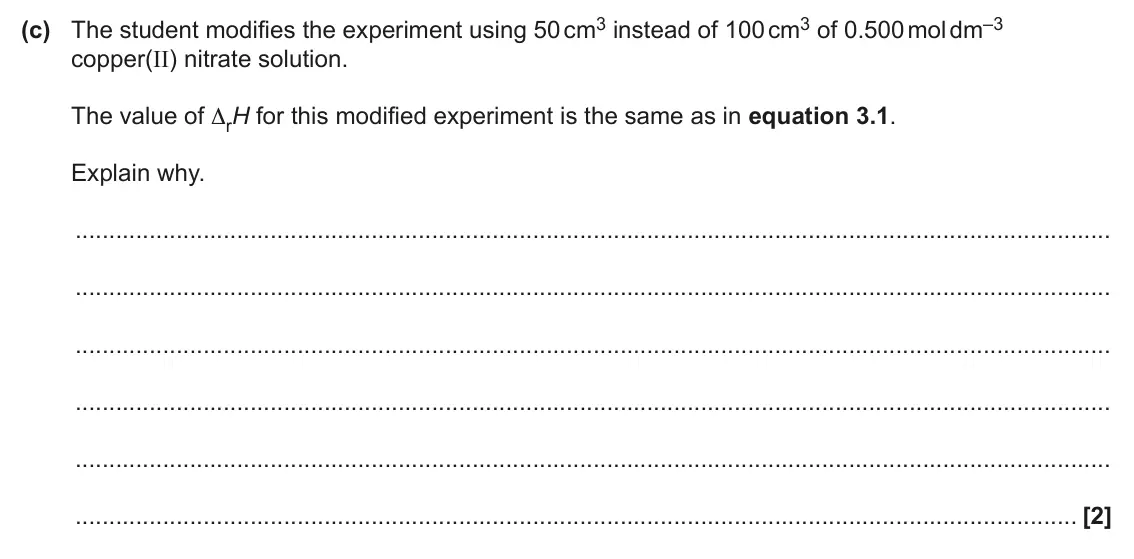
All 100 questions on Enthalpy changes, as a list
- June 2025, Paper 1, Q6 (1 mark): Methane reacts with oxygen as shown in the equation: CO2(g) + 2H2O(g) ΔrH = –730 kJ mol–1 CH4(g) + 2O2(g) The table shows some bond enthalpies. Bond O–H O=O C=O
- June 2025, Paper 1, Q17(a)(i) (1 mark): [1]
- June 2025, Paper 1, Q17(a)(ii) (2 marks): Calculate the enthalpy change, ΔrH, for the forward reaction in Equilibrium 17.1. ΔH = kJ mol–1 [2]
- June 2025, Paper 3, Q6 (6 marks): 6* The enthalpy change of Reaction 6.1, ∆H1, shown below, is difficult to measure directly by experiment. 2NaHCO3(s) Na2CO3(s) + H2O(l) + CO2(g) ∆H1 Reaction 6.
- June 2025, AS Paper 1, Q11 (1 mark): The equation for the complete combustion of methanol, CH3OH, is shown below. CH3OH(l) + 11 2O2(g) CO2(g) + 2H2O(l) The table shows standard enthalpy changes of
- June 2025, AS Paper 1, Q23(b) (3 marks): The displayed formulae of SO2 and SO3 are shown below. O S O O S O O The bond enthalpies for the S=O bond in SO2 and SO3 are not the same. The table shows bond
- June 2025, AS Paper 2, Q1(c)(i) (4 marks): Give your answer to 3 significant figures. Assume that the density of all solutions and the specific heat capacity, c, of the reaction mixture is the same as fo
- June 2025, AS Paper 2, Q1(c)(ii) (2 marks): The student repeats the experiment using the same volume and concentration of NaOH but using 20.0 cm3 of 2.80 mol dm–3 HCl instead of 40.0 cm3 of 1.40 mol dm–3
- June 2025, AS Paper 2, Q4(b)(ii) (2 marks): Use the information in Table 4.1 to calculate the mass of carbon dioxide formed when 1.00 kJ of energy is released during the complete combustion of pentane. Ma
- June 2025, AS Paper 2, Q4(b)(iii) (2 marks): Complete the enthalpy profile diagram for the complete combustion of pentane. On your diagram: • Label the enthalpy change as ΔH. • Include the formulae of the
- June 2025, AS Paper 2, Q4(b)(iv) (1 mark): Pentane C5H12 36 –3509 Hexane C6H14 69 –4163 (iv) Use the data in Table 4.1 to estimate a value for the enthalpy change of combustion of butane. Give your answe
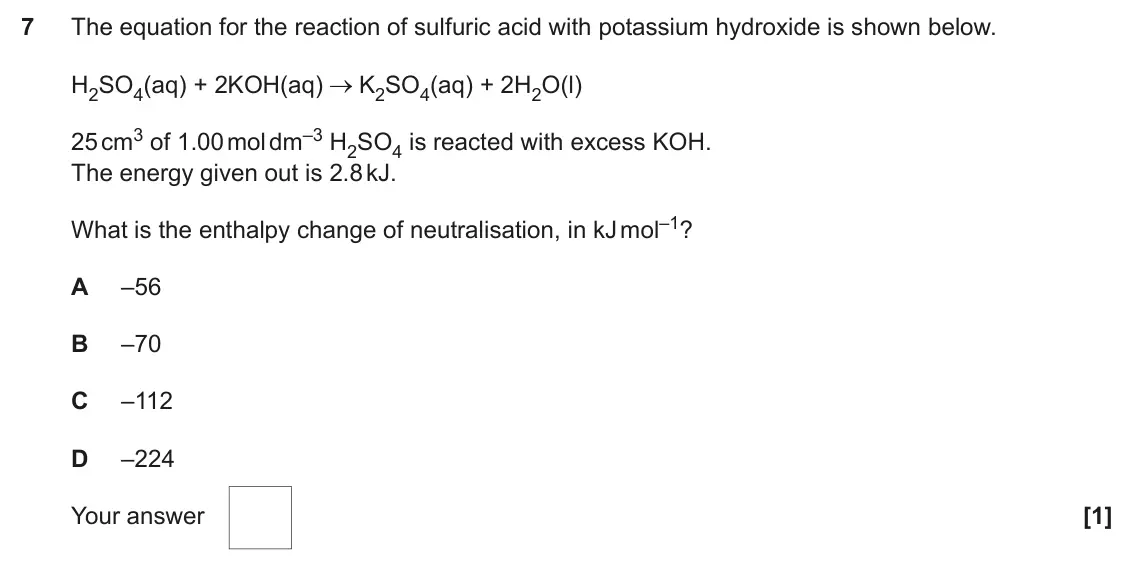
- June 2024, Paper 1, Q7 (1 mark): The equation for the reaction of sulfuric acid with potassium hydroxide is shown below. H2SO4(aq) + 2KOH(aq) K2SO4(aq) + 2H2O(l) 25 cm3 of 1.00 mol dm–3 H2SO4 i
- June 2024, Paper 3, Q2(a)(i) (1 mark): Why do all average bond enthalpies have a positive value? [1]
- June 2024, Paper 3, Q2(a)(ii) (3 marks): Determine the C–H bond enthalpy, in kJ mol–1, using the information above. C–H bond enthalpy = kJ mol–1 [3]
- June 2024, Paper 3, Q2(a)(iii) (2 marks): Hydrogen gas is being considered as a household fuel to replace methane. The enthalpy change of formation, ΔfH, for H2O(l) is –285.8 kJ mol–1. Determine the ene
- June 2024, AS Paper 1, Q11 (1 mark): An enthalpy cycle is shown below. ΔrH C(s) + ½O2(g) CO(g) + ½O2(g) + ½O2(g) ΔcH = –283 kJ mol–1 ΔcH = –393 kJ mol–1 CO2(g) What is ΔrH, in kJ mol–1, shown in th
- June 2024, AS Paper 1, Q23(b) (3 marks): Hydrazine, N2H4, shown below, can be used as a rocket fuel. H H N N H H As a fuel, N2H4 reacts with oxygen as shown below. N2(g) + 2H2O(g) ΔH = –581 kJ mol–1 N2
- June 2024, AS Paper 2, Q3(a) (1 mark): What is meant by the term enthalpy change of reaction? [1]
- June 2024, AS Paper 2, Q3(b) (6 marks): Enthalpy changes of reaction can be determined by experiment. (b)* A student carries out an experiment to determine the enthalpy change for the reaction between
- June 2024, AS Paper 2, Q3(c) (2 marks): The student modifies the experiment using 50 cm3 instead of 100 cm3 of 0.500 mol dm–3 copper(II) nitrate solution. The value of ΔrH for this modified experiment
- June 2023, Paper 1, Q18(a) (3 marks): A student determines the enthalpy change of combustion, ∆cH, of heptane, C7H16, using the method outlined below. • Add 150 g of water to a beaker and measure it
- June 2023, Paper 1, Q18(b) (2 marks): Nonane, C9H20, can be broken down by heat to form pentane, C5H12, and ethene, C2H4. C5H12(g) + 2C2H4(g) ∆H = +186 kJ mol–1 Reaction 1 C9H20(g) The enthalpy chan
- June 2023, Paper 3, Q2(a)(ii) (3 marks): A student carries out an experiment to determine the enthalpy change of solution of RbCl O3 using the method below. • A 2.00 g sample of solid RbCl O3 is added
- June 2023, AS Paper 1, Q11 (1 mark): The standard enthalpy change of formation of water is –286 kJ mol–1. Which statement or equation is correct? ΔH o = –143 kJ mol–1 A H2(g) + ½O2(g) H2O(l) ΔH o =
- June 2023, AS Paper 1, Q12 (1 mark): Which statement about energy changes is correct? A Combustion of an alkane is endothermic. B In an exothermic reaction, more energy is needed to break bonds tha
- June 2023, AS Paper 1, Q23(a)(ii) (2 marks): In a petrol engine, polluting gases such as CO and NO are formed. These are mostly removed before being emitted from the exhaust. The equation for the removal o
- June 2023, AS Paper 1, Q23(b)(i) (1 mark): State the conditions of temperature and pressure for standard enthalpy changes. Temperature Pressure [1]
- June 2023, AS Paper 1, Q23(b)(ii) (3 marks): Calculate the standard enthalpy change of formation for CO2(g). Δ f H o (CO2(g)) = kJ mol–1 [3]
- June 2023, AS Paper 2, Q4(a) (2 marks): Explain the term enthalpy change of combustion. [2]
- June 2023, AS Paper 2, Q4(b)(i) (1 mark): The thermometer had an uncertainty of ± 0.25 °C in each temperature reading. Calculate the percentage uncertainty in the temperature change. percentage uncertai
- June 2023, AS Paper 2, Q4(b)(ii) (6 marks): This question is about the enthalpy change of combustion of alcohols. (ii)* Use the student’s results to determine ∆cH of butan-1-ol in kJ mol–1. Explain why th
- June 2023, AS Paper 2, Q4(b)(iii) (1 mark): Another student carries out the experiment in 4(b) using 150 g of water in the beaker instead of 200 g. Calculate the mass of butan-1-ol that would produce the
- June 2023, AS Paper 2, Q4(c)(i) (4 marks): Use this value of ΔcH and the average bond enthalpies below to calculate the average bond enthalpy of C=O. Average bond enthalpy / Bond kJ mol–1 C–H +413 C–C +3
- June 2023, AS Paper 2, Q4(c)(ii) (2 marks): Methoxymethane, CH3OCH3, is an isomer of ethanol. On combustion, methoxymethane, in the gaseous state, produces carbon dioxide and steam. H H H C O C H(g) + 3 O
- June 2022, Paper 1, Q7 (1 mark): Bond enthalpies are shown in the table. Bond C–C C–H O–H C–O C=O O–O O=O Bond enthalpy 347 435 464 358 805 144 498 / kJ mol–1 What is the enthalpy change, in kJ
- June 2022, Paper 1, Q17(a)(i) (4 marks): Determine the maximum temperature reached in this reaction. Give your answer to 3 significant figures. Assume that the specific heat capacity and density of the
- June 2022, Paper 1, Q17(a)(ii) (1 mark): The student wants to repeat the experiment, but there is not enough AgNO3(aq) left to use another 100.0 cm3 portion. The student decides to modify the method by
- June 2022, Paper 1, Q17(b)(i) (1 mark): Explain the term enthalpy change of formation. [1]
- June 2022, Paper 1, Q17(b)(ii) (2 marks): Calculate the standard enthalpy change of formation, ∆fHө, of NO(g). ∆fHө of NO(g) = kJ mol–1 [2]
- June 2022, Paper 3, Q5(a) (6 marks): This question is about energy changes. (a)* A student plans to determine the enthalpy change of hydration of calcium ions. The student finds the information bel
- June 2022, Paper 3, Q5(b)(ii) (3 marks): Calculate the energy released, in kJ, by the complete combustion of 8.00 kg of this fuel. ∆cH(C8H18) = –5470 kJ mol–1; ∆cH(C2H5OH) = –1367 kJ mol–1. energy rele
- June 2022, AS Paper 1, Q11 (1 mark): Combustion of hydrazine, N2H4, produces NO2 and H2O as in the equation below. N2H4(l) + 3O2(g) → 2NO2(g) + 2H2O(l) The table shows standard enthalpy changes of
- June 2022, AS Paper 1, Q25(a)(i) (4 marks): Calculate ∆rH, in kJ mol–1, for the reaction shown in Equation 25.1. Give your answer to 3 significant figures. Assume that the density and specific heat capaci
- June 2022, AS Paper 1, Q25(a)(ii) (2 marks): The student looked back at Equation 25.1 and noticed that the reaction was a neutralisation. The student concluded that ∆rH is the enthalpy change of neutralisa
- June 2022, AS Paper 2, Q4(b) (3 marks): Hydrogen can also be manufactured by reacting ethanol with steam, as shown in Equilibrium 4.2. H H H C C O H + 3 H O H 6 H H + 2 O C O Equilibrium 4.2 H H Avera
- November 2021, Paper 1, Q8 (1 mark): Bond enthalpies are given in the table. Bond H–S O=O S=O O–H Bond enthalpy +346 +498 +531 +464 / kJ mol–1 What is the enthalpy change, in kJ mol–1, for the reac
- November 2021, Paper 1, Q22(b)(ii) (4 marks): Calculate the enthalpy change, ΔH1, for Equation 22.1, and deduce the value for the enthalpy change of neutralisation, ∆neutH, in kJ mol–1. Assume that the dens
- November 2021, Paper 1, Q22(b)(iii) (2 marks): The student repeats the experiment using 50.0 cm3 of 1.60 mol dm–3 H2SO4 and 110.0 cm3 of 1.50 mol dm–3 NaOH. Predict the increase in temperature. Explain your
- November 2021, AS Paper 1, Q10 (1 mark): The equation for the complete combustion of propene, C3H6, is shown below. C3H6(g) + 4½O2(g) → 3CO2(g) + 3H2O(l) Standard enthalpy changes of formation, ∆f Ho,
- November 2021, AS Paper 1, Q22(c) (3 marks): The reaction for the production of hydrogen is repeated below. 3H2(g) + CO(g) ∆H = +206 kJ mol–1 CH4(g) + H2O(g) Average bond enthalpies are shown in the table.
- November 2021, AS Paper 2, Q4(a) (6 marks): A student carries out an investigation to find the enthalpy change for the decomposition of magnesium carbonate, ∆H1 (Reaction 1). Reaction 1 MgCO3(s) MgO(s) +
- November 2020, Paper 1, Q6 (1 mark): The equation for the combustion of C7H8 is shown in the following equation. C7H8(l) + 9O2(g) 7CO2(g) + 4H2O(l) Enthalpy changes of formation are shown in the ta
- November 2020, Paper 3, Q3(a)(i) (3 marks): Determine the enthalpy change of combustion of propane, in kJ mol−1. Give your answer to 3 significant figures. ∆cH (C3H8) = kJ mol−1 [3]
- November 2020, Paper 3, Q3(a)(ii) (1 mark): The student finds that the experimental enthalpy change ∆cH (C3H8) is much less exothermic than the accurate standard enthalpy change ∆cH (C3H8) in databases. O
- November 2020, Paper 3, Q3(b) (6 marks): Propane, C3H8, (boiling point −42 °C) is used as ‘camping gas’. A student plans to determine the enthalpy change of combustion of propane, ∆cH (C3H8), by two me
- November 2020, AS Paper 1, Q11 (1 mark): Hydrogen and oxygen react as shown below. 2H2(g) + O2(g) → 2H2O(g) ∆rH = −486 kJ mol−1 Bond enthalpies are shown in the table. Bond H−H O=O Bond enthalpy +436 +
- November 2020, AS Paper 1, Q24(a) (3 marks): Ammonia is manufactured by reacting nitrogen with hydrogen: N2(g) + 3H2(g) → 2NH3(g) Standard enthalpy changes of combustion, ∆cHo, are given in the table. ∆cHo
- November 2020, AS Paper 2, Q2(a) (2 marks): Explain the term enthalpy change of combustion, ΔcH. [2]
- November 2020, AS Paper 2, Q2(b) (4 marks): A student carries out an experiment to determine the enthalpy change of combustion of cyclohexane, C6H12, using the apparatus shown in the diagram. thermometer
- November 2020, AS Paper 2, Q2(c)(i) (2 marks): The uncertainty in each thermometer reading is ±0.5 °C and the uncertainty in the measured volume of water is ±2 cm3. Determine whether the temperature change o
- November 2020, AS Paper 2, Q2(c)(ii) (2 marks): Suggest two reasons, apart from measurement uncertainties, why the experimental value for ΔcH is less exothermic than the data book value. Reason 1 Reason 2 [2]
- November 2020, AS Paper 2, Q2(c)(iii) (2 marks): In the experiment the water in the beaker was heated for 5 minutes. The student thought that the experiment could be improved by heating the water for 10 minute
- June 2019, Paper 1, Q10 (1 mark): Radical reactions are responsible for the catalysed breakdown of the ozone layer. The overall equation is shown below. 3O2 ∆rH = −284 kJ mol−1 2O3 The molar gas
- June 2019, Paper 1, Q19(a)(i) (1 mark): Explain why the enthalpy change for Reaction 1 has a negative value. Use ideas about enthalpy changes associated with bond breaking and bond making. [1]
- June 2019, Paper 1, Q19(a)(iii) (3 marks): Calculate the standard enthalpy change of formation, ∆fH ө, of hydrogen sulfide using the enthalpy change for Reaction 1, and the standard enthalpy changes of c
- June 2019, Paper 3, Q5(a)(i) (6 marks): The enthalpy change of reaction, ∆rH, for converting anhydrous copper(II) sulfate to hydrated copper(II) sulfate is difficult to measure directly by experiment.
- June 2019, Paper 3, Q5(a)(ii) (1 mark): The thermometer had an uncertainty in each temperature reading of ± 0.1 °C. The student calculates a 20% uncertainty in the temperature change in Experiment 2.
- June 2019, AS Paper 1, Q10 (1 mark): A reversible reaction has the enthalpy profile diagram shown below. 150 energy reactants /kJ mol–1 120 products progress of reaction Which statement about this
- June 2019, AS Paper 1, Q11 (1 mark): Hydrogen and chlorine react as shown below. H2(g) + Cl 2(g) → 2HCl (g) ∆H o = −184.6 kJ mol−1 Which statement about this reaction is correct? A Less energy is r
- June 2019, AS Paper 1, Q24(b)(i) (1 mark): State the conditions of temperature and pressure used for standard enthalpy measurements. Temperature Pressure [1]
- June 2019, AS Paper 1, Q24(b)(ii) (3 marks): Calculate the standard enthalpy change of formation for NO(g). Give your answer to a whole number. ∆fHo for NO(g) = kJ mol−1 [3]
- June 2018, Paper 1, Q16(b)(i) (2 marks): Explain what is meant by the term average bond enthalpy. [2]
- June 2018, Paper 1, Q16(b)(ii) (3 marks): Calculate the bond enthalpy of the F–F bond. bond enthalpy = kJ mol–1 [3]
- June 2018, Paper 3, Q5(a) (4 marks): Aqueous succinic acid can be neutralised by aqueous sodium hydroxide, NaOH(aq): (CH2COOH)2(aq) + 2NaOH(aq) → (CH2COONa)2(aq) + 2H2O(l) This reaction can be used
- June 2018, AS Paper 1, Q11 (1 mark): The equation for the reaction of aluminium sulfide, Al 2S3, with oxygen is shown below. 2Al 2S3(s) + 9O2(g) → 2Al 2O3(s) + 6SO2(g) The table shows standard enth
- June 2018, AS Paper 1, Q12 (1 mark): A student carried out an experiment to measure the enthalpy change of combustion of methanol. The energy from the combustion of methanol was used to heat a beak
- June 2018, AS Paper 1, Q23(a)(i) (4 marks): Calculate ∆rH, in kJ mol−1, for the reaction shown in equation 23.1. Give your answer to an appropriate number of significant figures. Assume that the density a
- June 2018, AS Paper 2, Q3(c) (2 marks): Hydrogen reacts with chlorine to form hydrogen chloride, HCl: 2HCl(g) ∆H = –184 kJ mol–1 H2(g) + Cl2(g) Table 3.1 shows bond enthalpies. Bond Enthalpy/kJ mol–1
- June 2018, AS Paper 2, Q3(d)(i) (1 mark): Write an equation, including state symbols, to represent the enthalpy change of vaporisation of bromine. [1]
- June 2018, AS Paper 2, Q3(d)(ii) (1 mark): Suggest whether the enthalpy change of vaporisation of bromine is exothermic or endothermic. Explain your answer. [1]
- June 2018, AS Paper 2, Q4(a)(i) (2 marks): Complete the enthalpy profile diagram for this reaction. On your diagram: • Label the activation energy, Ea • Label the enthalpy change of reaction, ∆H • Includ
- June 2018, AS Paper 2, Q4(a)(ii) (4 marks): 5.10 tonnes of NH3 are converted into NO. Calculate the energy released, in kJ, for this conversion. Give your answer in standard form and to an appropriate num
- June 2017, Paper 1, Q9 (1 mark): Enthalpy values are provided below. 2HI(g) ΔrH = –9 kJ mol–1 H2(g) + I2(g) Bond enthalpy Bond / kJ mol–1 H–H +436 I – I +151 What is the bond enthalpy, in kJ mo
- June 2017, Paper 1, Q18(b)(iv) (3 marks): Another equilibrium involved in the extraction of iron from Fe3O4 is shown below. 3Fe(s) + 4CO2(g) ∆H = –13.5 kJ mol–1 Fe3O4(s) + 4CO(g) Enthalpy changes of for
- June 2017, Paper 3, Q2(a) (6 marks): A student plans to determine the enthalpy change of reaction 3.1 shown below. Na2O(s) + 2HCl(aq) 2NaCl(aq) + H2O(l) reaction 3.1 This enthalpy change can be det
- June 2017, Paper 3, Q2(b) (2 marks): The uncertainty in each temperature reading is ±0.1 °C. The uncertainty in each mass reading is ±0.005 g. Determine whether the mass of Na2O or the temperature
- June 2017, Paper 3, Q2(c) (2 marks): Suggest a modification to this experiment, using the same apparatus, which would reduce the percentage errors in the measurements. Explain your reasoning. [2]
- June 2017, AS Paper 1, Q11 (1 mark): 50.0 cm3 of 1.00 mol dm–3 NaOH is neutralised by 50.0 cm3 of 1.00 mol dm–3 HNO3. The temperature increases by 6.0 °C. The experiment is repeated using: 25.0 cm3
- June 2017, AS Paper 1, Q12 (1 mark): The table shows standard enthalpy changes of combustion, ΔcH. ΔcH / kJ mol–1 Substance C(s) –393.5 H2(g) –285.8 C4H10(g) –2876.5 What is the enthalpy change for
- June 2017, AS Paper 1, Q25(a)(i) (1 mark): Explain, in terms of bond breaking and bond forming, why a reaction can be exothermic. [1]
- June 2017, AS Paper 1, Q25(a)(ii) (3 marks): Average bond enthalpies are shown in the table. Average bond enthalpy Bond /kJ mol–1 O–H +464 O=O +498 C–H +413 C=O +805 Calculate the average bond enthalpy of
- June 2017, AS Paper 2, Q3(a)(i) (4 marks): Calculate the enthalpy change of combustion, ∆cH, of hexane, in kJ mol−1. Give your final answer to an appropriate number of significant figures. ∆cH kJ mol−1 [
- June 2017, AS Paper 2, Q3(a)(ii) (2 marks): The calculated value of ∆cH for hexane from this experiment is different from the data book value. Suggest two reasons for this difference. 1 2 [2]
- June 2017, AS Paper 2, Q3(b)(i) (1 mark): The values for the first three alkanes are plotted on the graph below. Plot the value for butane on the graph. relative molecular mass 0 20 40 60 80 100 –1000 –
- June 2017, AS Paper 2, Q3(b)(ii) (3 marks): Use the graph to estimate the energy released during complete combustion of 1.80 g of pentane. Show relevant working below and on the graph. energy released = k
- June 2017, AS Paper 2, Q3(c) (3 marks): The equation for the complete combustion of cyclohexane is shown below. C6H12(l) + 9O2(g) 6CO2(g) + 6H2O(l) Standard enthalpy changes of formation, ∆fH , are sh
- June 2016, AS Paper 1, Q12 (1 mark): The enthalpy change of formation of butane can be calculated using the enthalpy changes of combustion, ΔcH, below. Substance C(s) H2(g) C4H10(g) ΔcH / kJ mol–1
- June 2016, AS Paper 1, Q24(a) (4 marks): Calculate ΔrH, in kJ mol–1, for the reaction shown in the equation above. Give your answer to an appropriate number of significant figures. Assume that the dens
- June 2016, AS Paper 2, Q4(a)(i) (1 mark): Explain, in terms of bond breaking and bond making, why the enthalpy change of formation of NO is endothermic. [1]
- June 2016, AS Paper 2, Q4(a)(ii) (2 marks): Draw a fully labelled enthalpy profile diagram to represent the enthalpy change of formation of N2O. The formulae, with state symbols, of the reactants and prod
Questions, mark schemes and examiner’s reports are © OCR, from their published past papers. Plumi isn’t affiliated with any exam board. Want whole papers? Every OCR A-Level Chemistry A paper, or our free OCR-style practice pack.
Rather write your answers by hand on iPad? Plumi marks them against the same mark schemes.