 plumi
Carbon–carbon bond formation: OCR A‑Level Chemistry A questions
Every OCR A-Level Chemistry A exam question on 6.2.4 Carbon–carbon bond formation, 2016–2025, with its mark scheme and examiner’s report.
Find questions1,820
Calculations
Q19(a)(i)
The whole paper ↗
Q19(a)(ii)
The whole paper ↗
Q18(b)
The whole paper ↗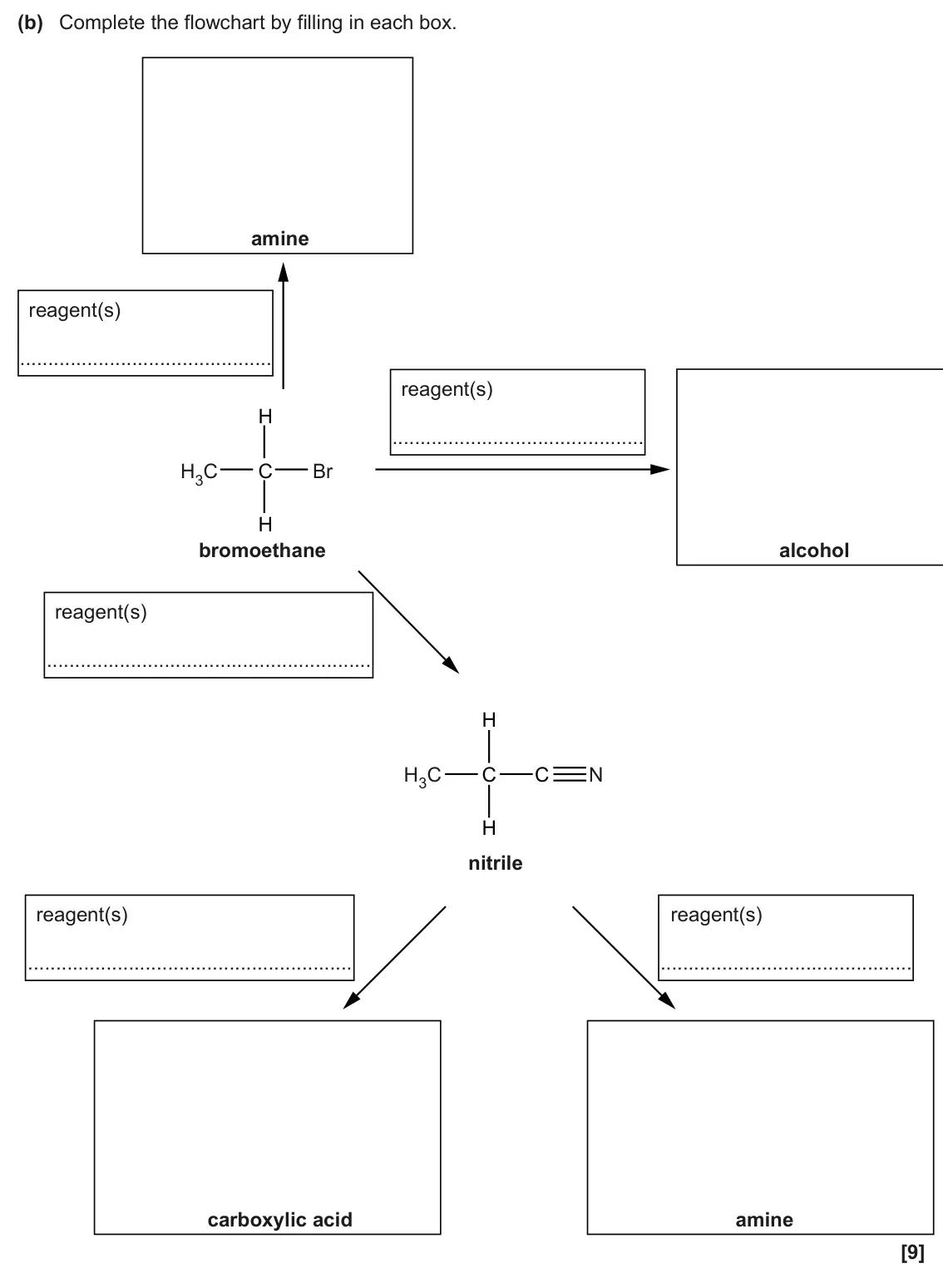

Q19(b)
The whole paper ↗
Q18(a)(i)
The whole paper ↗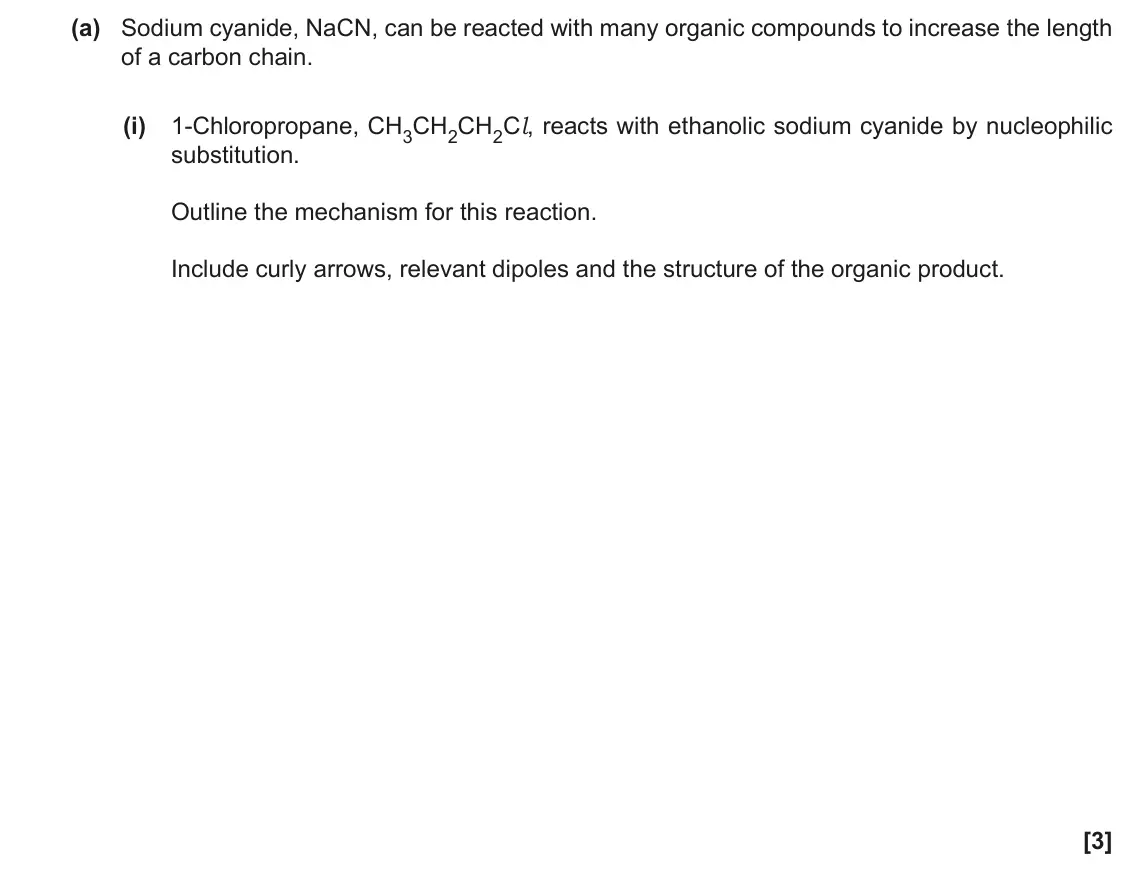
Q18(a)(ii)
The whole paper ↗
All 8 questions on Carbon–carbon bond formation, as a list
- June 2025, Paper 2, Q19(a)(i) (3 marks): Outline the mechanism for the reaction of 2-bromopropane with cyanide ions. Show curly arrows, relevant dipoles and products. Br [3]
- June 2025, Paper 2, Q19(a)(ii) (1 mark): Name this type of mechanism. [1]
- June 2024, Paper 2, Q18(b) (9 marks): Complete the flowchart by filling in each box. amine reagent(s) reagent(s) H H3C C Br H bromoethane alcohol reagent(s) H H3C C C N H nitrile reagent(s) reagent(
- June 2022, Paper 2, Q21 (6 marks): 21* Carbon-carbon bond formation is used in synthesis to increase the length of a carbon chain. Describe the formation of carbon–carbon bonds in aliphatic compo
- November 2021, Paper 2, Q19(b) (6 marks): This question is about organic synthesis. (b)* A student intends to synthesise compound A using the two-stage route below. O Stage 1 Stage 2 CH2 Cl Intermediate
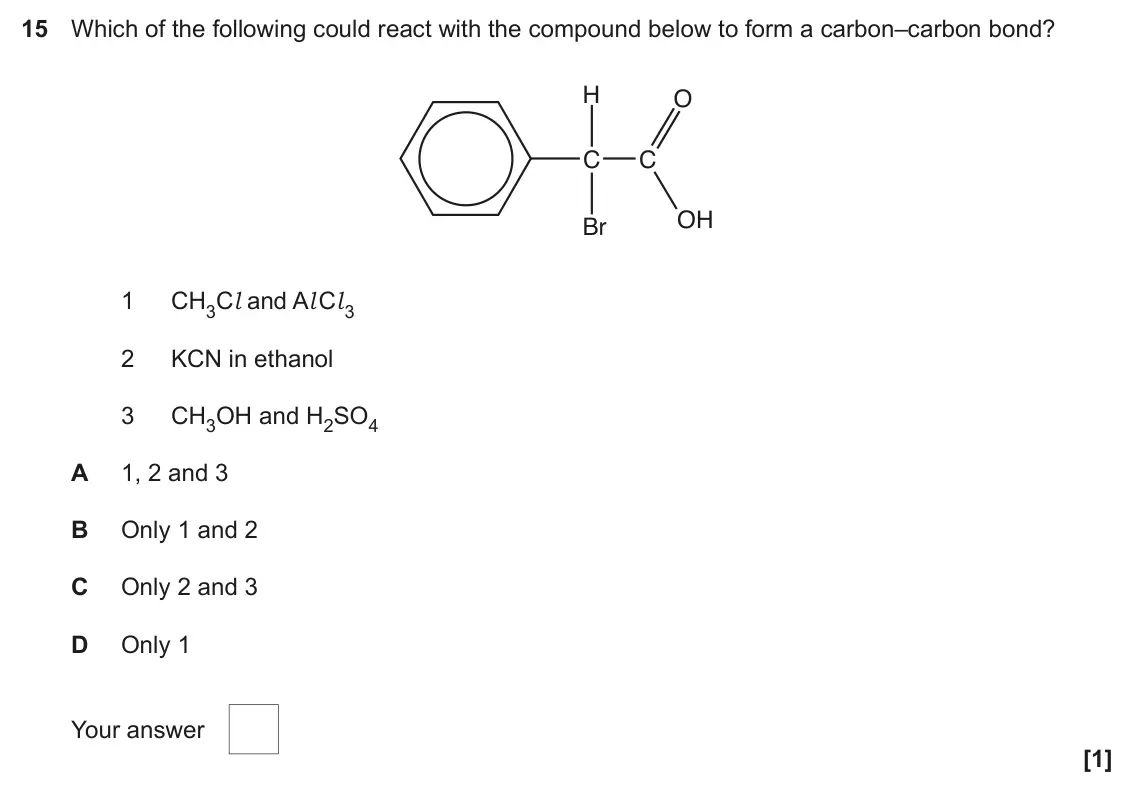
- June 2018, Paper 2, Q15 (1 mark): Which of the following could react with the compound below to form a carbon–carbon bond? H O C C OH Br 1 CH3Cl and Al Cl3 2 KCN in ethanol 3 CH3OH and H2SO4 A 1
- June 2017, Paper 2, Q18(a)(i) (3 marks): 1-Chloropropane, CH3CH2CH2Cl, reacts with ethanolic sodium cyanide by nucleophilic substitution. Outline the mechanism for this reaction. Include curly arrows,
- June 2017, Paper 2, Q18(a)(ii) (3 marks): Compound G is used to synthesise compounds H and I as shown in the flowchart below. Complete the flowchart showing the structure of compound G and the formulae
Questions, mark schemes and examiner’s reports are © OCR, from their published past papers. Plumi isn’t affiliated with any exam board. Want whole papers? Every OCR A-Level Chemistry A paper, or our free OCR-style practice pack.
Rather write your answers by hand on iPad? Plumi marks them against the same mark schemes.