 plumi
Acids: OCR A‑Level Chemistry A questions
Every OCR A-Level Chemistry A exam question on 2.1.4 Acids, 2016–2025, with its mark scheme and examiner’s report.
Find questions1,820
Calculations


Q1(a)
The whole paper ↗
Q1(b)
The whole paper ↗
Q3(a)(i)
The whole paper ↗
Q3(a)(ii)
The whole paper ↗
Q3(a)(iii)
The whole paper ↗
Q3(b)
The whole paper ↗
Q23(b)(i)
The whole paper ↗
Q1(d)
The whole paper ↗
Q22(a)
The whole paper ↗
Q22(b)(i)
The whole paper ↗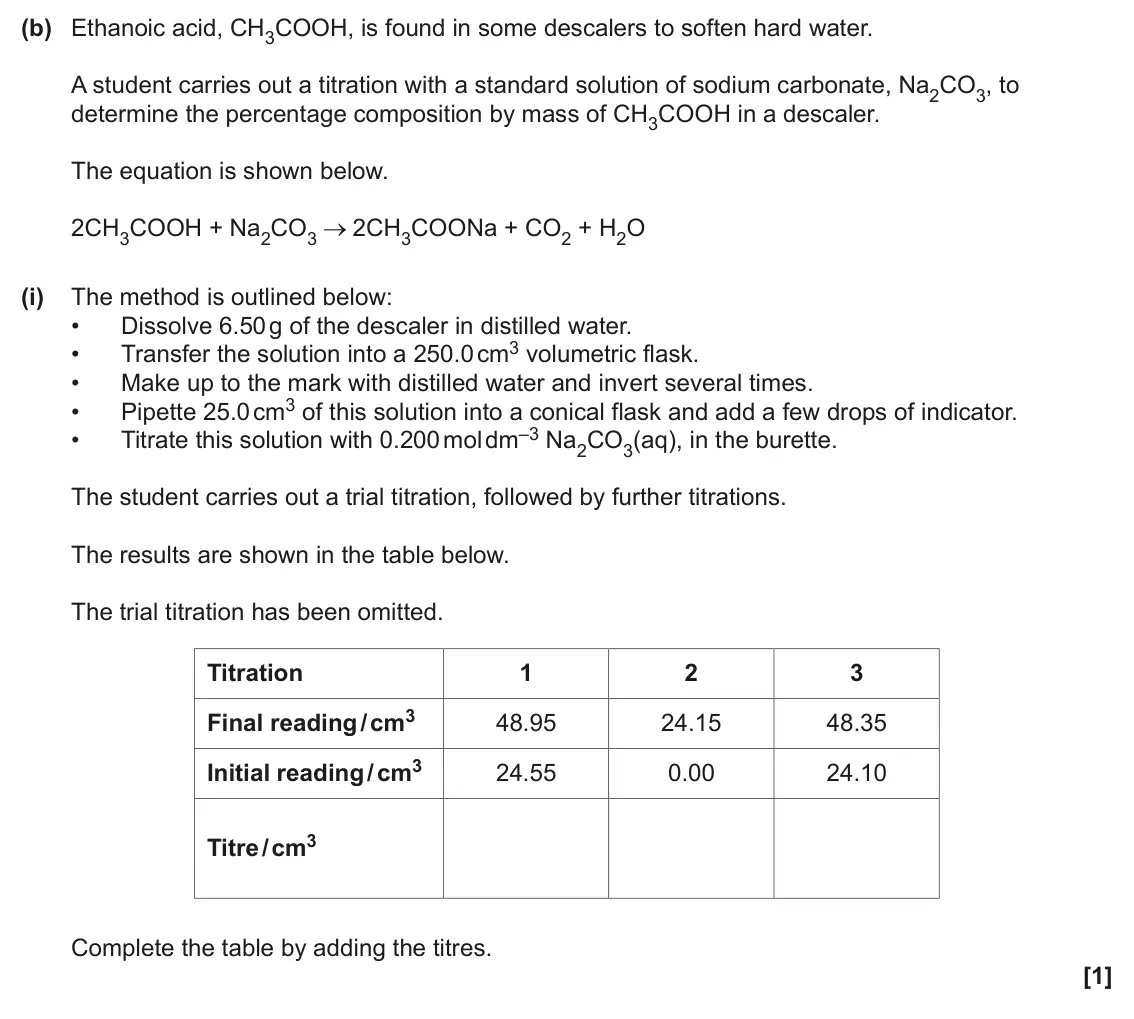
Q22(b)(ii)
The whole paper ↗
Q22(b)(iii)
The whole paper ↗
Q20(c)(i)
The whole paper ↗
Q20(d)(ii)
The whole paper ↗
Q5(a)
The whole paper ↗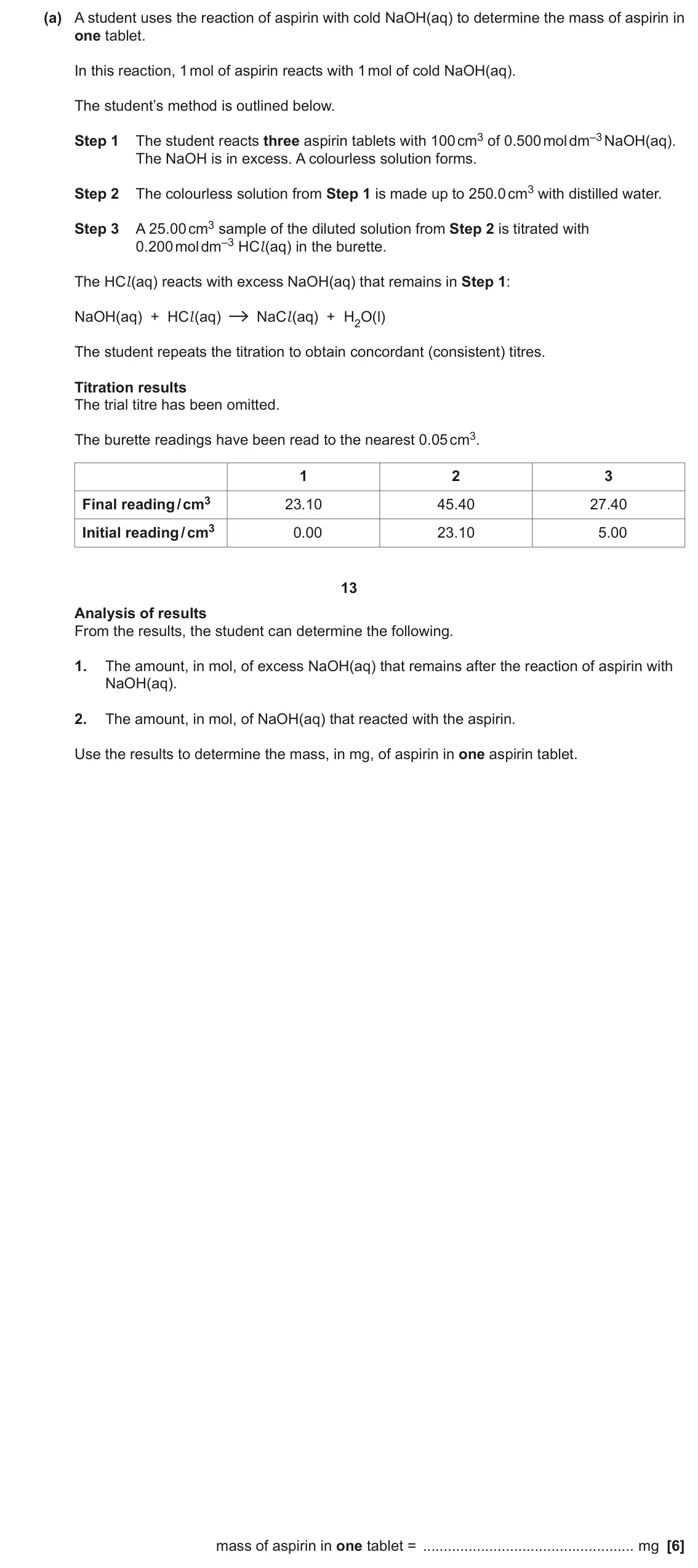
Q6(b)(i)
The whole paper ↗
Q22(a)
The whole paper ↗
All 79 questions on Acids, as a list
- June 2025, Paper 1, Q4 (1 mark): What volume, in cm3, of 0.250 mol dm–3 barium hydroxide solution is required to exactly 4 neutralise 25.0 cm3 of 0.115 mol dm–3 hydrochloric acid? Ba(OH)2(aq) +
- June 2025, Paper 1, Q8 (1 mark): The burette readings from an experiment are shown: Final reading / cm3 29.35 Initial reading / cm3 2.60 The burette has an uncertainty of ±0.05 cm3. What is the
- June 2025, AS Paper 1, Q1 (1 mark): The burette readings from a titration are shown below. Initial reading / cm3 4.95 Final reading / cm3 23.10 The burette used has an uncertainty of 0.05 cm3 for
- June 2025, AS Paper 2, Q1(a) (1 mark): Explain what is meant by an alkali. [1]
- June 2025, AS Paper 2, Q1(b) (1 mark): Write the ionic equation for the neutralisation reaction between an acid and an alkali. [1]
- June 2025, AS Paper 2, Q3(a)(i) (1 mark): Complete the table below. Titration 1 2 3 Final reading / cm3 23.60 46.70 25.65 Initial reading / cm3 0.30 23.65 2.50 Titre / cm3 [1]
- June 2025, AS Paper 2, Q3(a)(ii) (1 mark): Calculate the mean titre of NaOH that the student should use to analyse the results. Mean titre = cm3 [1]
- June 2025, AS Paper 2, Q3(a)(iii) (5 marks): Calculate the mass, in mg, of malic acid in one tablet. Assume that malic acid (molar mass 134.0 g mol–1) is the only acid in the tablets. Give your answer to 3
- June 2025, AS Paper 2, Q3(b) (2 marks): Another student carries out the same experiment. Instead of rinsing the burette used in Step 4 with 0.0800 mol dm–3 NaOH, the student rinses with water before f
- June 2024, Paper 2, Q23(b)(i) (3 marks): In Step 2, Na2CO3(aq) removes the sulfuric acid catalyst and any unreacted compound G from the mixture. Write equations for this removal. Removal of sulfuric ac
- June 2024, Paper 3, Q1(d) (5 marks): A student is provided with hydrated copper(II) nitrate, Cu(NO3)2•3H2O. The student needs to prepare a standard solution of Cu(NO3)2•3H2O with a concentration of
- June 2024, AS Paper 1, Q22(a) (1 mark): What is the difference between a strong acid and a weak acid? [1]
- June 2024, AS Paper 1, Q22(b)(i) (1 mark): The method is outlined below: • Dissolve 6.50 g of the descaler in distilled water. Transfer the solution into a 250.0 cm3 volumetric flask. • • Make up to the
- June 2024, AS Paper 1, Q22(b)(ii) (1 mark): Calculate the mean titre, to the nearest 0.05 cm3, that the student should use for analysing these results. mean titre = cm3 [1]
- June 2024, AS Paper 1, Q22(b)(iii) (5 marks): Calculate the percentage composition by mass of CH3COOH in the descaler. Assume that CH3COOH is the only acid in the descaler. Give your answer to 3 significant
- June 2023, Paper 1, Q20(c)(i) (1 mark): Construct the equation for this reaction. [1]
- June 2023, Paper 1, Q20(d)(ii) (3 marks): Explain why these two reactions of magnesium produce the same volume of gas but at different rates. [3]
- June 2023, Paper 3, Q5(a) (6 marks): A student uses the reaction of aspirin with cold NaOH(aq) to determine the mass of aspirin in one tablet. In this reaction, 1 mol of aspirin reacts with 1 mol o
- June 2023, Paper 3, Q6(b)(i) (2 marks): Write an equation for this reaction. [2]
- June 2023, AS Paper 1, Q22(a) (1 mark): Hydrochloric acid and nitric acid are classified as strong acids. What is meant by a strong acid? [1]
- June 2023, AS Paper 1, Q22(b)(i) (1 mark): The reaction of copper(II) oxide with dilute hydrochloric acid. [1]
- June 2023, AS Paper 1, Q22(b)(ii) (2 marks): The reaction of ammonium carbonate with dilute nitric acid. [2]
- June 2023, AS Paper 1, Q22(c)(i) (1 mark): Name the type of flask that the student should use to make up the 250.0 cm3 solution of MOH(aq). flask [1]
- June 2023, AS Paper 1, Q22(c)(ii) (1 mark): The student takes burette readings to the nearest 0.05 cm3. The student’s readings are shown in the table. The rough titre has been omitted. Complete the table
- June 2023, AS Paper 1, Q22(c)(iii) (1 mark): Calculate the mean titre of H2SO4, to the nearest 0.05 cm3, that the student should use to analyse the results. mean titre = cm3 [1]
- June 2023, AS Paper 1, Q22(c)(iv) (4 marks): Calculate the amount, in mol, of MOH in 25.0 cm3 of solution and determine the identity of the Group 1 metal M. metal M = [4]
- June 2022, Paper 1, Q19(a)(i) (2 marks): Complete the table and calculate the mean titre that the student should use for analysing the results. mean titre = cm3 [2]
- June 2022, Paper 1, Q19(a)(ii) (5 marks): Use the student’s results and Equation 19.1 to calculate the mass, in mg, of succinic acid in one tablet of the health supplement. Give you answer to 3 signific
- June 2022, Paper 1, Q21(c)(ii) (2 marks): Huntite is a carbonate mineral with the chemical formula Mg3Ca(CO3)4. Huntite reacts with dilute hydrochloric acid to produce bubbles of a gas and a colourless
- June 2022, AS Paper 1, Q3 (1 mark): Which compound is an alkali? A CH3COOH B CH3OH C HNO3 D NH3 Your answer [1]
- June 2022, AS Paper 2, Q1(a)(i) (1 mark): What is meant by an acid? [1]
- June 2022, AS Paper 2, Q1(a)(ii) (1 mark): What is meant by an acid that is weak? [1]
- June 2022, AS Paper 2, Q1(b)(i) (4 marks): Record the student’s burette readings in the table below. Calculate the mean titre, to the nearest 0.05 cm3, that the student should use to analyse the results.
- June 2022, AS Paper 2, Q1(b)(ii) (5 marks): Citric acid, C6H8O7, is neutralised by NaOH as shown in the equation below. C6H8O7 + 3NaOH Na3C6H5O7 + 3H2O Calculate the mass, in g, of citric acid in one lime
- June 2022, AS Paper 2, Q1(c) (2 marks): The student’s teacher thinks that there is an unnecessary safety risk in using a sodium hydroxide concentration of 0.800 mol dm–3 for the titration. Suggest how
- November 2021, Paper 1, Q18(a) (2 marks): In Step 1, the student observed that bubbles of gas were produced. Suggest the formula of the copper(II) compound which reacted with HNO3 to form the gas, and w
- November 2021, Paper 3, Q3(a) (5 marks): A student first prepares 250.0 cm3 of a standard solution of 0.150 mol dm–3 Ba(OH)2 for the titration. The student is provided with solid Ba(OH)2 and usual labo
- November 2021, Paper 3, Q3(b) (7 marks): The student prepares a 100.0 cm3 solution containing 3.215 g of acid D. The student titrates 25.0 cm3 samples of the solution of D with 0.150 mol dm–3 Ba(OH)2(a
- November 2021, AS Paper 1, Q3 (1 mark): Which compound releases hydroxide ions when it dissolves in water? A CH3COOH B HNO3 C H2SO4 D NH3 Your answer [1]
- November 2021, AS Paper 1, Q7 (1 mark): After delivering a solution from a pipette, a droplet remains in the tip of the pipette. How should a student ensure that the pipette delivers the volume of sol
- November 2021, AS Paper 2, Q3(a) (1 mark): State the colour change observed at the end point of the titration. Colour from to [1]
- November 2021, AS Paper 2, Q3(b)(i) (1 mark): Complete the table to show the titre in each titration. [1]
- November 2021, AS Paper 2, Q3(b)(ii) (1 mark): Why does the student carry out a trial titration? [1]
- November 2021, AS Paper 2, Q3(b)(iii) (1 mark): Calculate the mean titre of NaOH(aq) that the student should use for analysing the results. mean titre = cm3 [1]
- November 2021, AS Paper 2, Q3(b)(iv) (1 mark): In the titration, the uncertainty in each burette reading is ± 0.05 cm3. Calculate the percentage uncertainty in the titre for Titration 1. percentage uncertain
- November 2021, AS Paper 2, Q3(c) (5 marks): Calculate the value of n in HOOC(CH2)nCOOH. Give your answer to the nearest whole number. n = [5]
- November 2021, AS Paper 2, Q3(d) (2 marks): A 25.0 cm3 pipette was used to measure out the 25.0 cm3 of glutaric acid solution for each titration. Before use, one student washed the pipette out with water
- November 2020, Paper 1, Q1 (1 mark): Several students titrate 25.00 cm3 of the same solution of sodium hydroxide, NaOH(aq) with 1 hydrochloric acid, HCl (aq). One student obtains a smaller titre th
- November 2020, Paper 1, Q4 (1 mark): Phosphoric acid is a tribasic acid. What is the mass of Ca(OH)2 that completely neutralises 100 cm3 of 0.100 mol dm−3 phosphoric acid? A 0.49 g B 0.74 g C 1.11
- November 2020, Paper 3, Q4(a)(iii) (1 mark): In Stage 3, write the ionic equation for the reaction taking place in the titration. [1]
- November 2020, Paper 3, Q4(a)(iv) (6 marks): Metal M can be identified following the steps below. 1. The amount, in mol, of excess HCl (aq) that remains after the reaction of M with HCl (aq). 2. The amount
- November 2020, AS Paper 1, Q23(b)(i) (1 mark): What is meant by concordant titres? [1]
- November 2020, AS Paper 1, Q23(b)(ii) (3 marks): Calculate the concentration, in mol dm−3, of the Ba(OH)2(aq) solution. concentration of Ba(OH)2(aq) = mol dm−3 [3]
- June 2019, Paper 2, Q17(a)(ii) (4 marks): A student is provided with one of the four amino acids in Table 17.1. A student carries out a titration with a standard solution of hydrochloric acid to identif
- June 2019, AS Paper 1, Q22(a)(i) (1 mark): Complete the table by adding the titres to the table. Final reading / cm3 24.60 48.45 34.30 Initial reading / cm3 0.40 24.60 10.00 Titre / cm3 [1]
- June 2019, AS Paper 1, Q22(a)(ii) (1 mark): Calculate the mean titre of HCl , to the nearest 0.05 cm3, that the student should use for analysing the results. mean titre = cm3 [1]
- June 2019, AS Paper 1, Q22(b) (3 marks): Calculate the concentration, in mol dm−3, of the hydrochloric acid. Give your answer to 3 significant figures. concentration of HCl = mol dm−3 [3]
- June 2019, AS Paper 1, Q22(c) (2 marks): In the titrations, the student measured volumes with a pipette and a burette. • The pipette had an uncertainty of ± 0.04 cm3 in the volume measured. • The buret
- June 2019, AS Paper 2, Q2(a) (6 marks): Magnesium nitrate is used in fertilisers as a source of nitrogen. (a)* A student plans to prepare 250.0 cm3 of a 0.4000 mol dm–3 solution of magnesium nitrate,
- June 2018, Paper 1, Q4 (1 mark): A student titrates a standard solution of barium hydroxide, Ba(OH)2, with nitric acid, HNO3. 25.00 cm3 of 0.0450 mol dm–3 Ba(OH)2 are needed to neutralise 23.35
- June 2018, AS Paper 1, Q5 (1 mark): Which equation does not represent a neutralisation reaction? A Zn + 2HCl → ZnCl 2 + H2 B 2NH3 + H2SO4 → (NH4)2SO4 C Na2CO3 + 2CH3COOH → 2CH3COONa + CO2 + H2O D
- June 2018, AS Paper 1, Q22(a)(iii) (2 marks): How could the student obtain a sample of magnesium phosphate after reacting magnesium with phosphoric acid? [2]
- June 2018, AS Paper 1, Q22(a)(iv) (2 marks): Magnesium phosphate can also be prepared by reacting phosphoric acid with a compound of magnesium. Choose a suitable magnesium compound for this preparation and
- June 2018, AS Paper 2, Q1(a) (1 mark): What is meant by the term standard solution? [1]
- June 2018, AS Paper 2, Q1(b) (1 mark): Sodium hydroxide is an alkali. What is meant by the term alkali? [1]
- June 2018, AS Paper 2, Q1(c)(i) (4 marks): Record the student’s readings and the titres in the table below. Calculate the mean titre, to the nearest 0.05 cm3, that the student should use for analysing th
- June 2018, AS Paper 2, Q1(c)(ii) (1 mark): The uncertainty in each burette reading is ± 0.05 cm3. Calculate the percentage uncertainty for the titre in Titration 1. percentage uncertainty = % [1]
- June 2018, AS Paper 2, Q1(c)(iii) (1 mark): The student realised that the solution of A had not been prepared correctly. How should the student have made up the solution? [1]
- June 2018, AS Paper 2, Q1(d)(i) (4 marks): Calculate the molar mass of A from these results. Give your answer to the nearest whole number. Show your working. molar mass of A = g mol–1 [4]
- June 2017, Paper 1, Q17(a) (1 mark): Barium chloride can be prepared from barium hydroxide in a neutralisation reaction. Write the equation for this reaction. State symbols are not required. [1]
- June 2017, Paper 3, Q4(a)(i) (4 marks): Record the student’s readings and the titres in an appropriate format. Calculate the mean titre that the student should use for analysing the results. mean titr
- June 2017, Paper 3, Q4(a)(ii) (6 marks): The structure of compound A is shown below. O HO OH R compound A Compound A has four optical isomers. Using this information and the student’s results, answer t
- June 2017, AS Paper 1, Q5 (1 mark): The burette readings from a titration are shown below. Final reading / cm3 24.95 Initial reading / cm3 5.00 The burette used has an uncertainty of ±0.05 cm3 in
- June 2017, AS Paper 1, Q24(a) (1 mark): Ethanoic acid is a weak acid. What is meant by acid and weak acid? [1]
- June 2017, AS Paper 1, Q24(c)(i) (4 marks): Calculate the concentration, in mol dm–3, of CH3COOH in the original bottle of vinegar. Show your working. concentration of CH3COOH = mol dm–3 [4]
- June 2017, AS Paper 1, Q24(c)(ii) (2 marks): Suggest one assumption that the student has made that might mean that their calculated concentration of ethanoic acid in the vinegar is invalid. Predict, with a
- June 2016, AS Paper 1, Q4 (1 mark): Which equation is not a neutralisation reaction? Ca(s) + 2HCl(aq) → CaCl2(aq) + H2(g) A H+(aq) + OH–(aq) → H2O(l) B K2CO3(s) + 2HNO3(aq) → 2KNO3(aq) + H2O(l) +
- June 2016, AS Paper 1, Q21(c)(i) (1 mark): Write the equation for this reaction. [1]
- June 2016, AS Paper 1, Q22(c) (3 marks): A student prepares a solution of sodium sulfate, Na2SO4, by adding 6.25 × 10⁻² mol dm–3 sulfuric acid, H2SO4, from a burette to 25.0 cm3 of 0.124 mol dm–3 NaOH
Questions, mark schemes and examiner’s reports are © OCR, from their published past papers. Plumi isn’t affiliated with any exam board. Want whole papers? Every OCR A-Level Chemistry A paper, or our free OCR-style practice pack.
Rather write your answers by hand on iPad? Plumi marks them against the same mark schemes.