 plumi
Transport systems in plants: OCR A‑Level Biology B questions
Every OCR A-Level Biology B exam question on 2.2.4 Transport systems in plants, 2016–2025, with its mark scheme and examiner’s report.
Find questions1,889
Calculations
Q33(a)(i)
The whole paper ↗
Q33(a)(ii)
The whole paper ↗
Q33(a)(iii)
The whole paper ↗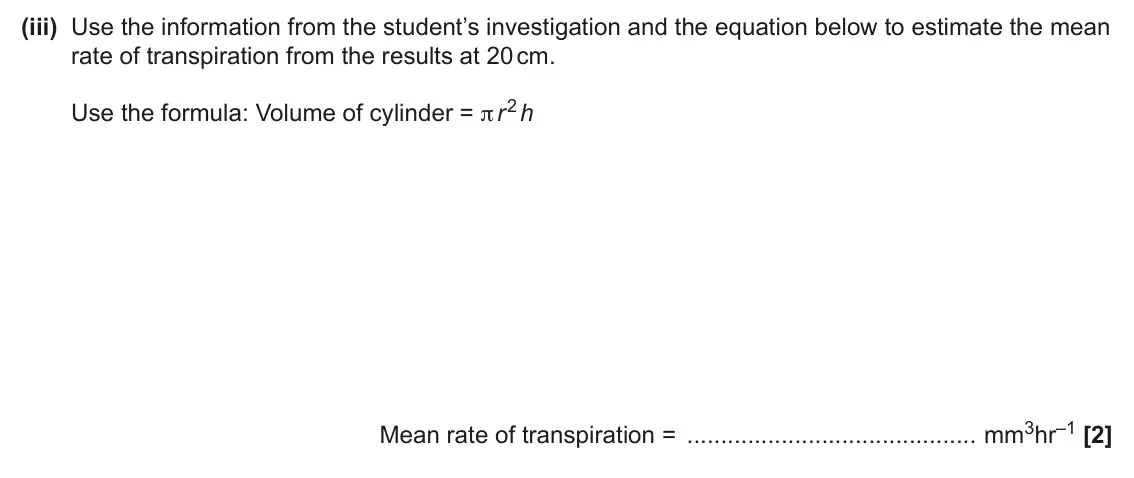
Q33(b)(i)
The whole paper ↗
Q1(d)(i)
The whole paper ↗
Q1(d)(ii)
The whole paper ↗
Q1(d)(iii)
The whole paper ↗
Q1(a)(i)
The whole paper ↗
Q1(a)(iii)
The whole paper ↗
Q1(b)(i)
The whole paper ↗
Q1(b)(ii)
The whole paper ↗
Q1(b)(iii)
The whole paper ↗

Q4(b)
The whole paper ↗
Q4(c)(i)
The whole paper ↗
Q4(c)(ii)
The whole paper ↗

Q1(a)(i)
The whole paper ↗
Q1(a)(ii)
The whole paper ↗
All 83 questions on Transport systems in plants, as a list
- June 2025, Paper 1, Q33(a)(i) (2 marks): A student wants to use the apparatus to investigate the effect of wind speed on the rate of transpiration. Explain two modifications to the apparatus that will
- June 2025, Paper 1, Q33(a)(ii) (4 marks): This is the raw data recorded by the student. Results after 30 minutes 20 cm 1) 15mm 2) 16 mm 3) 14 mm Mean = 15.0 40 cm 1) 13mm 2) 14 mm 3) 12 mm Mean = 13.0 6
- June 2025, Paper 1, Q33(a)(iii) (2 marks): Use the information from the student’s investigation and the equation below to estimate the mean rate of transpiration from the results at 20 cm. Use the formul
- June 2025, Paper 1, Q33(b)(i) (2 marks): Use the photomicrograph to identify whether the soybean plant is classified as dicotyledonous or monocotyledonous. Explain your choice. [2]
- June 2025, Paper 2, Q1(d)(i) (2 marks): In an initial experiment, the student obtains these results for one species of plant: Position of bubble at start = 2 mm Position of bubble after 10 minutes = 1
- June 2025, Paper 2, Q1(d)(ii) (1 mark): The student then calculates the rate of transpiration in two other species of plant, D and E. The student takes readings every 5 minutes using the potometer. Th
- June 2025, Paper 2, Q1(d)(iii) (2 marks): The student calculates the rate of movement of the air bubble in species D as 9.33 mm min–1. The internal diameter of the potometer tube is 1.5 mm. Calculate th
- June 2025, Paper 3, Q1(a)(i) (2 marks): The cells labelled A and B are two different types of cell in the vascular tissue of the root. Identify the types of cell labelled A and B. A B [2]
- June 2025, Paper 3, Q1(a)(iii) (1 mark): One risk when dissecting plant tissues, such as roots, is the potential for injury when using sharp instruments. State one other health and safety risk that sho
- June 2025, Paper 3, Q1(b)(i) (2 marks): State how the group of control plants would be set up differently to the group of plants given salt solution and explain the purpose of this control group. [2]
- June 2025, Paper 3, Q1(b)(ii) (2 marks): Calculate the largest percentage difference in water uptake between the plants in the control group and the plants given salt solution. Use your answer to compl
- June 2025, Paper 3, Q1(b)(iii) (2 marks): Suggest what conclusions can be made from the results shown in the graph. [2]
- June 2025, AS Paper 1, Q2 (1 mark): Which option about why multicellular plants need transport systems is not correct? A Assimilates must be transported from source to sink B Diffusion distances a
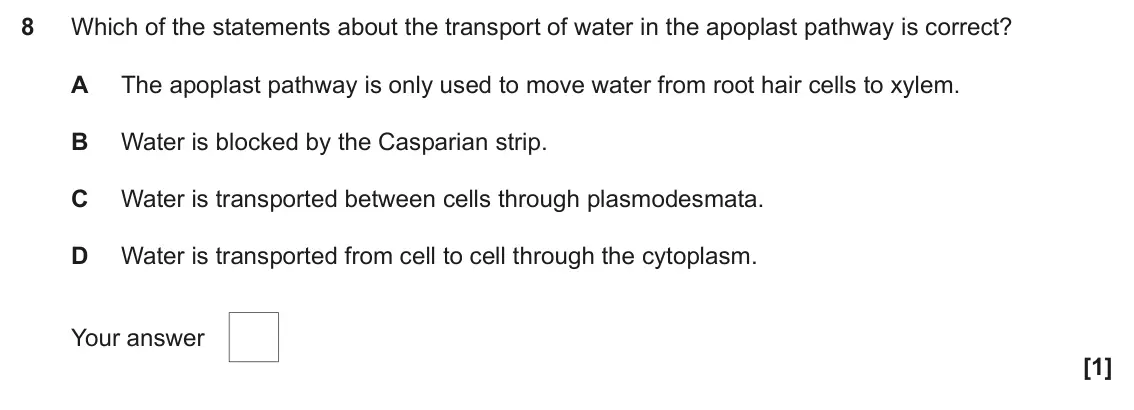
- June 2024, Paper 1, Q8 (1 mark): Which of the statements about the transport of water in the apoplast pathway is correct? A The apoplast pathway is only used to move water from root hair cells
- June 2024, Paper 3, Q4(b) (1 mark): Aphids are used in experiments to measure the rate of translocation in phloem tissue. Suggest appropriate units for the rate of translocation in phloem tissue.
- June 2024, Paper 3, Q4(c)(i) (3 marks): Discuss whether the production and deposition of callose would have a significant impact on the mass of starch this plant is able to store in its sinks. [3]
- June 2024, Paper 3, Q4(c)(ii) (2 marks): A scientist plans to compare the concentration of callose in the phloem tissue of two groups of plants of the same species: • plants that have not had aphids fe
- June 2024, AS Paper 1, Q12 (1 mark): Which row shows correct information about phloem loading during translocation. Ion used as ATP required to Molecule being co-transporter transport ions out co-t
- June 2024, AS Paper 2, Q1(a)(i) (2 marks): State the functions of tissues D and E. D E [2]
- June 2024, AS Paper 2, Q1(a)(ii) (3 marks): Using this image, produce a low power plan drawing of the stem tissues. [3]
- June 2024, AS Paper 2, Q1(b) (6 marks): The image below shows a transverse section of stem from a celery plant seen through a light microscope. Y D X E ×120 magnification (b)* A teacher wanted their s
- June 2023, Paper 1, Q8 (1 mark): Which of the statements about transport systems in plants is correct? A Carbon dioxide needs to be transported from leaves to other organs for photosynthesis. B
- June 2022, Paper 1, Q1 (1 mark): Stomatal conductance is a measure of the rate of diffusion of water vapour through the stomata of a leaf. Which of the environmental factors would cause an incr
- June 2022, Paper 1, Q2 (1 mark): The photomicrograph shows a section through the stem of a sunflower, Helianthus annuus. Which of the options correctly identifies what is shown in the photomicr
- June 2022, Paper 2, Q6(a)(i) (2 marks): Identify the tissues labelled E and F on Fig. 6.1. E F [2]
- June 2022, Paper 2, Q6(a)(ii) (3 marks): Suggest the function of the region marked G on Fig. 6.1. [3]
- June 2022, AS Paper 1, Q13 (1 mark): Acidified phloroglucinol is a differential stain that shows the presence of lignin in plant tissues by staining structures containing lignin red. Which of the p
- June 2022, AS Paper 1, Q14 (1 mark): A group of students used the potometer below to estimate the rate of transpiration during an investigation. Leafy Water shoot reservoir Screw clip Scale in mm P
- June 2022, AS Paper 1, Q15 (1 mark): A student completed the plan drawing, shown below, of a section of plant organ they observed using a light microscope. Cortex Xylem Phloem Which plant organ is
- June 2022, AS Paper 1, Q21(a) (2 marks): Explain why most of the sucrose extracted from sugarcane plants is found in their stems. [2]
- November 2021, Paper 1, Q28 (1 mark): A group of students were investigating the rate of translocation in plants using aphids. The diagram shows the apparatus used in their investigation. glass cham
- November 2021, Paper 3, Q3(a) (6 marks): During transpiration water vapour is lost from the leaves of a plant through stomata. A group of students set up the potometer shown in Fig. 3.1 to estimate the
- November 2021, Paper 3, Q3(c)(i) (2 marks): Using Fig. 3.3, describe and explain the effect of decreasing leaf water potential on the transpiration rate for the plants in this investigation. [2]
- November 2021, Paper 3, Q3(c)(ii) (2 marks): Use the curve in Fig. 3.3 to calculate the rate of change in transpiration at -0.7 MPa. Rate of change = g m 2 h 1 MPa 1 [2]
- November 2021, AS Paper 1, Q10 (1 mark): The diagram shows possible pathways in which water can travel between the cells of a plant. Item removed due to third party copyright restrictions. Taken from O
- November 2021, AS Paper 1, Q24(c)(i) (1 mark): Identify the feature of xylem tissue, labelled X in Fig. 24.2. [1]
- November 2021, AS Paper 1, Q24(c)(ii) (2 marks): Explain the importance of X in the movement of water through xylem tissue. [2]
- November 2020, Paper 1, Q30 (1 mark): At high altitude, the lower atmospheric pressure decreases the water content of air. Which of the options, A to D, describes the likely consequence of high alti
- November 2020, Paper 1, Q35(a) (1 mark): Explain why plants require transport systems. [1]
- November 2020, Paper 1, Q35(b)(i) (1 mark): Name the sugar most commonly translocated. [1]
- November 2020, Paper 1, Q35(b)(ii) (2 marks): After an aphid removes its mouthpart, sap continues to flow to the surface of the stem. Explain why. [2]
- November 2020, Paper 1, Q35(b)(iii) (1 mark): Some plant tissues are described as sources and sinks. Explain why the stem tissue in the diagram could be described as neither a source nor a sink. [1]
- November 2020, Paper 1, Q35(b)(iv) (6 marks): Translocation is the movement of organic substances made by a plant from one region to another along phloem tissue. (iv)* Investigators could use the example of
- November 2020, AS Paper 1, Q9 (1 mark): The diagram shows one mechanism of transporting molecules through a plant. source (leaf cell) molecule sink (root cell) Which of the statements, A to D, describ
- November 2020, AS Paper 1, Q21(a) (2 marks): The apparatus in Fig. 21.1 is designed to estimate rate of transpiration in the plant cutting by recording changes in mass over several days. Explain why this m
- November 2020, AS Paper 1, Q21(b)(i) (2 marks): The students maintained constant environmental factors such as temperature and light intensity throughout the investigation. Name one other factor regarding pla
- November 2020, AS Paper 1, Q21(b)(ii) (4 marks): Evaluate the method of estimating transpiration rate shown in Fig. 21.1 compared to using a standard potometer. [4]
- November 2020, AS Paper 1, Q21(c)(i) (1 mark): Suggest one reason why the students’ data showed much higher rates of transpiration than those shown by the secondary data. [1]
- November 2020, AS Paper 1, Q21(c)(ii) (2 marks): Calculate the percentage change in the mean rate of transpiration estimated by the students as wind speed is increased from 2.0 to 4.0 ms–1. Give your answer to
- June 2019, Paper 1, Q9 (1 mark): Which of the statements, A to D, is a correct description of why plants need transport systems? A Plants are multicellular. B Plants have a large surface area:v
- June 2019, Paper 1, Q32(a)(i) (2 marks): Most ABA is produced in root hair cells and is carried in xylem tissue to the leaves. ABA is transported to the xylem tissue via the apoplast pathway. Describe
- June 2019, Paper 1, Q32(a)(ii) (1 mark): Some ABA is produced in leaves and is transported to the rest of the plant in phloem tissue. The photomicrograph in Fig. 32.1, on the insert, is a transverse se
- June 2019, Paper 1, Q32(a)(iii) (3 marks): Describe and explain three ways in which phloem tissue is adapted for the transport of sugars and other small molecules. 1 2 3 [3]
- June 2019, AS Paper 1, Q20 (1 mark): The photomicrograph below shows a transverse section of a plant organ. vascular bundles Which of the plant organs, A to D, is shown in the photomicrograph? A st
- June 2019, AS Paper 2, Q1(b)(i) (1 mark): Through which of the tissues, labelled W to Z in Fig. 1.2, is sucrose transported? [1]
- June 2019, AS Paper 2, Q1(b)(ii) (2 marks): The plant tissues in Fig. 1.2 have been stained. State the type of stain and explain why it was used to prepare the slide. [2]
- June 2018, Paper 1, Q25 (1 mark): Wind speed influences the rate of transpiration in a plant. Which of the options, A to D, would increase in windy conditions? A kinetic energy of water molecule
- June 2018, Paper 2, Q2(a) (1 mark): Complete Table 2.1 by calculating the missing percentages for Coleus and Portulaca. Show your working. [1]
- June 2018, Paper 2, Q2(b)(i) (2 marks): Temperature was controlled in this experiment. State two other variables that should be controlled to ensure valid results in this experiment. 1 2 [2]
- June 2018, Paper 2, Q2(b)(ii) (3 marks): Freeman made the following conclusions: • There is a large difference between the rate of transpiration of a plant growing on its own roots (‘normal’ transpirat
- June 2018, Paper 2, Q2(c)(i) (3 marks): Freeman then designed an experiment to allow him to measure the rate of transpiration in an alfalfa plant growing in soil in a greenhouse. Fig. 2 shows the appa
- June 2018, Paper 2, Q2(c)(ii) (3 marks): The total area of leaves inside the cylinder was 22.28 cm2. Use this value and your graph to calculate the rate of transpiration. Give your answer in standard f
- June 2018, AS Paper 1, Q7 (1 mark): The rate of transpiration can be affected by changing certain environmental factors. Which of the options, A to D, are changes that would result in an increased
- June 2018, AS Paper 1, Q12 (1 mark): Phloem loading is the process whereby plants move sucrose from a source into phloem sieve tubes. During phloem loading, sucrose must be transported across the c
- June 2018, AS Paper 2, Q5(b)(i) (4 marks): The student made the following statement: My observations support the theory of translocation. Using the information in Table 5 and your knowledge of translocat
- June 2018, AS Paper 2, Q5(b)(ii) (3 marks): State three modifications to the procedure that would allow the observations in Table 5 to be reproducible. 1 2 3 [3]
- June 2018, AS Paper 2, Q5(c) (3 marks): Tomato plants are broad-leaved crop plants. Compare the structure of a tomato plant with that of a cereal crop plant, such as wheat with regards to their transp
- June 2017, Paper 1, Q10 (1 mark): In a plant, sucrose is loaded into a companion cell using a protein carrier that co-transports H+ ions. Which of the options, A to D, is a correct description o
- June 2017, Paper 1, Q33(a)(i) (1 mark): Give one piece of advice when setting up the potometer to ensure a continuous stream of water between the capillary tube and the shoot. [1]
- June 2017, Paper 1, Q33(a)(ii) (2 marks): Using information in Table 33, calculate the standard deviation for the data from row 4 (wind speed of 6 m s−1). _ i 2 / x x - s = n 1 - standard deviation = [2
- June 2017, Paper 1, Q33(a)(iii) (3 marks): Describe and explain the data trend in Table 33. [3]
- June 2017, Paper 1, Q33(a)(iv) (2 marks): State two environmental variables that should have been controlled during this investigation. 1 2 [2]
- June 2017, Paper 1, Q33(a)(v) (2 marks): Explain why the potometer only gives an estimate of the rate of transpiration. [2]
- June 2017, Paper 1, Q33(b) (3 marks): Plants take up water into the root hairs. The water is then transported into the vascular tissue via the root cortex. Describe how water travels through the roo
- June 2017, AS Paper 1, Q2 (1 mark): Transpiration in plants is affected by environmental factors. Which of the environmental factors, A to D, will affect transpiration by changing the kinetic ener
- June 2017, AS Paper 1, Q8 (1 mark): The photomicrograph below is a transverse section through a dicotyledonous stem showing two types of cell in phloem tissue. structure X The structure labelled X
- June 2017, AS Paper 2, Q6(c) (2 marks): Water must enter plants via the roots and move through the tissues to enter the xylem vessels. On Fig. 6, draw the apoplast pathway taken by water from point X
- June 2017, AS Paper 2, Q6(d) (4 marks): Complete the sentences below about the movement of water through xylem vessels. As water molecules move through xylem vessels they are attracted to each other b
- June 2016, AS Paper 1, Q13 (1 mark): Below are some statements about how water is transported from soil to the xylem of plants. The statements are not in the correct order. 1. Mineral ions are acti
- June 2016, AS Paper 1, Q22(a)(iii) (1 mark): Why do seed-bearing plants need a transport system? [1]
- June 2016, AS Paper 1, Q22(b) (3 marks): Flowering plants have developed organs, such as fruits, which act as ‘sinks’ in translocation. Explain the role of a ‘sink’ in the mechanism of translocation. [
- June 2016, AS Paper 2, Q1(c)(i) (1 mark): State the dependent variable in this investigation. [1]
- June 2016, AS Paper 2, Q1(c)(ii) (1 mark): Temperature is a variable that must be controlled in the investigation to obtain valid data. State one other variable and explain how it will be controlled. Var
Questions, mark schemes and examiner’s reports are © OCR, from their published past papers. Plumi isn’t affiliated with any exam board. Want whole papers? Every OCR A-Level Biology B paper.
Rather write your answers by hand on iPad? Plumi marks them against the same mark schemes.