 plumi
Gas exchange in mammals and plants: OCR A‑Level Biology B questions
Every OCR A-Level Biology B exam question on 2.2.3 Gas exchange in mammals and plants, 2016–2025, with its mark scheme and examiner’s report.
Find questions1,889
Calculations


Q21(b)
The whole paper ↗
Q33(a)(i)
The whole paper ↗
Q33(a)(ii)
The whole paper ↗
Q33(b)
The whole paper ↗

Q21(a)
The whole paper ↗
Q21(b)(i)
The whole paper ↗
Q21(b)(ii)
The whole paper ↗

Q7(a)(i)
The whole paper ↗
Q7(a)(ii)
The whole paper ↗
Q7(a)(iii)
The whole paper ↗
Q7(b)(i)
The whole paper ↗
Q7(b)(ii)
The whole paper ↗
Q33(b)(ii)
The whole paper ↗
Q4(a)(i)
The whole paper ↗
All 59 questions on Gas exchange in mammals and plants, as a list
- June 2025, Paper 1, Q7 (1 mark): Alveoli are structures found in the mammalian gaseous exchange system. Which cells would be present in the walls of alveoli? A Ciliated epithelial cells B Goble
- June 2025, Paper 1, Q8 (1 mark): The surface area provided by a single alveolus is approximately 300 000 μm2. 8 A person was estimated to have 250 million alveoli in each lung. What is the esti
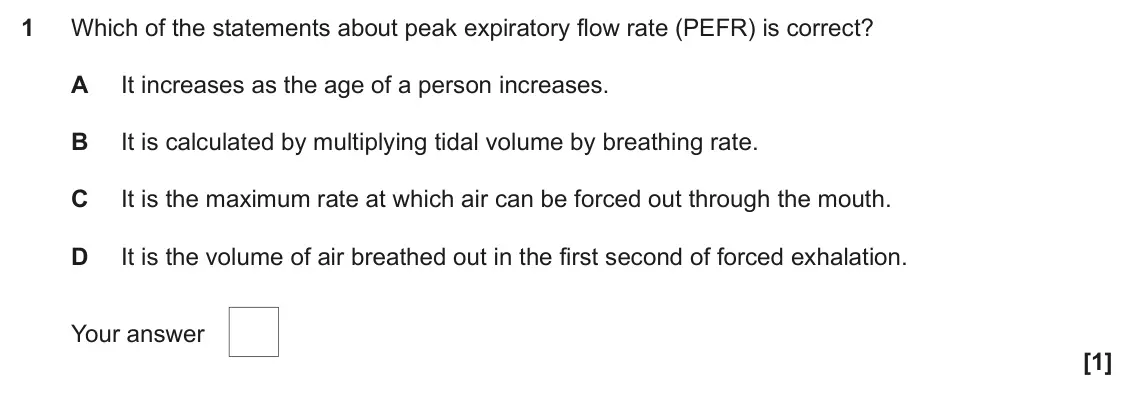
- June 2025, AS Paper 1, Q1 (1 mark): Which of the statements about peak expiratory flow rate (PEFR) is correct? A It increases as the age of a person increases. B It is calculated by multiplying ti
- June 2025, AS Paper 1, Q21(b) (1 mark): Lung disease may result in respiratory arrest. State the procedure used to help a person in respiratory arrest. [1]
- June 2024, Paper 1, Q33(a)(i) (1 mark): Name the structure labelled E. [1]
- June 2024, Paper 1, Q33(a)(ii) (3 marks): Compare gas exchange in this part of the stem with gas exchange in the underside of a leaf. [3]
- June 2024, Paper 1, Q33(b) (2 marks): The structures labelled E can also be found on the surface of fruit such as apples. The mean number of these structures found on a variety of apple was calculat
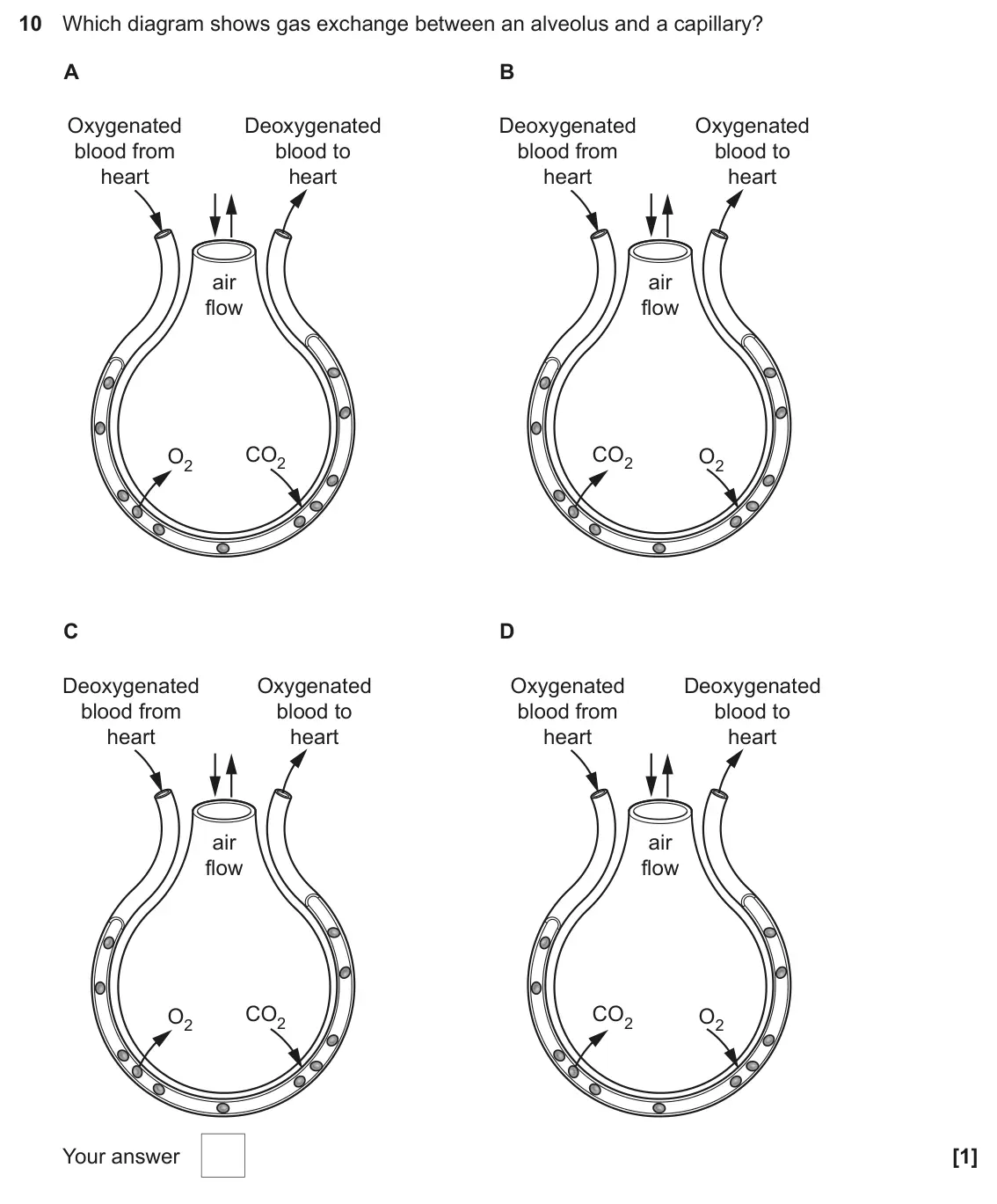
- June 2024, AS Paper 1, Q10 (1 mark): Which diagram shows gas exchange between an alveolus and a capillary? A B Oxygenated Deoxygenated Deoxygenated Oxygenated blood from blood to blood from blood t
- June 2024, AS Paper 1, Q11 (1 mark): The micrograph shows a section of a leaf tissue with two features labelled X and Y. X Y Which option correctly identifies the features in the micrograph? A X is
- June 2024, AS Paper 1, Q21(a) (2 marks): Explain why the trachea is described as an organ. [2]
- June 2024, AS Paper 1, Q21(b)(i) (1 mark): Identify the structure labelled Y. [1]
- June 2024, AS Paper 1, Q21(b)(ii) (1 mark): Identify the tissue labelled Z. [1]
- June 2023, Paper 1, Q9 (1 mark): Which of the statements about the mechanism that results in the opening of stomata is / are correct? The concentration of K+ ions and sucrose inside guard cells
- June 2023, Paper 2, Q7(a)(i) (2 marks): A student said that it was not possible to estimate vital capacity for subject L on the basis of the graph. Evaluate the student’s conclusion. [2]
- June 2023, Paper 2, Q7(a)(ii) (3 marks): With the aid of a calculation, show that it is possible to identify which of the two curves, K and L, is the normal control and which is the patient with COPD.
- June 2023, Paper 2, Q7(a)(iii) (2 marks): FEV1 is calculated using the formula: (4.3 × height) – (0.029 × age) – 2.49 where height is in m and age is in years. Use this formula to estimate the age in ye
- June 2023, Paper 2, Q7(b)(i) (4 marks): Explain the reasons for the following aspects of EAR. 1. Gloves and a mask should be worn. 2. The patient’s head should be held back. 3. Watch to see if the che
- June 2023, Paper 2, Q7(b)(ii) (2 marks): Suggest how EAR would differ if you were performing it on a small child. [2]
- June 2022, Paper 1, Q33(b)(ii) (1 mark): Suggest the mechanism by which germinating seeds take in oxygen from the soil. [1]
- June 2022, Paper 2, Q4(a)(i) (2 marks): Identify the tissues labelled A and B in Fig. 4.1. A B [2]
- June 2022, Paper 2, Q4(a)(ii) (2 marks): Identify the structure labelled C in Fig. 4.2 and describe one visible way it is adapted for gas exchange. Identity of C Adaptation [2]
- June 2022, Paper 2, Q4(a)(iii) (2 marks): Identify the tissue labelled D in Fig. 4.2 and describe its function. Identity of D Function [2]
- June 2022, Paper 2, Q6(d) (3 marks): Alfalfa is a leguminous plant used as a food crop for livestock such as beef cattle. Alfalfa grows in areas with a shortage of water. Scientists investigated th
- June 2022, AS Paper 1, Q9 (1 mark): The table shows some of the cells, tissues and organs found in the mammalian respiratory system. Cell Tissue Organ A cilia ciliated epithelium lung B cilia trac
- June 2022, AS Paper 2, Q2(a)(i) (2 marks): Using only Fig. 2.1, what conclusions can be drawn about the effect of water availability on lenticel number for these two varieties of apple? [2]
- June 2022, AS Paper 2, Q2(a)(ii) (4 marks): Another researcher suggested that: ‘Adding a known volume of water to the tree is not a suitable method of investigating the effect of water availability on len
- June 2022, AS Paper 2, Q2(a)(iii) (2 marks): Explain why any difference in lenticel number shown in Fig. 2.1 should not be described as a significant difference. [2]
- June 2022, AS Paper 2, Q2(a)(iv) (2 marks): During this investigation, the trees were kept in a laboratory at 20 °C. State two other variables that must also be controlled in this investigation and sugges
- June 2022, AS Paper 2, Q2(a)(v) (2 marks): The researcher compared the number of lenticels on apples of each variety. A more accurate method would be to compare the density of lenticels per apple. Sugges
- June 2022, AS Paper 2, Q2(b) (6 marks): Lenticels appear as small brown patches on the surface of some fruit. A researcher wanted to investigate if water availability affected the number of lenticels
- November 2021, AS Paper 1, Q15 (1 mark): Which of the plant structures, A to D, has intercellular spaces to allow for the process of gas exchange? A sieve tubes B lenticels C root hairs D xylem vessels
- November 2021, AS Paper 2, Q1(a)(i) (1 mark): State the function of the cell labelled X in Fig. 1.1. [1]
- November 2021, AS Paper 2, Q2(a) (2 marks): In the graph, a comparison is made with the VO2 max of an average 25-year-old. Give one reason why the VO2 max was not compared with a younger person and one re
- November 2021, AS Paper 2, Q2(b) (2 marks): Suggest why there is a decrease in the VO2 max of people as they get older. [2]
- November 2021, AS Paper 2, Q2(c) (3 marks): Respiratory arrest is a condition when a patient stops breathing. The first-aid treatment for respiratory arrest is to perform expired air resuscitation on the
- November 2020, Paper 1, Q15 (1 mark): A patient was assessed for pulmonary function. The volume of air breathed during a normal breath was 0.5 dm3 in and 0.5 dm3 out. The volumes of air breathed in
- November 2020, Paper 1, Q16 (1 mark): Gas exchange in the lungs occurs as a function of partial pressure differences in oxygen and carbon dioxide between the alveoli, and blood in the pulmonary capi
- November 2020, AS Paper 1, Q6 (1 mark): The following stages are part of the expired air resuscitation (EAR) procedure: 1. Place your lips around the victim’s mouth and create a seal 2. Pinch the nost
- November 2020, AS Paper 1, Q21(d)(i) (3 marks): Explain the difference in appearance of the stomata shown in Fig. 21.2. [3]
- November 2020, AS Paper 2, Q4(a)(i) (2 marks): Calculate the rate at which air can be exhaled by the patient suffering from pneumoconiosis between 0 and 5 seconds. rate = unit = [2]
- November 2020, AS Paper 2, Q4(a)(ii) (1 mark): Suggest why the mean lung volume for healthy individuals was included in the table. [1]
- November 2020, AS Paper 2, Q4(c) (2 marks): State two pieces of additional information that the doctor would need to consider when comparing the pneumoconiosis patient to a healthy person. 1 2 [2]
- November 2020, AS Paper 2, Q4(d)(i) (2 marks): Using the diagrams, explain why there would be a decrease in the oxygen concentration of the pneumoconiosis patient’s blood. [2]
- June 2019, Paper 1, Q32(b) (2 marks): ABA is known to promote the closure of stomata. Binding of ABA to receptors on the surface of guard cells results in the removal of ions. Explain how a loss of
- June 2019, Paper 1, Q32(c) (3 marks): An experiment was conducted to investigate the effect of soil water potential on the production of ABA in leaves and the resistance to air flow through stomata.
- June 2019, AS Paper 1, Q13 (1 mark): A spirometer was used to monitor the breathing of a student during periods of rest and exercise. The resulting spirometer trace is shown below. 5 4 3 volume (dm
- June 2019, AS Paper 1, Q21(a) (2 marks): Explain why tree seedlings need to develop lenticels in addition to stomata as they grow. [2]
- June 2018, Paper 1, Q37(a) (4 marks): Complete the table below by inserting, for each cell type: • the precise name • one role in gas exchange. Cell type Name Role R S [4]
- June 2018, Paper 1, Q37(c) (3 marks): Cigarette smoking increases an individual’s risk of a heart attack. A heart attack can lead to respiratory arrest. Describe how expired air resuscitation is per
- June 2017, AS Paper 1, Q18 (1 mark): A student used a light microscope to count the number of stomata in the lower epidermis of a leaf. The diagram below shows a drawing of the field of view made b
- June 2017, AS Paper 1, Q24(a) (2 marks): Explain the terms PEFR and FEV1 PEFR FEV1 [2]
- June 2017, AS Paper 1, Q24(b) (3 marks): Table 24 gives details of a 22-year-old male. Weight Height PEFR FEV1 (dm3 min−1) (dm3) (Kg) (cm) 110 175 400 2.9 Table 24 FEV1 values can be compared to a pred
- June 2017, AS Paper 1, Q24(c) (1 mark): Expired air resuscitation (EAR) is a first-aid procedure used when a person stops breathing. When EAR is carried out on a small child the First Aider will cover
- June 2016, AS Paper 1, Q9 (1 mark): A group of students were investigating the effect of exercise on pulmonary ventilation. The table below shows some of the results recorded for one of the studen
- June 2016, AS Paper 1, Q26(a)(i) (1 mark): Identify P labelled on Fig. 26, in the insert. [1]
- June 2016, AS Paper 1, Q26(a)(ii) (1 mark): The walls of the alveoli consist of squamous epithelial cells. How does the structure of these cells differ from the epithelial cells lining bronchioles? [1]
- June 2016, AS Paper 1, Q26(a)(iii) (2 marks): Bronchiole walls contain smooth muscle and elastic fibres. Describe the role of each of these tissues. smooth muscle elastic fibres [2]
- June 2016, AS Paper 1, Q26(b) (1 mark): Cartilage tissue is found in some areas of the gas exchange system. Name one area of the gas exchange system where cartilage is found and describe its role. [1]
- June 2016, AS Paper 2, Q1(d) (4 marks): Euphorbia virosa is a species of cactus that grows in the deserts of Namibia. It uses the guard cells to close its stomata during the hottest part of the day. D
Questions, mark schemes and examiner’s reports are © OCR, from their published past papers. Plumi isn’t affiliated with any exam board. Want whole papers? Every OCR A-Level Biology B paper.
Rather write your answers by hand on iPad? Plumi marks them against the same mark schemes.