 plumi
Transport systems in mammals: OCR A‑Level Biology B questions
Every OCR A-Level Biology B exam question on 2.2.2 Transport systems in mammals, 2016–2025, with its mark scheme and examiner’s report.
Find questions1,889
Calculations


Q3(b)(i)
The whole paper ↗
Q3(b)(ii)
The whole paper ↗
Q3(d)
The whole paper ↗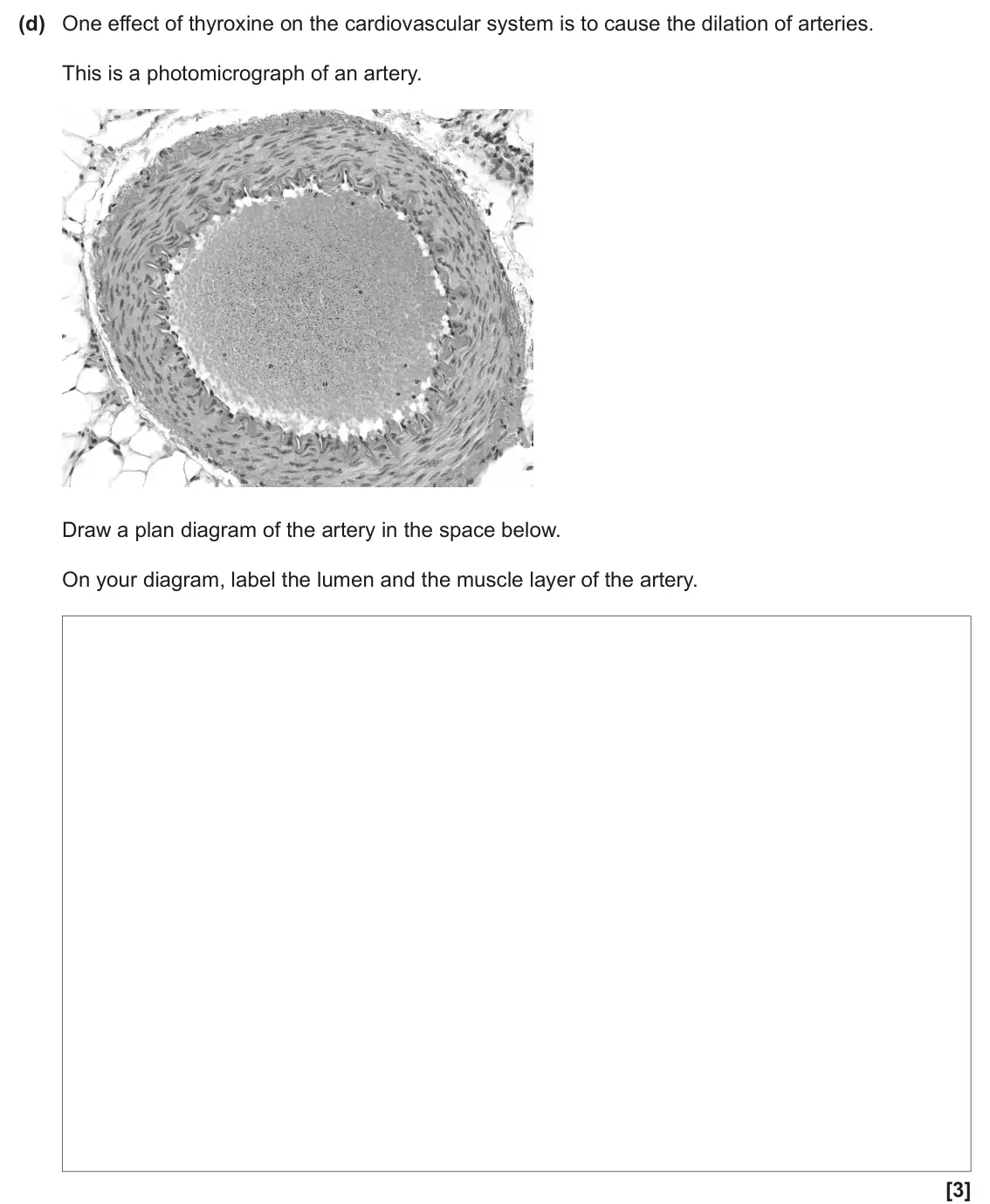
Q22(a)
The whole paper ↗
Q22(b)
The whole paper ↗
Q22(c)(i)
The whole paper ↗
Q22(c)(ii)
The whole paper ↗
Q22(c)(iii)
The whole paper ↗
Q22(d)
The whole paper ↗
Q4(e)
The whole paper ↗


Q24(a)
The whole paper ↗![November 2021 AS Paper 1, question 24(a): State two advantages of having blood vessels in a circulatory system. 1 2 12]](https://pub-e8a9dbab8e2a4d089f52b2a45e0d0b50.r2.dev/bank/h02201-nov21-24-a-qp.webp?v=3)
All 52 questions on Transport systems in mammals, as a list
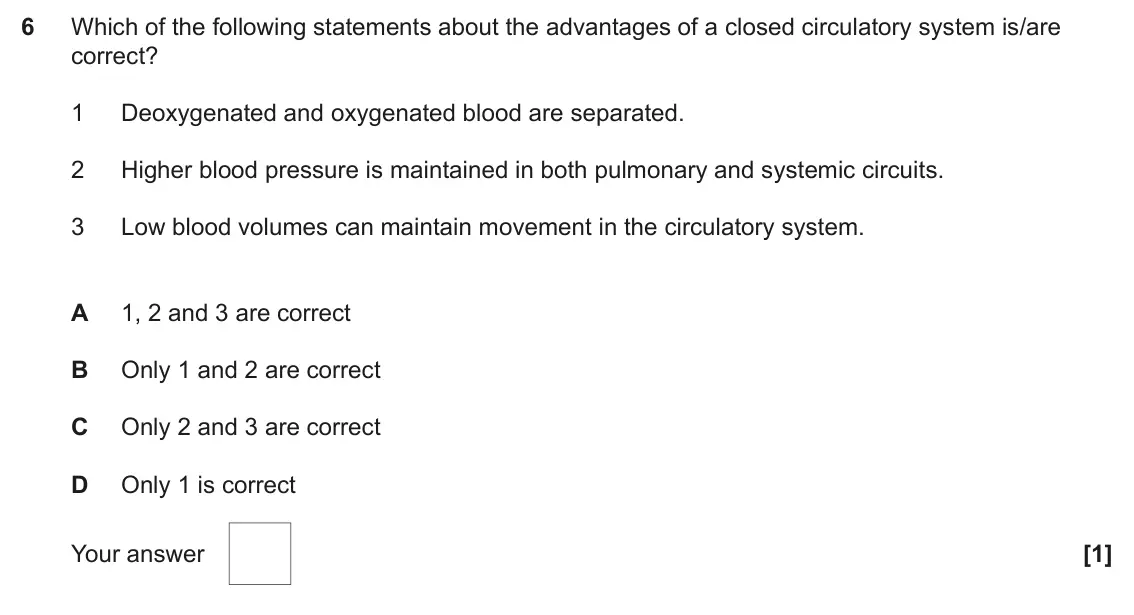
- June 2025, Paper 1, Q6 (1 mark): Which of the following statements about the advantages of a closed circulatory system is/are correct? 1 Deoxygenated and oxygenated blood are separated. 2 Highe
- June 2025, AS Paper 2, Q1(a)(i) (1 mark): Explain what is meant by a closed circulatory system. [1]
- June 2025, AS Paper 2, Q1(a)(ii) (2 marks): The diagram below shows the circulatory system of a frog. Capillaries in the lungs and skin right left side side Capillaries in the muscles Blood leaving the he
- June 2025, AS Paper 2, Q1(c) (6 marks): (c)* Describe how the tissues in the artery wall are adapted to their function. [6] Extra answer space if required.
- June 2024, Paper 1, Q7 (1 mark): What would result in an increase in the formation of tissue fluid? A Decrease in hydrostatic pressure at arteriole end of capillary B Decrease in hydrostatic pr
- June 2024, Paper 3, Q3(b)(i) (4 marks): Describe how to use a sphygmomanometer to measure the blood pressure of a person. [4]
- June 2024, Paper 3, Q3(b)(ii) (4 marks): A person with hypothyroidism compares their blood pressure measurements with a friend who does not have hypothyroidism. The person with hypothyroidism has measu
- June 2024, Paper 3, Q3(d) (3 marks): One effect of thyroxine on the cardiovascular system is to cause the dilation of arteries. This is a photomicrograph of an artery. Draw a plan diagram of the ar
- June 2024, AS Paper 1, Q22(a) (2 marks): Describe what is meant by diastolic and systolic pressures. Diastolic pressure Systolic pressure [2]
- June 2024, AS Paper 1, Q22(b) (1 mark): High blood pressure is referred to as hypertension. State a blood pressure reading that could suggest a person has hypertension. mm Hg [1]
- June 2024, AS Paper 1, Q22(c)(i) (1 mark): It was estimated that 85 000 adults in a population were aged between 20 and 40 years old. Calculate the number of adults in this age group that are likely to b
- June 2024, AS Paper 1, Q22(c)(ii) (2 marks): Suggest why young adults with YOH continue to experience hypertension in later life. [2]
- June 2024, AS Paper 1, Q22(c)(iii) (2 marks): Suggest two changes to the cardiovascular system that could be caused by YOH. 1 2 [2]
- June 2024, AS Paper 1, Q22(d) (3 marks): Blood pressure affects the formation of tissue fluid. Complete the sentences about the formation of tissue fluid using the most appropriate word(s). When pressu
- June 2023, Paper 3, Q4(e) (2 marks): Rabbits, like all mammals, have a double circulatory system. Explain the importance to mammals, such as rabbits, of having a double circulatory system. [2]
- June 2022, Paper 1, Q28 (1 mark): Blood pressure is measured using a special instrument. The blood pressure of a patient was measured as 130 90 mmHg. Which statement correctly identifies the ins
- June 2022, AS Paper 1, Q10 (1 mark): Which of the options would result in an increase in tissue fluid formation? A Decrease in hydrostatic pressure and increase in osmotic pressure at arteriole end
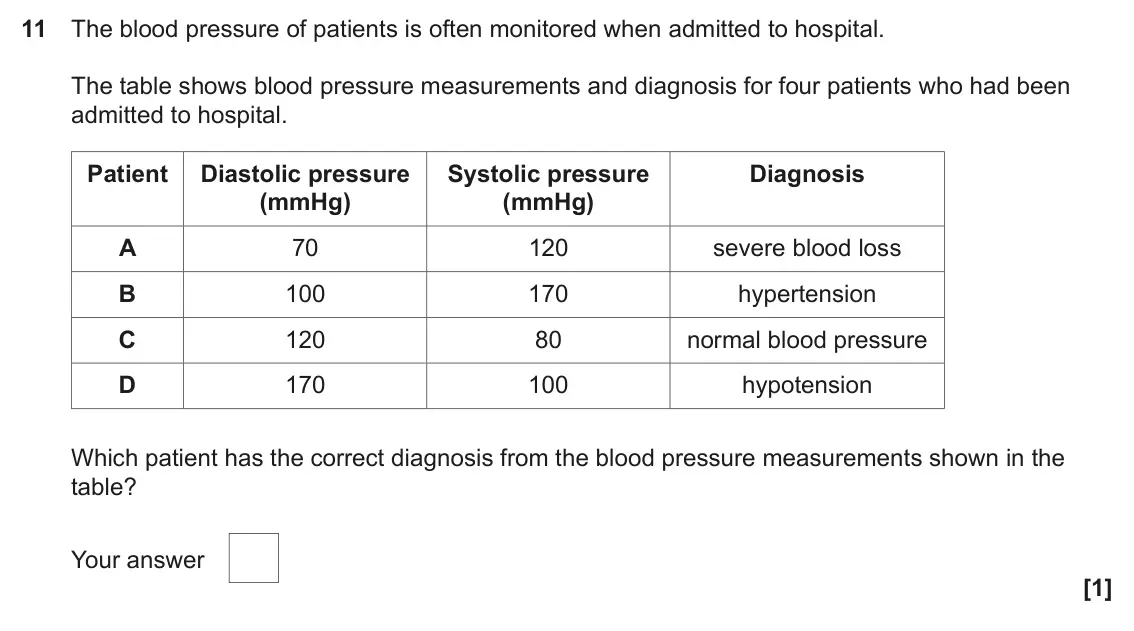
- June 2022, AS Paper 1, Q11 (1 mark): The blood pressure of patients is often monitored when admitted to hospital. The table shows blood pressure measurements and diagnosis for four patients who had
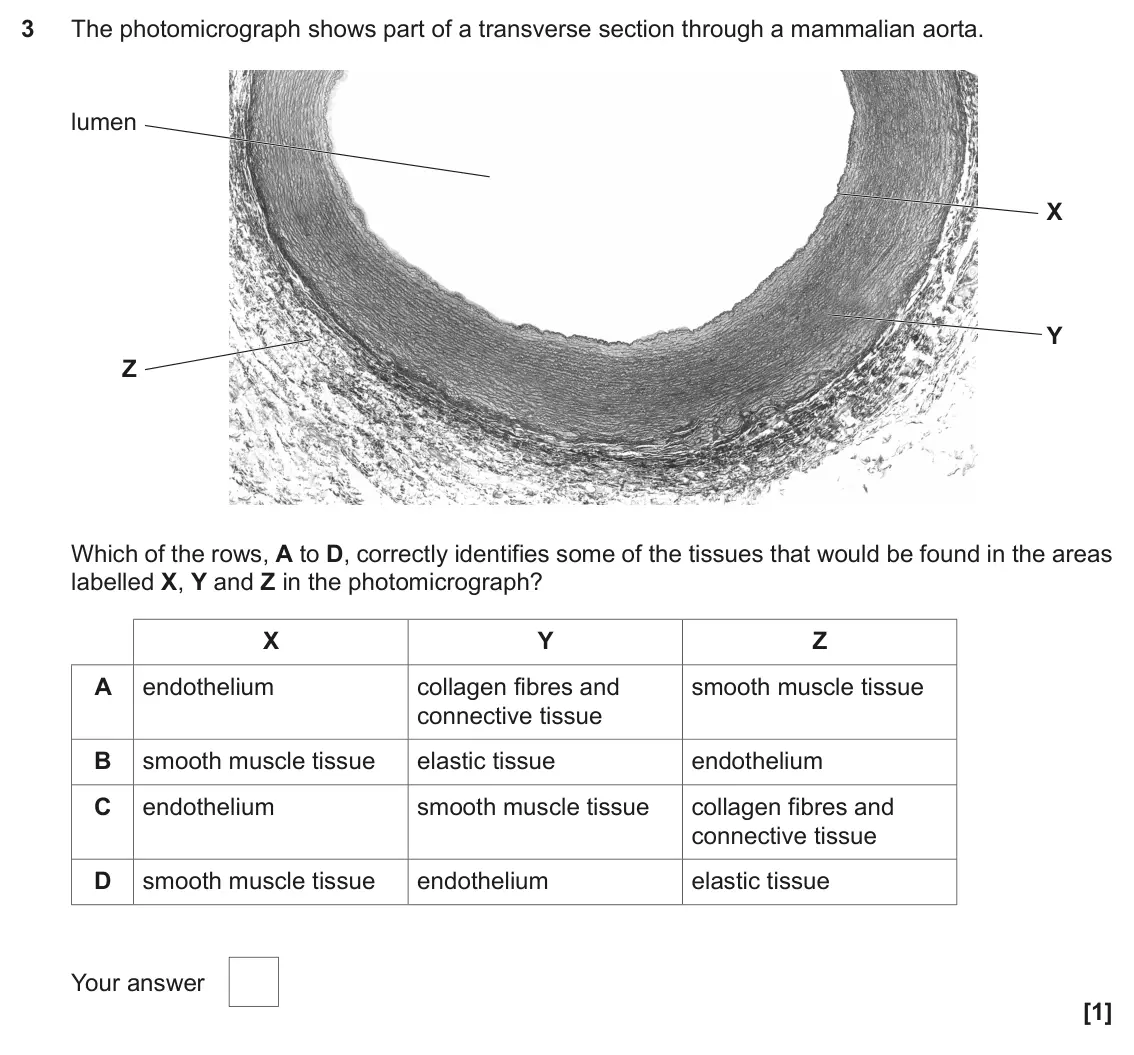
- November 2021, Paper 1, Q3 (1 mark): The photomicrograph shows part of a transverse section through a mammalian aorta. lumen X Y Z Which of the rows, A to D, correctly identifies some of the tissue
- November 2021, AS Paper 1, Q24(a) (2 marks): State two advantages of having blood vessels in a circulatory system. 1 2 12]
- November 2021, AS Paper 1, Q24(b)(i) (3 marks): Complete the labelled plan diagram below of the vein in Fig. 24.1. The fibrous outer layer (tunica externa) has been drawn and labelled for you. fibrous outer l
- November 2021, AS Paper 1, Q24(b)(ii) (1 mark): Describe one function of the fibrous outer layer labelled in the drawing above. [1]
- November 2021, AS Paper 1, Q24(b)(iii) (3 marks): Compare the structure of the vein in Fig. 24.1 with that of a similar sized artery. [3]
- November 2020, Paper 1, Q13 (1 mark): Hypoalbuminaemia is a condition in which blood albumin levels are low. Albumin is a plasma protein. Which of the options, A to D, is a correct explanation of wh
- November 2020, Paper 2, Q2(b)(i) (1 mark): Name an instrument used to measure blood pressure. [1]
- November 2020, Paper 2, Q2(b)(ii) (2 marks): Calculate the percentage decrease in the systolic blood pressure in the test group over the course of the trial. percentage decrease = % [2]
- November 2020, Paper 2, Q2(c) (3 marks): One factor that contributes to damage to the retina is macular oedema, which is swelling in the eye. Use your knowledge of tissue fluid formation to explain how
- June 2019, Paper 1, Q19 (1 mark): The graph below shows the normal variation in blood pressure across different regions of the human circulatory system. Four regions are labelled A to D. 140 120
- June 2019, Paper 3, Q1(b) (4 marks): The student was given a microscope slide of a large artery. The image seen is shown in Fig. 1.2, on the insert. A small part of the image in Fig. 1.2 has been e
- June 2019, AS Paper 1, Q12 (1 mark): Some students are preparing for a lecture on the mammalian transport system. student A student B I‛d say that valves in veins I think closed double circulations
- June 2019, AS Paper 2, Q3(b) (1 mark): Fig. 3.1 shows a device known as a ‘coupler’. A coupler is fitted between an artery and a vein in the upper leg of a patient who is suffering from hypertension
- June 2019, AS Paper 2, Q3(c)(i) (2 marks): State two variables that would need to be controlled by the researchers in this study. variable 1 variable 2 [2]
- June 2019, AS Paper 2, Q3(c)(ii) (2 marks): Describe and explain the effect on blood pressure in the artery and the vein after having a coupler fitted. [2]
- June 2019, AS Paper 2, Q3(c)(iii) (4 marks): Using the information in Fig. 3.2, calculate the mean percentage change in both systolic and diastolic blood pressure of the group of patients after the coupler
- June 2018, Paper 1, Q10 (1 mark): A doctor takes a blood pressure measurement from a patient using a manual sphygmomanometer. 160 mm Hg. The result is 100 Here are three statements about the doc
- June 2018, Paper 3, Q3(a)(i) (1 mark): Identify layer Y. [1]
- June 2018, Paper 3, Q3(a)(ii) (1 mark): Describe the importance of layer Y in the normal functioning of an artery. [1]
- June 2018, Paper 3, Q3(b)(ii) (2 marks): Fig. 3.2, on the insert, shows a light photomicrograph of a cross-section of a diseased artery. The diseased artery has a diameter 14.3% greater than the health
- June 2018, Paper 3, Q3(c) (2 marks): Suggest why layer Y is much thicker in this diseased artery than in the healthy artery shown in Fig. 3.1. [2]
- June 2018, Paper 3, Q3(d)(i) (1 mark): Capillaries do not have a layer Y. Explain why the absence of layer Y is important in the formation of tissue fluid. [1]
- June 2018, Paper 3, Q3(d)(ii) (4 marks): Complete this passage about the formation of tissue fluid using the most appropriate words. Tissue fluid is formed at the end of capillaries due to the high pre
- June 2018, AS Paper 1, Q10 (1 mark): Which of the structures, A to D, does not have smooth muscle tissue in its walls? A trachea B capillary C bronchiole D arteriole Your answer [1]
- June 2018, AS Paper 1, Q16 (1 mark): The table shows some of the properties of four types of blood vessel found in the human body. Which of the blood vessels, A to D, is a vein? Blood vessel Lumen
- June 2018, AS Paper 1, Q24(a)(i) (1 mark): Give one advantage of using a digital monitor for measuring blood pressure. [1]
- June 2018, AS Paper 1, Q24(a)(ii) (2 marks): Sources of error when taking blood pressure measurements using these monitors include improper technique and observer bias. Suggest two other sources of error w
- June 2018, AS Paper 1, Q24(a)(iii) (2 marks): Fig. 24 shows the variation in systolic pressure in different arteries. systolic pressure Aorta Carotid Brachial Radial (in neck) (in upper arm) (in wrist) Fig.
- June 2018, AS Paper 1, Q24(b)(i) (2 marks): Explain how the production of tissue fluid is affected in patients suffering from hemorrhagic shock syndrome. [2]
- June 2018, AS Paper 1, Q24(b)(ii) (2 marks): In cases of severe blood loss, the body actively reabsorbs fluid from the tissues to restore blood volume. Suggest how the composition of this restored blood wo
- June 2017, Paper 1, Q18 (1 mark): The diagram below represents a capillary (c) surrounded by interstitial tissue (i). Hydrostatic pressures (P) and oncotic pressures (π) are shown. interstitial
- June 2017, AS Paper 1, Q3 (1 mark): The table below shows the mean blood pressure measurements for four patients. Mean blood pressures (mm Hg) Systolic Diastolic Patient A 80 120 Patient B 100 190
- June 2017, AS Paper 1, Q14 (1 mark): The structure of blood vessels is related to their function. Which of the blood vessels, A to D, has a wall consisting of only endothelial cells? A venule B vei
- June 2016, AS Paper 2, Q3(c) (2 marks): ASD can cause the pulmonary artery to become enlarged. Complete the diagram in the space below to show the structure of a healthy artery as seen in transverse s
Questions, mark schemes and examiner’s reports are © OCR, from their published past papers. Plumi isn’t affiliated with any exam board. Want whole papers? Every OCR A-Level Biology B paper.
Rather write your answers by hand on iPad? Plumi marks them against the same mark schemes.