 plumi
Ventilation and lung volumes: OCR A‑Level Biology A questions
OCR A-Level Biology A past-paper questions on 3.1.1.3 Ventilation and lung volumes, 2016–2025, with mark schemes and examiner’s reports where available.
Paper
All papers
Exam
All years
Calculations
- Your answer
Q6(a)(i)
The whole paper ↗Q6(a)(ii)
The whole paper ↗Q6(b)
The whole paper ↗Q6(c)
The whole paper ↗Q20(a)(i)
The whole paper ↗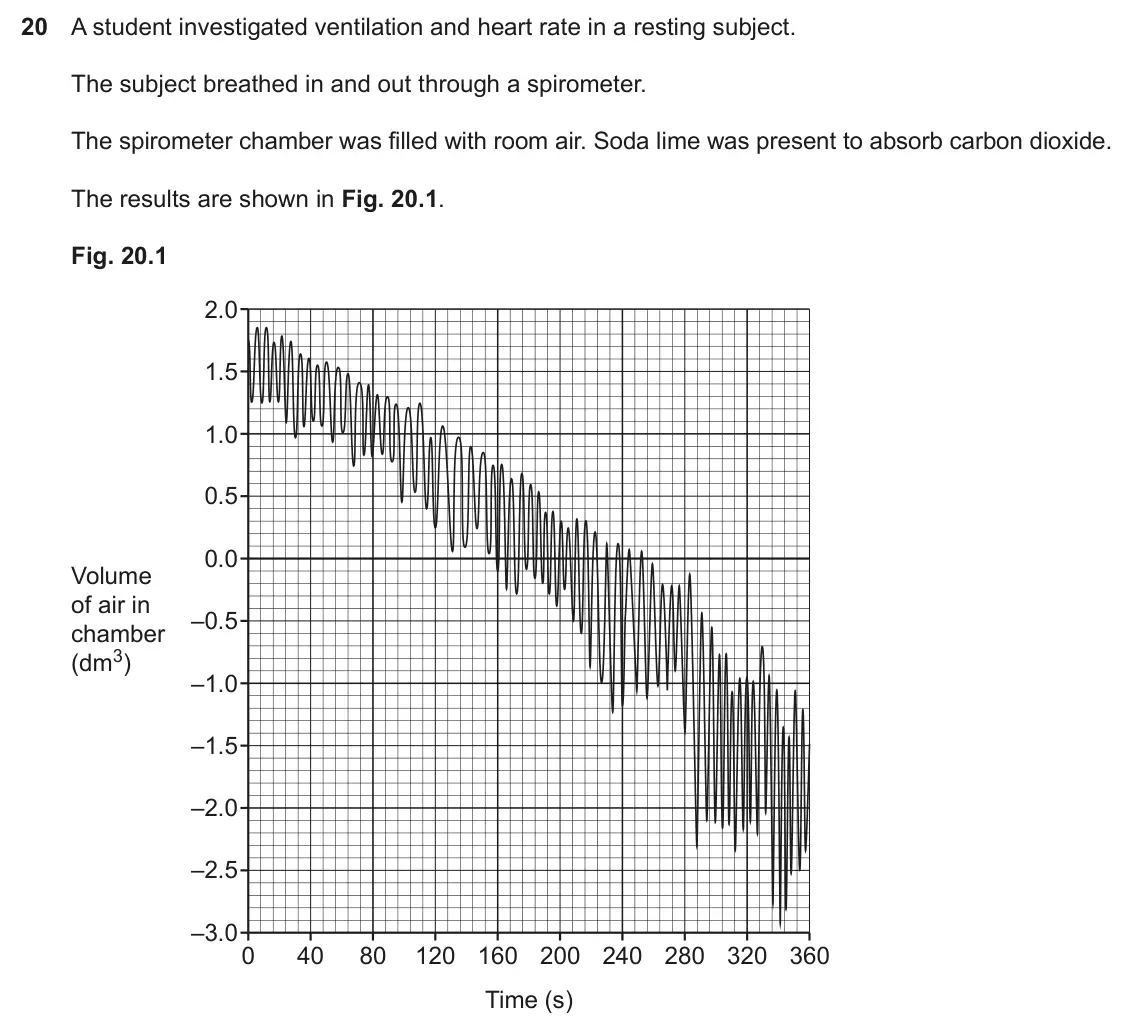
Q20(a)(ii)
The whole paper ↗Q20(a)(iii)
The whole paper ↗Q20(a)(iv)
The whole paper ↗Q20(b)
The whole paper ↗- Your answer
- Your answer
- Your answer
Q1(c)(i)
The whole paper ↗Q23(a)(i)
The whole paper ↗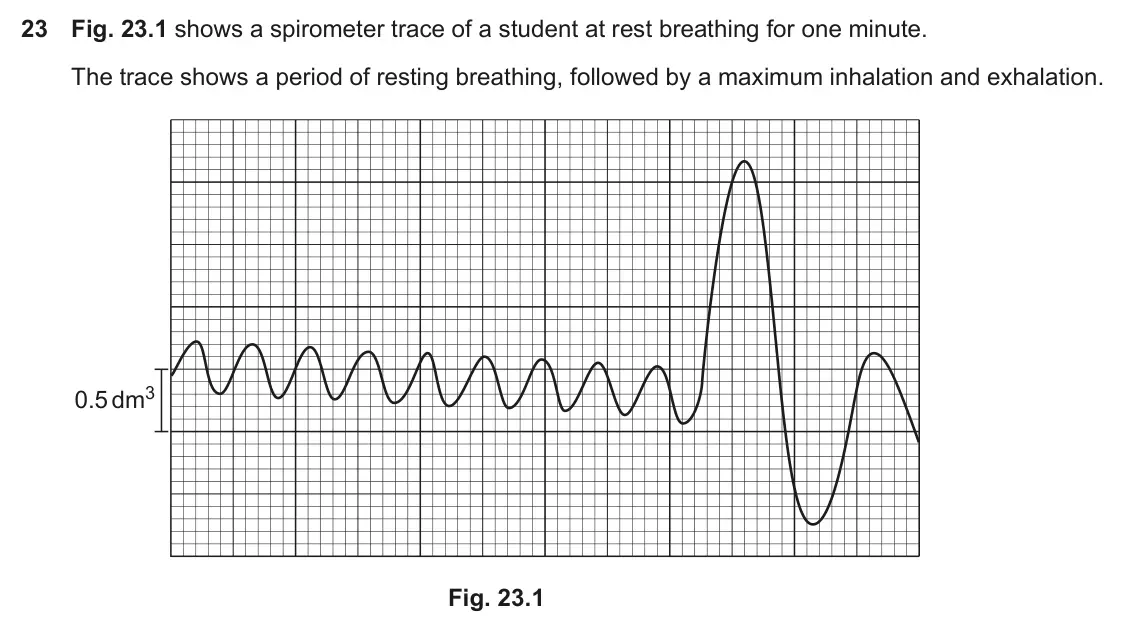
Q23(a)(ii)
The whole paper ↗Q23(a)(iii)
The whole paper ↗Q23(b)(i)
The whole paper ↗Q23(b)(ii)
The whole paper ↗
All 38 questions on Ventilation and lung volumes, as a list
- June 2025, Paper 1, Q10 (1 mark): Following a period of intense exercise an athlete breathes out forcefully. Which option describes the mechanism of forceful expiration in this athlete? A The di
- June 2025, AS Paper 2, Q6(a)(i) (2 marks): Calculate the breathing rate of the person at rest. Give your answer to the nearest whole number. Breathing rate = breaths per minute [2]
- June 2025, AS Paper 2, Q6(a)(ii) (1 mark): Calculate the person’s tidal volume during exercise. Tidal volume during exercise = cm3 [1]
- June 2025, AS Paper 2, Q6(b) (1 mark): A study shows that long term exposure to dust affects a person’s lung function by reducing their vital capacity. The graph shows a spirometer trace for a person
- June 2025, AS Paper 2, Q6(c) (2 marks): A student makes the following statement about ventilation in humans: “During inspiration the diaphragm contracts and flattens. Internal intercostal muscles cont
- June 2024, Paper 1, Q20(a)(i) (1 mark): The downward slope of the spirometer trace in Fig. 20.1 is due to oxygen consumption. The subject exhales the same volume of air as they inhale. State why the t
- June 2024, Paper 1, Q20(a)(ii) (2 marks): The subject had a mass of 75 kg. Calculate the subject’s oxygen consumption in cm3 kg–1 during the first 2 minutes of the experiment. Give your answer to 2 sign
- June 2024, Paper 1, Q20(a)(iii) (2 marks): Using Fig. 20.1, compare the breathing pattern between 0–120 s and 120–240 s. [2] 24 The student measured the subject’s heart rate and blood oxygen saturation e
- June 2024, Paper 1, Q20(a)(iv) (4 marks): Use the data in Fig. 20.1 and Fig. 20.2 and your own knowledge of homeostatic control to explain the changes in breathing rate and heart rate during the experim
- June 2024, Paper 1, Q20(b) (2 marks): Blood oxygen saturation of less than 90% can be dangerous. Explain one modification that you could make to the experiment to safely study the effect of extended
- June 2024, AS Paper 1, Q2 (1 mark): Which change in the mammalian gas exchange system takes place only during forced expiration? A Abdominal muscles relax B Diaphragm contracts to become dome-shap
- June 2024, AS Paper 1, Q4 (1 mark): The graph shows a trace recorded by a spirometer. The trace shows a period of normal breathing whilst at rest, followed by a maximum inhalation and maximum exha
- June 2022, Paper 1, Q6 (1 mark): Ventilation of the lungs involves muscles working together. Which option describes expiration? A In expiration at rest, the external intercostal muscles and the
- June 2022, AS Paper 2, Q5 (6 marks): 5* A teacher set up the apparatus shown in Fig. 5.1 to demonstrate ventilation in mammals to a group of students. Bell jar Glass tubing Balloons Elastic sheet t
- November 2021, Paper 3, Q1(c)(i) (1 mark): The West Highland Terrier develops CPF more often than other breeds of dog. The lung function of a West Highland Terrier was tested. At rest, its ventilation ra
- November 2021, AS Paper 1, Q23(a)(i) (2 marks): Explain why there is a downward trend in the trace. [2]
- November 2021, AS Paper 1, Q23(a)(ii) (2 marks): Using Fig. 23.1, calculate the mean resting breathing rate. Mean = breaths per minute [2]
- November 2021, AS Paper 1, Q23(a)(iii) (2 marks): Using the trace in Fig. 23.1, state the vital capacity. Give your answer in cm3. Vital capacity = cm3 [2]
- November 2021, AS Paper 1, Q23(b)(i) (3 marks): Describe three patterns in the data in Fig. 23.2. 1 2 3 [3]
- November 2021, AS Paper 1, Q23(b)(ii) (2 marks): State one group from Fig. 23.2 that is likely to contain an anomaly. Explain your choice. Group Explanation [2]
- November 2021, AS Paper 1, Q23(b)(iii) (2 marks): Explain why using standard deviation error bars in Fig. 23.2 would increase the confidence in any conclusion made. [2]
- November 2021, AS Paper 1, Q23(b)(iv) (3 marks): The table shows the raw data of resting tidal volume for 13-year-old boys in Fig. 23.2. The mean resting tidal volume for this group is 510 cm3. Resting tidal v
- November 2021, AS Paper 1, Q23(b)(v) (2 marks): Other than increasing the sample size, suggest two ways that the selection of participants in the study could have improved the validity of the data. 1 2 [2]
- November 2020, Paper 1, Q21(b)(i) (1 mark): Name the apparatus used to measure and record these air movements. [1]
- November 2020, Paper 1, Q21(b)(ii) (1 mark): The trace below shows a recording of ventilation movements from an individual subject. 5.0 4.5 4.0 3.5 volume of 3.0 air in air chamber 2.5 (dm3) 2.0 1.5 1.0 0.
- November 2020, Paper 1, Q21(b)(iii) (2 marks): After 60 seconds, the subject was told to breathe in as deeply as possible and then breathe out fully. Use the trace to calculate the vital capacity of the subj
- November 2020, Paper 1, Q21(c) (6 marks): (c)* Compare and contrast the mechanism of expiration during the first 60 seconds of the trace with the mechanism of expiration when the subject was told to bre
- November 2020, AS Paper 1, Q11 (1 mark): Which of the following muscles in the mammalian ventilation system contract to force air out of the lungs? A all of the muscles in the mammalian ventilation sys
- June 2019, AS Paper 1, Q18 (1 mark): Ventilation is a process that involves various parts of the body. Which of the following options, A to D, describes exhalation in a mammal? A ribcage moves upwa
- June 2019, AS Paper 1, Q22(a) (3 marks): Table 22 is a list of practical apparatus used in biological investigations. Each piece of apparatus has been assigned a letter. Letter Apparatus A calorimeter
- June 2018, Paper 1, Q9 (1 mark): Peak expiratory flow (PEF) is a measure of the maximum rate at which a person can exhale. The graph below shows the typical PEF values for men of different ages
- June 2018, Paper 1, Q16(c) (3 marks): During late pregnancy, women find ventilation more difficult, as the developing foetus reduces the volume of the thorax. This can lead to tiredness and difficul
- June 2018, Paper 1, Q21(a)(ii) (2 marks): A common cause of death from TTX poisoning is suffocation (not getting enough oxygen) as a result of paralysis of the diaphragm. Explain how paralysis of the di
- June 2017, Paper 3, Q7(b) (4 marks): Mammals use lungs for gas exchange. The following passage describes how gases are moved in and out of the lungs. Complete the passage using the most appropriate
- June 2016, AS Paper 1, Q5 (1 mark): Ventilation involves various parts of the mammalian respiratory system. Which of the following statements, A to D, describes inhalation? A ribcage moves upwards
- June 2016, AS Paper 2, Q1(b)(i) (2 marks): Which of the two diagrams, (a) or (b), represents the body immediately after expiration? Describe how this diagram justifies your choice. [2]
- June 2016, AS Paper 2, Q1(b)(ii) (1 mark): Why can expiration be a passive process? [1]
- June 2016, AS Paper 2, Q1(b)(iii) (8 marks): Some chemicals can act as allergens. If these allergens are inhaled, they can cause breathing problems. Allergens cause the smooth muscle in the walls of the ai
Questions, mark schemes and examiner’s reports are © OCR, from their published past papers. Plumi isn’t affiliated with any exam board. Want whole papers? OCR A-Level Biology A past papers, or our free OCR-style practice pack.
The Plumi iPad app also offers exam-style questions with AI feedback on your handwritten working.