 plumi
Specialised cells, tissues and organs: OCR A‑Level Biology A questions
OCR A-Level Biology A past-paper questions on 2.1.6.4 Specialised cells, tissues and organs, 2016–2025, with mark schemes and examiner’s reports where available.
Paper
All papers
Exam
All years
Calculations
Q22(a)
The whole paper ↗
- Your answer
Q7(a)
The whole paper ↗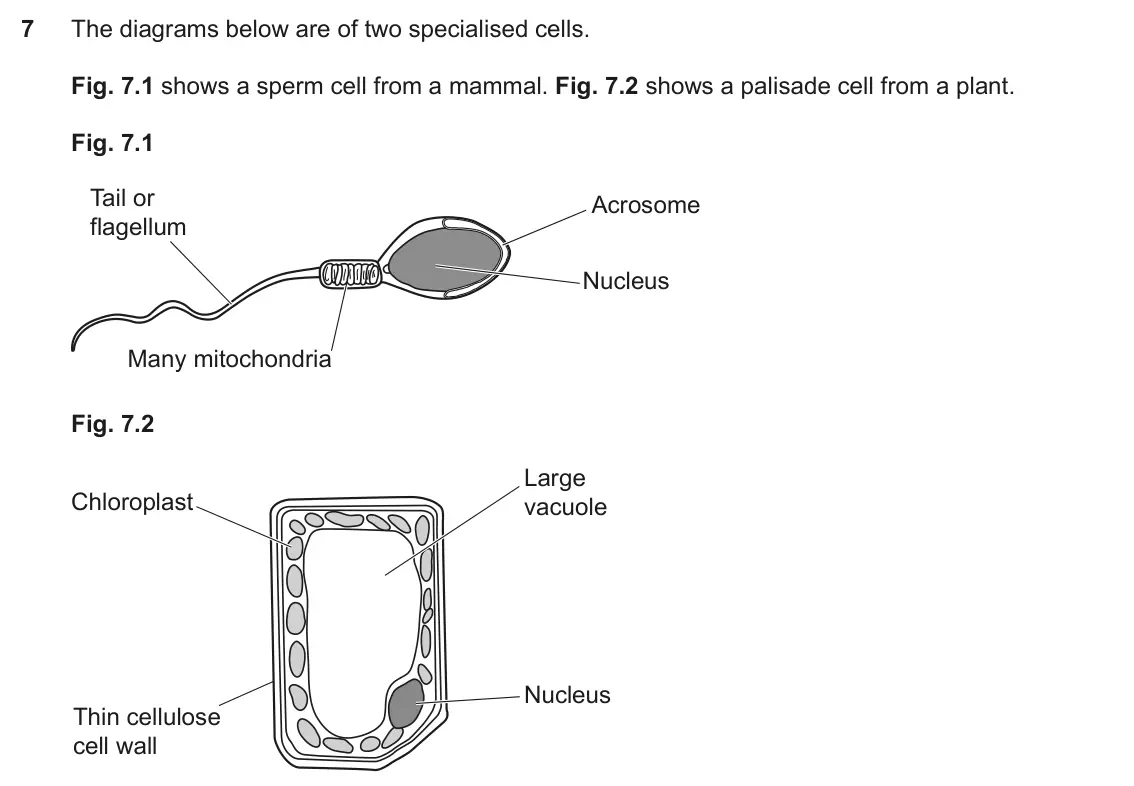
Q7(b)
The whole paper ↗Q2(a)(ii)
The whole paper ↗Q4(a)(iii)
The whole paper ↗- Your answer
Q19(c)(iii)
The whole paper ↗
Q22(a)(iv)
The whole paper ↗
- Your answer
Q1(c)(i)
The whole paper ↗Q1(c)(iii)
The whole paper ↗- Your answer
Q23(b)(i)
The whole paper ↗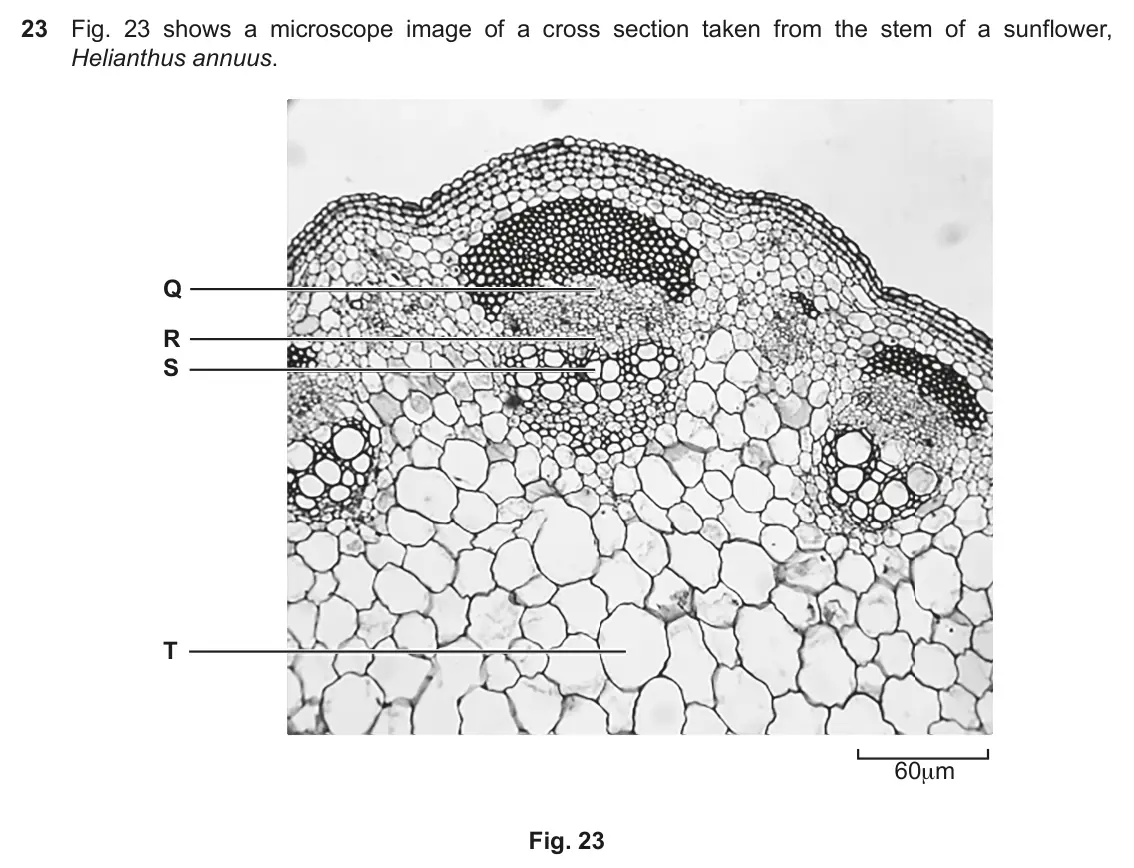
Q18(d)
The whole paper ↗- Your answer
Q24(b)(i)
The whole paper ↗
All 17 questions on Specialised cells, tissues and organs, as a list
- June 2024, AS Paper 1, Q22(a) (1 mark): State the difference between a tissue and an organ. [1]
- June 2023, Paper 2, Q1 (1 mark): Which option correctly describes a tissue? A A group of cells performing similar functions B A group of organs performing a specific function C A group of simil
- June 2023, AS Paper 2, Q7(a) (2 marks): With reference to the features shown in Fig. 7.1, explain how the sperm cell is adapted to its function. [2]
- June 2023, AS Paper 2, Q7(b) (2 marks): With reference to the features shown in Fig. 7.2, explain how the palisade cell is adapted to its function. [2]
- June 2022, Paper 3, Q2(a)(ii) (2 marks): The blood cell labelled Z in Fig. 2.1 contains a high concentration of haemoglobin. Outline two other ways in which the blood cell labelled Z is adapted for its
- June 2022, AS Paper 2, Q4(a)(iii) (1 mark): Using Fig. 4.1, explain why blood is described as a tissue and not an organ. [1]
- November 2021, Paper 1, Q6 (1 mark): The table describes adaptations of three types of specialised cell. Erythrocytes Neutrophils Palisade cells biconcave shape with a large, spherical nucleus flat
- November 2020, Paper 2, Q19(c)(iii) (2 marks): A diagram of a moss sperm is shown in Fig. 19.3. flagella nucleus Fig. 19.3 The flagella allow the sperm to move towards an egg. Suggest and explain another ada
- November 2020, Paper 2, Q22(a)(iv) (2 marks): Which letter or letters indicate a tissue? Explain your answer. 12]
- November 2020, AS Paper 1, Q4 (1 mark): Which of the rows, A to D, in the table below shows the correct order of increasing complexity of organisation within an organism? A epithelium goblet cell lung
- November 2020, AS Paper 2, Q1(c)(i) (3 marks): A student wrote the following passage about cells: ƇErythrocytes and neutrophils are formed in the spleen. One of the places ciliated epithelial cells are found
- November 2020, AS Paper 2, Q1(c)(iii) (6 marks): (iii)* Erythrocytes and neutrophils are both examples of specialised blood cells. Squamous and ciliated epithelial cells are also examples of specialised cells.
- June 2019, Paper 1, Q4 (1 mark): Which of the following rows, A to D, shows the correct cell names from the image above? P Q A neutrophil erythrocyte B erythrocyte epithelial cell C erythrocyte
- June 2018, AS Paper 1, Q23(b)(i) (1 mark): The cell labelled T on Fig. 23 is a parenchyma cell which carries out photosynthesis and stores starch. Suggest why cell T and the cells surrounding it, can be
- June 2017, Paper 1, Q18(d) (4 marks): Explain why a plant leaf is described as an organ. [4]
- June 2016, AS Paper 1, Q18 (1 mark): A diagram of a stained blood smear observed under a light microscope is shown below. B C D A Which of the structures labelled A to D in the diagram is a neutrop
- June 2016, AS Paper 1, Q24(b)(i) (2 marks): Explain one advantage and one disadvantage of the lack of nuclei and other membrane- bound organelles to mammalian erythrocytes. Advantage Disadvantage [2]
Questions, mark schemes and examiner’s reports are © OCR, from their published past papers. Plumi isn’t affiliated with any exam board. Want whole papers? OCR A-Level Biology A past papers, or our free OCR-style practice pack.
The Plumi iPad app also offers exam-style questions with AI feedback on your handwritten working.