 plumi
Respiration: OCR A‑Level Biology A questions
Every OCR A-Level Biology A exam question on 5.2.2 Respiration, 2016–2025, with its mark scheme and examiner’s report.
Find questions1,984
Calculations


Q16(a)(ii)
The whole paper ↗
Q17(a)(i)
The whole paper ↗
Q17(a)(v)
The whole paper ↗
Q17(c)(i)
The whole paper ↗
Q17(c)(ii)
The whole paper ↗
Q17(c)(iii)
The whole paper ↗

Q20(c)(i)
The whole paper ↗
Q20(c)(ii)
The whole paper ↗
Q4(b)
The whole paper ↗

Q19(d)
The whole paper ↗
Q2(c)(i)
The whole paper ↗
Q2(c)(ii)
The whole paper ↗
Q2(c)(iii)
The whole paper ↗
Q5(a)(i)
The whole paper ↗
Q5(a)(ii)
The whole paper ↗
All 71 questions on Respiration, as a list
- June 2025, Paper 1, Q9 (1 mark): A scientist measures the oxygen uptake and carbon dioxide output of an athlete on an exercise bike at increasing work rates. The results are shown in the graph.
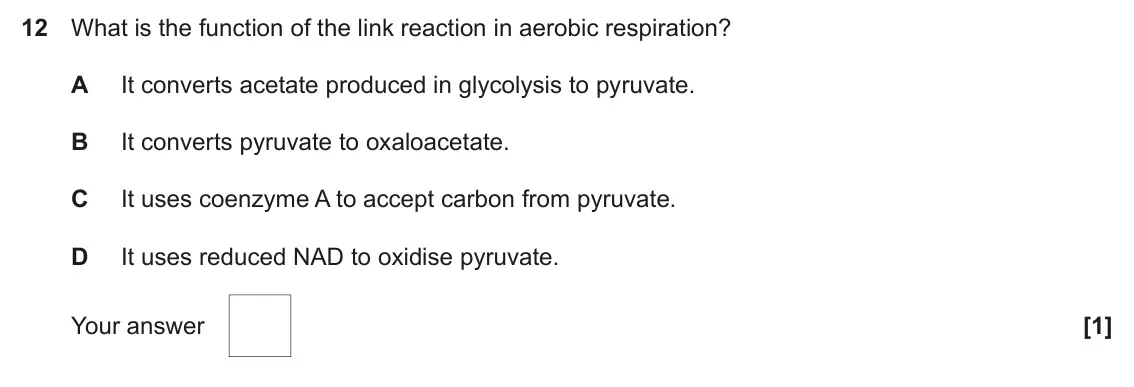
- June 2025, Paper 1, Q12 (1 mark): What is the function of the link reaction in aerobic respiration? A It converts acetate produced in glycolysis to pyruvate. B It converts pyruvate to oxaloaceta
- June 2025, Paper 1, Q13 (1 mark): Which statement does not describe the Krebs cycle? A It combines an acetyl group with citrate to form oxaloacetate. B It is a source of ATP produced by substrat
- June 2025, Paper 1, Q16(a)(ii) (2 marks): Identify one similarity and one difference between the structures of chloroplasts and the structures of mitochondria. Similarity Difference [2]
- June 2025, Paper 1, Q17(a)(i) (1 mark): State the type of reaction that is catalysed by PFK. [1]
- June 2025, Paper 1, Q17(a)(v) (2 marks): ATP is converted to ADP and then AMP (adenosine monophosphate) when ATP provides energy for processes in the cell. AMP reverses the inhibition of PFK by ATP. Us
- June 2025, Paper 1, Q17(c)(i) (1 mark): State the name of the type of reaction in aerobic respiration that produces CO2. [1]
- June 2025, Paper 1, Q17(c)(ii) (2 marks): State the names of the two stages in respiration where CO2 production occurs. 1 2 [2]
- June 2025, Paper 1, Q17(c)(iii) (2 marks): Respiration of glucose involves a series of oxidation reactions. Explain how oxidation occurs in glycolysis. [2]
- June 2024, Paper 1, Q15 (1 mark): Which option about the relative energy values of different foods is not correct? A Carbohydrates have lower energy values because they have a higher oxygen cont
- June 2024, Paper 1, Q20(c)(i) (1 mark): State the two measurements that you would need to make during the experiment to calculate RQ. 1 2 [1]
- June 2024, Paper 1, Q20(c)(ii) (3 marks): Explain what Fig. 20.3 shows about the respiratory substrate(s) used at different intensities of exercise. [3]
- June 2024, Paper 3, Q4(b) (1 mark): Outline why cellular respiration is necessary in cells that are carrying out DNA replication. [1]
- June 2023, Paper 1, Q9 (1 mark): The diagram shows some of the reactions that take place in a leaf cell in a flowering plant. Disaccharides and polysaccharides Glucose Hexose phosphate Hexose b
- June 2023, Paper 1, Q19(d) (2 marks): An adult was advised to change their diet to reduce their body mass before undergoing surgery. Over a period of several weeks their body mass reduced by 1 kg. S
- June 2023, Paper 3, Q2(c)(i) (2 marks): A mitochondrion is shown in Fig. 2.3. Label Fig. 2.3 to show the locations where FAD gains H atoms and where FAD releases H atoms during respiration. • Use the
- June 2023, Paper 3, Q2(c)(ii) (2 marks): The table lists features that are correct for FAD, NAD, both or neither. Complete the table by adding a tick (✓) to a box where the feature is correct and a cro
- June 2023, Paper 3, Q2(c)(iii) (1 mark): ATP is produced in respiration. Some of these molecules of ATP are used to release energy for processes in respiration. For example, ATP is used in the early st
- June 2023, Paper 3, Q5(a)(i) (2 marks): Compare CO2 production when the substrate is glucose and CO2 production when the substrate is maltose. [2]
- June 2023, Paper 3, Q5(a)(ii) (2 marks): The student wrote a note: ‘The CO2 production with fructose is approximately the same as the CO2 production with sucrose’. Explain whether you agree with the st
- June 2023, Paper 3, Q5(b)(i) (2 marks): The student uses glucose as the respiratory substrate in their experiment. The student produces a 0.01 mol dm–3 glucose solution for each yeast population. This
- June 2023, Paper 3, Q5(b)(ii) (3 marks): Complete the sentences using appropriate words or phrases. This is the method that the student uses in their experiment: • To avoid contamination, place the yea
- June 2022, Paper 1, Q3 (1 mark): Kendal Mint Cake is made from sugar, flavoured with peppermint, and was famously taken on the 1953 ascent of Mount Everest. Which statement describes why climbe
- June 2022, Paper 1, Q12 (1 mark): Linoleic acid is a fatty acid found in sunflower oil. The equation for oxidation of linoleic acid is: Linoleic acid: C18H32O2 + 25 O2 18 CO2 + 16 H2O What is th
- June 2022, Paper 1, Q15 (1 mark): Erythrocytes are formed from bone marrow stem cells. During this process they lose most of their organelles. Which statement about respiration in erythrocytes i
- June 2022, Paper 1, Q19(d) (6 marks): (d)* Muscle contraction requires energy in the form of ATP. Describe the different sources of the ATP that is used in muscle contraction during strenuous exerci
- June 2022, Paper 1, Q20(a)(i) (2 marks): Suggest two modifications the researcher would need to make to this apparatus to investigate the effect of temperature on the rate of respiration. 1 2 [2]
- June 2022, Paper 1, Q20(a)(ii) (1 mark): Suggest one advantage of using a computer to collect data. [1]
- June 2022, Paper 1, Q20(a)(iii) (2 marks): A constant flow of water past the oxygen probe allows continuous monitoring of oxygen concentration. Explain one other reason why it is necessary to maintain a
- June 2022, Paper 1, Q20(a)(iv) (2 marks): Suggest and explain one other precaution that the scientists should take to ensure that the results obtained using this apparatus are valid. [2]
- June 2022, Paper 1, Q20(b)(i) (2 marks): Calculate the Q10 for respiration in the largest fish. Give your answer to 3 significant figures. Q10 = [2]
- June 2022, Paper 1, Q20(b)(ii) (4 marks): The scientists concluded that the best temperature for farming of O. insignis was 18 °C. Evaluate their conclusion. [4]
- November 2021, Paper 1, Q13 (1 mark): NAD, FAD and Coenzyme A (CoA) are molecules that are involved in cellular respiration. Which of the following statements about these molecules is/are correct? 1
- November 2021, Paper 1, Q14 (1 mark): A respirometer, shown below, can be used to investigate respiration. tap capillary U-tube containing coloured liquid A student placed 5 cm3 of potassium hydroxi
- November 2021, Paper 3, Q4(b)(i) (4 marks): The table below contains information about three amino acids. Use Fig. 4.1 and Fig. 4.2 and your own knowledge to draw a conclusion about which amino acid is be
- November 2021, Paper 3, Q4(b)(ii) (2 marks): Outline the reactions that must occur to convert α-ketoglutaric acid to oxaloacetate in Fig. 4.2. [2]
- November 2021, Paper 3, Q4(c) (3 marks): Most ATP is produced in mitochondria by chemiosmosis. Outline how ATP is produced in mitochondria by chemiosmosis. [3]
- November 2021, Paper 3, Q4(d) (3 marks): A person’s RQ changes when they exercise. Fig. 4.3 shows how RQ changes with the power a person exerts during exercise. Power, measured in watts (W), increases
- November 2020, Paper 1, Q11 (1 mark): Which of the following would be necessary to ensure valid results? 1 Keeping the respirometer in the dark during the experiment. 2 Keeping the respirometer at t
- November 2020, Paper 1, Q12 (1 mark): The student investigated two types of seed, pea and sunflower: • pea seeds store mainly starch • sunflower seeds store mainly lipid. Which of the following, A t
- November 2020, Paper 1, Q13 (1 mark): Which of the following statements, A to D, describes and explains the relative yield of ATP in anaerobic and aerobic respiration? A Anaerobic respiration produc
- November 2020, Paper 1, Q19(a)(ii) (2 marks): Identify the structures labelled M and N in the photomicrograph. M N [2]
- November 2020, Paper 1, Q19(b) (2 marks): Describe two ways in which the structure of mitochondrial membranes is related to the function of a mitochondrion. 1 2 [2]
- November 2020, Paper 1, Q19(c)(ii) (3 marks): Explain why early eukaryotes were able to grow more quickly than cells that did not possess mitochondria. [3]
- November 2020, Paper 1, Q20(a)(i) (2 marks): Describe two precautions the student should take between each experiment to ensure repeatable results. 1 2 [2]
- November 2020, Paper 1, Q20(a)(ii) (1 mark): The student’s procedure did not include a negative control. Describe one negative control that the student could have used. [1]
- November 2020, Paper 1, Q20(b)(i) (3 marks): Describe how the student could use the graph to calculate the rate of respiration for each type of sugar. [3]
- November 2020, Paper 1, Q20(b)(ii) (6 marks): A student investigated the effect of different sugars on the respiration rate in yeast using the following procedure. Prepare a stock solution of yeast containi
- June 2019, Paper 3, Q2(d)(i) (2 marks): Suggest why the use of fructose allows naked mole rats to survive without oxygen for a long time. [2]
- June 2019, Paper 3, Q2(d)(ii) (1 mark): Suggest one other aspect of the physiology of naked mole rats that explains how they are able to survive without oxygen for a long time. [1]
- June 2018, Paper 1, Q11 (1 mark): Which of the following, A to D, is a similarity in the way ATP is made in respiration and photosynthesis? A both involve NAD B both involve substrate level phos
- June 2018, Paper 1, Q16(b)(ii) (3 marks): Explain why glucose is required for the contraction of skeletal muscle. [3]
- June 2018, Paper 1, Q19(a) (3 marks): Use the data in Table 19.1 to suggest the likely diet of each genus of honeypot ant. Justify your answer. Genus Diet Justification Camponotus mainly carbohydrat
- June 2018, Paper 1, Q19(c) (6 marks): Honeypot ants belong to several different genera. Some specialised individuals are used as food storage vessels. These individuals have swollen abdomens that st
- June 2018, Paper 1, Q22(a)(i) (3 marks): The diameter of the capillary tubing was 0.1 mm. The volume of a cylinder can be calculated using the following formula: volume of cylinder = πr2l Calculate the
- June 2018, Paper 3, Q2(a) (4 marks): Describe the production of ATP by substrate-level phosphorylation in different stages of respiration with reference to the number of ATP molecules produced. [4]
- June 2018, Paper 3, Q2(c)(i) (1 mark): Using the information in Fig. 2, calculate the percentage of carbon atoms in the fatty acid that are able to enter the Krebs cycle. Answer = % [1]
- June 2018, Paper 3, Q2(c)(ii) (1 mark): The percentage of carbon atoms that a reaction makes available for use in the Krebs cycle can be described as the efficiency of the reaction. Calculate the effi
- June 2018, Paper 3, Q2(c)(iii) (1 mark): Fig. 2 shows the role of coenzyme A in beta oxidation. Suggest a role for coenzymes other than coenzyme A in beta oxidation. [1]
- June 2017, Paper 1, Q18(b)(i) (3 marks): Summarise the conclusions that can be drawn from these data. [3]
- June 2017, Paper 1, Q18(b)(ii) (6 marks): (ii)* Water can fill air spaces in the soil surrounding the roots. This prevents oxygen from reaching root hair cells. Using your knowledge of aerobic and anaer
- June 2017, Paper 1, Q19(c)(i) (3 marks): Identify the structures labelled with the following letters: U W Z [3] ATP, FADH2 and hexose 1,6-bisphosphate are three organic products of respiration in sperm
- June 2017, Paper 1, Q19(c)(ii) (1 mark): What can be concluded about the difference between the effects of cyanide and fluoride on respiration in sperm? [1] for the next question
- June 2017, Paper 1, Q20(a) (3 marks): Using the information in Table 20, calculate the standard deviation for the number of CO2 bubbles produced by A. pullulans in anaerobic conditions. Write the an
- June 2017, Paper 1, Q20(b) (2 marks): Fig. 20 is a graph showing the mean values of the data from Table 20. 40 35 30 aerobic conditions 25 anaerobic conditions 20 15 10 5 0 S. cerevisiae C. krusei C
- June 2017, Paper 1, Q20(c) (3 marks): Calculate the mean percentage change in CO2 production for S. cerevisiae when moving from anaerobic to aerobic respiration. Give your answer to four significant
- June 2017, Paper 1, Q20(d)(i) (2 marks): The student drew the following conclusions: 1 All the yeast I investigated produced more CO2 during aerobic respiration than anaerobic respiration. 2 There is a
- June 2017, Paper 1, Q20(d)(ii) (1 mark): The student found the following definitions of errors in a text book: Random errors: mistakes during measurements caused by low-resolution equipment Systematic
- June 2017, Paper 3, Q2(b)(i) (3 marks): Suggest and explain what conclusions can be drawn from Fig. 2 about the factors that affected the rate and type of respiration carried out by S. cerevisiae in t
- June 2017, Paper 3, Q2(b)(iv) (3 marks): A group of students were designing an experiment to investigate the effect of temperature on the respiration rate of S. cerevisiae. Their planned method include
- June 2017, Paper 3, Q2(b)(v) (1 mark): The students used a Student’s t-test to compare the results at 30 °C and 35 °C. They calculated a t value of 2.200. The critical value for p = 0.05 is 2.306. As
Questions, mark schemes and examiner’s reports are © OCR, from their published past papers. Plumi isn’t affiliated with any exam board. Want whole papers? Every OCR A-Level Biology A paper, or our free OCR-style practice pack.
Rather write your answers by hand on iPad? Plumi marks them against the same mark schemes.