 plumi
Photosynthesis: OCR A‑Level Biology A questions
Every OCR A-Level Biology A exam question on 5.2.1 Photosynthesis, 2016–2025, with its mark scheme and examiner’s report.
Find questions1,984
Calculations
Q16(a)(i)
The whole paper ↗
Q16(a)(ii)
The whole paper ↗
Q16(b)(i)
The whole paper ↗
Q16(b)(ii)
The whole paper ↗
Q16(b)(iii)
The whole paper ↗
Q16(b)(iv)
The whole paper ↗
Q16(b)(v)
The whole paper ↗
Q19(a)(i)
The whole paper ↗
Q19(a)(ii)
The whole paper ↗
Q19(a)(iii)
The whole paper ↗
Q19(b)(i)
The whole paper ↗
Q19(b)(ii)
The whole paper ↗
Q19(c)(i)
The whole paper ↗
Q19(c)(ii)
The whole paper ↗

Q17(a)(i)
The whole paper ↗
Q17(a)(ii)
The whole paper ↗
All 76 questions on Photosynthesis, as a list
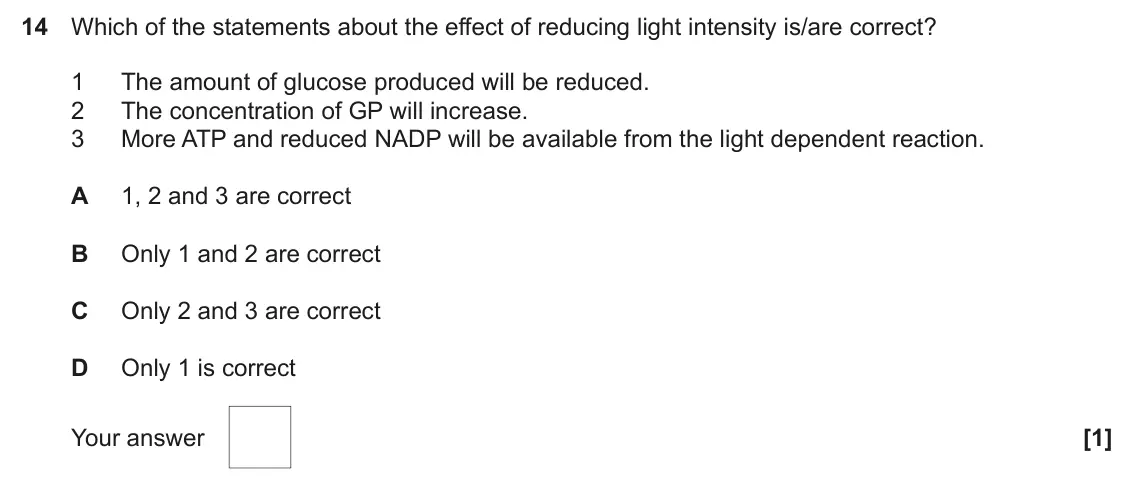
- June 2025, Paper 1, Q14 (1 mark): Which of the statements about the effect of reducing light intensity is/are correct? 1 The amount of glucose produced will be reduced. 2 The concentration of GP
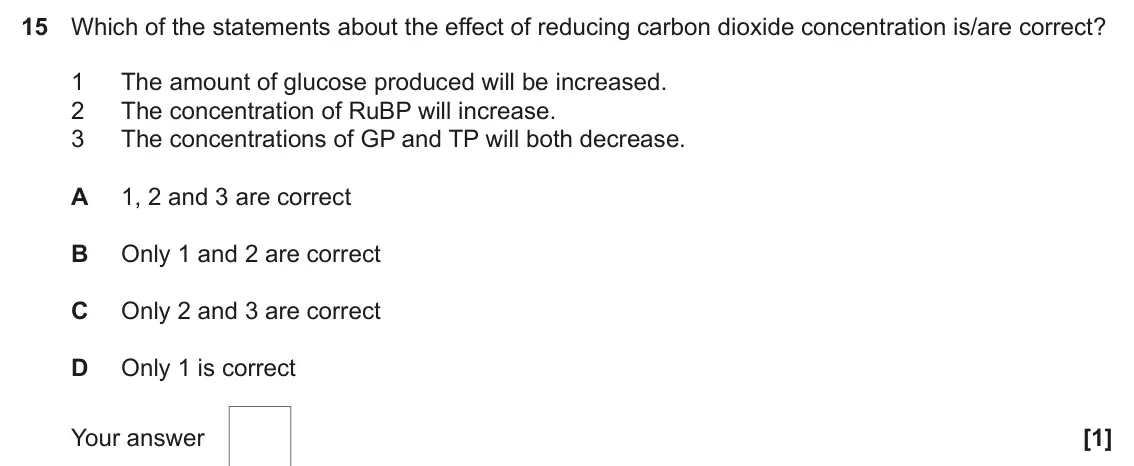
- June 2025, Paper 1, Q15 (1 mark): Which of the statements about the effect of reducing carbon dioxide concentration is/are correct? 1 The amount of glucose produced will be increased. 2 The conc
- June 2025, Paper 1, Q16(a)(i) (4 marks): Identify the components labelled A and B and describe how they are adapted for their function. Component A Adaptation Component B Adaptation [4]
- June 2025, Paper 1, Q16(a)(ii) (2 marks): Identify one similarity and one difference between the structures of chloroplasts and the structures of mitochondria. Similarity Difference [2]
- June 2025, Paper 1, Q16(b)(i) (3 marks): Calculate the R f for the most soluble pigment. Give your answer to 2 significant figures. Distance travelled = mm Rf = [3]
- June 2025, Paper 1, Q16(b)(ii) (2 marks): The student noticed that the spots were very faint and thought that there might be other pigments present in the mixture that were too faint to be seen. Describ
- June 2025, Paper 1, Q16(b)(iii) (1 mark): Describe how the student could use the same equipment but increase the accuracy of the calculated Rf value. [1]
- June 2025, Paper 1, Q16(b)(iv) (1 mark): The student was not able to identify any of the pigments using Rf values from a data book. Suggest an explanation for this. [1]
- June 2025, Paper 1, Q16(b)(v) (2 marks): Describe how the student could use TLC to identify the pigments present in the mixture without calculating Rf values. [2]
- June 2025, Paper 1, Q19(a)(i) (2 marks): State two variables that the student should keep constant during this experiment. 1 2 [2]
- June 2025, Paper 1, Q19(a)(ii) (2 marks): The student places the bottles at different distances from a light source. There are four replicates at each distance. The student’s results are shown in the ta
- June 2025, Paper 1, Q19(a)(iii) (2 marks): Outline an improvement to the method that the student could use to get a more accurate measure of the rate of photosynthesis. [2]
- June 2025, Paper 1, Q19(b)(i) (2 marks): Explain why it would not be possible to use the hydrogencarbonate indicator method to investigate the effect of CO2 concentration. [2]
- June 2025, Paper 1, Q19(b)(ii) (2 marks): Suggest how the student could modify the method so the effect of CO2 concentration on the rate of photosynthesis could be measured. [2]
- June 2025, Paper 1, Q19(c)(i) (2 marks): Explain the evidence from the graph that shows that CO2 concentration is a limiting factor in these experiments. [2]
- June 2025, Paper 1, Q19(c)(ii) (2 marks): A student looked at the graph and concluded that CO2 concentration has a greater effect on the rate of photosynthesis than temperature. Use your knowledge of Q1
- June 2024, Paper 1, Q13 (1 mark): Which of the statements about the effect of light intensity on the concentrations of GP, RuBP and TP is/are correct? 1 At low light intensity, less GP is conver
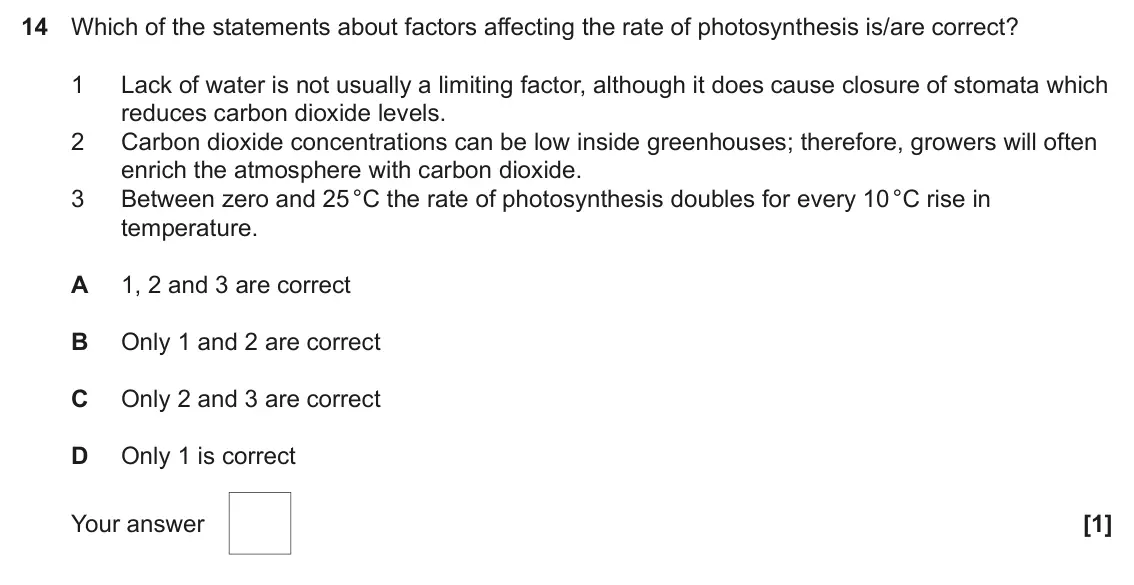
- June 2024, Paper 1, Q14 (1 mark): Which of the statements about factors affecting the rate of photosynthesis is/are correct? 1 Lack of water is not usually a limiting factor, although it does ca
- June 2024, Paper 1, Q17(a)(i) (2 marks): Identify the molecules labelled X, Y and Z in Fig. 17.1. X Y Z [2]
- June 2024, Paper 1, Q17(a)(ii) (3 marks): Use the information in Fig. 17.1 to explain how plants are able to survive in a sealed glass container, such as a terrarium or bottle garden, for many months or
- June 2024, Paper 1, Q17(b)(i) (1 mark): Chlorophyll a has an absorption peak at 680 nm. Use Fig. 17.2 to estimate the percentage of light absorbed by chlorophyll a that is used in photosynthesis by Po
- June 2024, Paper 1, Q17(b)(ii) (3 marks): Explain why the percentage of light used in photosynthesis is higher than your answer to part (i) at wavelengths other than 680 nm. [3]
- June 2024, Paper 1, Q17(b)(iii) (2 marks): Porphyra naiadum grows in deep water. Use the data in Fig. 17.2 to suggest how it is able to survive in conditions where other types of algae or plant cannot. [
- June 2024, Paper 1, Q17(c)(i) (2 marks): Calvin concluded that GP was the first product of carbon fixation, and that GP was converted into TP. Use the data in Fig. 17.3 to explain how Calvin reached th
- June 2024, Paper 1, Q17(c)(ii) (1 mark): State what you can conclude from Fig. 17.3 about what happens to TP. [1]
- June 2024, Paper 3, Q4(c)(i) (2 marks): Evidence for chemiosmosis during photosynthesis can be demonstrated by: • isolating chloroplasts from plant cells • placing the chloroplasts in an acidic soluti
- June 2024, Paper 3, Q4(c)(ii) (2 marks): André Jagendorf provided evidence for chemiosmosis in an experiment carried out in the 1960s. In his experiment, Jagendorf: • broke open chloroplasts to expose
- June 2023, Paper 1, Q8 (1 mark): The diagram shows the absorption spectra of different photosynthetic pigments. Chlorophyll b Carotenoids Absorbance (%) Chlorophyll a 400 500 600 700 Wavelength
- June 2023, Paper 1, Q9 (1 mark): The diagram shows some of the reactions that take place in a leaf cell in a flowering plant. Disaccharides and polysaccharides Glucose Hexose phosphate Hexose b
- June 2023, Paper 3, Q3(a)(i) (1 mark): State one dependent variable in this investigation. [1]
- June 2023, Paper 3, Q3(a)(ii) (2 marks): Explain the effect of genetic modification on the rate of CO2 fixation after 150 seconds of low light intensity. [2]
- June 2022, Paper 1, Q7 (1 mark): Which option is not a component of a chloroplast? A Cristae B DNA C Ribosome D Thylakoid Your answer [1] 5 The following information is needed to answer questio
- June 2022, Paper 1, Q8 (1 mark): One student examined a cross section of a leaf under a light microscope. They counted the number of chloroplasts in each cell in the field of view. Their result
- June 2022, Paper 1, Q9 (1 mark): Which option is the correct procedure for statistical analysis of the data collected by the class? A Calculate the mean number of chloroplasts per cell in the h
- June 2022, Paper 1, Q14 (1 mark): Which of the statements about the relationship between photosynthesis and aerobic respiration in plants is/are correct? 1 During the day, photosynthesis produce
- June 2022, Paper 1, Q22(a) (4 marks): The image is a transmission electron micrograph (TEM) of a chloroplast. F G D E Complete the table using the letters from the TEM which identifies the structure
- June 2022, Paper 1, Q22(b) (5 marks): Complete the sentences using the most appropriate terms. Carbon fixation occurs in the Calvin cycle when CO2 combines with the five-carbon molecule . This forms
- November 2021, Paper 1, Q19(a)(i) (1 mark): State the name of the final electron acceptor in the light-dependent stage of photosynthesis. [1]
- November 2021, Paper 1, Q19(a)(ii) (2 marks): DCPIP is reduced in the Hill reaction. Suggest and explain the function of DCPIP in the Hill reaction. [2]
- November 2021, Paper 1, Q19(a)(iii) (4 marks): Using the results shown in the table, explain what can be concluded from each tube, or pair of tubes, about the light-dependent stage of photosynthesis. Tube A
- November 2021, Paper 1, Q19(a)(iv) (2 marks): The student knew that it was important to use sucrose solution when homogenising the leaves. Explain why it was important that the pellet was suspended in buffe
- November 2021, Paper 1, Q19(a)(v) (4 marks): Suggest and explain two improvements that would increase the validity of the method. Improvement 1 Explanation Improvement 2 Explanation [4]
- November 2021, Paper 1, Q19(b)(i) (1 mark): Suggest one other reason why the plants in a sealed terrarium continue to grow. [1]
- November 2021, Paper 3, Q5(b) (2 marks): Light intensity is one factor that affects the rate of photosynthesis. Fig. 5.1 shows how the rate of photosynthesis varies with light intensity in two plants:
- November 2021, Paper 3, Q5(c)(i) (3 marks): The students investigated the relationship between the water content of soils and mean rate of photosynthesis for the two plants. Using the values in Table 5.2,
- November 2021, Paper 3, Q5(c)(ii) (1 mark): Use Table 5.3 to decide what the students can conclude from the rs value you calculated in part (i). [1]
- November 2021, Paper 3, Q5(c)(iii) (1 mark): The students calculated the rs value for water content and rate of photosynthesis in Calotropis procera as 0.714. Use Table 5.3 to decide what the students can
- November 2021, Paper 3, Q5(d)(i) (1 mark): The cyanobacterium Acaryochloris marina lives in an aquatic habitat with many aquatic plant species. Acaryochloris marina has a high concentration of chlorophyl
- November 2021, Paper 3, Q5(d)(ii) (1 mark): Diatoms are unicellular photosynthetic eukaryotes. Diatoms contain high concentrations of the pigment fucoxanthin. Fig. 5.3 shows a chromatogram with three pigm
- November 2020, Paper 1, Q17(a)(i) (3 marks): Calculate the Rf value for spot 3 and use this to identify the pigment that spot 3 represents. Rf = pigment = [3]
- November 2020, Paper 1, Q17(a)(ii) (1 mark): Predict the colour of spot 4. [1]
- November 2020, Paper 1, Q17(a)(iii) (2 marks): The solvent used for the separation was non-polar. Identify the spot corresponding to the least polar pigment. Give a reason for your choice. spot reason [2]
- November 2020, Paper 1, Q17(b)(i) (2 marks): Explain why the method included the following precautions: Hold the TLC plate carefully by the edges and avoid damaging the surface of the plate. Make sure the
- November 2020, Paper 1, Q17(b)(ii) (1 mark): Suggest an advantage of working as quickly as possible in Step 1. [1]
- November 2020, Paper 1, Q17(c) (3 marks): Algae are single-celled photosynthetic organisms. An investigation was carried out into the effect of CO2 concentration on the concentrations of ribulose bispho
- June 2019, Paper 1, Q14 (1 mark): Cyanobacteria are photosynthetic prokaryotes. A scientist exposed cyanobacteria to light of different colours and intensities and made the following observation
- June 2019, Paper 1, Q22(a) (4 marks): Identify the molecules represented by the letters A, B, C and D in Fig. 22.1 A B C D [4]
- June 2019, Paper 1, Q22(b)(i) (3 marks): Identify the following variables from the scientist’s method: independent variable dependent variable one control variable [3]
- June 2019, Paper 1, Q22(b)(ii) (1 mark): Identify one variable that was not controlled in the scientist’s method. [1]
- June 2019, Paper 1, Q22(c) (3 marks): Fig. 22.2 is a graph of the scientist’s results. 22 20 18 10 °C 16 O2 concentration 15 °C (mg dm–3) 14 20 °C 25 °C 12 30 °C 10 0 0 20 40 60 80 100 120 140 160 1
- June 2019, Paper 1, Q22(d)(i) (2 marks): Explain why this is both an accurate and an inaccurate way to describe the light- independent stage. [2]
- June 2019, Paper 1, Q22(d)(ii) (1 mark): Name the enzyme responsible for fixing CO2 in the light-independent stage. [1]
- June 2018, Paper 1, Q11 (1 mark): Which of the following, A to D, is a similarity in the way ATP is made in respiration and photosynthesis? A both involve NAD B both involve substrate level phos
- June 2018, Paper 1, Q17(a)(i) (4 marks): Outline the importance of photosynthetic pigments in photosynthesis. [4]
- June 2018, Paper 1, Q17(a)(ii) (1 mark): The wavelengths of light absorbed by chlorophyll c are different from those wavelengths absorbed by chlorophyll a and chlorophyll b. Suggest why Chromista need
- June 2018, Paper 1, Q17(b) (2 marks): Fig. 17.1 is a diagram of the chloroplast found in a Chromista cell. thylakoids stacked external membrane in threes DNA Fig. 17.1 Outline the structural differe
- June 2018, Paper 1, Q22(a)(ii) (2 marks): 1700 lux is a typical light intensity on a cloudy day in the UK. Calculate the percentage increase in gas production between 1700 and 2000 lux. Show your workin
- June 2018, Paper 1, Q22(a)(iii) (1 mark): Suggest why soda-lime was not placed in the respirometer with the seedlings grown in the light. [1]
- June 2018, Paper 1, Q22(b) (2 marks): The scientist made the following claim: These results suggest that, in maize seedlings, the rate of photosynthesis only exceeds the rate of respiration when the
- June 2018, Paper 3, Q3(a)(i) (2 marks): Identify the anomalous result in Table 3 and explain how this result could be confirmed as an anomaly. [2]
- June 2018, Paper 3, Q3(a)(ii) (6 marks): Temperature and light intensity are two factors that affect the rate of photosynthesis. A student investigated how temperature and light intensity affected the
- June 2018, Paper 3, Q3(b) (2 marks): Photosynthesis occurs in two stages: the light-dependent stage and the light-independent stage. The light-independent stage is affected by temperature more than
- June 2017, Paper 1, Q2 (1 mark): Which of the images, A to D, correctly summarises photosynthesis? A B reduced reduced light light light light NAD NAD independent dependent dependent independen
- June 2017, Paper 1, Q8 (1 mark): RuBisCO is an enzyme that fixes carbon dioxide in photosynthesis. In some conditions, RuBisCO also carries out oxygen fixation. The graph below shows how the ca
- June 2017, Paper 1, Q18(a) (2 marks): Light intensity, carbon dioxide concentration and temperature are all limiting factors in photosynthesis. Explain what is meant by a limiting factor. [2] Questi
- June 2017, Paper 3, Q1(b)(ii) (2 marks): State the precise location of photosynthetic pigments in a chloroplast. [2]
Questions, mark schemes and examiner’s reports are © OCR, from their published past papers. Plumi isn’t affiliated with any exam board. Want whole papers? Every OCR A-Level Biology A paper, or our free OCR-style practice pack.
Rather write your answers by hand on iPad? Plumi marks them against the same mark schemes.