 plumi
Osmosis and water potential: OCR A‑Level Biology A questions
OCR A-Level Biology A past-paper questions on 2.1.5.4 Osmosis and water potential, 2016–2025, with mark schemes and examiner’s reports where available.
Paper
All papers
Exam
All years
Calculations
- Your answer
Q5(a)
The whole paper ↗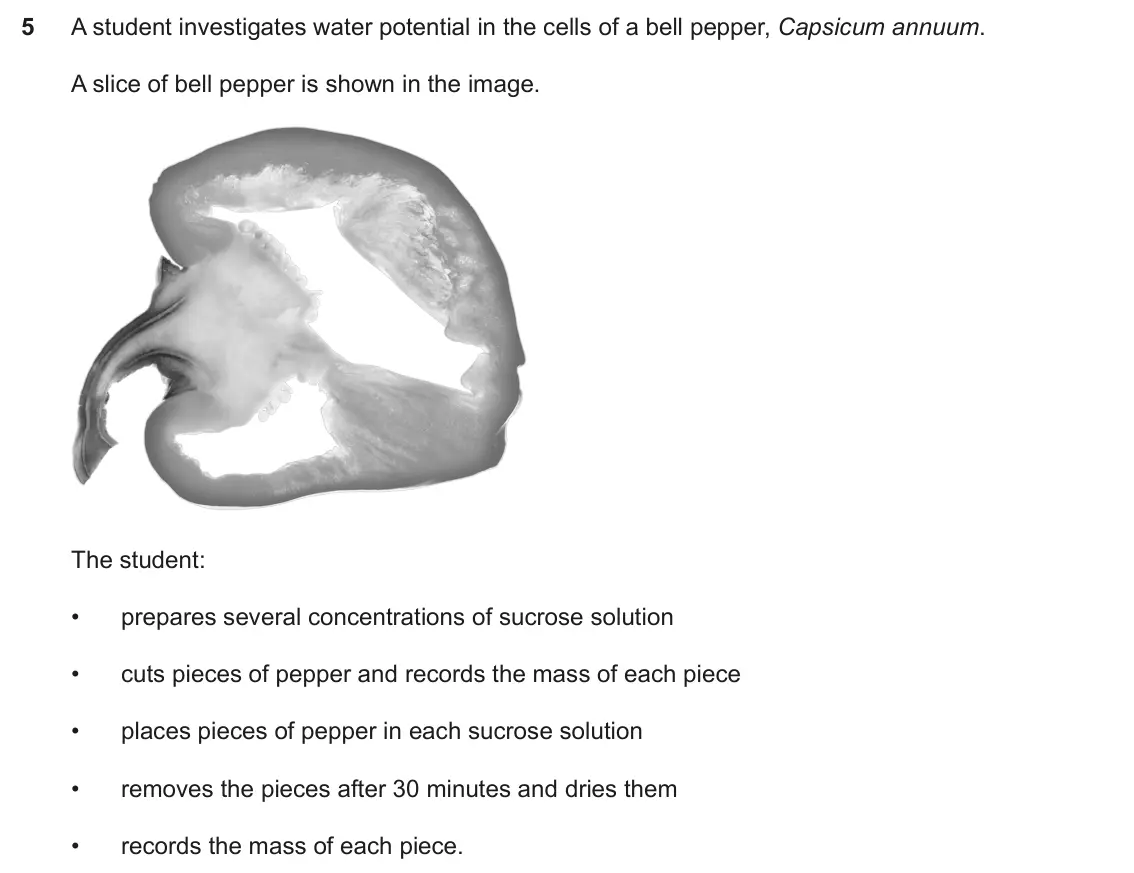
Q5(b)
The whole paper ↗Q5(c)
The whole paper ↗Q5(d)
The whole paper ↗Q21(a)
The whole paper ↗
Q21(b)
The whole paper ↗Q21(c)
The whole paper ↗Q21(d)
The whole paper ↗Q18(a)(i)
The whole paper ↗
Q18(a)(ii)
The whole paper ↗Q18(b)(i)
The whole paper ↗Q18(b)(ii)
The whole paper ↗- Your answer
Q3(a)(ii)
The whole paper ↗Q16(a)(i)
The whole paper ↗
Q16(a)(ii)
The whole paper ↗Q16(b)(i)
The whole paper ↗Q16(b)(ii)
The whole paper ↗Q16(c)(i)
The whole paper ↗
All 32 questions on Osmosis and water potential, as a list
- June 2025, Paper 2, Q6 (1 mark): Some students are conducting an osmosis investigation using cylinders of potato. They cut cylinders of potato 50 mm long using the ruler shown in the diagram. 0
- June 2025, Paper 3, Q5(a) (1 mark): The student makes sucrose solutions of different concentrations by diluting a stock solution. State a piece of equipment, with a higher resolution than a measur
- June 2025, Paper 3, Q5(b) (1 mark): The student controls temperature and the time that the pepper pieces are in the sucrose solution. State one other variable that the student should control durin
- June 2025, Paper 3, Q5(c) (1 mark): The student calculates the change in mass of each piece of pepper during the experiment and converts these values to percentage change in mass. Explain why the
- June 2025, Paper 3, Q5(d) (2 marks): The graph shows the results of the experiment. 15 10 Percentage change in mass 5 0 0.0 0.1 0.2 0.3 0.4 0.5 0.6 0.7 0.8 Sucrose concentration (mol dm–3) Use the
- June 2024, AS Paper 1, Q21(a) (2 marks): Explain the difference between the mean results obtained at the 0.0 mol dm–3 and 0.8 mol dm–3 sucrose concentrations. [2]
- June 2024, AS Paper 1, Q21(b) (3 marks): The students suggested that there was an anomaly in their results. Identify the anomalous result and explain how the anomalous result affects the precision of t
- June 2024, AS Paper 1, Q21(c) (2 marks): The students prepared the sucrose concentrations using a serial dilution technique. The students were provided with 10 cm3 of a 0.8 mol dm–3 sucrose concentrati
- June 2024, AS Paper 1, Q21(d) (2 marks): The students carried out a similar experiment with carrot tissue. Explain how the students could use their data to estimate whether sweet potato tissue or carro
- June 2022, Paper 1, Q18(a)(i) (3 marks): Complete Table 18.1 to show how the student should prepare the solutions. Final concentration Volume of Volume of Final volume 1 mol dm–3 sucrose of solution di
- June 2022, Paper 1, Q18(a)(ii) (2 marks): The solution given to the student was prepared using 34.23 g of sucrose in 100 cm3 water. The sucrose was measured on an electronic balance using the following
- June 2022, Paper 1, Q18(b)(i) (1 mark): Identify the anomalous result. [1]
- June 2022, Paper 1, Q18(b)(ii) (2 marks): State one variable that should be controlled in this experiment and give a reason for your choice. Control variable Reason [2]
- June 2022, AS Paper 1, Q1 (1 mark): The graph below shows the results of an osmosis experiment investigating the effect of changing the concentration of sodium chloride (NaCl) on mass of potatoes.
- June 2022, AS Paper 2, Q3(a)(ii) (2 marks): A common symptom of lactose intolerance in adults is the creation of extra fluid in the large intestine. Suggest why this occurs. [2]
- June 2019, Paper 2, Q16(a)(i) (2 marks): Define osmosis. [2]
- June 2019, Paper 2, Q16(a)(ii) (3 marks): Plants rely on osmosis for support. Explain the importance of osmosis in plant support. [3]
- June 2019, Paper 2, Q16(b)(i) (2 marks): The ruler used to measure the distance along the capillary tube was accurate to the nearest 0.5 mm. Calculate the percentage uncertainty of the measurement. unc
- June 2019, Paper 2, Q16(b)(ii) (2 marks): What conclusions can be drawn about the composition of solutions X and Y? [2]
- June 2019, Paper 2, Q16(c)(i) (2 marks): Explain why it was necessary to calculate percentage change in
- June 2019, Paper 2, Q16(c)(ii) (2 marks): The students identified replicate 3 of the potato in 0.7 mol dm–3 sucrose as anomalous. Suggest a practical error by the students that might have caused this re
- June 2019, Paper 2, Q16(c)(iii) (3 marks): Use Table 16 to identify which plant cells contained the highest concentration of sucrose. Justify your conclusion. [3]
- June 2019, AS Paper 1, Q21(a) (3 marks): In the space below, present the student’s results in an appropriate format. [3]
- June 2019, AS Paper 2, Q5(a) (2 marks): Explain why Paramecium needs to expel water when in fresh water. [2]
- June 2019, AS Paper 2, Q5(b)(i) (2 marks): Calculate the percentage decrease in the mean number of contractions as the concentration of sodium chloride solution increases from 0.00 mol dm−3 to 0.15 mol d
- June 2019, AS Paper 2, Q5(b)(ii) (2 marks): Explain why there is a decrease in the activity of the contractile vacuole as the concentration of sodium chloride increases. [2]
- June 2019, AS Paper 2, Q5(b)(iii) (3 marks): The cytoplasm of Paramecium contains salt crystals. These salt crystals can be used to alter the water potential of the cytoplasm. Suggest and explain how the w
- June 2019, AS Paper 2, Q5(b)(iv) (2 marks): The experiment described in Table 5 was extended to find out the effect of reducing the dissolved oxygen concentration on the mean number of contractions at eac
- June 2018, AS Paper 1, Q18 (1 mark): An investigation into how a change in sodium chloride concentration effects osmosis in potato cells concluded that the isotonic point of the potato was 0.25 M.
- June 2016, AS Paper 1, Q21(a)(i) (2 marks): State two details of the procedure that must be followed to obtain valid results. 1 2 [2]
- June 2016, AS Paper 1, Q21(a)(ii) (3 marks): Explain how a student could use the data in Table 21.2 to determine the water potential of the potato tuber tissue. [3]
- June 2016, AS Paper 1, Q21(b)(ii) (1 mark): What will be found at W in the immersed cell? [1]
Questions, mark schemes and examiner’s reports are © OCR, from their published past papers. Plumi isn’t affiliated with any exam board. Want whole papers? OCR A-Level Biology A past papers, or our free OCR-style practice pack.
The Plumi iPad app also offers exam-style questions with AI feedback on your handwritten working.