 plumi
Membrane structure and permeability: OCR A‑Level Biology A questions
OCR A-Level Biology A past-paper questions on 2.1.5.2 Membrane structure and permeability, 2016–2025, with mark schemes and examiner’s reports where available.
Paper
All papers
Exam
All years
Calculations
Q24(b)(i)
The whole paper ↗Q24(b)(ii)
The whole paper ↗Q24(b)(iii)
The whole paper ↗Q2(c)
The whole paper ↗Q21(c)(ii)
The whole paper ↗Q21(c)(iii)
The whole paper ↗Q22(a)
The whole paper ↗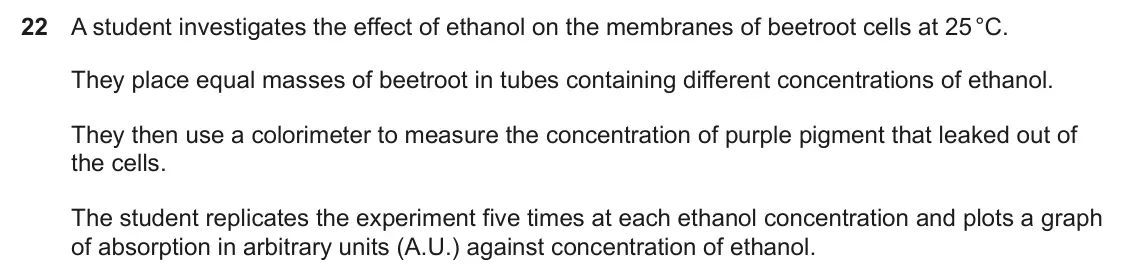
Q22(b)(i)
The whole paper ↗Q22(b)(ii)
The whole paper ↗- Your answer
- Your answer
Q25(b)
The whole paper ↗
Q1(a)
The whole paper ↗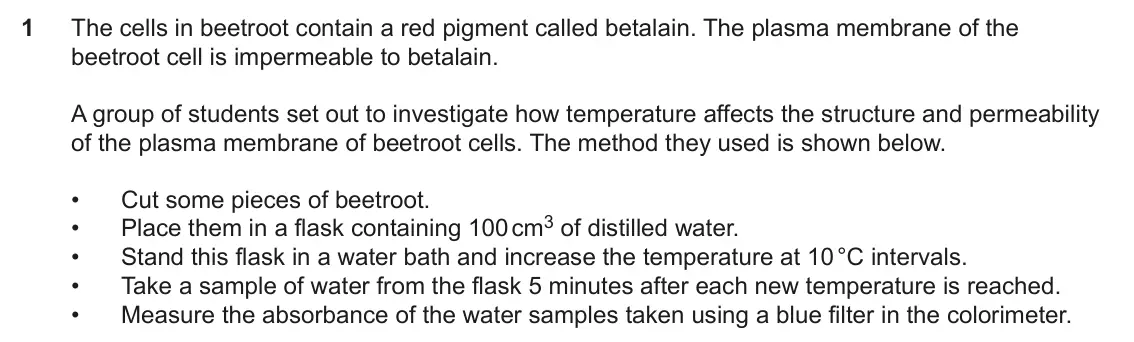
Q1(b)
The whole paper ↗Q1(c)(i)
The whole paper ↗Q1(c)(ii)
The whole paper ↗Q1(d)
The whole paper ↗Q18(b)(i)
The whole paper ↗
Q18(b)(ii)
The whole paper ↗Q18(b)(iii)
The whole paper ↗
All 34 questions on Membrane structure and permeability, as a list
- June 2025, AS Paper 1, Q24(b)(i) (2 marks): State two variables that were not controlled in this experiment. 1 2 [2]
- June 2025, AS Paper 1, Q24(b)(ii) (1 mark): One of the students suggests using a red filter in the colorimeter because this is what they had used for a Benedict’s test. Suggest why the student is incorrec
- June 2025, AS Paper 1, Q24(b)(iii) (3 marks): Explain how the students can process their data to assess repeatability. [3]
- June 2025, AS Paper 2, Q2(c) (3 marks): Using your knowledge of the phospholipid bilayer in plasma membranes, explain how an increase in temperature affects the permeability of the membrane. [3]
- June 2024, Paper 1, Q21(c)(ii) (3 marks): Scientists investigate the effect of hydrogen peroxide on sperm cells. This is the method that they use: • incubate sperm cells with different concentrations of
- June 2024, Paper 1, Q21(c)(iii) (2 marks): Suggest how hydrogen peroxide could affect the plasma membrane. [2]
- June 2024, Paper 1, Q22(a) (2 marks): The student controls the mass of beetroot in this investigation. Identify two other variables that the student should control in this investigation. 1 2 [2]
- June 2024, Paper 1, Q22(b)(i) (2 marks): Explain the shape of the graph. [2]
- June 2024, Paper 1, Q22(b)(ii) (2 marks): The student repeats the experiment at a temperature of 30 °C. Sketch the graph you expect the student to obtain. [2] Answer on the graph.
- June 2023, Paper 1, Q14 (1 mark): One student made the following observations: 1 Ethanol disrupts the cell membranes leading to increased permeability. 2 The permeability of the cell membranes i
- June 2023, Paper 1, Q15 (1 mark): The students were asked to decide whether the permeability of the membrane is significantly greater with 50% ethanol compared to 40% ethanol. Which statistical
- June 2023, AS Paper 1, Q25(b) (3 marks): The presence of cholesterol is one of several factors that affect membrane fluidity. A student examined two different cell surface membranes. One membrane had a
- June 2022, AS Paper 2, Q1(a) (4 marks): A second group of students made improvements to this method. One of the improvements they made was to carry out two further trials at each temperature. Suggest
- June 2022, AS Paper 2, Q1(b) (1 mark): Name the independent variable in this investigation. [1]
- June 2022, AS Paper 2, Q1(c)(i) (3 marks): The table shows the results obtained by the second group of students. Absorbance (%) Temperature (°C) Trial 1 Trial 2 Trial 3 Mean 10 0 0 0 0.0 20 0 0 0 0.0 30
- June 2022, AS Paper 2, Q1(c)(ii) (6 marks): The cells in beetroot contain a red pigment called betalain. The plasma membrane of the beetroot cell is impermeable to betalain. A group of students set out to
- June 2022, AS Paper 2, Q1(d) (2 marks): In a second experiment, students followed the same method but used pieces of beetroot that had been frozen for several days and then defrosted. They were surpri
- November 2021, Paper 2, Q18(b)(i) (4 marks): Present the students’ results in an appropriate table in the space below. [4]
- November 2021, Paper 2, Q18(b)(ii) (2 marks): The students concluded that the red pigment began to leak out of the beetroot cells at any pH below pH6. Suggest and explain why a low pH might cause the red pi
- November 2021, Paper 2, Q18(b)(iii) (2 marks): Outline how the students could modify their investigation to get a more accurate value for the pH at which the red pigment begins to leak out of the beetroot ce
- November 2021, AS Paper 1, Q19 (1 mark): The graph below shows readings from a colorimeter as pigment leaks out of beetroot membranes at different temperatures. P Absorbance (arbitrary units) Temperatu
- November 2020, AS Paper 1, Q3 (1 mark): Which of the lines, A to D, in the graph below, represents the effect of increasing ethanol concentration on the permeability of the plasma membrane to sodium i
- June 2019, AS Paper 1, Q21(a) (3 marks): In the space below, present the student’s results in an appropriate format. [3]
- June 2019, AS Paper 1, Q21(b)(i) (2 marks): Explain how the treatment results in the difference in the final lengths of rod A and rod E. [2]
- June 2019, AS Paper 1, Q21(b)(ii) (2 marks): Explain how the treatment results in the difference in the final lengths of rod D and rod F. [2]
- June 2019, AS Paper 1, Q21(c) (1 mark): State how the student could reduce the uncertainty of their data. [1]
- June 2018, Paper 1, Q20(a)(i) (3 marks): Each step in the student’s method relies on certain assumptions. For each assumption listed below, select the numbered step from the student’s method that relie
- June 2018, Paper 1, Q20(a)(ii) (2 marks): The student kept the ethanol solutions at a constant temperature. State two other variables which need to be controlled in this investigation to ensure the data
- June 2018, Paper 1, Q20(b)(i) (3 marks): Make three criticisms of the way the student has displayed these results. 1 2 3 [3]
- June 2018, Paper 1, Q20(b)(ii) (2 marks): Explain how carrying out replicates would improve this investigation. [2]
- June 2018, AS Paper 1, Q17 (1 mark): Swiss chard is a leafy green vegetable related to spinach. Some varieties have yellow stalks that have vacuoles containing yellow betaxanthin pigments. The grap
- June 2017, AS Paper 1, Q23(d)(i) (3 marks): Using the Student’s t-test formula below, calculate the value of t between the data for 50 °C and 60 °C. x x - A B where: x is the mean t = 2 2 S is the standar
- June 2017, AS Paper 1, Q23(d)(ii) (2 marks): The critical value for t at the significance level of 5%, with 18 degrees of freedom, is 2.10. Use the value of t that you calculated in part (i) to explain whe
- June 2017, AS Paper 1, Q23(e) (3 marks): The students plotted the data onto a graph, shown in Fig. 23. The effect of temperature on beetroot membrane permeability 0.50 0.45 0.40 0.35 0.30 absorbance 0.
Questions, mark schemes and examiner’s reports are © OCR, from their published past papers. Plumi isn’t affiliated with any exam board. Want whole papers? OCR A-Level Biology A past papers, or our free OCR-style practice pack.
The Plumi iPad app also offers exam-style questions with AI feedback on your handwritten working.